20th September 2025
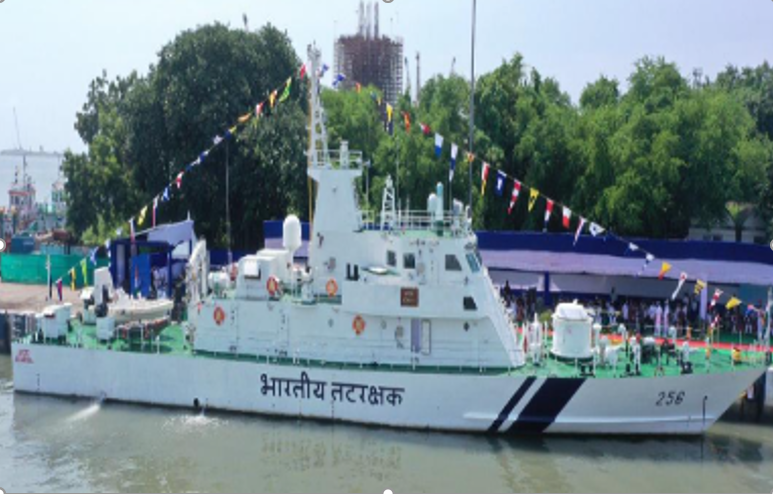
1. Adamya: Recently, the Indian Coast Guard commissioned its newest fast patrol vessel,
ICGS Adamya, at Paradip Port.
- About Adamya: First in a series of eight Adamya-class fast patrol vessels.
- Designed and built by Goa Shipyard Limited with over 60% indigenous content under Make in India.
- 51-metre-long vessel; displacement ~320 tonnes.
- Propelled by two 3,000 KW diesel engines, max speed 28 Knots, and endurance 1,500 nm.
- Commanded by Commandant Anurag Pandey, with 5 officers and 34 personnel.
- First ICG ship fitted with indigenously developed Controllable Pitch Propellers (CPP) and gearboxes.
- Weaponry: 30 mm CRN-91 gun + two 12.7 mm stabilised remote-controlled machine guns with fire-control systems.
- Equipped with Integrated Bridge System, Integrated Platform Management System, and Automated Power Management System.
- Ship will be based at Paradip (Odisha) under Coast Guard Region (North East).
- Commissioned in the presence of Defence Ministry Joint Secretary Satyajit Mohanty and Inspector General Yoginder Dhaka.
2. Power of Chirality: Recently, researchers at the
Centre for Nano and Soft Matter Sciences (CeNS), Bengaluru, made a breakthrough in understanding how chiral perovskite films crystallize.
- About Chirality: Non-superimposable mirror image property, common in nature (e.g., DNA, spiral galaxies).
- Enables unique light–matter interactions, such as electron spin control and circularly polarized light (CPL) detection.
- Researchers at CeNS Bengaluru discovered that crystallization in these films begins at the air–film interface and proceeds toward the substrate.
- A key challenge is the formation of impurity phases caused by trapped solvent, which reduces film quality.
- This can be overcome through vacuum processing and careful solvent selection, yielding phase-pure, uniform films.
- Such films open pathways for advanced applications like CPL detectors, spintronic devices, and photonic synapses.
- The breakthrough strengthens India’s potential leadership in semiconductors and quantum technologies.
3. World Trade Report 2025: Recently, the
World Trade Organization (WTO) released its
World Trade Report 2025, highlighting the transformative role of Artificial Intelligence (AI) in shaping global trade and growth.
- About World Trade Report 2025: Annual Flagship Publication of WTO, examining global trade trends, policies, and the future of the multilateral trading system.
- 2025 Theme: “Making Trade and AI Work Together to the Benefit of All” — focusing on AI’s impact on trade and inclusive development.
- Key Highlights: The report estimates that by 2040, AI could increase global trade by 34–37% and GDP by 12–13%, provided digital divides are bridged and inclusive policies are pursued.
- AI as a Trade Multiplier: AI could raise global trade in goods and services by nearly 40% by 2040, through reduced trade costs and productivity gains.
- Global GDP Impact: AI adoption, if spread across countries, could lift global GDP by 12–13%.
- AI-Trade Synergy: AI enhances efficiency in supply chains, logistics, and customs clearance, benefiting SMEs.
4. Plasticdweep: Recently,
Lakshadweep faced a Plasticdweep waste crisis after a fire at Minicoy Island’s dump yard exposed its 4,000-tonne waste problem, threatening reefs, ecosystems, and fisherfolk livelihoods
.
- About Plasticdweep: Refers to the worsening marine and land waste crisis in Lakshadweep.
- The Minicoy fire revealed years of neglected waste management, unregulated dumping, and the absence of a functional disposal system.
- Data & Trends: CUSAT Survey 2024: Found 32,710 litter items on 28 beaches, with 59% of coral colonies smothered and 15% coral bleaching recorded.
- Governance Failure: After the 2021 dismantling of panchayats, regular waste collection stopped, leading to unchecked dumping and open burning.- Logistical Barriers: Waste evacuation possible only 4–5 months annually due to monsoons; barges mainly used for essential supplies (food and fuel).
- Implications: Ecological: Coral degradation → collapse of fish stocks → loss of marine biodiversity.
- Livelihood: Severe threat to fishing-dependent communities, food security, and tourism prospects.
- Health: Exposure to toxic smoke, groundwater contamination from leachate, and microplastic bio-accumulation in the food chain.
5. Passbook Lite: Recently, the
Employees’ Provident Fund Organisation launched
“Passbook Lite”, a simplified PF balance view on its member portal.
- About Passbook Lite: To make PF data access easier and faster.
- Reduce login delays and technical hassles.
- Strengthen transparency and improve member satisfaction.
- Key Features: Single Login: No need for separate passbook portal access.
- Quick Snapshot: Displays contributions, withdrawals, and balance instantly.
- Faster Access: Reduces load on the main portal, ensuring quicker response.
- Detailed Option: Full passbook remains available for users needing comprehensive data.
- Integrated Tracking: Enables checking of PF transfer status and downloading of Annexure K.
- Significance: Enhances Transparency: Members can instantly verify employer contributions and transfers.
- Reduces Grievances: Eliminates issues from dual logins and password sync delays.
- Promotes Digital Inclusion: Provides 7 crore users with seamless access to PF details.
6. Air Defence Radars: Recently, the Indian Army initiated the procurement of
advanced Air Defence radars after Operation Sindoor revealed critical gaps in detecting and countering drones and low-flying aerial threats.
- About Radars: Systems use radio waves to determine the direction, distance, and velocity of airborne objects.
- Types of Radars: Surveillance Radars: Scan and identify aerial objects.
- Fire Control Radars: Guide weapon systems for engagement.
- Features of the New Systems:
- Enhanced Low-Level Light Weight Radars (LLLRs): Detect drone swarms and provide targeting data up to 10 km
- Air Defence Fire Control Radars for Drones (ADFCR-DDs): Classify threats, distinguish friend from foe and direct AD weapons against hostile drones.
- India’s Current Air Defence Infrastructure
- Missile Systems: Russian S-400 and indigenous Akash missile system.
- Akashteer System: Integrates radars, AD guns, and communication systems to generate a real-time air picture.
- IAF’s IACCS (Integrated Air Command and Control System): Unifies all AD assets for coordinated defence and offensive control.
7. Blue Ports: Recently, the Department of Fisheries, Ministry of Fisheries, Animal Husbandry & Dairying, Government of India, signed a Technical Cooperation Programme with the Food and Agriculture Organization of the UN to develop world-class Blue Ports.
- About Blue Ports: A joint initiative under FAO’s TCP aimed at upgrading fishing ports into smart, sustainable, and inclusive Blue Ports.
- Seeks to balance economic growth with ecological protection in fisheries infrastructure.
- Aim: Modernise fishing harbour infrastructure.
- Improve post-harvest efficiency, ensure traceability, and create climate-resilient, tech-driven fisheries value chains.
- Strengthen food and nutritional security, enhance export competitiveness, and empower coastal communities.
- Features: Smart Technology: IoT sensors, AI, 5G, automation, satellite connectivity, and real-time analytics.
- Eco-Friendly Infrastructure: Rainwater harvesting, energy-efficient lighting, electric equipment, waste and sewage treatment systems.
- Climate Resilience: Pollution control, debris clean-up mechanisms, and energy transition in port operations.
8. Civil Drone (Promotion and Regulation) Bill, 2025: Recently, the Ministry of Civil Aviation released the
Draft Civil Drone (Promotion and Regulation) Bill, 2025, inviting feedback from stakeholders and citizens.
- About Bill: The bill aims to establish a stricter legal framework for regulating Unmanned Aircraft Systems (UAS) in India, replacing the existing Drone Rules, 2021.
- Aim: Promote safe and efficient use of drones in India.
- Strengthen regulations to prevent misuse and ensure accountability.
- Enforcement Agency: The Directorate General of Civil Aviation (DGCA) will oversee safety, certification, and regulatory compliance.
- Key Provisions: Mandatory Registration: All drones must carry a Unique Identification Number (UIN) issued by DGCA.
-Type Certification: Drone manufacturers require DGCA certification before sale or operation.
- Insurance Requirement: Operators must have third-party liability insurance, unless specifically exempted.
- Digital Sky Zones: Green Zone: Free flying allowed.
- Yellow Zone: Requires air traffic control clearance.
- Red Zone: Operations prohibited without prior central government approval.
9. El Niño: Recently, a study found that
El Niño raises the probability of extreme daily rainfall events across central India by nearly 50%, despite generally suppressing monsoon rainfall.
· About El Niño: The warm phase of the El Niño–Southern Oscillation (ENSO), marked by unusual warming of sea surface temperatures in the central and eastern tropical Pacific Ocean.
- Effect: Disrupts normal atmospheric circulation, impacting global weather and climate patterns.
- Formation: Under normal conditions, trade winds push warm water westward (towards Indonesia), with cold water upwelling off South America.
- During El Niño: Trade winds weaken, warm water shifts eastwards.
- Thermocline deepens, reducing nutrient-rich upwelling.
- Alters Pacific jet streams and global circulation, causing weather anomalies worldwide.
- Factors Contributing to El Niño: Weakening of easterly trade winds (natural variability).
- Positive SST anomaly of ≥0.5 °C above average, lasting at least 5 overlapping 3-month seasons.
- Westerly wind bursts, the Madden–Julian Oscillation (MJO), and influence of global warming.


 theIASHub | 20 Sep, 2025









 Detailed Solutions & Explanations

