


 theIASHub | 15 Jan, 2026

1. BRICS India 2026 logo: Recently, India officially unveiled the BRICS India 2026 logo and website as part of its preparations to assume the BRICS Chairship in 2026.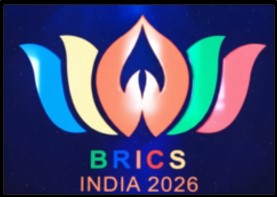
Key Highlights: India will hold the BRICS Chairship during calendar year 2026.
The year 2026 marks the 20th anniversary of BRICS (2006–2026).
The logo serves as the official visual identity of India’s BRICS Chairship.
Logo inspiration comes from India’s national flower – the Lotus.
The Lotus symbolises resilience, renewal, unity in diversity, and cultural harmony.
The core message of the logo is “togetherness for global welfare”.
It reflects India’s philosophy of Vasudhaiva Kutumbakam (One Earth, One Family).
Namaste hands at the centre signify respect, dialogue, and cooperation.
Five coloured petals represent the founding BRICS nations – Brazil, Russia, India, China, and South Africa.
The balanced design highlights unity among diverse political systems, cultures, and economies.
The BRICS India website will act as a digital hub for meetings, initiatives, outcomes, and public engagement.
The logo aligns with India’s four BRICS 2026 priorities: Resilience, Innovation, Cooperation, and Sustainability.
2. Export Preparedness Index (EPI) 2024: Recently, NITI Aayog released the Export Preparedness Index (EPI) 2024, offering a comprehensive, evidence-based assessment of how prepared India’s States and Union Territories are to drive exports.
Key Highlights: EPI 2024 is the 4th edition; the first edition was published in August 2020.
The Index assesses export readiness of States and Union Territories, recognising their role in India’s trade growth. It aligns with India’s targets of USD 1 trillion merchandise exports by 2030 and Viksit Bharat @2047.
Provides an evidence-based framework to evaluate strength, resilience, and inclusiveness of subnational export ecosystems. Emphasises export infrastructure, cost competitiveness, institutional strength, and predictable policy environments.
Structured around 4 pillars, 13 sub-pillars, and 70 indicators for granular assessment.
Four core pillars: Export Infrastructure, Business Ecosystem, Policy & Governance, Export Performance.
2024 edition introduces new dimensions like macroeconomic stability, human capital, MSME ecosystem, and financial access.
States/UTs classified into Leaders, Challengers, and Aspirers within peer groups.
Top Performers: Large States: Maharashtra, Tamil Nadu, Gujarat, Uttar Pradesh, Andhra Pradesh
Small States / NE States / UTs: Uttarakhand, Jammu & Kashmir, Nagaland, Dadra & Nagar Haveli and Daman & Diu, Goa
3. Marine and Space Biotechnology: Recently, India’s push in the Blue Economy, Deep Ocean Mission, and human spaceflight has drawn attention to the emerging field of marine and space biotechnology.
About Marine Biotechnology: Studies microorganisms, algae, and marine life adapted to extreme ocean conditions such as: High pressure, High salinity, Low light and Nutrient-poor environments
These organisms yield: Bioactive compounds, Industrial enzymes, Biomaterials, Food ingredients and Biostimulants.
Their resilience makes them ideal for climate-resilient and industrial applications.
About Space Biotechnology: Examines how microbes, plants, and human biological systems behave in microgravity and radiation.
Key focus areas include: Microbial biomanufacturing for food and materials
Closed-loop life-support systems and Astronaut microbiome research
Health and probiotic interventions for long-duration missions
4. Responsible Nations Index (RNI): Recently, the World Intellectual Foundation (WIF), in collaboration with JNU, IIM Mumbai, and the Dr Ambedkar International Centre, announced the launch of the Responsible Nations Index (RNI).
About Responsible Nations Index: A global ranking framework designed to assess how responsibly countries govern their societies, protect the environment, and contribute to global stability.
Its core objective is to shift international benchmarking away from purely economic or power-based metrics towards a values-driven evaluation that emphasizes human dignity, sustainability, and responsible global conduct.
The Index will cover 154 countries worldwide and will be based on transparent, globally sourced data. It is structured around three key dimensions:
Internal Responsibility, focusing on dignity, justice, and citizen welfare;
Environmental Responsibility, assessing climate action and natural resource stewardship;
External Responsibility, evaluating peace, international cooperation, and global stability.
By introducing an ethical lens beyond GDP and military strength, the RNI aims to encourage nations to prioritize human development, environmental sustainability, and global peace, while supporting international commitments such as the Sustainable Development Goals (SDGs), climate action frameworks, and human rights norms.
5. World Bank: Recently, the World Bank raised India’s GDP growth forecast for FY 2025–26 to 2%, up from 6.3% projected in June.
Key Highlights: The upward revision reflects robust domestic demand and the impact of earlier tax reforms.
India’s growth is projected to moderate to 6.5% in FY 2026–27.
Growth is expected to edge up to 6.6% in FY 2027–28, supported by strong services, export recovery, and higher investment.
Projections assume 50% US import tariffs remain in place throughout the forecast period.
Despite tariffs, India is expected to remain the fastest-growing major economy globally.
Negative tariff impacts are likely to be offset by resilient exports and strong domestic consumption.
The US accounts for about 12% of India’s merchandise exports.
Domestic demand strength is driven by private consumption, tax reforms, and improved real rural household incomes.
Ministry of Statistics and Programme Implementation estimates India’s growth at 4% for the current fiscal (First Advance Estimates).
6. Employment and Social Trends 2026: Recently, the International Labour Organization (ILO), in its Employment and Social Trends 2026 report, warned about emerging challenges in the global labour market.
Key Findings: Global unemployment rate is projected to remain unchanged at 4.9% in 2026, affecting about 186 million people worldwide.
Around 284 million workers continue to live in extreme poverty, earning less than $3 per day.
Between 2015 and 2025, extreme working poverty declined by only 1 percentage points (to 7.9%), compared to a 15-point decline in the previous decade.
The global informality rate increased by 0.3 percentage points between 2015 and 2025.
By 2026, about 1 billion workers are projected to be informally employed, mainly in Africa and Southern Asia.
Trade uncertainty is likely to persist and, combined with digitalisation and structural transformation, is reshaping labour markets.
ILO modelling suggests trade uncertainty could reduce real wages for both skilled and unskilled workers, with the highest income losses in South-Eastern Asia (up to 0.45%).
Women account for only two-fifths of global employment in 2025.
Women are 2 percentage points less likely than men to participate in the labour force.
Global youth unemployment rose slightly to 4% in 2025, from 12.3% in 2024.
7. Menkes Disease: Recently, the U.S. Food and Drug Administration approved Zycubo (copper histidinate) as the first treatment for Menkes disease in pediatric patients.
About Menkes Disease: A genetic disorder that impairs the body’s ability to absorb, transport, and utilize copper.
It is caused by a mutation in the ATP7A gene, located on the X chromosome.
The ATP7A gene is essential for maintaining copper balance in the body.
Even though copper is required in very small quantities, it is vital for multiple physiological functions.
The disorder leads to low copper levels in blood plasma, liver, and brain.
Activities of copper-dependent enzymes are significantly reduced.
Copper may abnormally accumulate in other tissues, such as the kidneys.
Impaired copper utilization causes severe damage to the brain and nervous system, affecting child development.
Role of Copper in the Body: Copper is crucial for metabolism and brain development.
It supports blood vessel and blood cell formation.
It aids in wound healing and immune system functioning.
Copper helps convert iron into a usable form in the body.
It is naturally found in many foods and dietary supplements.
8. Africa Solar Outlook: Recently, Africa has emerged as the fastest-growing solar market globally, overtaking traditional leaders like China and the Middle East, according to the Africa Solar Outlook 2026.
Key Highlights: Africa recorded a 26% increase in installed solar capacity in 2025, reaching 4 GW.
The continent now shows the fastest solar growth rate globally, outpacing China and the Middle East in relative terms.
Over 42,000 solar projects are operational across Africa, spanning utility-scale, C&I, mini-grids, and solar home systems.
Falling solar costs and improved battery energy storage systems (BESS) are major growth drivers.
Africa now commands ~2.5–3% of global solar capacity, up from below 1% earlier estimates.
Export-based analysis suggests ~63.9 GW of solar capacity may already be installed, nearly 3× higher than documented figures.
Energy storage costs have dropped to about $33/MWh, enabling round-the-clock, dispatchable solar power.
More than half of African countries now generate at least 10% of their electricity from solar.
Top performers per capita: South Africa, Seychelles, Mauritius, Namibia, Cape Verde.
Fastest year-on-year movers: Chad, Comoros, Equatorial Guinea, Botswana.
Growth in 2025 slowed from 44% (2024 peak) but remained higher than 22% in 2023, indicating sustained momentum.
9. National Green Tribunal (NGT): Recently, the National Green Tribunal (NGT) took suo motu notice of sewage-contaminated drinking water risks in Rajasthan, Madhya Pradesh, and Uttar Pradesh.
Key Highlights: Notices issued to State Pollution Control Boards, Ministry of Environment, Forest and Climate Change, and Central Pollution Control Board.
NGT Principal Bench acted based on media reports highlighting systemic failures in drinking water infrastructure.
Corroded and outdated pipelines identified as the main cause of sewage mixing with drinking water.
Affected cities in Rajasthan include Udaipur, Jodhpur, Kota, Banswara, Jaipur, Ajmer, and Bora.
Visual evidence shows drinking water pipelines running alongside open sewage drains, posing severe health risks.


Refine your answer writing skills and elevate your UPSC preparation with personalized support and expert feedback.
Fill out the form to get started with the program or any other enquiries !
Are you dreaming of becoming an IAS officer? Then, IAShub can be your best guide. It is one of the Best IAS Coaching in Delhi. Many students who want to clear the UPSC exam join IAShub for learning. The institute gives both online and offline classes. Their teachers are experienced and helpful. They easily explain every topic. Students also get notes, tests, and tips to do well in the exam.
IAShub is in Delhi and is trusted by many UPSC students. It offers coaching for every part of the UPSC exam – Prelims, Mains, and Interview. The classes are simple and easy to understand. The teachers are experts and guide students in the right way. IAShub is also known for its helpful notes, test series, and answer-writing practice. IAShub is the best coaching in Delhi and also gives UPSC Online Classes. This helps students from any place in India to learn. The online classes are live and also recorded. So, students can watch them anytime. These classes cover the full UPSC syllabus.
Here are some important services provided by IAShub:
The UPSC Civil Services Exam has three parts:
This exam is tough, but with the right guidance, it becomes easy to manage. Students must study smart and stay regular.
IAShub supports students from the beginning to the end. It gives the right books, tests, and notes. The classes are easy to follow, and the teachers are always ready to help. Students get personal doubt sessions too. The test series and answer checking help students learn where they need to do better. Also, free study materials save time and money.
IAShub also guides students during the final stage – the interview. Experts take mock interviews and give useful tips. This full support makes IAShub one of the best IAS coaching in Delhi.
 Detailed Solutions & Explanations
Improve Your Answer Writing & Strategy
Detailed Solutions & Explanations
Improve Your Answer Writing & Strategy

