10th September 2025
1. Gyanex: Recently, the
Indian Space Research Organisation (ISRO) has carried out a series of simulation missions known as
Gaganyaan Analog Experiments (Gyanex).
- Aim: Prepare astronauts for space-like conditions. Develop protocols for communication, resource management, and operations.
- Only missing factor: microgravity, which cannot be simulated on Earth.
- Life inside the Simulator: Astronauts live in confined crew module/space station-like environments.
- Activities include: Following daily routines
- Conducting scientific experiments
- Managing resources and communication protocols
- Food supplied is specially developed by DRDO.
- Astronauts have access only to materials available during a real mission.
- Gyanex-1 (First Mission): Conducted in July 2025.
- Duration: 10 days
- Outcome: 11 science experiments
- Health, psychological, and operational parameters were monitored → valuable findings for protocol refinement.
2. AdFalciVax: Recently, the
Indian Council of Medical Research (ICMR) licensed its multi-stage malaria vaccine,
AdFalciVax, to five Indian companies — Indian Immunologicals Limited, Techinvention Lifecare Private Limited, Panacea Biotec Limited, Biological E Limited, and Zydus Lifesciences.
- About AdFalciVax: Developed by the Regional Medical Research Centre (RMRC), Bhubaneswar under ICMR, is India’s first indigenous multi-stage recombinant malaria vaccine.
- It targets Plasmodium falciparum, the deadliest malaria parasite, responsible for severe outbreaks worldwide.
- The vaccine is designed to prevent infection and reduce community transmission.
- Pre-clinical validation was conducted in collaboration with:
- ICMR-National Institute of Malaria Research (ICMR-NIMR)
- National Institute of Immunology (NII), Delhi under the Department of Biotechnology.
3. EV Testing Facility: Recently, Union Minister for New and Renewable Energy announced the inauguration of a
state-of-the-art Electric Vehicle (EV) Testing Facility at the Alipore Regional Laboratory in Kolkata.
- Facility Features: Equipped with advanced infrastructure for testing Electric Vehicle (EV) batteries and components.
- Tests to include: Electrical safety
- Federal Communications Commission (FCC)/Innovation, Science and Economic Development Canada (ISED) compliance
- Functional safety and durability
- Climate tests (Ingress Protection (IP), Ultraviolet (UV), corrosion)
- Mechanical and material safety (flammability, glow wire, etc.)
- Benefits: Provides reliable, internationally recognized testing and certification.
- Enables early fault detection, enhancing product reliability.
- Ensures compliance with stringent safety and performance standards.
- Boosts confidence among Electric Vehicle (EV) users and accelerates India’s shift to green mobility.
4. UPI–UPU Integration Project: Recently, the Union Minister for Communications and Development of North Eastern Region launched the
UPI–UPU Integration project at the 28th Universal Postal Congress in Dubai. This landmark initiative aims to revolutionise cross-border remittances for millions worldwide.
· About UPI–UPU Integration: Developed by Department of Posts (DoP), NPCI International Payments Limited (NIPL), and the Universal Postal Union (UPU).
- Integrates Unified Payments Interface (UPI) with the UPU Interconnection Platform (IP).
- Combines postal network reach with UPI’s speed and affordability, transforming cross-border remittances.
- Vision & Significance: Ensures remittances are faster, safer, and cheaper.
- India commits 10 million US dollars for innovation in e-commerce and digital payments.
- Emphasized motto: ‘Sabka Saath, Sabka Vikas, Sabka Vishwas, Sabka Prayas’.
- India’s postal vision anchored in four actions:
- Connect – seamless, data-driven logistics.
- Include – affordable digital financial services for migrants and enterprises.
- Modernise – using Artificial Intelligence (AI), DigiPIN, and Machine Learning.
- Cooperate – South–South partnerships with a UPU-backed technical cell.
5. Indian Fishery: Recently, the
European Union (EU) approved
102 new Indian fishery establishments for export to its member countries.
- Key Highlights: Reflects India’s strong commitment to food safety, traceability, and EU regulations
- Strengthens India’s position as a trusted global supplier of high-quality seafood
- Expected to increase exports, generate employment, and boost foreign exchange earnings
- Export Inspection Council (EIC) and Export Inspection Agency Services (EIAS) ensure compliance with international norms.
- Significance: Boosts exports of aquaculture shrimps and cephalopods (squid, cuttlefish and octopus).
- Strengthens India’s position as a trusted supplier of high-quality seafood.
6. Combined Commanders’ Conference: Recently, the Prime Minister announced the inauguration of the
Combined Commanders’ Conference (CCC) 2025 in Kolkata, West Bengal.
- About CCC: Apex-level forum of the Armed Forces for strategic brainstorming.
- It provides a platform for top civil and military leadership to exchange views at the conceptual and strategic levels.
- CCC 2025 Theme: “Year of Reforms – Transforming for the Future”
- Objectives: Strengthen the Armed Forces to remain agile and decisive in a complex geo-strategic environment.
- Ensure inclusive engagement by involving officers and personnel of various ranks → bringing field-level perspectives into high-level discussions.
7. K.–India Infrastructure Financing Bridge (UKIIFB): Recently, the
U.K.–India Infrastructure Financing Bridge (UKIIFB) celebrated its first anniversary with the launch of a report in the City of London.
- About UKIIFB: A collaborative initiative jointly led by NITI Aayog and the City of London.
- Objective: Channel sustainable infrastructure investments into India, using the UK’s expertise in managing and structuring large-scale projects.
- Established as part of the UK Economic and Financial Dialogue (EFD).
- Operationalised with a steering committee comprising:
- Representatives from the UK Treasury
- Construction companies
- Engineering and legal firms from both countries
- Focus Areas: National highways, Regional rapid transport systems and Renewable energy ventures
8. SAAnA: Recently, researchers at BITS Pilani’s Hyderabad campus developed an innovation in
organic waste management reactor, SAAnA.
- About SAAnA: Stands for Sandwich Aerobic–Anaerobic–Aerobic Reactor
- An innovative reactor designed for efficient organic waste processing.
- Provides a faster and more effective alternative to traditional waste-to-energy systems.
- Key Features: Reduced Treatment Time – Completes processing in 23 days, compared to up to 60 days in single-stage anaerobic digestion.
- Diverse Waste Handling – Capable of treating: Municipal solid waste, slaughterhouse waste, landfill leachate and faecal sludge.
- Sustainable Biofertilizer – Generates: High biogas yield (up to 8 m³/kg of volatile solids). Biofertilizer meeting quality standards without additional processing.
- Scalable & Energy-Efficient: Gravity-based design reduces operational costs.
- Suitable for urban and rural applications
- Patented Innovation – Recognized under the Kapila Scheme for innovation.
9. Giant African Snail: Recently, experts highlighted that the
Giant African Snail (Lissachatina fulica) presents serious risks to Chennai’s residents.
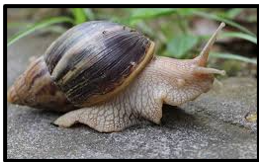
- About Giant African Snail: Refers to several large African land snail species; the most destructive is Lissachatina fulica.
- Classified as one of the world’s worst invasive species.
- Feeds on 500+ types of crops and ornamental plants.
- Native: East Africa.
- Introduced worldwide through the pet trade, food resource use, and accidental introduction.
- Feed mainly on decaying organic matter such as: Garbage, fallen fruit and animal manure
- Habitat: Thrives in warm tropical climates with mild year-round temperatures and high humidity.
- Adverse Impact on Humans: Health threat as it can transmit parasites and diseases.
- Acts as a vector for parasitic nematodes, including:
- Angiostrongylus cantonensis – causes eosinophilic meningoencephalitis (brain infection).
- Angiostrongylus costaricensis – causes abdominal angiostrongyliasis.
- Infections spread through ingestion of contaminated snails or their residues.
10. World Duchenne Muscular Dystrophy Day: Recently,
World Duchenne Muscular Dystrophy Day was observed on 7 September by the Ministry of Social Justice & Empowerment, Government of India.
- About Duchenne Muscular Dystrophy: A rare genetic disorder marked by progressive muscle degeneration and weakness.
- Caused by a genetic defect in producing dystrophin, a protein that protects muscle fibers from enzyme-related breakdown.
- First described in 1860 by French neurologist Guillaume Benjamin Amand Duchenne.
- A multi-systemic condition that affects: Skeletal muscles, Heart muscles and Lung muscles
- Genetics: The dystrophin gene is located on the X-chromosome. Primarily affects males; females are usually carriers.
- Symptoms: Onset & Progression: Symptoms begin as early as age 2–3, starting with proximal muscles (near the core) and later affecting distal muscles, with lower limbs impacted before upper limbs.
- Common Signs: Difficulty in walking, running, jumping, along with enlarged calves, waddling gait, and lumbar lordosis (inward spinal curve).
- Treatments (Presently Available):
- Gene therapy – adds functional dystrophin gene.
- Exon skipping – skips faulty gene segments to make functional protein.
- Stop codon read-through – bypasses premature stop signals.
- Gene repair/genome editing – corrects mutations (e.g., CRISPR).


 theIASHub | 10 Sep, 2025






 Detailed Solutions & Explanations

