2 Min Series 27 November 2025

THEIASHUB
Get an Instant Call Back from Our Expert Mentors Now!
+91

 27th November 2025


  1. Asia-Pacific Disaster Report: Recently, the United Nation’s 2025 Asia-Pacific Disaster Report highlighted that Asia’s megacities face an increasing risk of deadly heatwaves.
  • Key Highlights: Asian megacities like Delhi, Karachi, Shanghai, Dhaka, Manila, and Seoul may face 2–7°C extra local heating due to Urban Heat Island effect by 2100.
  • Even if global warming is limited to 5–2°C, city temperatures will rise much higher.
  • India, Pakistan, Bangladesh may experience 300+ days per year with heat index >35°C.
  • Many regions will face 200+ days where the heat index exceeds 41°C (extreme danger).
  • Southeast Asia: ~30% population projected to face extreme heat under business-as-usual.
  • South & Southwest Asia: >40% population expected to face 35°C & 41°C+ levels in medium & long term.
  • Extreme heat now the fastest-growing climate hazard in Asia-Pacific.
  • 2024 was the hottest year ever; Asia saw severe, prolonged heat events.
  • Extreme heat may double heat-related mortality by 2050.
  • Urban poor are most exposed due to dense, heat-trapping neighbourhoods.
  • High losses in agriculture, construction & industry due to outdoor labour exposure.
  1. New Bush Frog Species: Recently, thirteen new bush frog species were identified in Northeast India, marking the region’s biggest amphibian discovery in over a decade.
  • Key Findings: Species identified across Arunachal Pradesh, Meghalaya, Assam, Mizoram, Nagaland & Manipur.
  • State-wise Distribution: Arunachal Pradesh: 6 species, Meghalaya: 3 species and Assam, Mizoram, Nagaland, Manipur: 1 species each
  • Survey & Methods: Discovered from 2016–2024 using 204 specimens from 81 locations across eight states.
  • Used integrative taxonomy: mitochondrial DNA, nuclear gene, morphology and bioacoustics (call patterns)
  • Biodiversity Significance: All 13 species are endemic to northeast India.
  • Total Raorchestes species in the NE now: 21.
  • Asia hosts 212 bush frog species, with 121 discovered in last 20 years.
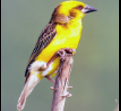
  1. Finn’s Weaver: Recently, the Finn’s Weaver, a small yellow bird, has been disappearing across the marshy lowlands of northern India and Nepal.
  • About Finn’s Weaver (Ploceus megarhynchus): No male, female, nest, egg or chick found despite extensive surveys.
  • Species & Habitat: Also called Finn’s Baya, Yellow Weaver, Himalayan Weaver, and Pahari Baya.
  • Found in Terai grasslands of Uttarakhand, Uttar Pradesh & Nepal.
  • Prefers marshy soil, tall grasses, Semal & Shisham trees, near dams/reservoirs.
  • Population Crash: Highest recent count: 17 males + 10 females (2021) → rapid fall to zero by 2025.
  • Estimated population in Uttarakhand & UP: ~200 birds.
  • Total India population (including subspecies): ~500 birds.
  • Habitat Loss & Human Pressure: Terai grasslands converted to agriculture — wheat cropping when dam water recedes.
  • Grass cutting, land clearing, construction, industrial growth destroying habitat.
  • Species disappeared from Sitarganj, Kichcha, Bajpur, Nainital, Haridwar.
  • IUCN Concern: Listed as Vulnerable (2016)Endangered (2021).
  • IUCN officials fear it may now meet criteria for Critically Endangered.


  1. New Multitracking Projects: Recently, the Cabinet approved two new multitracking projects worth ₹2,781 crore, adding 224 km to the Indian Railways network.
  • Key Highlights: Projects Approved: Devbhumi Dwarka (Okha) – Kanalus Doubling: 141 km and Badlapur – Karjat 3rd & 4th Line: 32 km (Mumbai suburban corridor)
  • Economic & Operational Impact: Enhances line capacity, reduces congestion, and improves speed, punctuality & reliability of services. Strengthens both passenger and freight corridors.
  • Gati Shakti Alignment: Part of PM Gati Shakti National Master Plan → integrated planning, multimodal connectivity, and improved logistics efficiency.
  • Regional Development Boost: Benefits 4 districts across both states and improves access for 585 villages (32 lakh population).
  • Expected to generate local jobs & self-employment opportunities.
  • Special Connectivity Gains: Kanalus–Okha doubling improves access to Dwarkadhish Temple, boosting pilgrimage and Saurashtra’s economic growth.
  • Badlapur–Karjat expansion strengthens the Mumbai suburban rail network and links to Southern India.
  1. SIDDHI 2.0: Recently, the Central Council for Research in Ayurvedic Sciences (CCRAS) launched SIDDHI 2.0 to accelerate evidence-based innovation in India’s Ayurveda pharma sector.
  • About SIDDHI 2.0: A national industry–research interface platform to accelerate evidence-based Ayurvedic product development.
  • Purpose & Vision: Strengthens research-led innovation, translational pathways, and Ayurveda pharma modernisation.
  • Accelerates indigenous technologies, IPR sharing, and industry partnerships.
  • Supports India’s goal of a globally competitive, evidence-driven Ayurveda sector.
  • New Releases & Digital Initiatives: Launch of medico-historical publication: “Evolution of Ayurveda, Siddha & Unani Drug Regulations in India”.
  • Launch of Drug Inventory Management System (DIMS) portal to strengthen regulation & quality control.
  • Key Focus Areas of SIDDHI 2.0: Evidence-based product development.
  • Strengthening industry–academia–regulator ecosystem.
  • Enhancing quality, safety, toxicity validation.
  • Promoting AI-driven, tech-enabled Ayurvedic innovation.
  • Wider industry adoption of CCRAS technologies.
  1. OncoMark: Recently, scientists from the S N Bose National Centre for Basic Sciences (DST) and Ashoka University developed OncoMark, the first AI tool to decode cancer’s molecular behaviour.
  • About OncoMark: Moves beyond traditional staging (like Tumor–Node–Metastasis (TNM)) by analyzing the molecular “personality” of tumors.
  • Cancer driven by molecular programs called hallmarks: metastasis, immune evasion, genomic instability, treatment resistance, etc.
  • OncoMark reads these hallmark activities, offering a far deeper understanding than size/spread alone.
  • Visualizing Cancer Progression: For the first time, researchers can visualize hallmark activity increasing as cancer advances through stages.
  • Shows why patients with identical TNM stages can have very different outcomes.
  • Precision-Guided Treatment Decisions: OncoMark reveals which hallmarks are active in a patient’s tumor.
  • Helps doctors select drugs targeting those specific biological processes.
  • Identifies aggressive tumors that appear low-risk under traditional staging, enabling early intervention
  1. Aravalli Hills: Recently, the Supreme Court approved a Union Environment Ministry proposal defining the Aravalli Hills as landforms rising 100 m or more above the local relief, along with their adjoining slopes.
  • Key Highlights: Massive Area Now Left Out: This excludes over 90% of the Aravalli Hills, making many low-lying hills vulnerable to mining and construction. g.: Only 1,048 of 12,081 hills meet the 100-m height cut-off.
  • What the FSI Assessment Revealed: Internal Forest Survey of India Analysis: FSI mapped Aravalli hills ≥20 m (functional wind barriers) across 15 Rajasthan districts. E.g.: Only 8.7% of these hills exceed 100 m above surrounding ground.
  • Importance of Lower Hills Ignored: FSI cautioned that smaller hills (10–30 m) are critical for blocking sand and dust from the Thar Desert. g.: Losing these hills exposes Delhi-NCR to massive dust inflow.
  • About Aravalli (A Critical Shield for NCR): Lower & Upper Hills Work Together Upper Aravalli blocks fine PM2.5; lower hills halt heavier sand. g.: Natural barrier from Rajasthan to Delhi that reduces dust storms.
  • Vital Wildlife Corridors: Aravalli links habitats between Sariska, Ranthambhore and other protected areas. g.: Fragmentation threatens movement of tigers, leopards and ungulates.

8.       Krishnan Crater: Recently, a 3.5-billion-year-old crater on Mars was officially named ‘Krishnan Crater’ in honour of pioneering geologist M.S. Krishnan.
  • Key Highlights: International Astronomical Union approved multiple Kerala-based names for smaller features around the crater:
  • Valiamala (crater)
  • Thumba (crater)
  • Bekal (crater)
  • Varkala (crater)
  • Periyar (vallis/valley)
  • Why “Krishnan Crater”: M.S. Krishnan (born 1898, Thanjavur) → first Indian Director of the Geological Survey of India. Honoured for foundational contributions to geology and planetary sciences.
  • IAU Naming Guidelines: Large craters → named after deceased scientists with major contributions to planetary science.
  • Small craters → named after towns/villages with population <1,00,000; must be culturally significant & easy to pronounce.
  • Findings and naming proposal published in Meteoritics & Planetary Science
  1. Young Stellar Objects (YSOs): Recently, a decade of NASA WISE–NEOWISE observations produced the most detailed mid-infrared variability catalogue of Young Stellar Objects (YSOs) to date.
  • Key Highlights: Study published in The Astrophysical Journal Supplement Series by researchers from ARIES (DST, India).
  • About Young Stellar Object: These are very young stars still in their earliest developmental phases, before they begin stable hydrogen fusion in their cores.
  • They appear before the main-sequence stage on the Hertzsprung–Russell diagram, which charts stellar evolution based on temperature and brightness.
  • YSOs originate from the gravitational collapse of dense molecular clouds, which are vast, cold regions packed with gas and dust.
  • The collapse can be initiated by several events that create local density increases and gravitational instability, such as:
    • Shockwaves from nearby supernova explosions
    • Intense stellar radiation from neighbouring massive stars
    • Turbulence within the interstellar medium


UPSC QEP 2026 Batch 5 - English
Buy now View Details
Submit Your Details to Learn More
I agree to give my consent to receive updates through SMS/Email & WhatsApp*.

NEEV GS + CSAT Foundation 2026/27
Buy now View Details


Join theIAShub’s Mains Answer Writing Program

Refine your answer writing skills and elevate your UPSC preparation with personalized support and expert feedback.

Fill out the form to get started with the program or any other enquiries !

I agree to give my consent to receive updates through SMS/Email & WhatsApp*.

Best IAS Coaching In Delhi, UPSC Online & Offline Classes by IAShub

Are you dreaming of becoming an IAS officer? Then, IAShub can be your best guide. It is one of the Best IAS Coaching in Delhi. Many students who want to clear the UPSC exam join IAShub for learning. The institute gives both online and offline classes. Their teachers are experienced and helpful. They easily explain every topic. Students also get notes, tests, and tips to do well in the exam.

UPSC Online Classes by IAShub

IAShub is in Delhi and is trusted by many UPSC students. It offers coaching for every part of the UPSC exam – Prelims, Mains, and Interview. The classes are simple and easy to understand. The teachers are experts and guide students in the right way. IAShub is also known for its helpful notes, test series, and answer-writing practice. IAShub is the best coaching in Delhi and also gives UPSC Online Classes. This helps students from any place in India to learn. The online classes are live and also recorded. So, students can watch them anytime. These classes cover the full UPSC syllabus.

Key Offerings Provided by IAShub

Here are some important services provided by IAShub:

  • UPSC Prelims: IAShub teaches for Prelims with a focus on basics. It also gives daily current affairs and monthly magazines.
  • Classroom Courses: IAShub has classroom learning for students in Delhi. The environment is good and peaceful for study.
  • Live Classes: Students who live far can join live UPSC online classes. These classes are just like real classes.
  • QEP for Mains: The Quality Enrichment Program (QEP) is special for Mains preparation. It helps students write better and faster.
  • Answer Writing: Regular answer writing practice is given. Teachers also check answers and give tips to improve.
  • Free Resource: IAShub gives free notes by toppers and helpful Main Booster material.
  • Test Series: Test series are available for every subject. These help students know their weak points and improve.
  • Interview Guidance Session: IAShub also gives interview practice sessions with experts. These help students feel confident.

UPSC Exam Overview

The UPSC Civil Services Exam has three parts:

  • Prelims: It has two papers: General Studies and CSAT.
  • Mains: It has nine papers, including essays and optional subjects.
  • Interview: It tests the personality and confidence of the student.

This exam is tough, but with the right guidance, it becomes easy to manage. Students must study smart and stay regular.

How IAShub Helps in the UPSC Journey

IAShub supports students from the beginning to the end. It gives the right books, tests, and notes. The classes are easy to follow, and the teachers are always ready to help. Students get personal doubt sessions too. The test series and answer checking help students learn where they need to do better. Also, free study materials save time and money.
IAShub also guides students during the final stage – the interview. Experts take mock interviews and give useful tips. This full support makes IAShub one of the best IAS coaching in Delhi.

Best IAS Coaching In Delhi FAQs

Yes, IAShub offers live and recorded online classes. Students can attend from any part of India.

Classes are available in both English and Hindi, so students can choose the language they are comfortable with.

The classroom centre is located in Delhi. Students can visit and join offline batches there.

IAShub gives interview guidance sessions to help students prepare for the final round of UPSC.