2 Min Series 25 October 2025

THEIASHUB
Get an Instant Call Back from Our Expert Mentors Now!
+91

 25th October 2025

  1. Gyan Bharatam Mission: Recently, the Union Ministry of Culture’s flagship initiative, the Gyan Bharatam Mission, announced plans to sign Memorandums of Understanding (MoUs) with around 20 institutions across India to conserve and digitise the nation’s manuscript heritage.
  • Key Highlights: Participating Institutions (First Phase): Include prominent organisations such as the Asiatic Society (Kolkata), University of Kashmir (Srinagar), Hindi Sahitya Sammelan (Prayagraj), and Government Oriental Manuscript Library (Chennai).
  • About Gyan Bharatam Mission: A flagship initiative of the Ministry of Culture, announced in the Union Budget 2025, dedicated to:
  • Identifying, documenting, conserving, digitising, preserving, and promoting India’s manuscript heritage.
  • The mission seeks to establish a National Digital Repository (NDR) — a unified digital platform to share India’s manuscript heritage globally.
  • Activities Covered: Survey and cataloguing of manuscripts, Conservation and capacity building, Technology and digitisation, Linguistics and translation, Research, publication, and outreach.
  1. Sardar Vallabhbhai Patel: Recently, India announced the celebration of Rashtriya Ekta Diwas (National Unity Day) on October 31, marking the 150th birth anniversary of Sardar Vallabhbhai Patel, the architect of modern India.
  • About Sardar Vallabhbhai Patel: Born on October 31, 1875, in Nadiad, Gujarat, to Jhaverbhai Patel and Ladba Patel.
  • Early Political Career: Inspired by Mahatma Gandhi’s leadership.
  • Contributions: Kheda Satyagraha (1918): Secured tax exemption for farmers during crop failure.
  • Non-Cooperation Movement (1920): Left law practice; led protests and boycott of British goods.
  • Bardoli Satyagraha (1928): Opposed unfair land tax; successful campaign earned him the title “Sardar.”
  • Quit India Movement (1942): Supported Congress resolution; arrested and imprisoned in Ahmednagar Fort.
  • Served as Deputy Prime Minister and Home Minister after independence.
  • Integrated over 560 princely states into India using diplomacy and firm resolve — preventing disintegration; known as “Iron Man of India.”
  • Established the All India Services — called the “Steel Frame of India”, ensuring administrative unity.
  • Death: Died on December 15, 1950.
  • Honored with the Statue of Unity (2018) — world’s tallest statue, celebrating his leadership and vision.
  1. UNESCO International Convention against Doping: Recently, India was re-elected as Vice-Chairperson of the Bureau for the Asia-Pacific (Group IV) during the 10th Session of the Conference of Parties (COP10) to the UNESCO International Convention against Doping in Sport.
  • About International Convention against Doping in Sport: A UNESCO multilateral treaty (2005) where member States commit to prevent and eliminate doping in sports, ensuring fair and ethical competition.
  • Adopted: 19 October 2005 (33rd UNESCO General Conference)
  • Came into force: 1 February 2007
  • Members: 192 States Parties — UNESCO’s second most ratified treaty.
  • Aims: To promote integrity, ethics, and health in sports by curbing performance-enhancing drug use.
  • Key Features: Legal Framework: Requires States to align national policies with the World Anti-Doping Agency (WADA) Code.
  • Global Cooperation: Promotes coordination among governments, sports bodies, and research institutions.
  1. National Blockchain Framework: Recently, the Ministry of Electronics and Information Technology (MeitY) reported significant progress under the National Blockchain Framework (NBF).
  • About NBF: Launched in September 2024 with a budget of ₹64.76 crore.
    • Developed by the Ministry of Electronics and Information Technology (MeitY) to provide a unified blockchain architecture for governance and industry.
    • Aims to promote secure, transparent, and scalable digital governance in alignment with Digital India and Aatmanirbhar Bharat
    • Core Components of NBF: Vishvasya Blockchain Stack – Indigenous modular platform forming the technical backbone of NBF.
    • NBFLite – Sandbox version to support startups, researchers, and students in developing blockchain applications.
    • Praamaanik – Blockchain-based app verification solution to ensure authenticity of mobile applications.
    • National Blockchain Portal – Central platform for coordination, policy guidance, and standardization of blockchain adoption.
  1. PM SVANidhi: Recently, the Union Minister for Housing and Urban Affairs chaired a high-level review meeting on the PM Street Vendor’s AtmaNirbhar Nidhi (PM SVANidhi) scheme with representatives from 33 States and Union Territories.
  • Key Highlights: Meeting Objectives: To assess State-wise progress in implementation.
  • To address operational challenges and streamline processes for loan sanction and disbursement.
  • To enhance coordination among States, UTs, ULBs, and banks.
  • Ensure progression of beneficiaries from first to second and third loan tranches, strengthening their creditworthiness and livelihood stability.
  • Emphasized digital onboarding for 100% beneficiary coverage and active digital transactions.
  • Directed that all street food vendors be trained in Hygiene and Food Safety through the FSSAI.
  • New Initiative Announced: Launch of “SVANidhi Sankalp Abhiyaan” — a month-long national drive from 3rd November to 2nd December 2025.
  • Aim: To boost outreach, expedite application processing, and improve loan disbursal efficiency by Urban Local Bodies (ULBs) and banks.
  1. Pension System: Recently, the Government of India approved the extension of Life Cycle 75 (LC75) and Balanced Life Cycle (BLC) options under both the National Pension System (NPS) and the Unified Pension Scheme (UPS).
  • Key Highlights: This decision meets long-standing employee demand for greater investment flexibility similar to that enjoyed by non-government subscribers.
  • Purpose: To enhance flexibility and broaden choice in retirement planning.
  • Enables employees to align pension investments with their individual risk preferences and retirement goals.
  • Key Benefits to Employees: Greater Flexibility & Choice: Employees can choose plans that suit their risk appetite and retirement objectives.
    • Glide Path Mechanism: Automatic reduction in equity exposure with age — 15% for LC75 and 35% for BLC by age 55, minimizing volatility near retirement.
    • Broadened Auto Choice Options: Expands investment diversity and risk-adjusted growth potential.
    • Support for Informed Planning: Promotes personalized and risk-aware pension corpus management.
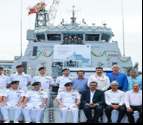
  1. Mahe: Recently, Cochin Shipyard Limited (CSL) delivered ‘Mahe’, the first in a series of eight Anti-Submarine Warfare Shallow Water Crafts (ASW SWC), to the Indian Navy.
  • About Mahe: Named after the historic port town of Mahe in the Union Territory of Puducherry.
  • Symbolises India’s rich maritime heritage and strategic coastal legacy.
  • Design & Construction: Indigenously designed and constructed by CSL, reflecting India’s self-reliance in naval shipbuilding.
  • Incorporates over 80% indigenous content, aligning with the Aatmanirbhar Bharat
  • Specifications: Length: ~78 metres
  • Displacement: ~1,100 tonnes
  • Role: Specialised for underwater surveillance, Low Intensity Maritime Operations (LIMO), and Anti-Submarine Warfare (ASW) in coastal waters.
  • Strategic Importance: Enhances the Indian Navy’s ASW and littoral defence capability.
  • Strengthens maritime security and surveillance in coastal regions.
  1. ICGS Ajit and ICGS Aparajit: Recently, the Indian Coast Guard (ICG) launched two advanced Fast Patrol Vessels (FPVs) ICGS Ajit and ICGS Aparajit at Goa Shipyard Limited (GSL).
  • Key Highlights: These are the 7th and 8th vessels in a series of eight indigenously built FPVs constructed by GSL for the ICG.
  • Design & Construction: Fully designed and built in India by Goa Shipyard Limited, showcasing indigenous shipbuilding strength.
  • Each vessel measures 52 metres in length and displaces 320 tonnes.
  • Equipped with Controllable Pitch Propellers (CPP)first of their kind in this class in India, ensuring enhanced manoeuvrability and propulsion efficiency.
  • Operational Capabilities: Designed for multi-mission roles, including:
    • Fisheries protection, Coastal patrol and surveillance
    • Anti-smuggling and anti-piracy operations
    • Search & rescue missions, particularly around island territories and the Exclusive Economic Zone (EEZ).
  • Significance: Marks a major step in strengthening India’s maritime security and coastal response capacity.
  1. Bharat International Rice Conference (BIRC) 2025: Recently, the Government of India announced that the Bharat International Rice Conference (BIRC) 2025 will be held at New Delhi.
  • Key Highlights: To position India as a global leader in the rice supply chain and strengthen transparency, sustainability, and efficiency in the global rice trade.
  • Expected to unlock ₹1.80 lakh crore in new rice markets and sign ₹25,000 crore worth of export MoUs.
  • Global Participation: Foreign Ministers from Philippines, Ghana, Namibia, and The Gambia to attend.
  • Participation from over 1,000 foreign buyers (80+ countries), 3,000 farmers/FPOs, and 2,500 exporters and allied industries.
  • Vision & Roadmap: Launch of a Vision & Roadmap document for India’s rice sector aligned with Viksit Bharat @2047.
  • Technical Sessions: Eight technical sessions to cover sustainability, innovation, and trade mechanisms.
  • Focus areas: agronomy, irrigation efficiency, certification, traceability, and environmental sustainability.
  • India’s Rice Sector Snapshot (2024–25): Production: 150 million tonnes from 47 million hectares (~28% of global output).
  • Innovation Showcase: Launch of India’s first AI-based rice sorting system at the AgriTech Pavilion.


UPSC QEP 2026 Batch 5 - English
Buy now View Details
Submit Your Details to Learn More
I agree to give my consent to receive updates through SMS/Email & WhatsApp*.

NEEV GS + CSAT Foundation 2026/27
Buy now View Details


Join theIAShub’s Mains Answer Writing Program

Refine your answer writing skills and elevate your UPSC preparation with personalized support and expert feedback.

Fill out the form to get started with the program or any other enquiries !

I agree to give my consent to receive updates through SMS/Email & WhatsApp*.

Best IAS Coaching In Delhi, UPSC Online & Offline Classes by IAShub

Are you dreaming of becoming an IAS officer? Then, IAShub can be your best guide. It is one of the Best IAS Coaching in Delhi. Many students who want to clear the UPSC exam join IAShub for learning. The institute gives both online and offline classes. Their teachers are experienced and helpful. They easily explain every topic. Students also get notes, tests, and tips to do well in the exam.

UPSC Online Classes by IAShub

IAShub is in Delhi and is trusted by many UPSC students. It offers coaching for every part of the UPSC exam – Prelims, Mains, and Interview. The classes are simple and easy to understand. The teachers are experts and guide students in the right way. IAShub is also known for its helpful notes, test series, and answer-writing practice. IAShub is the best coaching in Delhi and also gives UPSC Online Classes. This helps students from any place in India to learn. The online classes are live and also recorded. So, students can watch them anytime. These classes cover the full UPSC syllabus.

Key Offerings Provided by IAShub

Here are some important services provided by IAShub:

  • UPSC Prelims: IAShub teaches for Prelims with a focus on basics. It also gives daily current affairs and monthly magazines.
  • Classroom Courses: IAShub has classroom learning for students in Delhi. The environment is good and peaceful for study.
  • Live Classes: Students who live far can join live UPSC online classes. These classes are just like real classes.
  • QEP for Mains: The Quality Enrichment Program (QEP) is special for Mains preparation. It helps students write better and faster.
  • Answer Writing: Regular answer writing practice is given. Teachers also check answers and give tips to improve.
  • Free Resource: IAShub gives free notes by toppers and helpful Main Booster material.
  • Test Series: Test series are available for every subject. These help students know their weak points and improve.
  • Interview Guidance Session: IAShub also gives interview practice sessions with experts. These help students feel confident.

UPSC Exam Overview

The UPSC Civil Services Exam has three parts:

  • Prelims: It has two papers: General Studies and CSAT.
  • Mains: It has nine papers, including essays and optional subjects.
  • Interview: It tests the personality and confidence of the student.

This exam is tough, but with the right guidance, it becomes easy to manage. Students must study smart and stay regular.

How IAShub Helps in the UPSC Journey

IAShub supports students from the beginning to the end. It gives the right books, tests, and notes. The classes are easy to follow, and the teachers are always ready to help. Students get personal doubt sessions too. The test series and answer checking help students learn where they need to do better. Also, free study materials save time and money.
IAShub also guides students during the final stage – the interview. Experts take mock interviews and give useful tips. This full support makes IAShub one of the best IAS coaching in Delhi.

Best IAS Coaching In Delhi FAQs

Yes, IAShub offers live and recorded online classes. Students can attend from any part of India.

Classes are available in both English and Hindi, so students can choose the language they are comfortable with.

The classroom centre is located in Delhi. Students can visit and join offline batches there.

IAShub gives interview guidance sessions to help students prepare for the final round of UPSC.