


 theIASHub | 21 Nov, 2025


1. Meerut Bugle: Recently, the Meerut Bugle received recognition with the granting of a Geographical Indication (GI) tag.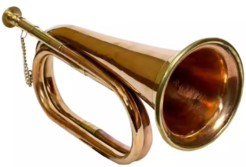
About Meerut Bugle: It is a brass wind instrument traditionally used in armed forces drills, wars, ceremonies, and parades for signalling movements and important events.
The bugle holds a strong historical association with India’s military traditions.
Over decades, the city became a key centre for crafting bugles, closely tied to the evolution of India’s defence culture.
A brass sheet is cut, hammered, and shaped using a specialised die.
The instrument is then moulded, polished, and fitted with a mouthpiece to achieve its final form.
Gold-Finish Bugle – Features a polished, gold-like appearance.
Silver-Finish Bugle – Made on request.
2. Kodaikanal Solar Observatory: Recently, researchers from the Aryabhatta Research Institute of Observational Sciences (ARIES), the Indian Institute of Astrophysics (IIA), and international collaborators reconstructed over a century of the Sun’s polar magnetic field using archival observations from the Kodaikanal Solar Observatory.
About the Kodaikanal Solar Observatory: One of India’s oldest and globally recognised solar observatories, with continuous solar observations for over 120 years.
Operates as a field station of the Indian Institute of Astrophysics (IIA), Bengaluru.
Began systematic Ca II K wavelength solar imaging in 1904, creating one of the longest solar data archives in the world.
Captures multi-wavelength chromospheric images, including plages, sunspot groups, and magnetic network structures.
Hosts a digitised, publicly accessible database, enabling global research.
3. India and Israel: Recently, India and Israel signed the Terms of Reference (ToR) to formally launch negotiations for a Free Trade Agreement (FTA).
Key Highlights: The ToR sets the framework for the upcoming negotiations, covering:
Market access for goods, including removal of tariff and non-tariff barriers
Investment facilitation and promotion
Simplified customs procedures
Technology transfer and innovation partnerships
Easing rules to boost trade in services
Israel has floated a $50 billion metro project, with Indian companies eligible to participate.
Past Negotiations: India and Israel had previously held 8 rounds of talks, but negotiations did not conclude. The newly signed ToR revives and formalises the negotiation process.
4. Regional Open Digital Health Summit (RODHS): Recently, India hosted the second Regional Open Digital Health Summit (RODHS) 2025 in New Delhi.
Key Highlights: Organised by NeGD (MeitY), NHA, WHO-SEARO, UNICEF, with participation from India, Bangladesh, Sri Lanka, Thailand, Nepal, Maldives, etc.
Focus on Digital Public Infrastructure (DPI), open standards, interoperability, and Generative AI for advancing Universal Health Coverage (UHC) in South-East Asia.
WHO SEARO stressed trust, consistency, and interoperability as foundations for scalable adoption.
UNICEF highlighted community-, child-, and health-worker-centric digital health approaches.
India showcased leadership through Aadhaar, UPI, CoWIN, Ayushman Bharat Digital Mission as successful DPI-based health solutions.
Consensus on shifting from pilot projects to large-scale digital health ecosystems.
UNICEF emphasised child rights, safety, and data protection in digital health.
5. 2035 Climate Ambition Gap: Recently, Greenpeace International released a report titled “2035 Climate Ambition Gap” at COP30.
Key Findings: Report reveals insufficient climate ambition in the 2035 NDCs submitted by G20 countries.
Greenpeace urges governments to adopt a Global Response Plan to keep the 5°C limit alive.
Announced but not submitted: Mexico, South Korea.
Not submitted/not announced: Argentina, India, and Saudi Arabia.
Lack of quantified targets for renewables or energy efficiency.
6. President & Governors Recently, a five-judge Constitution Bench held that courts cannot impose fixed timelines on the President or Governors for deciding on State Bills.
Key Highlights: Courts also cannot assume “deemed consent” if a Bill remains pending after a court-mandated period; doing so would usurp executive functions and violate separation of powers.
Judicially-created deadlines would cast suspicion on Presidential/Gubernatorial actions after expiry of such timelines.
No constitutional provision prescribes a specific timeline under Articles 200 or 201.
Prolonged, unexplained, and indefinite delay can be addressed by a limited mandamus directing them to act within a reasonable time.
However, they cannot be made personally answerable due to personal immunity under Article 361.
Consulting the Court under Article 143 remains entirely discretionary.
7. SARAL SIMS: Recently, the Ministry of Steel launched ‘SARAL SIMS’, a simplified version of the Steel Import Monitoring System (SIMS).
About SARAL SIMS: Aimed at MSMEs, small importers, and export-linked importers using Advance Authorization / SEZ / EOU
A single SARAL SIMS number allows multiple consignments for the entire financial year.
Export-linked imports (Advance Authorization / SEZ / EOU): No quantity limit.
8. Acanthosis Nigricans: Recently, experts noted that dark, velvety patches appearing on the folds of the skin called as Acanthosis Nigricans, may signal insulin resistance and can often be the first visible sign of prediabetes or diabetes.
About Acanthosis Nigricans: A skin condition marked by dark, velvety, thickened patches on skin folds.
It is strongly linked to insulin resistance, making it an early warning sign of prediabetes or diabetes.
For obesity/insulin resistance: Weight loss, diet changes, and lifestyle modifications. Medications for insulin resistance or obesity, if required
Skin treatments may include: Prescription creams (lightening/softening), Antibacterial soaps, Topical antibiotics and Laser therapy (after addressing primary cause)
9. Mount Semeru: Recently, Mount Semeru in Indonesia, one of the country’s most active volcanoes, erupted, releasing hot ash and debris.
It lies in a subduction zone where the Indo–Australian Plate subducts beneath the Eurasian Plate, creating intense volcanic activity.
It is the highest mountain on the island of Java, making it a prominent geographical landmark.
The name “Semeru” comes from Meru/Sumeru, the sacred cosmic mountain in Hindu mythology, considered the abode of gods.
Indonesia lies on the Pacific Ring of Fire, an area with frequent earthquakes and volcanic eruptions due to active tectonic plate boundaries.
10. Heat–Power Trap: Recently, a new study revealed that heatwaves pushed India’s electricity demand up by nearly 9% during the peak summer of 2024, sharply increasing reliance on fossil fuels and triggering a surge in emissions.
Key Findings: New study Breaking the Cycle warns of a dangerous “heat–power trap” — rising heat → higher cooling demand → increased fossil fuel use → more emissions → further warming.
2024 was India’s hottest year on record, with temperatures 65°C above the 1991–2020 baseline; Delhi’s Mungeshpur hit 52.9°C.
Northern & central India recorded 500+ cumulative heatwave days in the past decade; new hotspots emerged in Uttarakhand & Ladakh.
Electricity Demand & Fossil Dependence: Peak power demand jumped from 154 GW (2015) to 246 GW (2024) — a 59% rise.
Despite massive renewable expansion (solar ↑ 18x, wind nearly doubled), fossil fuels still meet peak heatwave-time demand.


Refine your answer writing skills and elevate your UPSC preparation with personalized support and expert feedback.
Fill out the form to get started with the program or any other enquiries !
Are you dreaming of becoming an IAS officer? Then, IAShub can be your best guide. It is one of the Best IAS Coaching in Delhi. Many students who want to clear the UPSC exam join IAShub for learning. The institute gives both online and offline classes. Their teachers are experienced and helpful. They easily explain every topic. Students also get notes, tests, and tips to do well in the exam.
IAShub is in Delhi and is trusted by many UPSC students. It offers coaching for every part of the UPSC exam – Prelims, Mains, and Interview. The classes are simple and easy to understand. The teachers are experts and guide students in the right way. IAShub is also known for its helpful notes, test series, and answer-writing practice. IAShub is the best coaching in Delhi and also gives UPSC Online Classes. This helps students from any place in India to learn. The online classes are live and also recorded. So, students can watch them anytime. These classes cover the full UPSC syllabus.
Here are some important services provided by IAShub:
The UPSC Civil Services Exam has three parts:
This exam is tough, but with the right guidance, it becomes easy to manage. Students must study smart and stay regular.
IAShub supports students from the beginning to the end. It gives the right books, tests, and notes. The classes are easy to follow, and the teachers are always ready to help. Students get personal doubt sessions too. The test series and answer checking help students learn where they need to do better. Also, free study materials save time and money.
IAShub also guides students during the final stage – the interview. Experts take mock interviews and give useful tips. This full support makes IAShub one of the best IAS coaching in Delhi.
 Detailed Solutions & Explanations
Improve Your Answer Writing & Strategy
Detailed Solutions & Explanations
Improve Your Answer Writing & Strategy

