19th September 2025
- New Natural Heritage Sites: Recently, India added another milestone to its global heritage journey with the inclusion of seven natural heritage sites in UNESCO’s Tentative List of World Heritage Sites. This raised India’s representation on the list from 62 to 69 properties.
- Deccan Traps at Panchgani and Mahabaleshwar, Maharashtra – well-preserved lava flows within Koyna Wildlife Sanctuary.
- Geological Heritage of St. Mary’s Island Cluster, Karnataka – rare columnar basaltic rocks, ~85 million years old.
- Meghalayan Age Caves, Meghalaya – Mawmluh Cave as global reference point for Meghalayan Age.
- Naga Hill Ophiolite, Nagaland – rare ophiolite rocks, uplifted oceanic crust.
- Erra Matti Dibbalu (Red Sand Hills), Andhra Pradesh – unique red sand formations with paleo-climatic significance.
- Natural Heritage of Tirumala Hills, Andhra Pradesh – Eparchaean Unconformity and Silathoranam (Natural Arch).
- Varkala Cliffs, Kerala – Warkalli Formation of Mio-Pliocene age, natural springs, erosional landforms.
- National Index: Recently, NITI Aayog started developing a national index to assess states’ manufacturing and infrastructure performance. It is also exploring a metals and energy community in the Indian Ocean Region to strengthen critical supply chains.
- About National Index: To foster competitive and cooperative federalism, help investors and policymakers compare state performance.
- The index will consolidate data on: State policies, Infrastructure readiness, Logistics efficiency and Ease of approvals
- Survey underway to refine implementation.
- Critical minerals focus: Comes after China’s rare earth export restrictions (April–Aug 2025, lifted only for India).
- Slow progress in
critical mineral block auctions due to complex design, pollution, community, and multi-level governance concerns.
- Auction design expected to improve with evolving regulatory frameworks.
- Testicular Torsion: Recently, doctors warned that testicular torsion, though rare, is a medical emergency where delays of hours can mean saving or losing a testicle.
- About Testicular Torsion: It happens when a testicle twists around the spermatic cord, cutting off blood supply. Irreversible damage can occur within 4–6 hours without treatment.
- Who is most at risk: Newborns and young children.
- Teenagers during puberty, when rapid growth makes testicles more mobile.
- Why urgent care is needed: Immediate medical attention is critical to save the testicle.
- Any scrotal pain in children should be treated as an emergency.
- Warning signs: Sudden, severe testicular pain.
- Swelling or redness in the scrotum.
- Nausea and vomiting.
- Difficulty walking or sitting.
- Pain that persists even after minor injury.
- Diagnosis & treatment: Confirmed by physical exam or ultrasound. Standard treatment is emergency surgery to untwist the spermatic cord and secure both testicles.
- Prognosis: Surgery within 6 hours usually saves the testicle.
- After 6–8 hours, survival chances drop significantly.
- If not salvageable, the testicle may need to be removed.
- Chabahar Port: Recently, the United States announced it will revoke the sanctions waiver for operations at Iran’s Chabahar Port, a concession first granted in 2018.
- About Chabahar Port: A deep-water port in Iran’s Sistan-Baluchistan province.
- Situated on the Gulf of Oman, at the entrance of the Strait of Hormuz.
- It is the only Iranian port with direct access to the Indian Ocean.
- Comprises two ports: Shahid Beheshti and Shahid Kalantari.
- Strategic importance: Close to Afghanistan, Pakistan, and India.
- Serves as a
key transit hub on the
International North-South Transport Corridor (INSTC).
- Has the potential to emerge as a
major regional commercial hub.
- About Saudi Arabia–Pakistan Defence Pact: Recently, the Ministry of External Affairs said it will study the Saudi Arabia–Pakistan defence pact for its impact on India’s security, regional balance, and global stability.
- About Saudi Arabia–Pakistan Defence Pact: Pakistan and Saudi Arabia signed a mutual defence pact declaring that aggression against one will be treated as aggression against both.
- Marks the first major defence agreement between an Arab nation and a nuclear-armed state.
- Finalised after Israel’s strike in Qatar and amid weakening US defence assurances.
- Objectives: Strengthen defence cooperation and joint deterrence.
- Promote
regional and global security.
- Reinforce ties rooted in
Islamic solidarity and long-standing defence partnership since the 1960s.
- Hathei Chilli: Recently, the 14th Sirarakhong Hathei Chilli Festival was inaugurated in Manipur to promote the GI-tagged Hathei Chilli.
- About Hathei Chilli: Also known as the Sirarakhong Chilli.
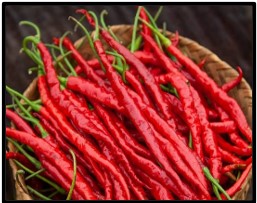
- Grows best only in the climate of Sirarakhong village, about 66 km from Imphal, Manipur.
- Cultivated under the jhum system on hill slopes.
- Received Geographical Indication (GI) tag in 2021.
- Key Features: Recognised as one of the finest chilli varieties in the world.
- Distinctive
deep red colour, taste, size, and shape unique to Sirarakhong village.
- High demand both
within and outside Manipur.
- Main source of income for the
Tangkhul Naga community of Sirarakhong.
- Has a very high
ASTA colour value of 164 (measure of chilli’s extractable colour).
- Health Benefits: Acts as a powerful antioxidant and rich in calcium and Vitamin C.
- First PM MITRA Park: Recently, the Prime Minister laid the foundation stone of the first PM MITRA Park in Dhar district, Madhya Pradesh.
- About PM MITRA Park: Pradhan Mantri Mega Integrated Textile Region and Apparel (PM MITRA) is a mega textile hub.
- Integrates all stages of textile production — spinning, weaving, dyeing, printing, garment-making — in one location.
- Each park covers ~1,000 acres or more.
- Parks can be Greenfield or Brownfield
- Inspired by the vision: “Farm to Fibre to Factory to Fashion to Foreign”.
- Aims to make Indian textiles cheaper, faster, and higher quality.
- Nodal Ministry: Ministry of Textiles.
- Key Features: World-class infrastructure: modern roads, power, water, logistics, worker hostels, plug-and-play units, research and training spaces.
- Land use:
50% manufacturing,
20% utilities,
10% commercial development.
- Employment impact: ~
1 lakh direct jobs +
2 lakh indirect jobs per park.
- PPP model: Developed by a
Special Purpose Vehicle (SPV) jointly owned by State Govt. and Govt. of India.
- Pink Tax: Recently, India’s National Consumer Disputes Redressal Commission (NCDRC) ruled that firms must ensure fair pricing and avoid gender-based price discrimination, addressing the issue of the Pink Tax.
- About Pink Tax: It is not a formal tax but a price disparity, where women are charged more than men for comparable goods and services.
- Businesses use gender-specific branding such as different packaging, colours, or labels like “for women” to justify higher costs.
- In India, there is no specific law preventing this practice, so prices are determined by the market.
- Impact: Women spend much more on similar products across their lives, even though their average earnings are lower.
- The burden deepens gender inequality, particularly in families where women do not contribute to household income.
- Beyond financial strain, it raises concerns of equality and fairness in consumer markets.
- Bima Sugam Portal: Recently, the Insurance Regulatory and Development Authority of India (IRDAI) announced the launch of the Bima Sugam portal.
- About Bima Sugam Portal: A unified digital insurance marketplace bringing together insurers, intermediaries, and customers on one platform.
- Supported by the Life Insurance Council and the General Insurance Council (GIC).
- Key Features: Enables users to buy, sell, renew, service, manage, and claim insurance policies with full transparency.
- Acts as a
centralised database to address insurance-related queries and simplify consumer navigation.
- Promotes faster adoption of
new and sandbox products, encouraging innovation in insurance.
- Covers the entire spectrum of
life insurance products — term plans, savings schemes, annuity, pension, and ULIPs.
- Provides
health insurance options, catering to diverse medical and wellness needs.
- Flexible design to host
future insurance products as approved by regulatory councils.
- Uses
advanced digital technologies to automate and streamline processes for all stakeholders.
- NE-SPARKS Programme: Recently, the Union Minister of Development of North Eastern Region and Communications virtually engaged with school students from the North Eastern states who visited ISRO under the NE-SPARKS programme.
- About NE-SPARKS: North East Students’ Programme for Awareness, Reach, and Knowledge on Space.
- A flagship initiative supported by the Ministry of Development of North-East Region (MDoNER) in collaboration with all 8 North Eastern States.
- Aims to ignite curiosity and awareness about space science and technology among students from the North East.
- Objectives: Inspire students to take interest in STEM fields (Science, Technology, Engineering, and Mathematics).
- Bridge geographical and informational gaps by exposing students to India’s space achievements.
- Implementation: Students will visit ISRO centres in Bengaluru for immersive exposure to cutting-edge space research and technology.
- 800 meritorious science students (100 from each NE state) will be selected for exposure visits.
- Funding: Supported jointly by MDoNER and State Governments in a 60:40 ratio.


 theIASHub | 19 Sep, 2025






 Detailed Solutions & Explanations

