01st September 2025
1. Ramon Magsaysay Award: Recently, for the first time, an Indian non-profit organization has been awarded the prestigious Ramon Magsaysay Award.
- The recognition was given to ‘Educate Girls’, a grassroots NGO dedicated to advancing girls’ education and promoting gender equality in rural and underserved areas of India.

- About Ramon Magsaysay Award: Established in 1957, is Asia’s highest honor and premier prize, recognizing individuals who demonstrate exceptional dedication to serving the people of Asia, regardless of their background.
- It is presented annually on August 31st, marking the birthday of Ramon Magsaysay, the third President of the Philippines.
- Awardees are selected annually by the Board of Trustees of the Ramon Magsaysay Award Foundation (RMAF).
- Recipients receive a certificate, cash prize and a medallion, featuring an embossed profile of Ramon Magsaysay facing right.
2. Killer Whales: Recently, a study revealed an extraordinary behavior in
killer whales (Orcinus orca), an apex predators have been seen presenting freshly caught prey to humans and waiting for a reaction.
- Published in the Journal of Comparative Psychology, this rare interaction underscores the orcas’ curiosity and advanced social intelligence.

- About Killer Whale: Often called the “wolves of the sea”, the killer whale, or orca, is the ocean’s top predator.
- It is the largest member of the Delphinidae family (dolphins) and is renowned for its intelligence and hunting skills.
- Hunting and Abilities: Orcas are highly skilled hunters, capable of coordinated hunting strategies. They are fast swimmers, reaching speeds of up to 54 km/h.
- Distribution: Found in all the world’s oceans, making them the most widely distributed cetaceans. They inhabit both open seas and coastal waters.
- Physical Description: Body: Large and black; Underside: White
- Eye patch: White area above and behind the eye
- Saddle patch: White patch behind the dorsal fin
- Conservation Status: IUCN: Data Deficient
3. Interpol Purple Notice: Recently, the
Enforcement Directorate (ED) issued its first
Interpol Purple Notice, highlighting a sophisticated
trade-based money laundering (TBML) scheme uncovered during its investigations.
- The notice seeks to alert law enforcement agencies worldwide about evolving trends in financial crimes.
- About Purple Notice: It is one of eight types of notices issued by Interpol.
- Purpose: To provide member countries with information on criminal methods, objects, devices, and concealment techniques.
- Focus: Unlike Red Notices that target specific individuals, Purple Notices focus on practices and tools that threaten public safety.
- Other Interpol notices: Red, Yellow, Blue, Black, Green, Orange, and Silver (pilot phase).
- About Interpol: Stands for International Criminal Police Organisation and founded in 1923.
- Membership: 196 member countries
- Headquarters: Lyon, France
- Functions: Information-sharing network for international police cooperation.
4. Mela Patt Festival: Recently, in Jammu and Kashmir, the annual three-day
Mela Patt commenced at the historic Khakhal Mohalla in Bhaderwah town, Doda district.
- About Mela Patt Festival: The festival is dedicated to Lord Vasuki Nag, the presiding deity of Bhaderwah Valley.
- Rooted in Nag culture, it commemorates the historic meeting between Mughal Emperor Akbar and King Nag Pal of Bhaderwah.
- Celebrated since the 16th century, it was first organized by King Nag Pal when Bhaderwah was known as Bhadarkashi.
- Held every year on Nag Panchami, seven days after the Kailash Yatra.
- Cultural Highlights: Dikko Dance: A traditional folk performance in which men and women of all religions and backgrounds participate, symbolizing peace, pride, and communal harmony.
- Dhakku Dance: The traditional dance of the Dogras, respected as part of India’s rich folk dance heritage.
5. SEEI 2024: Recently, the Bureau of Energy Efficiency (BEE) released the
State Energy Efficiency Index (SEEI) 2024.
- Key Findings: Assessed 36 States/UTs for FY 2023–24 using 66 indicators.
- Sectors Covered: Buildings, Industry, Transport, Agriculture, DISCOMs, Municipal Services, and Cross-sector initiatives.
- 24 states notified the Energy Conservation Building Code (ECBC) 2017.
- 31 states adopted electric mobility policies.
- 13 states promoted solar agricultural pumps, with Kerala leading at 74% adoption.
- All 36 States/UTs prepared State Energy Efficiency Action Plans (SEEAPs).
- About SEEI: A composite index measuring the energy efficiency performance of states and UTs.
- Purpose: To track and compare the energy efficiency progress of Indian states and Union Territories.
- First launched: 2018; SEEI 2024 is the sixth edition.
- Objectives: Encourage data-driven monitoring of energy efficiency.
- Promote healthy competition and policy innovation among states.
- Align state actions with India’s net-zero by 2070 vision.
6. Interministerial Central Teams: Recently, under the Union Home Ministry,
interministerial central teams were set up for Himachal Pradesh, Uttarakhand, Punjab, and Jammu and Kashmir.
- Purpose of teams: Assess damage caused by heavy rainfall, floods, flash floods, cloudbursts, and landslides.
- Conduct on-the-spot evaluation of relief works carried out by the state governments.
- Coordinating between central and state agencies to expedite assistance.
- Areas of focus: Flood- and landslide-affected districts in the four states, severely hit during the monsoon season.
- Composition of teams: Led by a senior officer of Joint Secretary Level from the Home Affairs Ministry and NDMA.
- Include senior officers from Expenditure, Agriculture & Farmers Welfare, Jal Shakti, Power, Road Transport & Highways, and Rural Development ministries/departments.
7. Vrindavani Vastra: Recently, Assam is set to temporarily host its treasured 16th-century silk textile, the Vrindavani Vastra, as the British Museum in London has agreed to lend it for 18 months in 2027.
- This will be the first time the museum has approved the loan, subject to specific conditions.
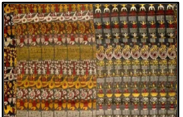
- About Vrindavani Vastra: A silk textile woven in Assam.
- It depicts the childhood stories and divine pastimes of Lord Krishna in Vrindavan, woven intricately with thread.
- Historical Background: Created under the guidance of Srimanta Sankardeva at the request of Koch king Nara Narayan, ruler of parts of modern-day Assam and West Bengal.
- Significance: The textile is a testament to Assamese weaving, blending elements from multiple artistic traditions.
- It travelled from Assam to Tibet before being acquired by the British Museum in 1904.
- The exhibit is nine and a half metres long, composed of several silk drapes, originally consisting of 15 separate pieces later assembled.
- Regarded as a masterpiece of sacred art, the Vrindavani Vastra holds a central place in Assamese Vaishnavism.
8. Green Credit: Recently, the Environment Ministry released a revised methodology for calculating
Green Credit under the Green Credit Programme.
- About Green Credit: A market-based incentive mechanism rewarding voluntary eco-friendly actions such as tree plantation, mangrove restoration, sustainable farming, water conservation, and waste management.
- Purpose of Credits: Serve as measurable rewards for positive environmental outcomes.
- Aim of the Programme: Promote voluntary participation by industries, cooperatives, and communities in ecological restoration.
- Shift focus from tree counting to ecological improvement, considering tree survival and canopy density.
- Link corporate obligations with long-term ecological benefits.
- Key Features (2025 Notification): Credit issuance: Only after 5 years, ensuring tree survival and growth.
- Canopy requirement: Minimum 40% canopy density for credit issuance.
- Conversion: 1 Green Credit = 1 surviving tree beyond 5 years.
9. Mira Variable Stars: Recently, a study led by
IUCAA (Inter-University Centre for Astronomy and Astrophysics), with Nobel laureate Adam Riess as co-author, used
Mira variable stars to measure the
Hubble constant with
7% precision.
- This research offers an independent reference for the cosmic distance ladder, potentially helping to resolve the Hubble tension.
- About Mira Variable Stars: Cool, pulsating red giant stars whose brightness varies regularly due to expansion and contraction of their outer layers.
- Discovery: The prototype, Mira (Omicron Ceti), was first identified as variable in 1596 by David Fabricius. Further studied in the 17th century, becoming the first recognized variable star.
- Key Features: Brightness variation period: 100–1,000 days.
- Surface temperature: ~3,000 K (~half of the Sun’s surface).
- Evolutionary stage: Late stage of stellar life (dying giant stars).
- Period–luminosity relationship: Strong correlation, similar to Cepheid variables.
- Oxygen-rich types: Less affected by metallicity, providing cleaner luminosity calibration for distance measurement.
10. Coral Microatolls: Recently, a study on
coral microatolls in the Maldives revealed that sea levels in the central Indian Ocean have been rising.
- Using coral microatolls and uranium dating, researchers were able to obtain precise long-term records of these changes.
- Key Findings: Sea-level acceleration began in the 1950s, earlier than the previously assumed 1990s.
- Coral growth bands and interruptions reveal effects of El Niño, Indian Ocean Dipole (IOD), and lunar cycles.
- Central Indian Ocean shows earlier and faster sea-level rise compared to coastal areas, due to regional oceanic factors.
- Microatolls are corals that are alive at the edges but have flat, dead tops. They usually grow in shallow water areas like reef flats and lagoons.
- They are important natural indicators of sea-level changes over long periods.


 theIASHub | 01 Sep, 2025








 Detailed Solutions & Explanations

