20th August 2025
- Saltwater Crocodile: Recently, a survey by the West Bengal Forest Department revealed that the population of saltwater crocodiles, among the world’s largest reptiles, has been steadily increasing in the Sundarban Biosphere Reserve (SBR).
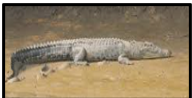
- About: The largest living reptile and the biggest of all crocodilian species. Males grow much larger than females, which usually reach a maximum length of 2.5–3 m.
- Adaptability & Habitat: These crocodiles can tolerate saline water and are commonly found in coastal areas, estuaries, and mangrove swamps, though they also inhabit freshwater rivers and wetlands.
- Communication: They produce a range of vocalizations, including barks, hisses, growls, and chirps, for communication.
- Distribution: They occur across tropical and warm temperate regions, particularly in the eastern Indian Ocean and western Pacific Ocean.
- Diet & Hunting: Juveniles: Feed mainly on insects, amphibians, reptiles, crustaceans, and small fish.
- Adults: Prey on crabs, turtles, snakes, birds, buffalo, wild boar, and monkeys.
- They typically kill with a powerful jaw snap and drag prey underwater to consume it.
- Conservation Status: IUCN Red List: Least Concern
- Wildlife Protection Act, 1972 (India): Schedule I
- CITES: Appendix I/II
- Anna-Chakra Initiative: Recently, the Union Minister of State for Consumer Affairs, Food and Public Distribution shared details about the Anna-Chakra initiative.
o Working: Uses advanced algorithms to map optimal routes for foodgrain movement across supply chain nodes.
o Covers: 4.37 lakh Fair Price Shops (FPSs) and around 6,700 warehouses linked to PDS.
o Developed an inter-state route optimization tool for PDS movement.
o Integrated with: FOIS (Freight Operations Information System) portal of Railways via ULIP (Unified Logistics Interface Platform) and PM Gati Shakti platform (which now maps geo-locations of FPSs and warehouses).
o Advantages: Enhances speed and efficiency of PDS—the world’s largest food security program serving 81 crore beneficiaries.
- Lower fuel consumption & logistics cost
- Reduced time in transportation
- Environmental benefits through reduced carbon emissions.
- Rubella: Recently, the World Health Organization (WHO) declared that Nepal has eliminated rubella as a public health problem.
- About Rubella: A highly contagious viral infection known for its distinctive red rash.
- Also called German measles or three-day measles.
- Caused by the Rubella virus (enveloped, single-stranded RNA virus).
- Not the same as measles: Different virus than measles.
-Less infectious and generally less severe than measles.
- Transmission: Spread through coughing, sneezing, or touching contaminated surfaces.
- Can spread from mother to fetus during pregnancy.
- Individuals can be contagious even without symptoms.
- Symptoms: Characteristic rash: starts on face/behind ears → spreads to neck and body.
- Rash usually appears 2–3 weeks after infection.
- Serious risk in pregnancy: 90% chance of fetal infection if mother is infected in early pregnancy. May lead to fetal death or Congenital Rubella Syndrome (CRS).
- Prevention: Measles-Mumps-Rubella (MMR) vaccine: safe and highly effective.
- Framework To Remove PM, CM Etc: Recently, the Union Home Minister announced plans to introduce three key bills in the Lok Sabha .These bills aim to establish a legal framework for the removal of top political executives, including the Prime Minister, Union Ministers, Chief Ministers, and Ministers in States and Union Territories, if they are arrested and detained on serious criminal charges.
- Conditions for Removal: As per the draft provisions:
- Any Prime Minister, Chief Minister, or Minister (Union, State, or UT) arrested and detained for 30 consecutive days in connection with an offence punishable with imprisonment of five years or more shall be removed from office on the 31st day.
- The removal will be executed by: President – in case of the Prime Minister and Union Ministers.
- Governor – in case of Chief Ministers of States.
- Chief Minister – in case of State Ministers.
- Lieutenant-Governor – for Chief Ministers in Union Territories.
- The provision also allows such leaders to be reappointed once released from custody.
- Sahariya Tribe: Recently, a genetic study revealed a possible genetic link behind the unusually high incidence of tuberculosis (TB) among the Sahariya tribe of central India.
o Culture: Known for Saharia Swang dance performed during Holi. Accompanied by dhol, nagari, and matki. Features a male performer dressed as a female, dancing around other male performers.
o Depend on forest produce, small-scale cultivation, and landless labor.
- Water-Scarce Districts: Recently, the Government identified 193 districts as over-exploited, critical, or semi-critical in terms of groundwater resources.
- About Water-Scarce Districts: Areas where groundwater extraction exceeds recharge or water availability is critically low.
- Classified by Central Ground Water Board (CGWB) into:
- Over-exploited: 102 districts
- Critical: 22 districts
- Semi-critical: 69 districts
- Trends in India: Rising Stress: Growing urbanisation, agriculture, and industrial use deepening water scarcity.
- Geographic Hotspots: Highest stress seen in Punjab, Haryana, Rajasthan, Tamil Nadu, and Karnataka.
- Medical Application Portal: Recently, the National Accreditation Board for Testing and Calibration Laboratories (NABL), under the Quality Council of India (QCI), launched a new Medical Application Portal. The portal is designed for laboratories applying under ISO 15189:2022 standards.
- Key Features: Reimagined digital platform aligned with real-world medical lab operations.
- Streamlined application process with: Restructured application flow
- Standardized templates
- Pre-registration checklist
- Intuitive interface
- Multi-user access with distinct roles → improves accountability & oversight.
- Reduced timelines: Tasks earlier taking weeks/months can now be done in 2–3 hours.
- Significance: Enhances ease, efficiency, and transparency in accreditation.
- Disruptive reform in India’s healthcare quality ecosystem.
- Supports ease of doing business for medical laboratories.
- Strengthens India’s quality assurance framework in healthcare services.
- Expected to benefit hundreds of medical laboratories across India.
- UN High Commissioner for Refugees: Recently, the UN High Commissioner for Refugees (UNHCR) suspended the repatriation of Sri Lankan Tamil refugees from India. The decision came after some returnees were arrested in Sri Lanka for alleged immigration law violations.
- About UNHCR: A UN agency responsible for protecting and supporting: Refugees, Stateless persons and internally displaced people (IDPs)
- Promotes durable solutions: Voluntary repatriation, Local integration and Resettlement in third countries
- Establishment: Created in 1950 by the UN General Assembly, post-World War II. Began operations in 1951, initially with a 3-year mandate (later made permanent).
- Leadership: Headed by the UN High Commissioner for Refugees, elected by the UN General Assembly.
- Functions & Powers: Protection of Refugees → Enforces non-refoulement (no forced return to danger).
- Humanitarian Assistance → Shelter, food, healthcare, education.
- Repatriation & Resettlement → Supports voluntary return or third-country resettlement.
- Advocacy → Works with governments to frame refugee rights & asylum policies.
- Statelessness Reduction → leads global efforts to eliminate statelessness.
- Thattekad Bird Sanctuary: Recently, a comprehensive faunal survey at Thattekad Bird Sanctuary in Ernakulam, Kerala, added nine new species records to its official biodiversity checklist.
- About Thattekad Bird Sanctuary: Location: On the banks of Periyar River, Ernakulam district, Kerala.
- First Bird Sanctuary of Kerala → notified in 1983.
- Also Known As: Salim Ali Bird Sanctuary (named after India’s “Birdman” Dr. Salim Ali, who had recommended its establishment).
- Geography: Spread across the foothills of the Western Ghats.
- Major peaks: Thoppimudi and Nyayapillimudi.
- Habitats: Periyar River, lagoons, marshes (formed by Bhootathankettu dam reservoir), tropical forests.
- Major Flora: Myristica dactyloides, Hopea parviflora, Tetrameles nudiflora, Teak, Rosewood, Mahogany etc.
- Fauna: Ceylon Frogmouth, Black Baza, Oriental Dwarf Kingfisher, Bay Owl etc
- Other Faunal Diversity: Mammals, reptiles, amphibians, and insects also recorded, making it a rich biodiversity hub of the Western Ghats.


 theIASHub | 20 Aug, 2025









 Detailed Solutions & Explanations

