The British Conquest of India and European Expansion in South India: Trade, Policies, and Colonial Rivalries

Explore how trade transformed into territorial conquest during the British Conquest of India and wider European expansion in South India. Understand key policies like the Doctrine of Lapse and how the spice trade, strategic ports, and political rivalries shaped colonial dominance in South India.

THEIASHUB
Get an Instant Call Back from Our Expert Mentors Now!
+91

The British Conquest of India: From Trade to Colonial Domination

The British conquest of India marks a pivotal period in Indian history, characterized by the gradual expansion of British influence and control over Indian territories from the early 17th century until independence in 1947.
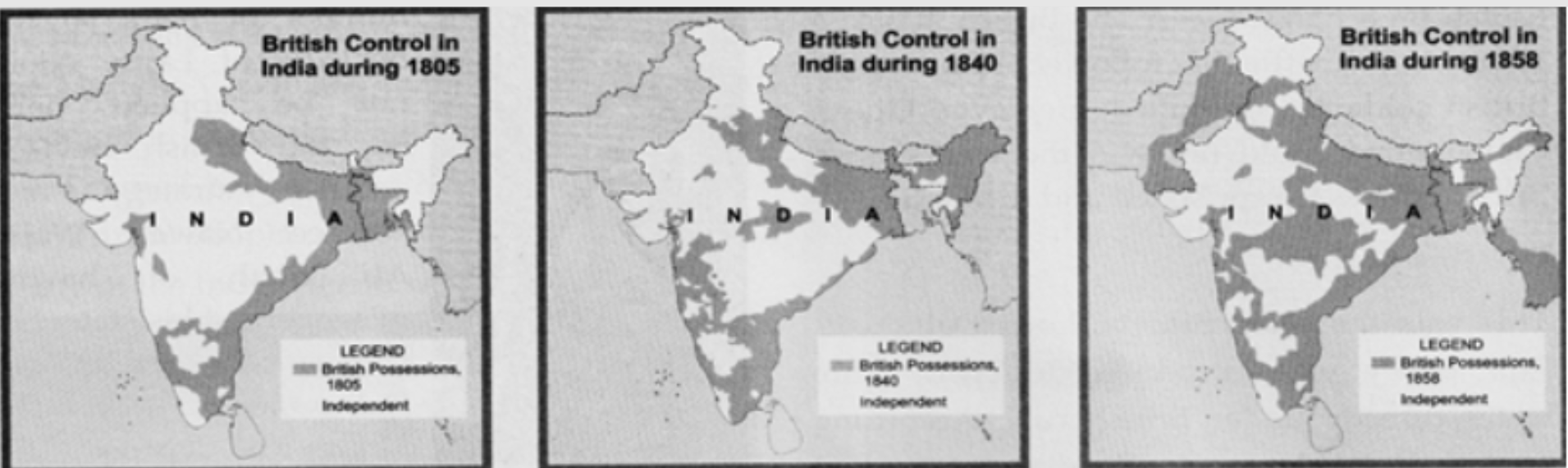
  • Beginning with the establishment of the East India Company's trading posts, the conquest evolved into a process of political and military dominance, driven by strategic alliances, economic exploitation, and eventual direct colonial rule.

British Expansionary Policies: Strategies of Annexation and Control in India

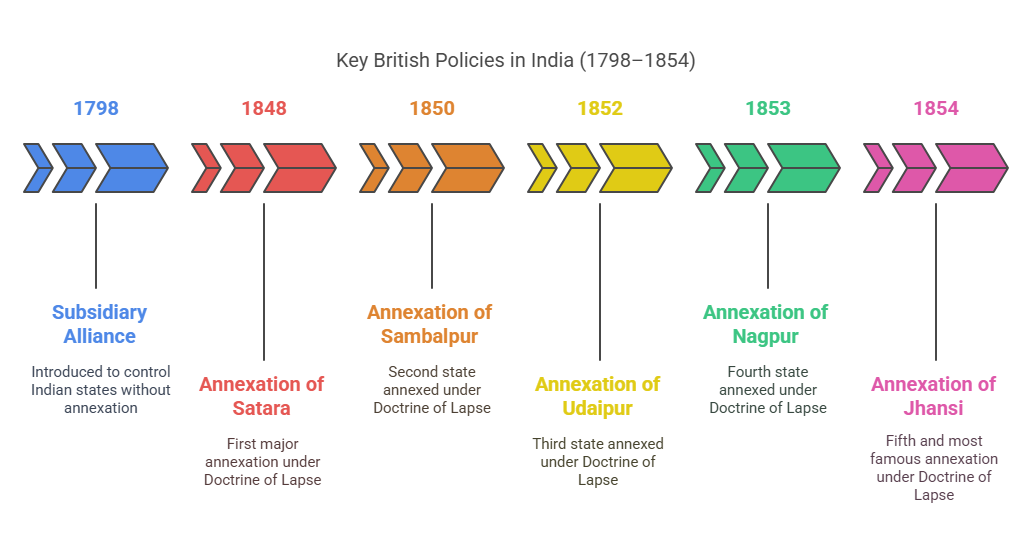
  • Doctrine of Lapse: Introduced by Lord Dalhousie, it allowed the British to annex Indian princely states if they lacked a natural heir.
  • Satara (1848), Sambalpur (1850), Udaipur (1852), Nagpur (1853), and Jhansi (1854).
  • Ring Fence Policy: As part of the British Conquest of India, Warren Hastings implemented the ring fence policy to create buffer zones around Company territories, requiring neighbouring states to maintain subsidiary forces under Company control. 
  • Subsidiary Alliance System: Implemented to control Indian states without direct annexation, exemplified by the treaties with Hyderabad and Mysore.
  • Policy of Paramountcy: During the British Conquest of India, empowered the East India Company to annex or threaten annexation of any princely state, influencing subsequent policies.
  • Land Revenue System: The British imposed a system that led to exploitative taxation, exemplified by the Permanent Settlement of Bengal.


British Expansion in India: Accidental or Intentional Conquest?

ASPECTS

ACCIDENTAL

INCIDENTAL

Initial Arrival

For trade purposes, with no initial intent for conquest.

Arrived for trade, incidentally engaged in territorial conflicts.

Early Actions

Drawn into conflicts by the chaotic Indian political landscape.

Involvement in politics grew as a byproduct of trade interests.

Nature of East India Company

Politically neutral, no initial expansion plans.

Initially neutral, later their involvement in politics grew incidentally.

Motivation

Reluctant acquisition to secure commercial interests.

Expansion was a byproduct of securing and promoting trade.

Wars and Conflicts

Engaged reluctantly to protect trade.

Conflicts arose incidentally from involvement in local politics.

Imperial Policies (1798-1818)

Reacting to external threats like France and Russia.

Expansionist policies developed from geopolitical needs.


European Expansion in South India: Trade, Spices, and Colonial Rivalries

The strategic location, rich spice trade, and minimal Mughal influence made South India a prime target for European Expansion in South India, as European powers sought trade dominance and colonial expansion. Among these powers, the British played a leading role through the British Conquest of India, which gradually extended their control from trading posts to full colonial rule across the subcontinent, including key regions in the south.
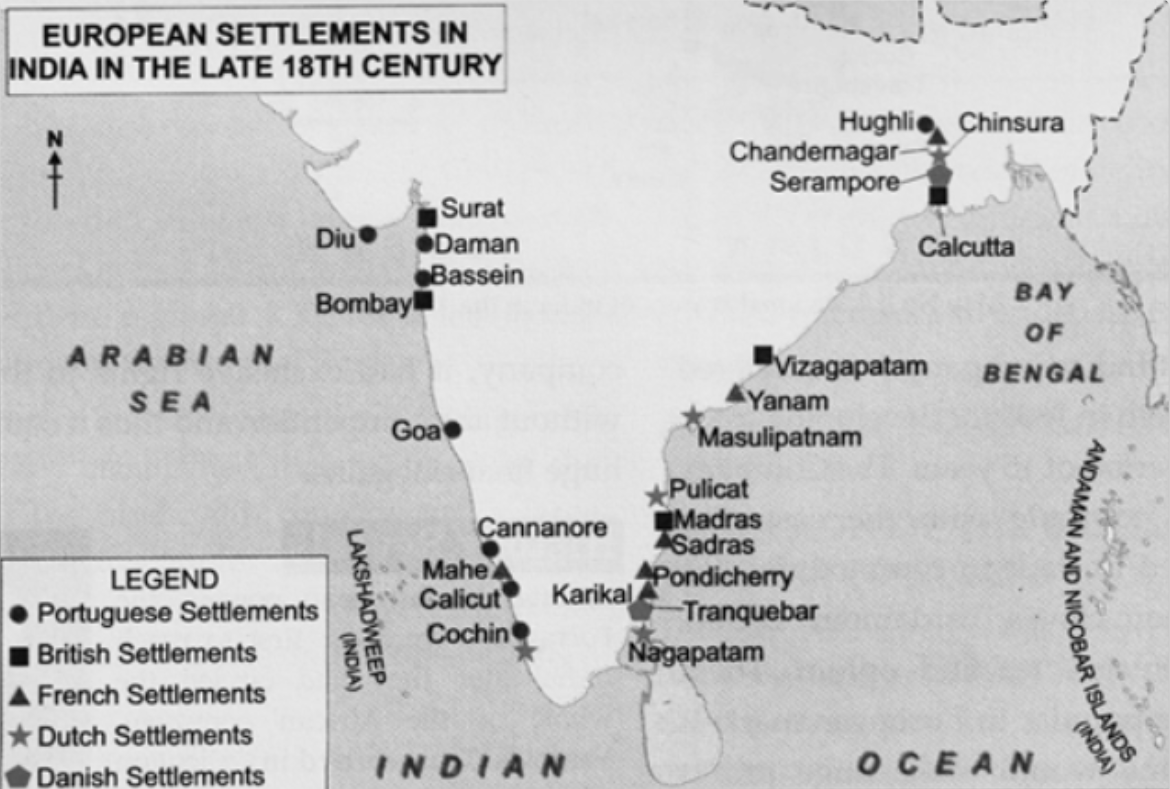

  • Trade and Commerce: South India's strategic coastal locations provided lucrative trade routes with Europe, attracting European powers.
  • Discovery of the Cape of Good Hope Sea route by Vasco da Gama in 1498.
  • Access to Spice Trade: The region's abundant spices like pepper, cinnamon, and cardamom were highly sought after in Europe, driving colonial interest. 
  • Strategic Importance: South India's ports provided convenient bases for naval operations and control over maritime trade routes.

Among these powers, the British eventually played the dominant role through the British Conquest of India, transitioning from trade to territorial control, especially in South India.


  • Cultural Exchange: Europeans were drawn to the rich cultural heritage, architecture, and intellectual centres in cities like Madras and Goa.
  • Political Rivalries: European powers established bases to compete with each other for European Expansion in South India through territorial expansion and influence in the region.
  • Natural Resources: The presence of natural resources such as timber, textiles, and minerals in South India attracted European exploitation and colonization efforts.
  • Less Mughal Influence: South India experienced less influence from the dominant Mughal Empire, providing a relatively easier environment for European Expansion in South India.

KEY FACTS

  • Portuguese trading settlements at Cochin, Goa, Daman and Diu, Salsette and Bassein and Bombay. 
  • The British established their first factory outside the Mughal empire in 1611 at Masulipattam, which was followed by Madras (1639) and Hooghly (1651).
  • The first Dutch factory was established at Masulipattam in 1605.

Stages of Colonialism in India: Economic and Political Impact (1757–1900s)

Each stage reflects a distinct phase of British economic strategy in India, marked by changing objectives, policies, and their impact on Indian society and economy.

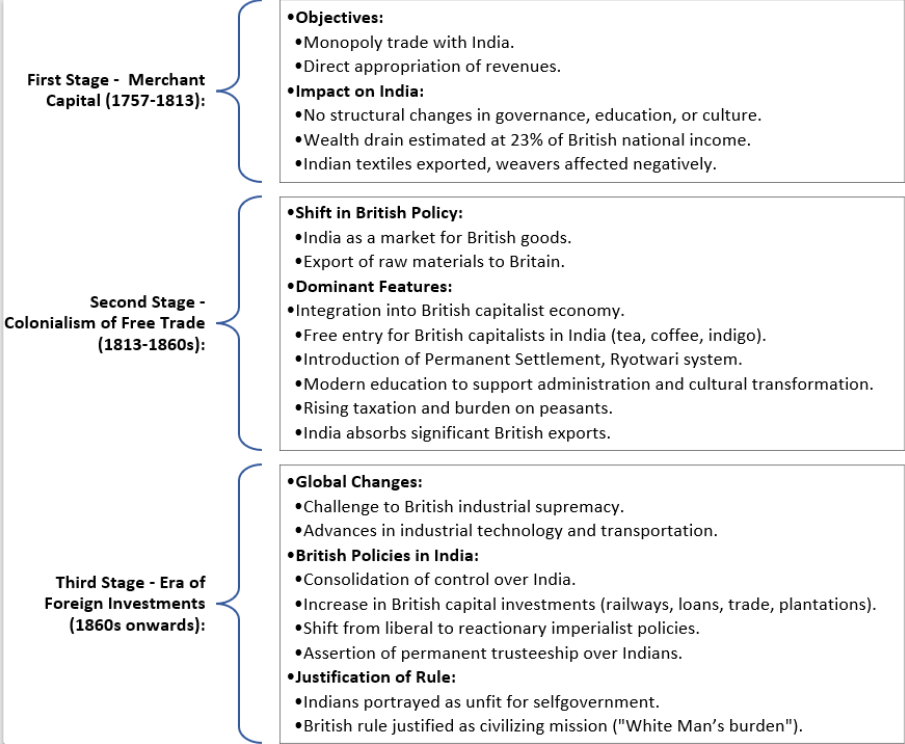
First Stage – Merchant Capital (1757–1813)

Objectives

  • Monopoly trade with India.
  • Direct appropriation of revenues.

Impact on India

  • No structural changes in governance, education, or culture.
  • Wealth drain estimated at 23% of British national income.
  • Indian textiles exported, weavers affected negatively.

Second Stage – Colonialism of Free Trade (1813–1860s)

Shift in British Policy

  • India as a market for British goods.
  • Export of raw materials to Britain.

Dominant Features

  • Integration into British capitalist economy.
  • Free entry for British capitalists in India (tea, coffee, indigo).
  • Introduction of Permanent Settlement, Ryotwari system.
  • Modern education to support administration and cultural transformation.
  • Rising taxation and burden on peasants.
  • India absorbs significant British exports.

Third Stage – Era of Foreign Investments (1860s onwards)

 Global Changes

  • Challenge to British industrial supremacy.
  • Advances in industrial technology and transportation.

British Policies in India

  • Consolidation of control over India.
  • Increase in British capital investments (railways, loans, trade, plantations).
  • Shift from liberal to reactionary imperialist policies.
  • Assertion of permanent trusteeship over Indians.

Justification of Rule

  • Indians are portrayed as unfit for self-government.
  • British rule was justified as a civilizing mission ("White Man’s burden").


UPSC QEP 2026 Batch 5 - English
Buy now View Details
Submit Your Details to Learn More
I agree to give my consent to receive updates through SMS/Email & WhatsApp*.

NEEV GS + CSAT Foundation 2026/27
Buy now View Details


Join theIAShub’s Mains Answer Writing Program

Refine your answer writing skills and elevate your UPSC preparation with personalized support and expert feedback.

Fill out the form to get started with the program or any other enquiries !

I agree to give my consent to receive updates through SMS/Email & WhatsApp*.

Best IAS Coaching In Delhi, UPSC Online & Offline Classes by IAShub

Are you dreaming of becoming an IAS officer? Then, IAShub can be your best guide. It is one of the Best IAS Coaching in Delhi. Many students who want to clear the UPSC exam join IAShub for learning. The institute gives both online and offline classes. Their teachers are experienced and helpful. They easily explain every topic. Students also get notes, tests, and tips to do well in the exam.

UPSC Online Classes by IAShub

IAShub is in Delhi and is trusted by many UPSC students. It offers coaching for every part of the UPSC exam – Prelims, Mains, and Interview. The classes are simple and easy to understand. The teachers are experts and guide students in the right way. IAShub is also known for its helpful notes, test series, and answer-writing practice. IAShub is the best coaching in Delhi and also gives UPSC Online Classes. This helps students from any place in India to learn. The online classes are live and also recorded. So, students can watch them anytime. These classes cover the full UPSC syllabus.

Key Offerings Provided by IAShub

Here are some important services provided by IAShub:

  • UPSC Prelims: IAShub teaches for Prelims with a focus on basics. It also gives daily current affairs and monthly magazines.
  • Classroom Courses: IAShub has classroom learning for students in Delhi. The environment is good and peaceful for study.
  • Live Classes: Students who live far can join live UPSC online classes. These classes are just like real classes.
  • QEP for Mains: The Quality Enrichment Program (QEP) is special for Mains preparation. It helps students write better and faster.
  • Answer Writing: Regular answer writing practice is given. Teachers also check answers and give tips to improve.
  • Free Resource: IAShub gives free notes by toppers and helpful Main Booster material.
  • Test Series: Test series are available for every subject. These help students know their weak points and improve.
  • Interview Guidance Session: IAShub also gives interview practice sessions with experts. These help students feel confident.

UPSC Exam Overview

The UPSC Civil Services Exam has three parts:

  • Prelims: It has two papers: General Studies and CSAT.
  • Mains: It has nine papers, including essays and optional subjects.
  • Interview: It tests the personality and confidence of the student.

This exam is tough, but with the right guidance, it becomes easy to manage. Students must study smart and stay regular.

How IAShub Helps in the UPSC Journey

IAShub supports students from the beginning to the end. It gives the right books, tests, and notes. The classes are easy to follow, and the teachers are always ready to help. Students get personal doubt sessions too. The test series and answer checking help students learn where they need to do better. Also, free study materials save time and money.
IAShub also guides students during the final stage – the interview. Experts take mock interviews and give useful tips. This full support makes IAShub one of the best IAS coaching in Delhi.

Best IAS Coaching In Delhi FAQs

Yes, IAShub offers live and recorded online classes. Students can attend from any part of India.

Classes are available in both English and Hindi, so students can choose the language they are comfortable with.

The classroom centre is located in Delhi. Students can visit and join offline batches there.

IAShub gives interview guidance sessions to help students prepare for the final round of UPSC.