Social and Religious Reform Movements in 19th Century India

Explore the 19th-century social and religious reform movements in India, their impact on society, and the key reformist and revivalist movements that shaped modern India.

THEIASHUB
Get an Instant Call Back from Our Expert Mentors Now!
+91

The 19th-century social and religious reform movements in India have had lasting significance, influencing subsequent generations. These movements aimed at social reform and religious revival, addressing widespread superstitions and social obscurantism in India.

Emergence and Causes of Social and Religious Reform Movements in 19th Century India

Reasons for Development:

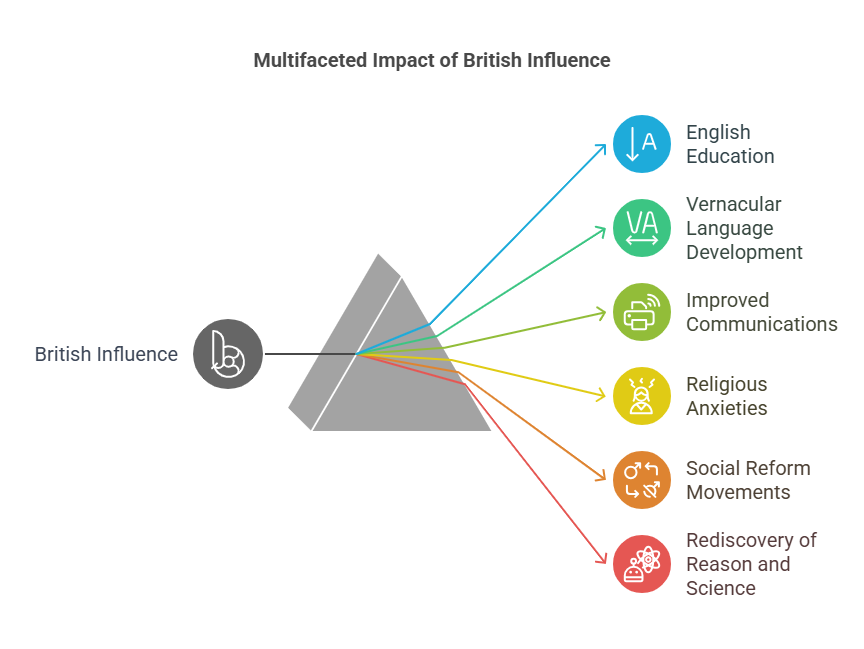
  • Dissemination of English education among the high castes.
  • Development of vernacular languages.
  • Improved communications, and expansion of print culture.
  • Fears of conversions to Christianity: Christian missionaries were entering the sphere of service like education, hospitals, orphanages and schools in a significant way, creating further anxieties among Hindus.
  • There was a need felt by Hindu social reformers to seek changes in Hindu customs and British policies.
  • Social and Religious Reform Movements emerged as reformers further wished to eliminate social evils and certain ‘unreasonable’ and ‘wrong’ religious beliefs from within, leading to an age of definition and redefinition of religion.
  • These reforms represented a contest for moral authority and were a response of Hindu men and women to foreign presence.
  • A want to rediscover reason and science in their civilization, and to produce a modernized world within the cultural space defined by Indian tradition.


Emergence of Social and Religious Reform Movements

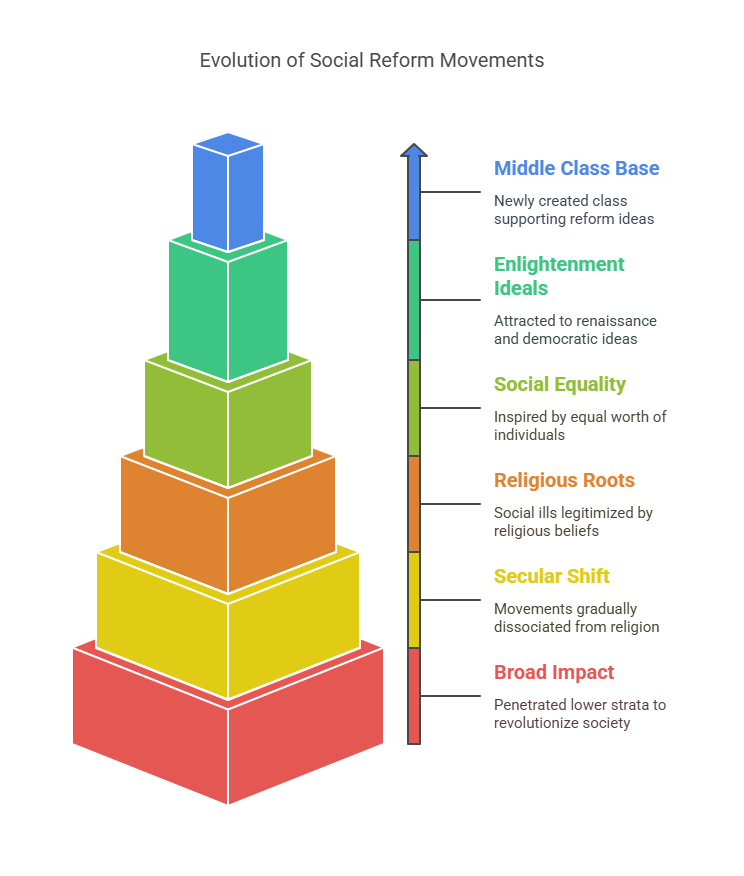
  • The newly created middle class and the educated intellectuals provided the base for these Social and Religious Reform Movements.
  • This class was attracted to the new ideas of renaissance, reformation, enlightenment, and democratic revolution or reform.
  • The ideals of social equality and the equal worth of all individuals which inspired the newly educated middle class influenced the field of Social and Religious Reform Movements in a major way.
  • The social reform movements were linked to the religious reforms primarily because nearly all social ills like untouchability and gender-based inequity derived legitimacy from religion in one way or the other.
  • In later years, though, these Social and Religious Reform Movements gradually dissociated themselves from religion and adopted a secular approach.
  • With time, from having a narrow base, these social reform movements penetrated the lower strata of society to revolutionize and reconstruct the social sphere.
  • Reformers like Raja Ram Mohan Roy, Ishwar Chandra Vidyasagar, and Swami Vivekananda were influenced by Western ideas and worked towards integrating them with Indian traditions.


Reformist and Revivalist Approaches in Social and Religious Reform Movements

The reform movements could broadly be classified into two categories: Reformist movements and Revivalist movements.

Aspects

Reformist

Revivalist

Philosophical Basis

Relied more on reason and rationalism in accepting or rejecting customs

Relied on the lost purity of religion they sought to reform

Goal

Aimed at modernization, not Westernization, while embracing modern ideas

Demonstrated that ancient Indian socio-cultural ideas were progressive and rationalist

Examples

Brahmo Samaj, Aligarh movement

Arya Samaj movement, Deoband movement, Wahabi Movement

Social Impact

Sought to reform and modernize social customs and religious practices

Sought to revive and purify religious traditions


Examples of Revivalists

  • Dharma Sabha: Founded by Pandit Radha Kanta Deb in the first half of the 19th century. Opposed Western education and the abolition of Sati and was against the reformist agenda of Raja Ram Mohan Roy.
  • Arya Samaj: Found by Swami Dayanand Saraswati in 1875 in Bombay. Led Hindu revivalism but criticized Puranic evils like polytheism, idol, worship, superstitious beliefs, etc.

Revivalism among Muslims:

Wahabi movement:
  • Founder- Syed Ahmed of Bareilly.
  • Emphasized the puritan reconstruction of Islam and the right of every individual to read and interpret religious texts.
Faraizi movement:
  • Started by Haji Shariatullah in 1819.
  • Aimed to prevent unIslamic behavior and encourage Muslims in Eastern Bengal to fulfill their religious obligations. 
Deoband Movement:
  • Launched by Muhammad Qasim Nanotavi and Rashid Ahmad Gangohi in 1866.
  • Focused on preserving the spirit of jihad against foreign rulers and disseminating the clear teachings of the Quran and Hadith among Muslims.

Reformist:

  • Neither favored a blind revival of the past, nor the blind imitation of the West.
  • Impressed by modern values like humanism, rationalism, and liberalism.

Reformism among Hindus:

    • Educational reforms: Ishwar Chandra Vidyasagar opened 36 schools for girls and introduced modern education at Sanskrit College in Bengal.
Social religious reforms: 
  • Brahmo Samaj: Founded by Raja Ram Mohan Roy in 1828, advocated monotheism, rejected idol worship, and promoted social reforms.
Religious modernism: 
      • Organizations like the Ramakrishna Mission combined traditional Hindu knowledge with modern curriculum through educational institutions
Women's rights and empowerment: 
    • Prarthana Samaj: Founded by Atmaram Pandurang in Bombay in 1867, focused on social reform, education, and women’s rights.

Reformism among Muslims:

  • Educational Reform: Establishment of institutions like Aligarh Muslim University by Sir Syed Ahmed Khan to provide Western and scientific education alongside Islamic teachings.
  • Social and Religious Reform Movements: Worked towards the abolition of practices like polygamy and purdah, and advocated for progressive reinterpretation of religion.
  • Interfaith Harmony: Promoted by reformists like Sir Syed Ahmed Khan through interfaith dialogue and cultural exchanges.
  • Religious Modernism: Aimed to reconcile Islamic teachings with scientific knowledge and rationality.
  • Political Awareness: Advocated for political participation, representation, and social justice.

Overall, the reforms played a crucial role in shaping the intellectual, social, and political landscape of the country and laid the foundation for the broader nationalist movement in the early 20th century.


UPSC QEP 2026 Batch 5 - English
Buy now View Details
Submit Your Details to Learn More
I agree to give my consent to receive updates through SMS/Email & WhatsApp*.

NEEV GS + CSAT Foundation 2026/27
Buy now View Details


Join theIAShub’s Mains Answer Writing Program

Refine your answer writing skills and elevate your UPSC preparation with personalized support and expert feedback.

Fill out the form to get started with the program or any other enquiries !

I agree to give my consent to receive updates through SMS/Email & WhatsApp*.

Best IAS Coaching In Delhi, UPSC Online & Offline Classes by IAShub

Are you dreaming of becoming an IAS officer? Then, IAShub can be your best guide. It is one of the Best IAS Coaching in Delhi. Many students who want to clear the UPSC exam join IAShub for learning. The institute gives both online and offline classes. Their teachers are experienced and helpful. They easily explain every topic. Students also get notes, tests, and tips to do well in the exam.

UPSC Online Classes by IAShub

IAShub is in Delhi and is trusted by many UPSC students. It offers coaching for every part of the UPSC exam – Prelims, Mains, and Interview. The classes are simple and easy to understand. The teachers are experts and guide students in the right way. IAShub is also known for its helpful notes, test series, and answer-writing practice. IAShub is the best coaching in Delhi and also gives UPSC Online Classes. This helps students from any place in India to learn. The online classes are live and also recorded. So, students can watch them anytime. These classes cover the full UPSC syllabus.

Key Offerings Provided by IAShub

Here are some important services provided by IAShub:

  • UPSC Prelims: IAShub teaches for Prelims with a focus on basics. It also gives daily current affairs and monthly magazines.
  • Classroom Courses: IAShub has classroom learning for students in Delhi. The environment is good and peaceful for study.
  • Live Classes: Students who live far can join live UPSC online classes. These classes are just like real classes.
  • QEP for Mains: The Quality Enrichment Program (QEP) is special for Mains preparation. It helps students write better and faster.
  • Answer Writing: Regular answer writing practice is given. Teachers also check answers and give tips to improve.
  • Free Resource: IAShub gives free notes by toppers and helpful Main Booster material.
  • Test Series: Test series are available for every subject. These help students know their weak points and improve.
  • Interview Guidance Session: IAShub also gives interview practice sessions with experts. These help students feel confident.

UPSC Exam Overview

The UPSC Civil Services Exam has three parts:

  • Prelims: It has two papers: General Studies and CSAT.
  • Mains: It has nine papers, including essays and optional subjects.
  • Interview: It tests the personality and confidence of the student.

This exam is tough, but with the right guidance, it becomes easy to manage. Students must study smart and stay regular.

How IAShub Helps in the UPSC Journey

IAShub supports students from the beginning to the end. It gives the right books, tests, and notes. The classes are easy to follow, and the teachers are always ready to help. Students get personal doubt sessions too. The test series and answer checking help students learn where they need to do better. Also, free study materials save time and money.
IAShub also guides students during the final stage – the interview. Experts take mock interviews and give useful tips. This full support makes IAShub one of the best IAS coaching in Delhi.

Best IAS Coaching In Delhi FAQs

Yes, IAShub offers live and recorded online classes. Students can attend from any part of India.

Classes are available in both English and Hindi, so students can choose the language they are comfortable with.

The classroom centre is located in Delhi. Students can visit and join offline batches there.

IAShub gives interview guidance sessions to help students prepare for the final round of UPSC.