The Great Rebellion of 1857: Causes, Battles, and British Repression

Explore the Great Rebellion of 1857, its causes, key battles, and British suppression. Learn about the nationalist and colonial perspectives on India's first major uprising against British rule.

THEIASHUB
Get an Instant Call Back from Our Expert Mentors Now!
+91

A chronological overview of the 1857 Revolt, tracing its causes, key battles, heroic leaders, and brutal British suppression.
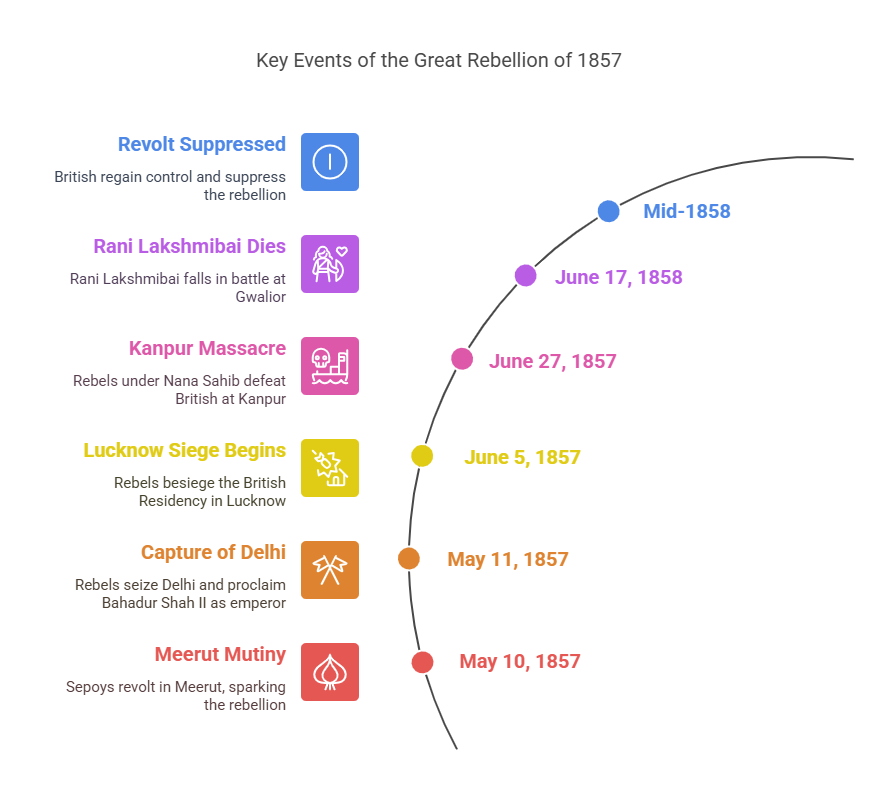
  • Meerut Mutiny and Capture of Delhi: The Great Rebellion of 1857 began on May 10, 1857, in Meerut, when sepoys refused to use the greased cartridges and were subsequently court-martialed. They revolted, killed British officers, and marched to Delhi.
  • The rebels captured Delhi and proclaimed Bahadur Shah II as the Emperor of India, symbolizing the unity of the revolt against British rule.
  • Spread of the Revolt: The Great Rebellion of 1857 spread to various parts of northern and central India, including Kanpur, Lucknow, Jhansi, and Gwalior, with local rulers and peasants joining the rebellion.
  • Prominent leaders like Rani Lakshmibai of Jhansi, Tantia Tope, and Nana Sahib emerged as key figures in the revolt.
  • Siege of British Residency in Lucknow: The British Residency in Lucknow was besieged by rebels, leading to a prolonged and bloody battle.
  • The British forces, under the command of Sir Henry Lawrence and later Sir Colin Campbell, eventually relieved the Residency, but with heavy casualties on both sides.
  • Battles and Suppression: Several key battles were fought, including the Battle of Kanpur, where Nana Sahib led the rebels, and the Battle of Gwalior, where Rani Lakshmibai fought bravely but was defeated by British forces.
  • The British gradually regained control, with superior military strength and reinforcements, and by mid-1858, the revolt was largely suppressed.
  • The Use of Military Power: The British employed massive military force to suppress the rebellion. 
  • However, they also utilized other strategies alongside military operations. 
  • Breaking Unity and Rewarding Loyalty: In regions of present-day Uttar Pradesh, where big landholders and peasants united in resistance during the Great Rebellion of 1857,  the British aimed to divide them. 
  • Promises were made to return estates to loyal landholders while dispossessing rebel landholders. 

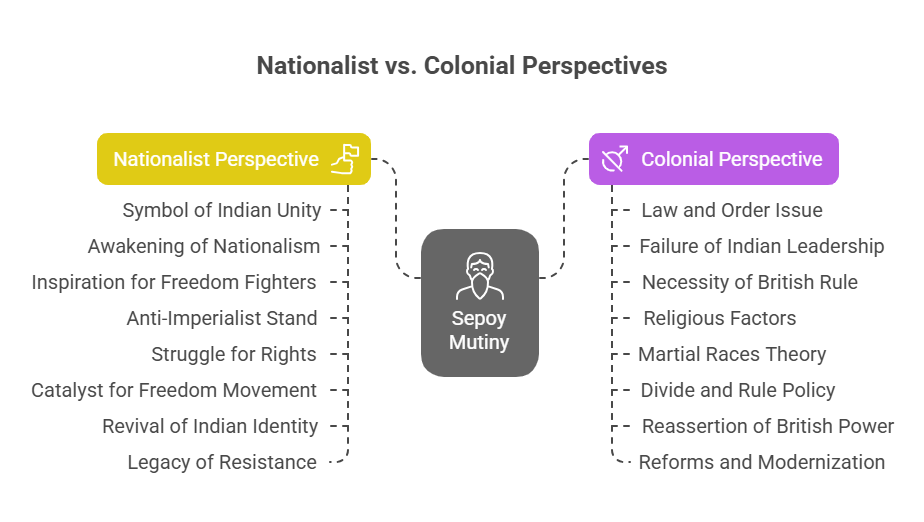
Nationalist vs. Colonial Perspectives on the Revolt of 1857

NATIONALIST PERSPECTIVE

COLONIAL PERSPECTIVE

  • Symbol of Indian Unity: Seen as a symbol of unity among Indians against British rule, transcending regional and cultural differences.
  • Sepoy Mutiny: Often referred to as the Sepoy Mutiny, portraying it as a mutiny by sepoys rather than a widespread uprising against British rule.
  • Awakening of Nationalism: Considered a key event that awakened nationalist sentiments and the desire for independence from British colonial rule.
  • Law and Order Issue: Viewed primarily as a law-and-order problem that needed to be quelled to maintain British control and stability in India.
  • Inspiration for Freedom Fighters: The leaders and participants are revered as inspirations for future freedom fighters in India's struggle for independence.
  • Failure of Indian Leadership: Portrayed Indian leaders as self-serving and incapable of providing effective leadership, emphasizing divisions within Indian society.
  • Anti-Imperialist Stand: Viewed as a strong anti-imperialist stand by Indians, highlighting their resistance against British imperialism and exploitation
  • Necessity of British Rule: Reinforced the belief in the necessity of British rule in India, portraying themselves as a civilizing force that brought order and progress.
  • Struggle for Rights: Seen as a struggle for basic rights and dignity, including the right to self-rule, which were denied under British colonial rule.
  • Religious Factors: Characterized as a result of religious fanaticism, citing the cartridge controversy as an example of irrational behavior.
  • Catalyst for Freedom Movement: Considered a catalyst for the organized freedom movement in India, leading to future movements against British rule.
  • Martial Races Theory: Strengthened the belief in the martial races theory, categorizing certain Indian communities as naturally martial and others as inherently inferior.
  • Revival of Indian Identity: It was seen as a revival and reaffirmation of Indian identity, culture, and traditions, which were suppressed under British rule.
  • Divide and Rule Policy: Used as a justification for the divide and rule policy, emphasizing the need to maintain divisions among different communities.
  • Demand for Social Reform: It raised voices against social evils like caste discrimination and widow remarriage, advocating for social reform.
  • Reassertion of British Power: Seen as a reassertion of British power and authority in India, demonstrating their ability to quell dissent.
  • Legacy of Resistance: The legacy of the revolt is seen in subsequent independence movements, serving as an inspiration for future struggles against colonialism.
  • Reforms and Modernization: Highlighted the reforms and modernization efforts that followed, portraying British rule as beneficial for India's development.


UPSC QEP 2026 Batch 5 - English
Buy now View Details
Submit Your Details to Learn More
I agree to give my consent to receive updates through SMS/Email & WhatsApp*.

NEEV GS + CSAT Foundation 2026/27
Buy now View Details


Join theIAShub’s Mains Answer Writing Program

Refine your answer writing skills and elevate your UPSC preparation with personalized support and expert feedback.

Fill out the form to get started with the program or any other enquiries !
I agree to give my consent to receive updates through SMS/Email & WhatsApp*.

Best IAS Coaching In Delhi, UPSC Online & Offline Classes by IAShub

Are you dreaming of becoming an IAS officer? Then, IAShub can be your best guide. It is one of the Best IAS Coaching in Delhi. Many students who want to clear the UPSC exam join IAShub for learning. The institute gives both online and offline classes. Their teachers are experienced and helpful. They easily explain every topic. Students also get notes, tests, and tips to do well in the exam.

UPSC Online Classes by IAShub

IAShub is in Delhi and is trusted by many UPSC students. It offers coaching for every part of the UPSC exam – Prelims, Mains, and Interview. The classes are simple and easy to understand. The teachers are experts and guide students in the right way. IAShub is also known for its helpful notes, test series, and answer-writing practice. IAShub is the best coaching in Delhi and also gives UPSC Online Classes. This helps students from any place in India to learn. The online classes are live and also recorded. So, students can watch them anytime. These classes cover the full UPSC syllabus.

Key Offerings Provided by IAShub

Here are some important services provided by IAShub:

  • UPSC Prelims: IAShub teaches for Prelims with a focus on basics. It also gives daily current affairs and monthly magazines.
  • Classroom Courses: IAShub has classroom learning for students in Delhi. The environment is good and peaceful for study.
  • Live Classes: Students who live far can join live UPSC online classes. These classes are just like real classes.
  • QEP for Mains: The Quality Enrichment Program (QEP) is special for Mains preparation. It helps students write better and faster.
  • Answer Writing: Regular answer writing practice is given. Teachers also check answers and give tips to improve.
  • Free Resource: IAShub gives free notes by toppers and helpful Main Booster material.
  • Test Series: Test series are available for every subject. These help students know their weak points and improve.
  • Interview Guidance Session: IAShub also gives interview practice sessions with experts. These help students feel confident.

UPSC Exam Overview

The UPSC Civil Services Exam has three parts:

  • Prelims: It has two papers: General Studies and CSAT.
  • Mains: It has nine papers, including essays and optional subjects.
  • Interview: It tests the personality and confidence of the student.

This exam is tough, but with the right guidance, it becomes easy to manage. Students must study smart and stay regular.

How IAShub Helps in the UPSC Journey

IAShub supports students from the beginning to the end. It gives the right books, tests, and notes. The classes are easy to follow, and the teachers are always ready to help. Students get personal doubt sessions too. The test series and answer checking help students learn where they need to do better. Also, free study materials save time and money.
IAShub also guides students during the final stage – the interview. Experts take mock interviews and give useful tips. This full support makes IAShub one of the best IAS coaching in Delhi.

Best IAS Coaching In Delhi FAQs

Yes, IAShub offers live and recorded online classes. Students can attend from any part of India.

Classes are available in both English and Hindi, so students can choose the language they are comfortable with.

The classroom centre is located in Delhi. Students can visit and join offline batches there.

IAShub gives interview guidance sessions to help students prepare for the final round of UPSC.