End of Company Rule and British Policy Shift After 1857: Impact of Government of India Act 1858

The Government of India Act 1858 marked the end of East India Company rule and triggered major shifts in British colonial policy. Discover the political, administrative, and social transformations that followed the Revolt of 1857.

THEIASHUB
Get an Instant Call Back from Our Expert Mentors Now!
+91

Consequences of Revolt of 1857: Political, Social and Economic Changes

The Revolt of 1857 was a turning point in the colonial history of India that brought about critical political, military, and economic transformations. The rebellion may have been suppressed, but the Consequences of Revolt of 1857 heavily influenced British rule in India and planted the seeds of rebellion to come.
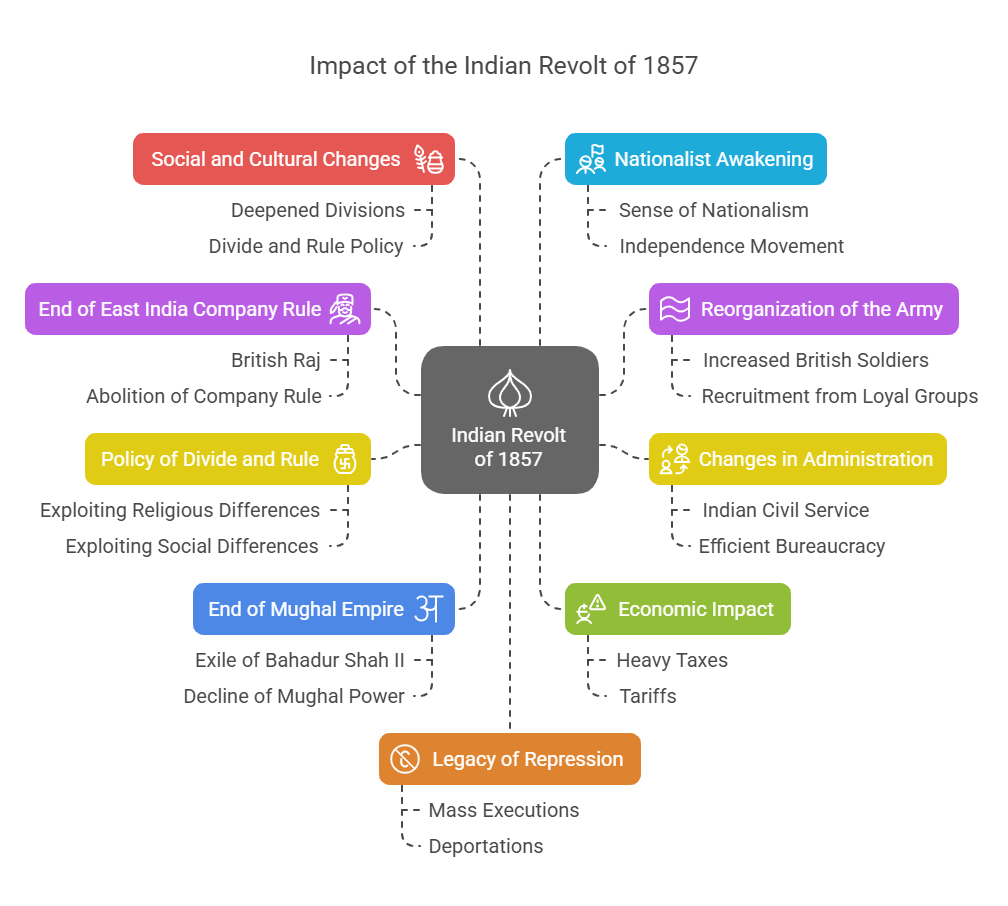
  • End of East India Company Rule: The British government took direct control of India, abolishing the rule of the East India Company and establishing the British Raj through the Government of India Act 1858, which transferred all powers to the British Crown and introduced the post of Secretary of State for India to administer Indian affairs.
  • Reorganization of the Army: The British reorganized the Indian army, increasing the ratio of British to Indian soldiers and recruiting from more loyal groups like the Sikhs and Gurkhas.
  • Changes in Administration: Administrative reforms were introduced, including the establishment of the Indian Civil Service (ICS) to ensure a more efficient and loyal bureaucracy.
  • Policy of Divide and Rule: The British adopted a policy of divide and rule, exploiting religious, social, and regional differences to prevent unity among Indians.
  • End of Mughal Empire: The revolt led to the decline of the Mughal Empire, with the British exiling the last Mughal emperor, Bahadur Shah II, after the revolt's failure.
  • Economic Impact: The revolt had economic repercussions, with the British imposing heavy taxes and tariffs to recover the costs of suppressing the revolt.
  • Social and Cultural Changes: The revolt deepened divisions between the British and Indians, leading to a policy of divide and rule by the British.
  • Nationalist Awakening: The revolt inspired a sense of nationalism among Indians, laying the groundwork for the independence movement.
  • Legacy of Repression: The British response to the revolt was harsh, resulting in mass executions and deportations, leaving a legacy of bitterness.
  • Religious Impact: The revolt strained relations between Hindus and Muslims, which the British exploited for their gain.
  • Educational Reforms: The revolt prompted the British to introduce educational reforms to create a class of loyal and educated Indians.

Impact of Government of India Act 1858

The Good Governance Act of 1858, formally known as the Government of India Act 1858, was a significant piece of legislation that marked the beginning of direct British rule in India.

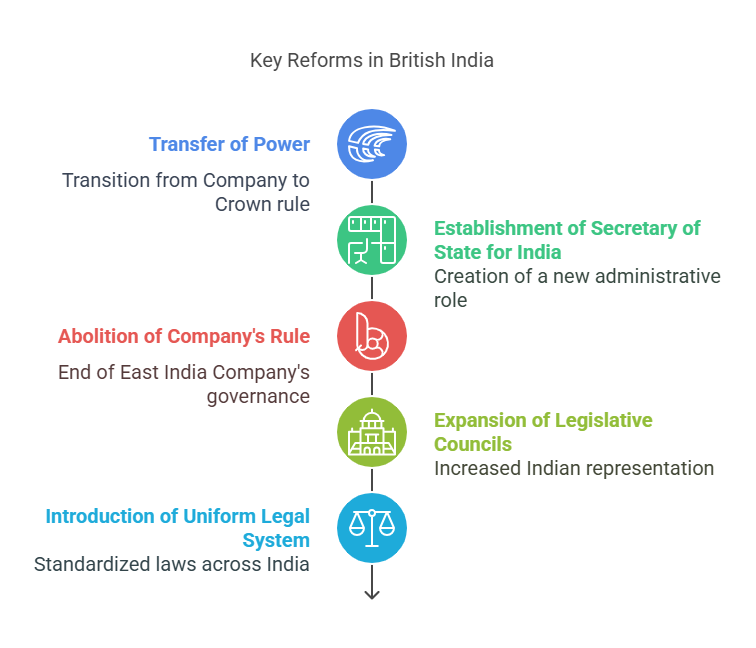
  • Transfer of Power:  The Government of India Act 1858 transferred the powers and territories held by the East India Company to the British Crown. The British government assumed direct control over India.
  • Establishment of Secretary of State for India: The Government of India Act 1858 created the position of Secretary of State for India, who was a member of the British cabinet and responsible for overseeing Indian affairs. 
  • Abolition of Company's Rule: The Government of India Act 1858 abolished the East India Company's rule and dissolved its administrative and military functions.
  • Expansion of Legislative Councils: The Government of India Act 1858 expanded the powers of the legislative councils in India, allowing for increased Indian representation and participation in the legislative process.
  • Introduction of Uniform Legal System: The Government of India Act 1858 introduced a uniform legal system in India, based on English law, to ensure consistency and fairness in the administration of justice.

Overall, the Revolt of 1857 was a significant, although unsuccessful, attempt to challenge British colonial rule. It marked a turning point in Indian history, leading to profound changes in governance through the Government of India Act 1858 and setting the stage for the eventual rise of the Indian independence movement.
Colonial Policies Before and After 1858

CRITERIA

PRE- 1858

POST-1858

Social

  • Greater intervention in social issues (e.g., abolition of Sati, support for widow remarriage)
  • Promotion of Western cultural values and norms.
  • Encouragement of social reform movements.
  • Limited interference in social and cultural practices.
  • Focus on economic exploitation rather than social reforms.

Economics

  • Exploitation of Indian resources for Company's profit.
  • Monopoly over trade and control of key commodities.
  • Heavy taxation on peasants.
  • Expansion of infrastructure (railways, telegraphs) (Imperialism)
  • Promotion of British industrial interests in India.
  • Continued exploitation of Indian resources, but with more structured economic policies.

Political

  • Indirect rule through treaties with local rulers.
  • Maintenance of a balance of power among Indian states.
  • Direct rule under the British Crown with the Viceroy as representative.
  • Reduction in the power of local rulers and princely states.
  • Introduction of councils and legislative bodies with limited Indian participation.

Religious

  • Generally non-interfering stance in religious matters.
  • Focus on maintaining stability among diverse religious groups.
  • Increase in missionary activities.
  • Policies causing occasional religious tensions (e.g., cow slaughter, missionary zeal).
  • Encouragement of religious reform movements.

Nature of Revolt of 1857: Colonial, Nationalist, and Marxist Views

Nature of the Revolt


Interpretation

Details and Scholars

Sepoy Mutiny

Sir John Seeley: Viewed as a localized military uprising without broader national support. Reflects British perspective minimizing the political aspect.

National Uprising

V.D. Savarkar: Termed it the First War of Independence, emphasizing its significance as a unified struggle against British rule.

Lack of National Character

R.C. Majumdar: Critiques the idea of it being a national revolt, pointing out limited geographical spread and participation.

Political Rebellion

S.N. Sen: Acknowledges the political motives behind the revolt, while noting its failure to encompass all Indian communities.

Diverse Views

Eric Stokes, Percival Spear: Highlighted the multifaceted nature of the revolt, from military grievances to broader societal discontent.

Feudal Reaction

Marxist Interpretation: Seen as a response by feudal elements against colonial policies threatening their traditional standings.


UPSC PREVIOUS YEAR QUESTIONS (PYQs)

  1. The 1857 Uprising was the culmination of the recurrent big and small local rebellions that had occurred in the preceding hundred years of British rule. Elucidate. (2019, 10 Marks).
  2. Explain how the Uprising of 1857 constitutes an important watershed in the evolution of British policies towards colonial India. (2016, 12.5 Marks).


UPSC QEP 2026 Batch 5 - English
Buy now View Details
Submit Your Details to Learn More
I agree to give my consent to receive updates through SMS/Email & WhatsApp*.

NEEV GS + CSAT Foundation 2026/27
Buy now View Details


Join theIAShub’s Mains Answer Writing Program

Refine your answer writing skills and elevate your UPSC preparation with personalized support and expert feedback.

Fill out the form to get started with the program or any other enquiries !

I agree to give my consent to receive updates through SMS/Email & WhatsApp*.

Best IAS Coaching In Delhi, UPSC Online & Offline Classes by IAShub

Are you dreaming of becoming an IAS officer? Then, IAShub can be your best guide. It is one of the Best IAS Coaching in Delhi. Many students who want to clear the UPSC exam join IAShub for learning. The institute gives both online and offline classes. Their teachers are experienced and helpful. They easily explain every topic. Students also get notes, tests, and tips to do well in the exam.

UPSC Online Classes by IAShub

IAShub is in Delhi and is trusted by many UPSC students. It offers coaching for every part of the UPSC exam – Prelims, Mains, and Interview. The classes are simple and easy to understand. The teachers are experts and guide students in the right way. IAShub is also known for its helpful notes, test series, and answer-writing practice. IAShub is the best coaching in Delhi and also gives UPSC Online Classes. This helps students from any place in India to learn. The online classes are live and also recorded. So, students can watch them anytime. These classes cover the full UPSC syllabus.

Key Offerings Provided by IAShub

Here are some important services provided by IAShub:

  • UPSC Prelims: IAShub teaches for Prelims with a focus on basics. It also gives daily current affairs and monthly magazines.
  • Classroom Courses: IAShub has classroom learning for students in Delhi. The environment is good and peaceful for study.
  • Live Classes: Students who live far can join live UPSC online classes. These classes are just like real classes.
  • QEP for Mains: The Quality Enrichment Program (QEP) is special for Mains preparation. It helps students write better and faster.
  • Answer Writing: Regular answer writing practice is given. Teachers also check answers and give tips to improve.
  • Free Resource: IAShub gives free notes by toppers and helpful Main Booster material.
  • Test Series: Test series are available for every subject. These help students know their weak points and improve.
  • Interview Guidance Session: IAShub also gives interview practice sessions with experts. These help students feel confident.

UPSC Exam Overview

The UPSC Civil Services Exam has three parts:

  • Prelims: It has two papers: General Studies and CSAT.
  • Mains: It has nine papers, including essays and optional subjects.
  • Interview: It tests the personality and confidence of the student.

This exam is tough, but with the right guidance, it becomes easy to manage. Students must study smart and stay regular.

How IAShub Helps in the UPSC Journey

IAShub supports students from the beginning to the end. It gives the right books, tests, and notes. The classes are easy to follow, and the teachers are always ready to help. Students get personal doubt sessions too. The test series and answer checking help students learn where they need to do better. Also, free study materials save time and money.
IAShub also guides students during the final stage – the interview. Experts take mock interviews and give useful tips. This full support makes IAShub one of the best IAS coaching in Delhi.

Best IAS Coaching In Delhi FAQs

Yes, IAShub offers live and recorded online classes. Students can attend from any part of India.

Classes are available in both English and Hindi, so students can choose the language they are comfortable with.

The classroom centre is located in Delhi. Students can visit and join offline batches there.

IAShub gives interview guidance sessions to help students prepare for the final round of UPSC.


