


Learn about the causes of World War I, key events like the assassination of Archduke Ferdinand, trench warfare, and the US entry into the global conflict.
 theIASHub | 13 Jun, 2025

The outbreak of World War I in 1914 marked one of the most significant turning points in modern history. Also known as the Great War, it involved the world's major powers and led to massive destruction, political upheaval, and the reshaping of global alliances. Understanding the causes of World War I and the key events that followed helps us grasp how a localized conflict turned into a global catastrophe.
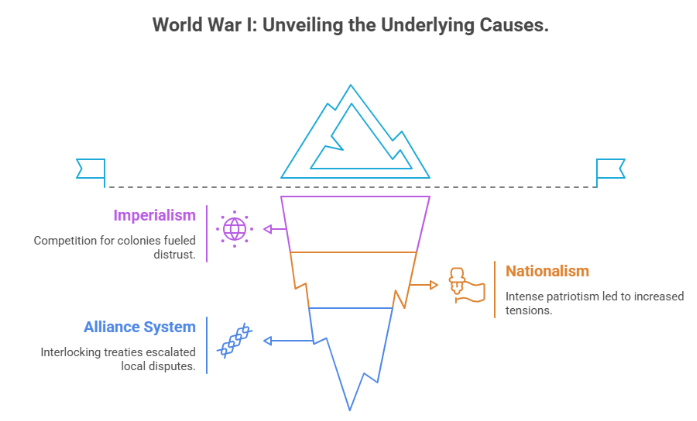
One of the underlying causes of World War I was imperialism. In the late 19th and early 20th centuries, European powers like Britain, France, Germany, and others were engaged in fierce competition for overseas colonies and resources, especially in Africa and Asia. These imperial ambitions brought the powers into frequent conflict and fueled distrust, laying the groundwork for future wars.
Nationalism was another powerful force behind World War I. Across Europe, intense patriotic feelings and a desire for national superiority led to increased tensions. Nations like Germany, France, and Britain competed for global dominance. In multi-ethnic empires such as Austria-Hungary and the Ottoman Empire, nationalist movements created internal instability. Serbian nationalism, in particular, played a direct role in triggering World War I.
By the early 20th century, Europe was divided into two major alliance systems:
These alliances were meant to maintain balance and peace but instead made war more likely. Any conflict between two countries had the potential to draw in others, making a localized dispute escalate into a global war. This interlocking system of treaties was a significant structural cause of World War I.
The period before World War I saw an unprecedented arms race, particularly between Britain and Germany. Germany sought to challenge Britain’s naval supremacy, leading to a rapid increase in battleships and military spending.
Britain, with its powerful Royal Navy, saw Germany’s naval ambitions as a direct threat. Both nations developed new weapons and strengthened their armies and navies, creating a climate of suspicion and fear. This culture of militarism made nations more willing to resort to force to resolve disputes.
On June 28, 1914, Archduke Franz Ferdinand, heir to the Austro-Hungarian throne, was assassinated in Sarajevo by Gavrilo Princip, a Bosnian Serb nationalist associated with the Black Hand group. This single act set off a chain of events that would plunge the world into World War I.
Austria-Hungary blamed Serbia for the assassination and, with Germany’s support, issued an ultimatum. When Serbia's response did not fully satisfy Austria-Hungary, they declared war, setting off a domino effect among allied nations.
The Balkan region had long been a source of tension. The Bosnian Crisis (1908) and the Balkan Wars (1912-1913) highlighted the instability in the region. The rise of nationalism among ethnic groups and the struggle for independence from empires like Austria-Hungary and the Ottoman Empire contributed to the region’s volatility. These events made the Balkans a "powder keg" of Europe, and when the Archduke was assassinated, it exploded into World War I.
Following the assassination, diplomatic attempts to resolve the crisis failed. The July Crisis of 1914 saw a series of ultimatums, mobilizations, and declarations of war. Poor communication, rigid alliances, and an unwillingness to compromise led to the breakdown of diplomacy. Within weeks, the major powers of Europe were at war, and World War I had officially begun.
The Western Front, stretching from the North Sea to Switzerland, became a symbol of the stagnation and brutality of World War I. Trench warfare led to horrific conditions and massive casualties. The Battle of the Somme and the Battle of Verdun are two of the deadliest battles in human history.
On the Eastern Front, Germany and Austria-Hungary fought against Russia. Unlike the stalemate in the West, the Eastern Front saw more movement but was equally brutal. Russia faced internal problems, eventually leading to the Russian Revolution in 1917.
World War I expanded beyond Europe. Colonial powers brought their empires into the conflict, with battles in Africa, the Middle East, and Asia. Nations like Japan joined the Allies, while colonies provided troops, labor, and resources.
Initially neutral, the United States entered the war in 1917 due to several factors:
The entry of the U.S. shifted the balance and contributed to the eventual defeat of the Central Powers.
The causes and events of World War I demonstrate how a combination of nationalism, militarism, alliances, imperialism, and failed diplomacy can lead to catastrophic global conflict. The war reshaped the world, led to the collapse of empires, and sowed the seeds for World War II. Millions lost their lives, and the political map of Europe was forever altered. Understanding the causes of World War I remains crucial to preventing future conflicts and maintaining global peace.





Refine your answer writing skills and elevate your UPSC preparation with personalized support and expert feedback.
Fill out the form to get started with the program or any other enquiries !

Are you dreaming of becoming an IAS officer? Then, IAShub can be your best guide. It is one of the Best IAS Coaching in Delhi. Many students who want to clear the UPSC exam join IAShub for learning. The institute gives both online and offline classes. Their teachers are experienced and helpful. They easily explain every topic. Students also get notes, tests, and tips to do well in the exam.
IAShub is in Delhi and is trusted by many UPSC students. It offers coaching for every part of the UPSC exam – Prelims, Mains, and Interview. The classes are simple and easy to understand. The teachers are experts and guide students in the right way. IAShub is also known for its helpful notes, test series, and answer-writing practice. IAShub is the best coaching in Delhi and also gives UPSC Online Classes. This helps students from any place in India to learn. The online classes are live and also recorded. So, students can watch them anytime. These classes cover the full UPSC syllabus.
Here are some important services provided by IAShub:
The UPSC Civil Services Exam has three parts:
This exam is tough, but with the right guidance, it becomes easy to manage. Students must study smart and stay regular.
IAShub supports students from the beginning to the end. It gives the right books, tests, and notes. The classes are easy to follow, and the teachers are always ready to help. Students get personal doubt sessions too. The test series and answer checking help students learn where they need to do better. Also, free study materials save time and money.
IAShub also guides students during the final stage – the interview. Experts take mock interviews and give useful tips. This full support makes IAShub one of the best IAS coaching in Delhi.
 Detailed Solutions & Explanations
Improve Your Answer Writing & Strategy
Detailed Solutions & Explanations
Improve Your Answer Writing & Strategy

