


The role of opposition in India is crucial for democracy. Learn about its importance, challenges, impact, and ways to strengthen political accountability.
 theIASHub | 10 May, 2025
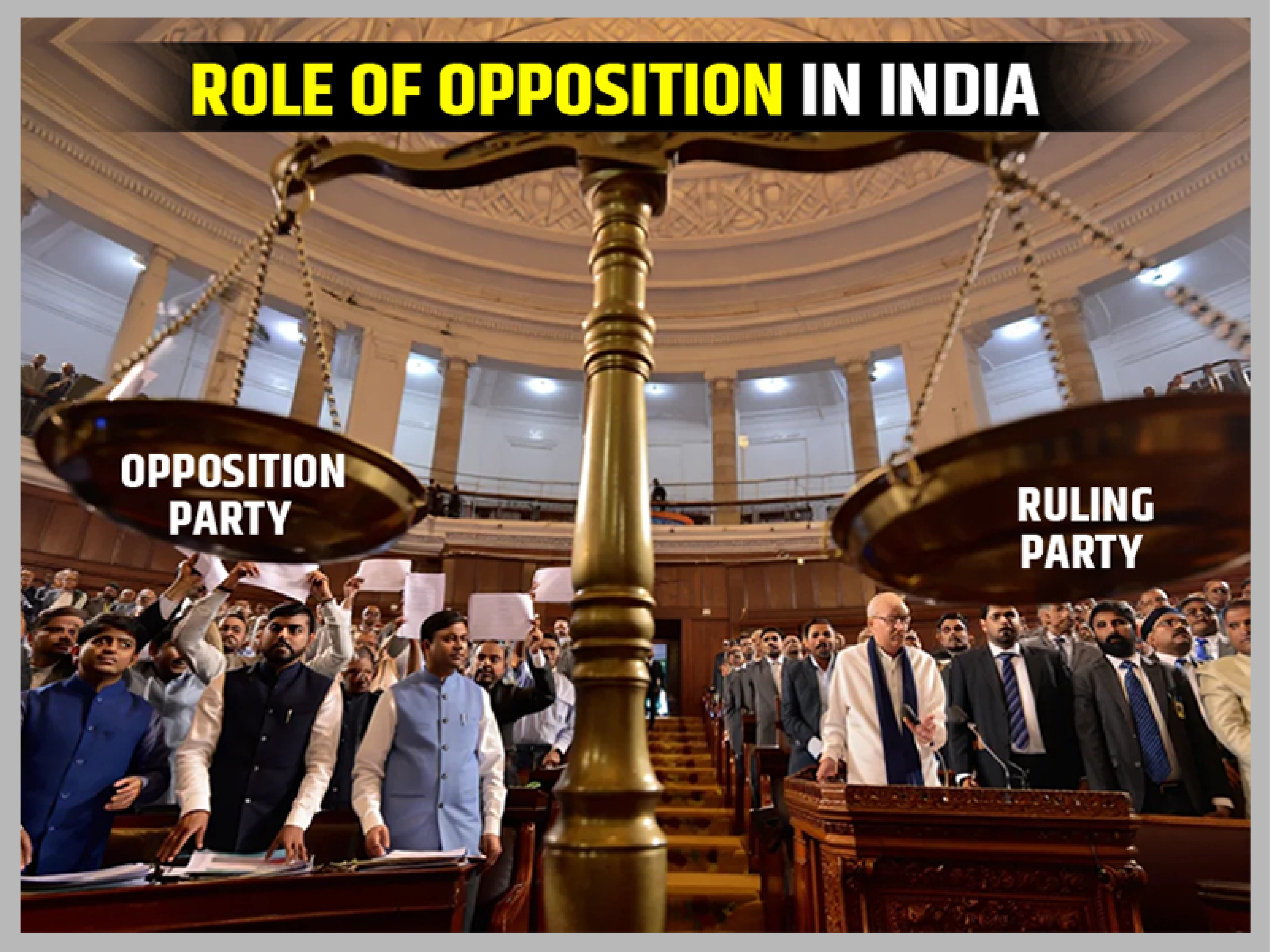

A strong opposition is essential for a vibrant democracy. It ensures accountability, transparency, and balanced governance by keeping the ruling party in check. Without a credible opposition, democracy risks turning into majoritarian rule, where the government enforces its policies unchecked. This article explores the role of opposition in India, the challenges it faces, the consequences of its weakness, and the way forward for a healthier democratic system.
The opposition critically examines government policies, expenditures, and legislative actions, ensuring transparency. For example, the removal of indexation in taxation was reversed after opposition pressure.
A responsible opposition doesn’t just oppose but also suggests better policies. This ensures a more balanced and comprehensive policy-making process.
The opposition plays a crucial role in debating and refining laws before they are passed. For instance, concerns raised over the Digital Personal Data Protection Bill, 2023, led to better discussions on privacy and data security.
A strong opposition protects minority rights and prevents discriminatory laws. The Citizenship Amendment Act (CAA), 2019, faced strong opposition as it allegedly discriminated against religious minorities.
Opposition parties prevent abuse of power and undemocratic actions. The Farm Laws, 2020, were repealed after widespread protests supported by opposition parties.
By raising critical issues like inflation, unemployment, and social justice, the opposition ensures that the government addresses real concerns affecting citizens.
In both the 16th and 17th Lok Sabha, no party qualified for the Leader of Opposition post due to the 10% seat requirement. This weakened legislative oversight and parliamentary committee representation.
The multiplicity of political parties with differing ideologies makes it difficult to present a unified front against the ruling party.
Instead of presenting new policies, the opposition often reacts to government actions without offering viable solutions.
Blind opposition to government policies, even when they are beneficial, reduces credibility and weakens public trust.
Frequent party-switching (defections) and inadequate discussion time further weaken the role of opposition in legislative matters.
Without a strong opposition, meaningful debates and discussions in Parliament decrease, leading to poor policymaking.
With fewer bills referred to committees and increased use of ordinances, governance becomes less democratic and more centralized.
A weak opposition fails to pressure the government to address issues like unemployment, inflation, and economic distress.
When the opposition fails to engage with the public, it loses grassroots support, making it ineffective in challenging the government.
Unchecked governance leads to unpopular laws and protests, as seen in the opposition-led movement against farm laws and their eventual repeal.
The opposition should focus on policy-based criticism and provide alternative solutions instead of mere opposition for political gain.
To gain mass support, opposition parties must connect with the public and work on real social and economic issues.
A modern opposition should adopt a centrist ideology that appeals to the majority and follows a decentralized party structure for better decision-making.
Encouraging internal democracy will help in nurturing strong leaders and ensuring issue-based politics.
Instead of constant confrontation, the opposition should be involved in key discussions and legislative processes to ensure better governance.
Tightening laws against political defections will ensure party stability and a more accountable opposition.
The 10% seat requirement should be revised to allow the largest opposition party to hold the Leader of Opposition post, ensuring better legislative balance.
A healthy democracy requires both a responsible government and a strong opposition. The ruling party and opposition must work together to uphold democratic values and ensure that the concerns of the people are addressed effectively. Strengthening the opposition through internal reforms, grassroots engagement, and issue-based politics will create a more accountable and transparent governance system in India.

Refine your answer writing skills and elevate your UPSC preparation with personalized support and expert feedback.
Fill out the form to get started with the program or any other enquiries !
Are you dreaming of becoming an IAS officer? Then, IAShub can be your best guide. It is one of the Best IAS Coaching in Delhi. Many students who want to clear the UPSC exam join IAShub for learning. The institute gives both online and offline classes. Their teachers are experienced and helpful. They easily explain every topic. Students also get notes, tests, and tips to do well in the exam.
IAShub is in Delhi and is trusted by many UPSC students. It offers coaching for every part of the UPSC exam – Prelims, Mains, and Interview. The classes are simple and easy to understand. The teachers are experts and guide students in the right way. IAShub is also known for its helpful notes, test series, and answer-writing practice. IAShub is the best coaching in Delhi and also gives UPSC Online Classes. This helps students from any place in India to learn. The online classes are live and also recorded. So, students can watch them anytime. These classes cover the full UPSC syllabus.
Here are some important services provided by IAShub:
The UPSC Civil Services Exam has three parts:
This exam is tough, but with the right guidance, it becomes easy to manage. Students must study smart and stay regular.
IAShub supports students from the beginning to the end. It gives the right books, tests, and notes. The classes are easy to follow, and the teachers are always ready to help. Students get personal doubt sessions too. The test series and answer checking help students learn where they need to do better. Also, free study materials save time and money.
IAShub also guides students during the final stage – the interview. Experts take mock interviews and give useful tips. This full support makes IAShub one of the best IAS coaching in Delhi.
 Detailed Solutions & Explanations
Improve Your Answer Writing & Strategy
Detailed Solutions & Explanations
Improve Your Answer Writing & Strategy

