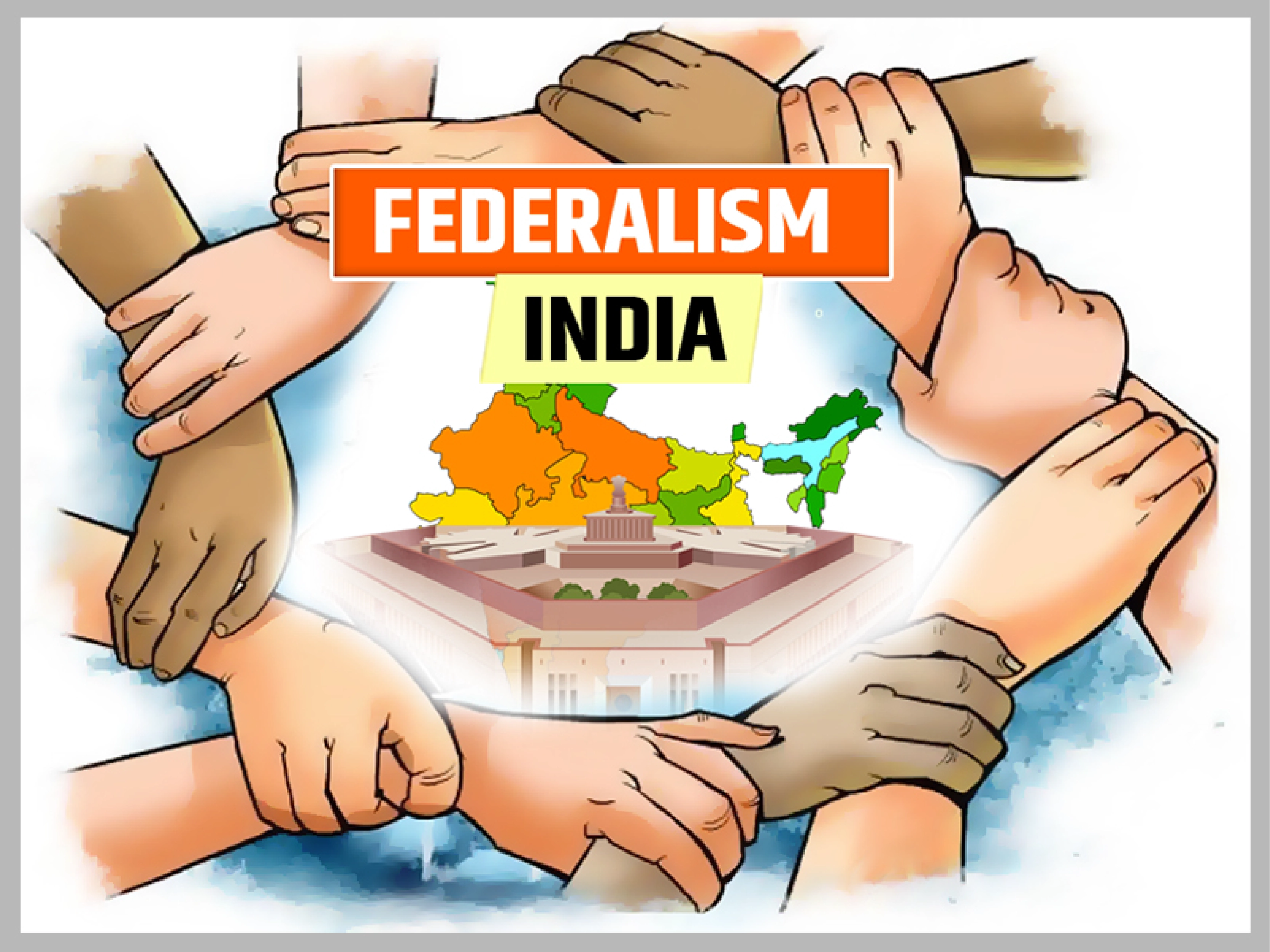
Federalism in India a Unique Blend of Unity and Autonomy

Learn about Indian Federalism, its features, challenges, and evolution. Understand the Centre-State relationship and the future of federalism in India.

THEIASHUB
Get an Instant Call Back from Our Expert Mentors Now!
+91

What is Federalism in India?

Federalism is a system of government where power is divided between a central authority and regional units (states or provinces). It ensures that governance is shared between the national government and smaller political units, allowing local autonomy while maintaining national unity.

In most federations, the central government handles national issues, such as defense and foreign affairs, while state or local governments manage matters like education, law enforcement, and local infrastructure.

Federalism in India Unique Structure

Unlike traditional federations like the United States, where states have sovereign powers, India's system is often called "quasi-federal"—a mix of federal and unitary features. The Indian Constitution does not explicitly use the term "federation" but describes India as a "Union of States" (Article 1).

Federalism in India was influenced by the Canadian model, which emphasizes a strong central government rather than the American model, where states have more autonomy.
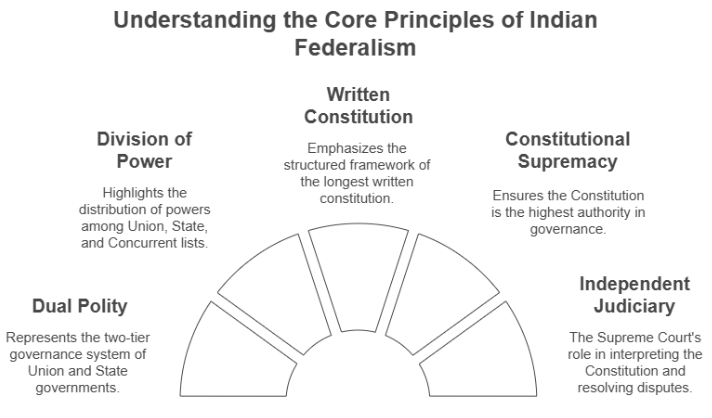
Key Features of Federalism in India


1. Federal Characteristics of India’s Constitution

Despite being quasi-federal, India exhibits several classic features of federalism:

  • Dual Polity: India has a two-tier governance system—the Union Government (Central Government) and the State Governments.
  • Division of Power: The Seventh Schedule of the Constitution divides powers between the Union List, State List, and Concurrent List.
  • Written Constitution: The Indian Constitution is the longest written constitution in the world, providing a structured framework for governance.
  • Supremacy of the Constitution: The Constitution is the highest authority, ensuring that both the Centre and States operate within constitutional limits.
  • Constitutional Rigidity: The process of amending federal provisions requires a special majority, making the Constitution relatively rigid.
  • Independent Judiciary: The Supreme Court of India acts as the final interpreter of the Constitution and resolves Centre-State disputes.
  • Bicameralism: The Indian Parliament has two houses—the Lok Sabha (House of the People) and the Rajya Sabha (Council of States)—representing both national and regional interests.

2. Unitary Features of Indian Federalism

India’s federalism has several unitary (centralized) features, which make it unique:
  • Emergency Powers: During a national, state, or financial emergency, the Centre gains overriding authority, reducing states’ autonomy.
  • All-India Services: Key administrative services (IAS, IPS, IFS) are controlled by the Central Government, ensuring uniform governance across states.
  • Parliament’s Authority Over State List: Under Article 249, Parliament can legislate on State List subjects if it is in the national interest.
  • Single Constitution: Unlike the U.S., where each state has its own constitution, India follows one uniform Constitution for the entire country.
  • Role of Governors: The Governor, appointed by the President, acts as a bridge between the Centre and the State, sometimes influencing state decisions.
  • Demos-Enabling Federalism: The Indian model ensures that a single electorate (the people of India) elects both central and state governments.

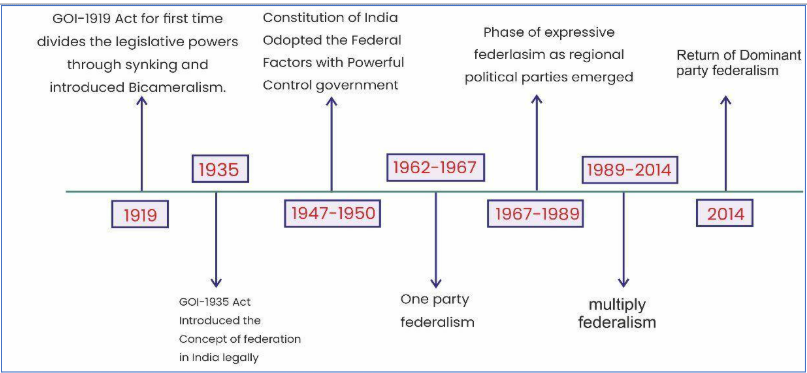
Evolution of Federalism in India


1. Pre-Independence Federalism

  • Government of India Act, 1935: Laid the foundation for Indian federalism by creating a division of powers between the Centre and Provinces.
  • British Rule: The British adopted a unitary system, but gradually introduced provincial autonomy through Montagu-Chelmsford Reforms (1919) and Government of India Act (1935).

2. Post-Independence Federalism

  • Constitution of India (1950): Adopted a quasi-federal structure with a strong Centre to maintain national unity.
  • Reorganization of States (1956): States were reorganized based on linguistic lines, ensuring better regional representation.
  • Rise of Regional Parties (1970s-1990s): The dominance of regional political parties led to greater demands for autonomy and power decentralization.
  • Economic Reforms (1991): Liberalization led to greater financial independence for states, promoting competitive federalism.

Types of Federalism in India

1. Cooperative Federalism

  • Centre and States work together on policies, economic development, and governance.
  • Example: GST Council, where both Union and State governments collaborate on taxation policies.
  • Key Institutions: NITI Aayog promotes cooperative federalism by involving states in economic planning.

2. Competitive Federalism

  • States compete with each other to attract investments and improve governance.
  • Example: The Ease of Doing Business Rankings, where states compete to attract businesses.

Challenges to Indian Federalism

1. Financial Imbalance

  • The Centre collects more taxes than states, leading to fiscal dependency.
  • Finance Commission recommendations help distribute financial resources but often favor the Centre.

2. Role of Governors

  • Governors are often seen as agents of the Centre, influencing state politics.
  • Example: Political crises in Maharashtra, Karnataka, and Puducherry.

3. Implementation of Laws

  • Some Central laws impose a uniform approach, ignoring regional diversity.
  • Example: Farm Laws faced opposition from states, leading to protests.

Strengthening Federalism in India: The Way Forward

  • Greater Financial Autonomy: More direct tax collection by states can reduce dependence on the Centre.
  • Stronger State Representation: States should have a greater say in national policymaking through institutions like the Inter-State Council.
  • Reforming Governor’s Role: The role of the Governor should be redefined to ensure political neutrality.
  • Decentralization: More powers should be given to local governments (Panchayati Raj and Municipalities) to strengthen grassroots democracy.

Conclusion

Federalism in India is dynamic and evolving. While it retains strong unitary features, the growth of regional parties, economic reforms, and cooperative federalism models are making it more inclusive and participatory. A balanced approach that ensures both national unity and state autonomy is crucial for the future of Indian democracy.



UPSC QEP 2026 Batch 5 - English
Buy now View Details
Submit Your Details to Learn More
I agree to give my consent to receive updates through SMS/Email & WhatsApp*.

NEEV GS + CSAT Foundation 2026/27
Buy now View Details


Join theIAShub’s Mains Answer Writing Program

Refine your answer writing skills and elevate your UPSC preparation with personalized support and expert feedback.

Fill out the form to get started with the program or any other enquiries !
I agree to give my consent to receive updates through SMS/Email & WhatsApp*.

Best IAS Coaching In Delhi, UPSC Online & Offline Classes by IAShub

Are you dreaming of becoming an IAS officer? Then, IAShub can be your best guide. It is one of the Best IAS Coaching in Delhi. Many students who want to clear the UPSC exam join IAShub for learning. The institute gives both online and offline classes. Their teachers are experienced and helpful. They easily explain every topic. Students also get notes, tests, and tips to do well in the exam.

UPSC Online Classes by IAShub

IAShub is in Delhi and is trusted by many UPSC students. It offers coaching for every part of the UPSC exam – Prelims, Mains, and Interview. The classes are simple and easy to understand. The teachers are experts and guide students in the right way. IAShub is also known for its helpful notes, test series, and answer-writing practice. IAShub is the best coaching in Delhi and also gives UPSC Online Classes. This helps students from any place in India to learn. The online classes are live and also recorded. So, students can watch them anytime. These classes cover the full UPSC syllabus.

Key Offerings Provided by IAShub

Here are some important services provided by IAShub:

  • UPSC Prelims: IAShub teaches for Prelims with a focus on basics. It also gives daily current affairs and monthly magazines.
  • Classroom Courses: IAShub has classroom learning for students in Delhi. The environment is good and peaceful for study.
  • Live Classes: Students who live far can join live UPSC online classes. These classes are just like real classes.
  • QEP for Mains: The Quality Enrichment Program (QEP) is special for Mains preparation. It helps students write better and faster.
  • Answer Writing: Regular answer writing practice is given. Teachers also check answers and give tips to improve.
  • Free Resource: IAShub gives free notes by toppers and helpful Main Booster material.
  • Test Series: Test series are available for every subject. These help students know their weak points and improve.
  • Interview Guidance Session: IAShub also gives interview practice sessions with experts. These help students feel confident.

UPSC Exam Overview

The UPSC Civil Services Exam has three parts:

  • Prelims: It has two papers: General Studies and CSAT.
  • Mains: It has nine papers, including essays and optional subjects.
  • Interview: It tests the personality and confidence of the student.

This exam is tough, but with the right guidance, it becomes easy to manage. Students must study smart and stay regular.

How IAShub Helps in the UPSC Journey

IAShub supports students from the beginning to the end. It gives the right books, tests, and notes. The classes are easy to follow, and the teachers are always ready to help. Students get personal doubt sessions too. The test series and answer checking help students learn where they need to do better. Also, free study materials save time and money.
IAShub also guides students during the final stage – the interview. Experts take mock interviews and give useful tips. This full support makes IAShub one of the best IAS coaching in Delhi.

Best IAS Coaching In Delhi FAQs

Yes, IAShub offers live and recorded online classes. Students can attend from any part of India.

Classes are available in both English and Hindi, so students can choose the language they are comfortable with.

The classroom centre is located in Delhi. Students can visit and join offline batches there.

IAShub gives interview guidance sessions to help students prepare for the final round of UPSC.