


Explore the origins, features, causes, and consequences of Fascism and its impact on global history, especially in the 20th century.
 theIASHub | 13 Jun, 2025

Fascism is a far-right, authoritarian political ideology that emerged in the early 20th century and reshaped the political dynamics of Europe and the world. Rooted in extreme nationalism, dictatorial power, and suppression of dissent, Fascism played a critical role in the rise of regimes such as Mussolini’s Italy, Hitler’s Germany, and militarist Japan. Its ideology and practices had devastating global consequences, particularly during World War II.
Fascism is a radical ideology that advocates a centralized autocratic government led by a dictatorial leader, severe economic and social regimentation, and forcible suppression of opposition. It rejects democracy, liberalism, socialism, and communism. The ideology aims to unite the people under one national identity, often through propaganda, racism, and militarism.
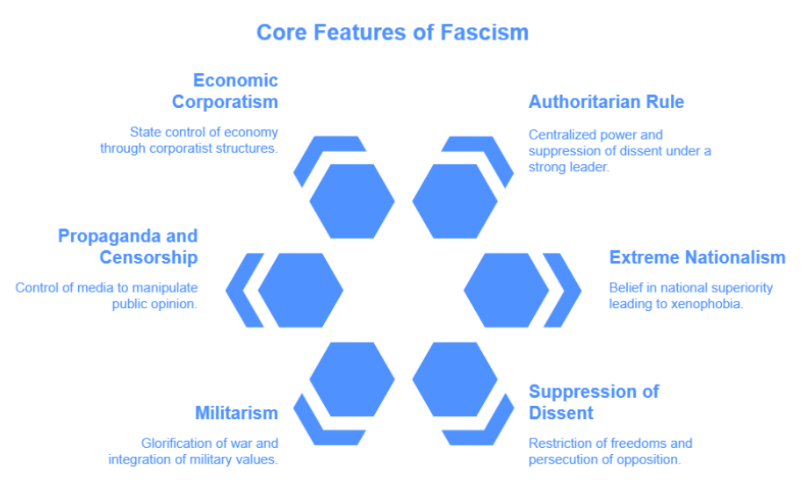
Understanding the core features of Fascism helps explain how it gained traction in multiple countries during a time of global crisis and instability.
Fascism relies on an all-powerful leader who is often portrayed as the savior of the nation. Power is centralized, and political dissent is brutally suppressed.
Fascist regimes promote the idea that their nation is superior to others. This nationalism often leads to xenophobia and the scapegoating of minorities.
Freedom of speech, press, and assembly is restricted. The opposition is often labeled as enemies of the state, imprisoned, exiled, or executed.
Fascism glorifies war and military strength. Military values are integrated into civilian life, and war is often considered a means of national rejuvenation.
Control of media is a central aspect of Fascism. Through mass rallies, films, posters, and radio broadcasts, fascist leaders build a cult of personality and manipulate public opinion.
Under Fascism, the economy is neither capitalist nor communist. Instead, the state controls production and labor through corporatist structures, ensuring that businesses serve state interests.
The rise of Fascism in the 20th century was not accidental. A combination of historical, political, and social factors contributed to its emergence, particularly in Italy, Germany, and Japan.
Countries like Italy felt betrayed by the Treaty of Versailles, as they did not receive territorial rewards despite supporting the Allies. In Germany, the treaty imposed harsh penalties, fostering resentment and a desire for revenge—fertile ground for Fascism to grow.
In many countries, parliamentary systems were seen as slow, corrupt, or ineffective. People began to yearn for strong leadership that could take decisive actions.
The success of the Russian Revolution scared the elites in Europe. The upper and middle classes turned to Fascism as a bulwark against socialism and communism.
The Great Depression of the 1930s created massive unemployment, inflation, and social unrest. Fascist parties offered simple solutions and quick fixes, attracting support from struggling citizens.
Figures like Benito Mussolini in Italy and Adolf Hitler in Germany used charisma, oratory skills, and propaganda to present themselves as national saviors, gaining mass support.
Fascist regimes expertly used media and public spectacles to craft a powerful image of unity, strength, and revival. Emotional appeals to patriotism and fear of enemies were key tools.
The rise of Fascism led to unprecedented destruction, suffering, and transformation of global politics. The consequences of fascist rule were devastating both domestically and internationally.
Fascism imposed total control over every aspect of public and private life. There was no space for personal freedom, independent thought, or opposition.
Fascist leaders were worshipped like gods. In Italy, Mussolini was called “Il Duce,” while Hitler was referred to as “Der Führer.” Their images dominated public spaces, and their words were treated as law.
Fascist states aggressively built up their military forces and pursued expansionist policies. This directly led to invasions and, eventually, World War II, the deadliest conflict in human history.
Driven by the belief in national superiority, Fascist regimes launched wars to gain territory. Germany annexed Austria and invaded Poland, while Italy attacked Ethiopia and Japan invaded China.
Under Fascism, millions suffered from discrimination, forced labor, and genocide. The Holocaust orchestrated by Nazi Germany remains one of the most horrific examples of fascist atrocities.
Art, literature, and education were strictly controlled. Only those that promoted fascist ideals were allowed. Dissenting voices were silenced or destroyed.
Though not communist, Fascist regimes heavily controlled the economy. Labor unions were banned or brought under state control, and industries were directed to serve national goals, especially militarization.
The defeat of Fascism in World War II did not completely eliminate the ideology. In the post-war world, the horrors of fascist regimes served as a warning about the dangers of authoritarianism, militarism, and unchecked nationalism. International institutions like the United Nations were created to prevent the recurrence of such ideologies. However, elements of Fascism, such as xenophobia, ultra-nationalism, and authoritarianism, occasionally re-emerge in global politics, making it crucial to understand its origins and consequences.
Fascism emerged in response to social unrest, economic hardship, and fear of political instability in the early 20th century. Its radical ideology transformed nations like Italy and Germany into totalitarian states that caused immense human suffering and global conflict. The legacy of Fascism is one of war, genocide, and destruction, and it serves as a powerful reminder of the need to protect democratic values, human rights, and social justice. Understanding the history and consequences of Fascism is essential to preventing its return in modern societies.





Refine your answer writing skills and elevate your UPSC preparation with personalized support and expert feedback.
Fill out the form to get started with the program or any other enquiries !


Are you dreaming of becoming an IAS officer? Then, IAShub can be your best guide. It is one of the Best IAS Coaching in Delhi. Many students who want to clear the UPSC exam join IAShub for learning. The institute gives both online and offline classes. Their teachers are experienced and helpful. They easily explain every topic. Students also get notes, tests, and tips to do well in the exam.
IAShub is in Delhi and is trusted by many UPSC students. It offers coaching for every part of the UPSC exam – Prelims, Mains, and Interview. The classes are simple and easy to understand. The teachers are experts and guide students in the right way. IAShub is also known for its helpful notes, test series, and answer-writing practice. IAShub is the best coaching in Delhi and also gives UPSC Online Classes. This helps students from any place in India to learn. The online classes are live and also recorded. So, students can watch them anytime. These classes cover the full UPSC syllabus.
Here are some important services provided by IAShub:
The UPSC Civil Services Exam has three parts:
This exam is tough, but with the right guidance, it becomes easy to manage. Students must study smart and stay regular.
IAShub supports students from the beginning to the end. It gives the right books, tests, and notes. The classes are easy to follow, and the teachers are always ready to help. Students get personal doubt sessions too. The test series and answer checking help students learn where they need to do better. Also, free study materials save time and money.
IAShub also guides students during the final stage – the interview. Experts take mock interviews and give useful tips. This full support makes IAShub one of the best IAS coaching in Delhi.
 Detailed Solutions & Explanations
Improve Your Answer Writing & Strategy
Detailed Solutions & Explanations
Improve Your Answer Writing & Strategy

