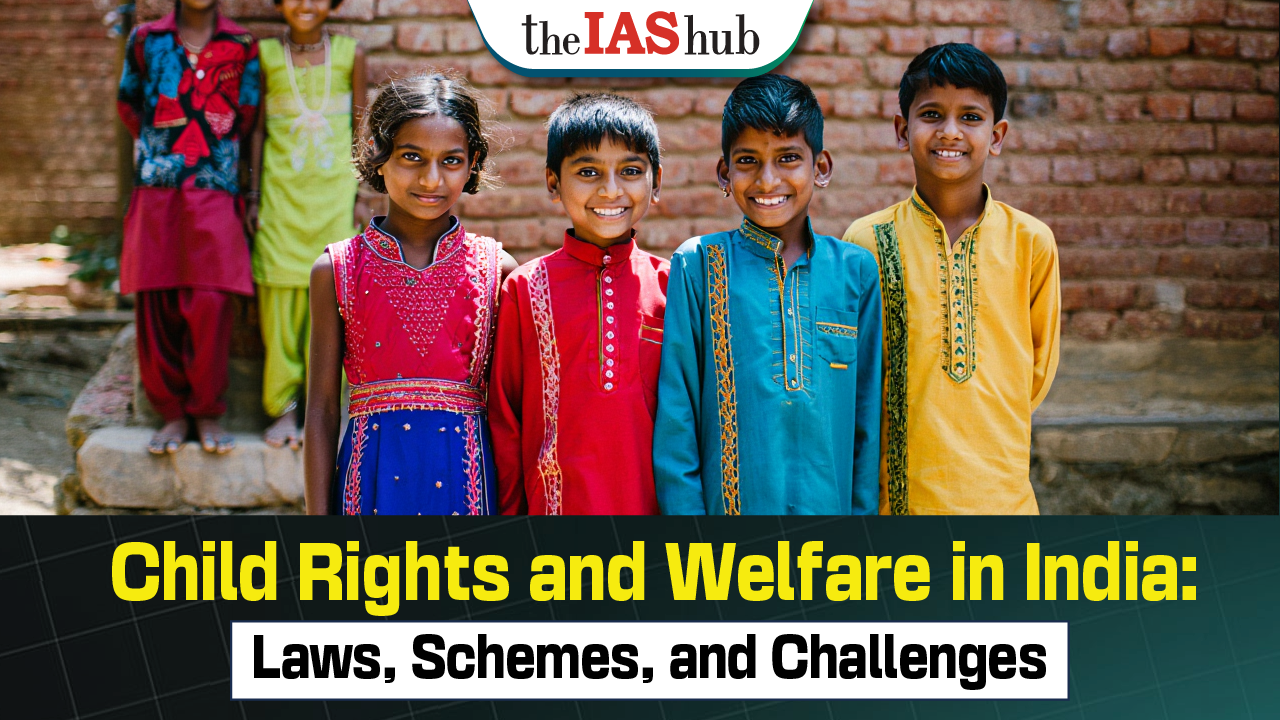
Child Rights and Welfare in India: Laws, Schemes, and Challenges

Explore child rights and welfare in India, including major laws, government schemes like ICDS, Mission Vatsalya, and RTE Act. Understand key issues like child labor, abuse, trafficking, and initiatives protecting children’s health, education, and safety.

THEIASHUB
Get an Instant Call Back from Our Expert Mentors Now!
+91

Children are the cornerstone of a nation’s future, and their well-being directly reflects the country’s development. Ensuring their rights, protection, and holistic growth is essential for building a just, equitable, and progressive society.
  • Children are the future of a country. Their healthy development is crucial for national progress. 
  • Poverty often forces children to work instead of attending school, hindering their physical, mental, and emotional growth. 
    • Children who experience poverty and prejudice are more likely to experience hunger, poor health, limited financial resources, inadequate educational opportunities, and bad health, which restricts their freedoms and chances.
  • Further, due to social norms that favour boys over girls and place a greater emphasis on male sexuality, newborn females are at a greater disadvantage than male babies.
  • An infanticide, disrespect for nutritional requirements, lack of access to school and healthcare, among other forms of abuse, are all experienced by girl children.

Constitutional Provisions Related to Child Rights in India

  • Article 21A: Education up to the age of 14 was declared a fundamental right. 
  • Article 24: Children have a fundamental right against exploitation and the employment of children under the age of 14 in factories and hazardous processes is prohibited.
  • Article 45: Requires states to provide early childhood care and education for children up to age six.

Major Issues Affecting Child Rights in India

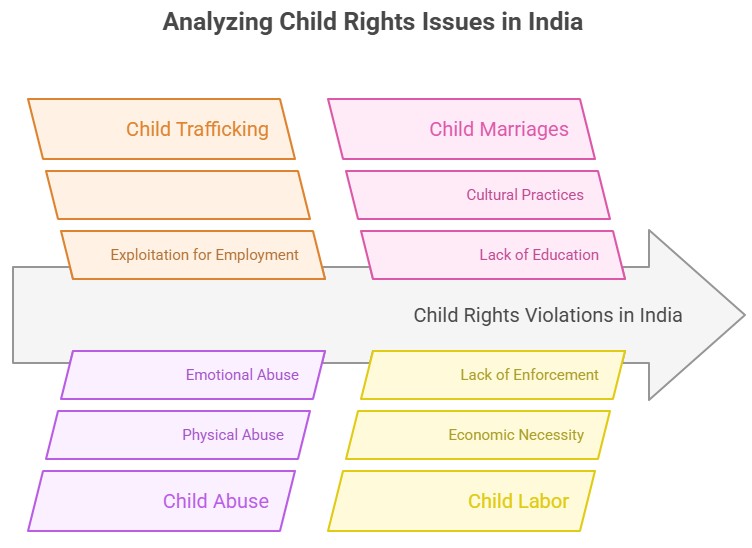
  • Child trafficking: As per National Crime Record Bureau Report (NCRB), eight children were exploited and trafficked into the nation daily for various sorts of exploitation, including employment, sexual exploitation, and begging.
  • Child abuse: A survey by the National Commission for the Protection of Child Rights (NCPCR) found that over 55% of Indian children have been the victim of abuse of some type.
  • Child Marriages: India has come a long way in the fight against child marriage, but it still has the highest rate of child brides in the world. 
  • Despite progress on many fronts, the Sustainable Development Goals' aim of ending the practice by 2030 will not be met at the current rate of reduction.
  • Child labor: As per Census 2011, the total child population in India in the age group (5-14) years is 259.6 million. Of these, 10.1 million (3.9% of total child population) are working, either as 'main worker' or as 'marginal worker'.
  • Health issues: For many Indians, poverty, hunger, and inadequate sanitation are serious issues that contribute significantly to the high infant death rate. More than 40% of kids are stunted or malnourished.

Government Schemes Promoting Child Rights and Welfare in India

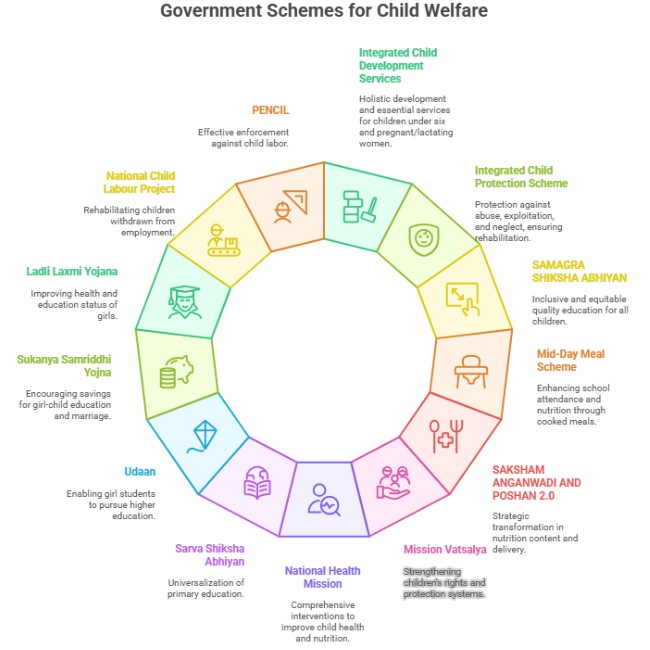
  • Integrated Child Development Services (ICDS): To promote holistic development and provide essential services for the overall well-being of children under six years of age, as well as pregnant and lactating women.
  • Integrated Child Protection Scheme: To create a protective environment for vulnerable children by preventing their abuse, exploitation, and neglect, and ensuring their rehabilitation and social integration.
  • SAMAGRA SHIKSHA ABHIYAN: To provide inclusive and equitable quality education to all children from pre-primary to higher secondary levels.
  • Mid-Day Meal (MDM) Scheme: To enhance enrollment, retention, and attendance of children in schools by providing them with a nutritious cooked meal during school hours.
  • SAKSHAM ANGANWADI AND POSHAN 2.0: Addressing the challenges of malnutrition by implementing a strategic transformation in the content and delivery of nutrition.
  • Mission Vatsalya: The Mission Vatsalya program is a roadmap for achieving development and child protection priorities in line with the Sustainable Development Goals (SDGs). 
    • Under the motto “Leave no child behind”, the focus is on strengthening children's rights, advocacy and awareness, as well as juvenile justice and protection systems. 
    • The provisions of the Juvenile Justice (Child Care and Protection) Act 2015 and the Protection of Children from Sexual Offenses Act 2012 provide the basic framework for the implementation of the Mission. 
    • Funds under the Mission Vatsalya program will be released in accordance with State/UT requirements and demands. 
  • National Health Mission - comprehensively interventions to improve child health and nutrition status.
  • Sarva Shiksha Abhiyan - for universalisation of primary education .
  • Udaan - to enable girl students to soar to higher education
  • Sukanya Samriddhi Yojna - A small deposit scheme, launched as a part of the ‘Beti Bachao Beti Padhao' to encourage parents of a girl-child to stock a fund for their education and marriage. 
  • Ladli Laxmi Yojana (MP) - To improve the health and educational status of the girls. 
  • The National Child Labour Project for rehabilitating the children withdrawn from employment 
  • Platform for Effective Enforcement for No Child Labour (PENCIL)

Legislative Measures to Safeguard Child Rights

  • The Immoral Traffic (Prevention) Act, 1987: Its objective is to end the trafficking of children, including boys and girls.
  • Child Labour (Prohibition and Regulation) Act 1986: This law forbids the employment of minors in some occupations and controls the working conditions of children in other occupations.
  • Prohibition of Child Marriage Act, 2006: This Act follows the basic premise (a) to make a child go through marriage is an offence, and (b) child or minor is a person up to 18 years of age in the case of girls and 21 years in the case of boys.
  • Right of Children to Free and Compulsory Education Act, 2009: With the inclusion of the Right to Education in the list of fundamental rights, it is now a legally protected right under Article 21a. 
  • The Right to Education Act, 2009, usually referred to as the RTE Act, outlines the significance of free and mandatory education for children in India ages 6 to 14 years old.
  • Protection of Children from Sexual Offences Act, 2012: It was passed in an effort to protect minors from sexual assault, sexual harassment, and pornographic offences while upholding the best interests of the child throughout the whole legal process.

Institutional Measures for Child Welfare

National Commission for Protection of Child Rights (NCPCR)

  • The Government of India established the National Commission for Protection of Child Rights (NCPCR) in accordance with the Commission for Protection of Child Rights (CPCR) Act, 2005, to exercise and carry out the powers and duties entrusted to it by the CPCR Act, 2005.
    • It emphasizes the idea of the universality and inviolability of children's rights and acknowledges the urgency with which all national policies pertaining to children are being implemented. 
    • The Commission places equal focus on the protection of all children in the 0 to 18 age range.
  • Functions 
  • It examines and assess the protections established by or pursuant to any law presently in effect for the protection of child rights and make recommendations for implementation strategies;
  • It reports on the operation of those safeguards to the central government yearly and at such other periods as the commission may deem appropriate;
  • It investigates child rights violations and that legal action be taken where necessary;
  • It looks into issues involving children who require extra attention and protection, such as children in need, children who are marginalized and underprivileged, children who are in confrontation with the law etc.

Central Adoption Resources Authority (CARA) 

  • It is a statutory body of the Ministry of Women and Child Development, Government of India. 
  • It serves as a hub for child adoptions in India and is tasked with supervising and regulating domestic and international adoptions. 
  • It has been designated as the central authority to administer international adoption under the provisions of the 1993 Hague Convention on International Adoption ratified by the Government of India in 2003.
  • CARA primarily deals with adoptions of orphaned, abandoned and abandoned children through affiliated and approved adoption agencies.

National Institute of Public Cooperation and Child Development (NIPCCD)

  • The Ministry of Women and Child Development oversees the NIPCCD, an autonomous independent organization with its headquarters in Delhi.
  • Over the past 50 years, NIPCCD has strategically advanced the development of women and children. 
  • The institution provides programmatic research, capacity building, and advising services to the Ministry for the following programs:
    • Mission Poshan 2.0/Saksham Anganwadi
    • Child welfare and protection services are provided by Mission Vatsalya.
    • The mission of Mission Shakti is to protect and empower women.

Child Rights and Welfare in India: Laws, Schemes, and Challenges FAQs

Child rights in India include the right to education, health, protection from exploitation, and the right to a safe and nurturing environment.

Article 21A of the Indian Constitution guarantees free and compulsory education for children aged 6 to 14 years.

Mission Vatsalya is a government scheme focused on child protection, development, and rehabilitation in alignment with the Sustainable Development Goals.

The Child Labour (Prohibition and Regulation) Act, 1986, along with schemes like the National Child Labour Project, aim to eliminate child labor in India.

The National Commission for Protection of Child Rights (NCPCR) monitors and ensures the effective implementation of laws and policies for safeguarding child rights.


UPSC QEP 2026 Batch 5 - English
Buy now View Details
Submit Your Details to Learn More
I agree to give my consent to receive updates through SMS/Email & WhatsApp*.

NEEV GS + CSAT Foundation 2026/27
Buy now View Details


Join theIAShub’s Mains Answer Writing Program

Refine your answer writing skills and elevate your UPSC preparation with personalized support and expert feedback.

Fill out the form to get started with the program or any other enquiries !

I agree to give my consent to receive updates through SMS/Email & WhatsApp*.

Best IAS Coaching In Delhi, UPSC Online & Offline Classes by IAShub

Are you dreaming of becoming an IAS officer? Then, IAShub can be your best guide. It is one of the Best IAS Coaching in Delhi. Many students who want to clear the UPSC exam join IAShub for learning. The institute gives both online and offline classes. Their teachers are experienced and helpful. They easily explain every topic. Students also get notes, tests, and tips to do well in the exam.

UPSC Online Classes by IAShub

IAShub is in Delhi and is trusted by many UPSC students. It offers coaching for every part of the UPSC exam – Prelims, Mains, and Interview. The classes are simple and easy to understand. The teachers are experts and guide students in the right way. IAShub is also known for its helpful notes, test series, and answer-writing practice. IAShub is the best coaching in Delhi and also gives UPSC Online Classes. This helps students from any place in India to learn. The online classes are live and also recorded. So, students can watch them anytime. These classes cover the full UPSC syllabus.

Key Offerings Provided by IAShub

Here are some important services provided by IAShub:

  • UPSC Prelims: IAShub teaches for Prelims with a focus on basics. It also gives daily current affairs and monthly magazines.
  • Classroom Courses: IAShub has classroom learning for students in Delhi. The environment is good and peaceful for study.
  • Live Classes: Students who live far can join live UPSC online classes. These classes are just like real classes.
  • QEP for Mains: The Quality Enrichment Program (QEP) is special for Mains preparation. It helps students write better and faster.
  • Answer Writing: Regular answer writing practice is given. Teachers also check answers and give tips to improve.
  • Free Resource: IAShub gives free notes by toppers and helpful Main Booster material.
  • Test Series: Test series are available for every subject. These help students know their weak points and improve.
  • Interview Guidance Session: IAShub also gives interview practice sessions with experts. These help students feel confident.

UPSC Exam Overview

The UPSC Civil Services Exam has three parts:

  • Prelims: It has two papers: General Studies and CSAT.
  • Mains: It has nine papers, including essays and optional subjects.
  • Interview: It tests the personality and confidence of the student.

This exam is tough, but with the right guidance, it becomes easy to manage. Students must study smart and stay regular.

How IAShub Helps in the UPSC Journey

IAShub supports students from the beginning to the end. It gives the right books, tests, and notes. The classes are easy to follow, and the teachers are always ready to help. Students get personal doubt sessions too. The test series and answer checking help students learn where they need to do better. Also, free study materials save time and money.
IAShub also guides students during the final stage – the interview. Experts take mock interviews and give useful tips. This full support makes IAShub one of the best IAS coaching in Delhi.

Best IAS Coaching In Delhi FAQs

Yes, IAShub offers live and recorded online classes. Students can attend from any part of India.

Classes are available in both English and Hindi, so students can choose the language they are comfortable with.

The classroom centre is located in Delhi. Students can visit and join offline batches there.

IAShub gives interview guidance sessions to help students prepare for the final round of UPSC.