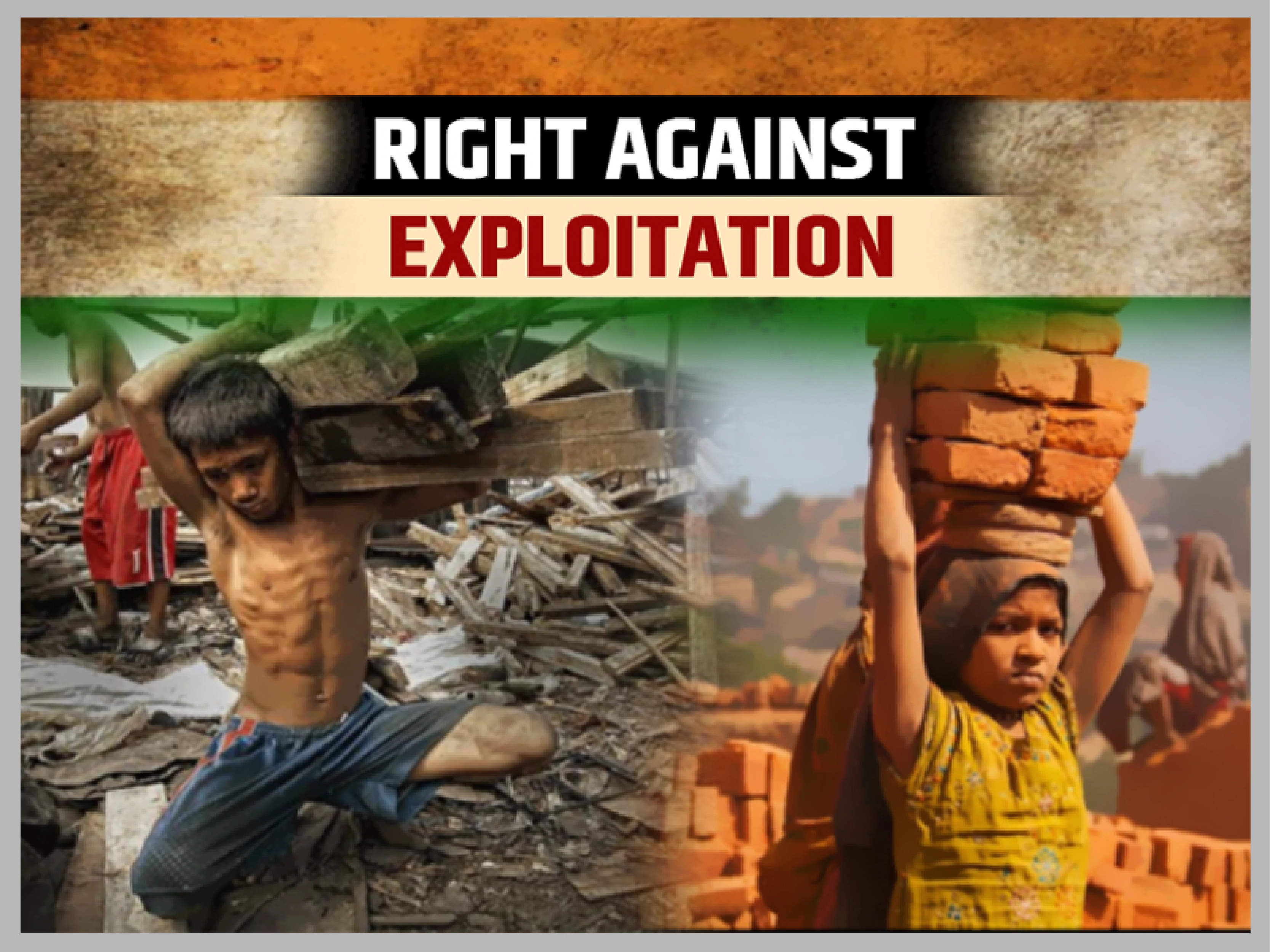
Right Against Exploitation Articles 23-24 of the Indian Constitution

Learn about the Right Against Exploitation (Articles 23-24) in the Indian Constitution, prohibiting forced labour, child labour, and human trafficking. Key laws explained.

THEIASHUB
Get an Instant Call Back from Our Expert Mentors Now!
+91

The Right Against Exploitation is a fundamental right enshrined in Articles 23 and 24 of the Indian Constitution. It safeguards individuals from human trafficking, forced labour, and child labour, ensuring dignity and fair treatment. These provisions play a crucial role in protecting marginalized communities from exploitation.
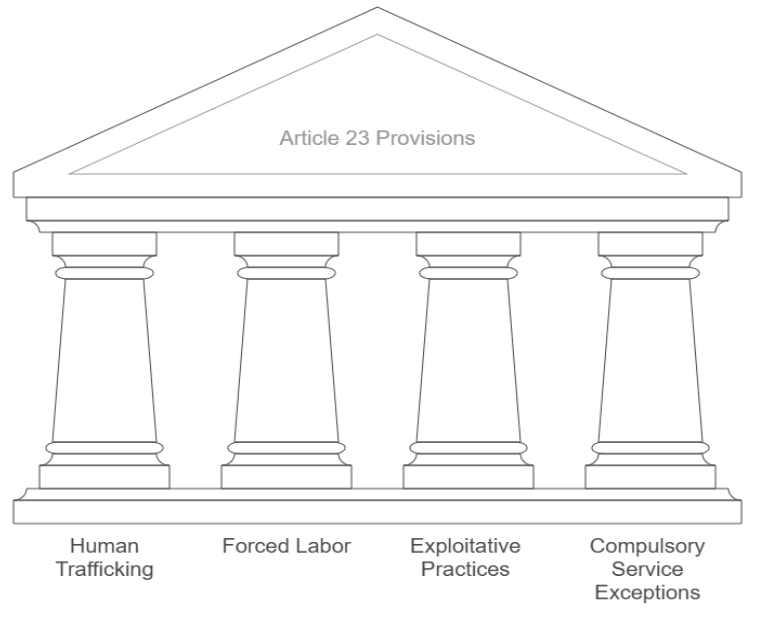
Article 23: Prohibition of Human Trafficking and Forced Labour


Key Provisions of Article 23

Article 23 explicitly bans:

  • Human trafficking – Including sex trafficking, bonded labour, and modern slavery.

  • Begar (forced labour) – Compelling individuals to work without wages.

  • Other exploitative practices – Such as the Devadasi system and forced servitude.

Exceptions to Article 23

While forced labour is prohibited, the State can impose compulsory service for public purposes, including:

  • Military service

  • Social service programs

The government is not required to provide wages in these cases, as long as the service is justified in the public interest.

Laws Enforcing Article 23

To strengthen the Right Against Exploitation, India has enacted several laws:

  • Immoral Traffic (Prevention) Act, 1956 – Criminalizes human trafficking and prostitution-related offenses.

  • Bonded Labour System (Abolition) Act, 1976 – Eliminates all forms of bonded labour.

  • Protection of Human Rights Act, 1993 – Establishes measures to prevent human rights violations.

Landmark Supreme Court Case: PUDR vs. Union of India (1982)

In this case, the Supreme Court expanded the definition of forced labour by ruling that:

  • The Right Against Exploitation includes the right to a minimum wage.

  • Poor workers can directly approach the Supreme Court under Article 32 to enforce their labour rights.

This judgment reinforced the protection of marginalized workers against economic exploitation.
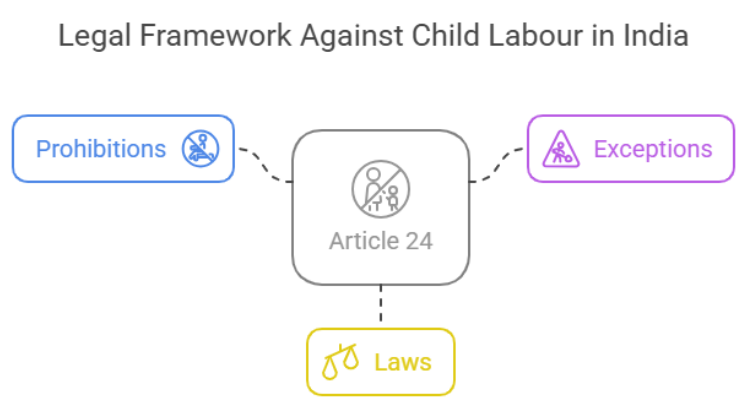
Article 24: Prohibition of Child Labour


Key Provisions of Article 24

Article 24 prohibits the employment of children below 14 years in:

  • Factories

  • Mines

  • Hazardous activities like construction work and railways

Exceptions to Article 24

Children are allowed to work in:

  • Non-hazardous family-run occupations

  • Entertainment and sports industries, provided safeguards are in place

Laws Against Child Labour in India

The government has introduced various laws to eliminate child labour:

1. Child Labour (Prohibition and Regulation) Act, 1986

  • Bans child labour in certain occupations.

  • Regulates working conditions in permitted industries.

2. Child Labour (Prohibition and Regulation) Amendment Act, 2016

  • Completely bans employment of children below 14 years in all occupations.

  • Prohibits adolescents (14-18 years) from engaging in hazardous work.

3. Commissions for Protection of Child Rights Act, 2005

  • Established the National Commission for Protection of Child Rights (NCPCR).

  • Created Children’s Courts for cases involving crimes against children.

4. Protection of Children from Sexual Offences (POCSO) Act, 2012

  • Provides strict laws against child sexual abuse and exploitation.

  • Includes child-friendly judicial procedures.

5. Juvenile Justice (Care and Protection of Children) Act, 2015

  • Protects children in conflict with the law.

  • Establishes a framework for juvenile rehabilitation.

India’s International Commitments on Child Labour

India has ratified two key International Labour Organization (ILO) Conventions:

  • Convention No. 138 – Establishes the minimum age for employment.

  • Convention No. 182 – Prohibits hazardous work for children that endangers their health.

Significance of Articles 23 and 24 in India

1. Protection of Human Rights

The Right Against Exploitation ensures that every individual is treated with dignity, free from forced labour and trafficking.

2. Economic and Social Justice

Preventing forced labour and child labour promotes:

  • Fair wages

  • Safe working conditions

  • Equal employment opportunities

3. Strengthening Legal Protections

The Supreme Court and government policies continuously improve laws against exploitation and human rights violations.

4. Role of Government and NGOs

  • Government agencies and NGOs rescue and rehabilitate victims of trafficking and child labour.

  • Public awareness campaigns educate communities about exploitation and legal protections.

Challenges in Enforcing the Right Against Exploitation

Despite strong laws, challenges remain:

  • Child labour persists in informal sectors like domestic work and agriculture.

  • Human trafficking networks continue to exploit vulnerable groups.

  • Weak enforcement mechanisms in some areas hinder the effectiveness of laws.

The Way Forward

To strengthen the Right Against Exploitation, India must:

  • Increase strict enforcement of child labour and forced labour laws.

  • Enhance victim rehabilitation programs for rescued individuals.

  • Strengthen international cooperation to combat human trafficking.

  • Encourage public participation through awareness and education.

Conclusion

Articles 23 and 24 of the Indian Constitution play a vital role in preventing exploitation. While Article 23 prohibits forced labour and human trafficking, Article 24 protects children from hazardous employment. Over the years, India has introduced several laws, policies, and international commitments to eliminate labour exploitation. However, effective enforcement and public awareness remain key to achieving an exploitation-free society.



UPSC QEP 2026 Batch 5 - English
Buy now View Details
Submit Your Details to Learn More
I agree to give my consent to receive updates through SMS/Email & WhatsApp*.

NEEV GS + CSAT Foundation 2026/27
Buy now View Details


Join theIAShub’s Mains Answer Writing Program

Refine your answer writing skills and elevate your UPSC preparation with personalized support and expert feedback.

Fill out the form to get started with the program or any other enquiries !

I agree to give my consent to receive updates through SMS/Email & WhatsApp*.

Best IAS Coaching In Delhi, UPSC Online & Offline Classes by IAShub

Are you dreaming of becoming an IAS officer? Then, IAShub can be your best guide. It is one of the Best IAS Coaching in Delhi. Many students who want to clear the UPSC exam join IAShub for learning. The institute gives both online and offline classes. Their teachers are experienced and helpful. They easily explain every topic. Students also get notes, tests, and tips to do well in the exam.

UPSC Online Classes by IAShub

IAShub is in Delhi and is trusted by many UPSC students. It offers coaching for every part of the UPSC exam – Prelims, Mains, and Interview. The classes are simple and easy to understand. The teachers are experts and guide students in the right way. IAShub is also known for its helpful notes, test series, and answer-writing practice. IAShub is the best coaching in Delhi and also gives UPSC Online Classes. This helps students from any place in India to learn. The online classes are live and also recorded. So, students can watch them anytime. These classes cover the full UPSC syllabus.

Key Offerings Provided by IAShub

Here are some important services provided by IAShub:

  • UPSC Prelims: IAShub teaches for Prelims with a focus on basics. It also gives daily current affairs and monthly magazines.
  • Classroom Courses: IAShub has classroom learning for students in Delhi. The environment is good and peaceful for study.
  • Live Classes: Students who live far can join live UPSC online classes. These classes are just like real classes.
  • QEP for Mains: The Quality Enrichment Program (QEP) is special for Mains preparation. It helps students write better and faster.
  • Answer Writing: Regular answer writing practice is given. Teachers also check answers and give tips to improve.
  • Free Resource: IAShub gives free notes by toppers and helpful Main Booster material.
  • Test Series: Test series are available for every subject. These help students know their weak points and improve.
  • Interview Guidance Session: IAShub also gives interview practice sessions with experts. These help students feel confident.

UPSC Exam Overview

The UPSC Civil Services Exam has three parts:

  • Prelims: It has two papers: General Studies and CSAT.
  • Mains: It has nine papers, including essays and optional subjects.
  • Interview: It tests the personality and confidence of the student.

This exam is tough, but with the right guidance, it becomes easy to manage. Students must study smart and stay regular.

How IAShub Helps in the UPSC Journey

IAShub supports students from the beginning to the end. It gives the right books, tests, and notes. The classes are easy to follow, and the teachers are always ready to help. Students get personal doubt sessions too. The test series and answer checking help students learn where they need to do better. Also, free study materials save time and money.
IAShub also guides students during the final stage – the interview. Experts take mock interviews and give useful tips. This full support makes IAShub one of the best IAS coaching in Delhi.

Best IAS Coaching In Delhi FAQs

Yes, IAShub offers live and recorded online classes. Students can attend from any part of India.

Classes are available in both English and Hindi, so students can choose the language they are comfortable with.

The classroom centre is located in Delhi. Students can visit and join offline batches there.

IAShub gives interview guidance sessions to help students prepare for the final round of UPSC.