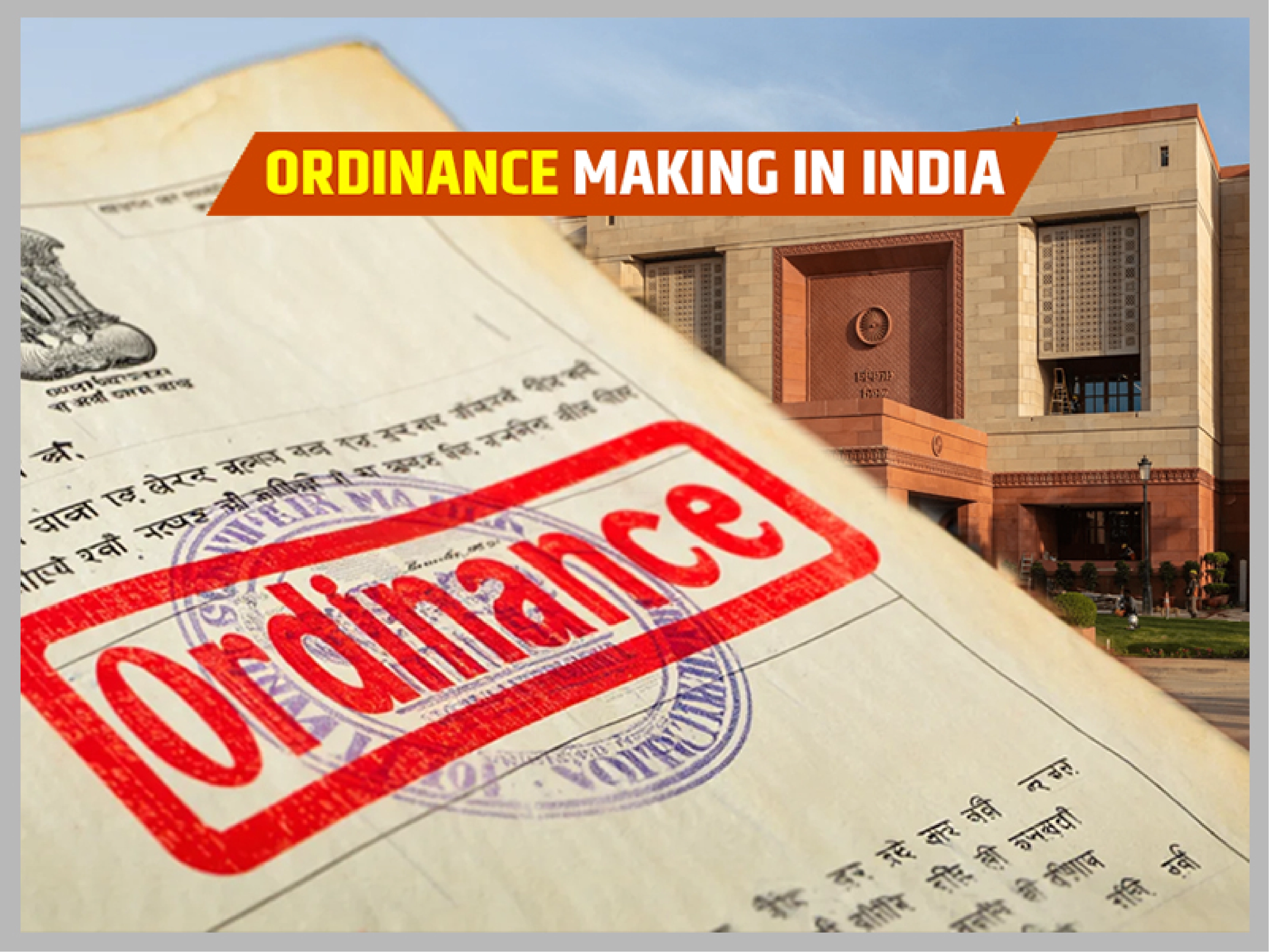
Ordinance Making in India Challenges and Way Forward

Understand ordinance making in India, its challenges, and reforms needed to prevent misuse, strengthen legislative oversight, and maintain democratic principles.

THEIASHUB
Get an Instant Call Back from Our Expert Mentors Now!
+91

Ordinance making in India is a crucial tool that allows the executive to enact temporary laws when the Parliament or State Legislature is not in session. The President of India (Article 123) and the Governor (Article 213) have the power to promulgate ordinances under extraordinary circumstances. While this provision ensures continuity in governance, its frequent use raises concerns about bypassing the legislature, weakening democratic principles, and creating an "ordinance raj." Addressing these challenges requires judicial clarity, legislative scrutiny, and reforms to maintain the constitutional balance of power.

Challenges in Ordinance Making

1. Bypassing the Legislature

  • Ordinances allow the executive to overstep its constitutional mandate, undermining the separation of powers.

  • Frequent use reduces the role of the elected legislature, diluting the people’s mandate.

2. Democratic Deficit

  • Ordinances are issued without detailed parliamentary debate or public consultation, raising transparency concerns.

  • This leads to laws being passed without thorough scrutiny and deliberation.

3. Misuse of Power as an Alternative to Legislation

  • Ordinances are sometimes used to push political agendas, bypassing parliamentary oversight.

  • Example: The controversial Three Farm Laws were introduced through an ordinance, which later faced massive protests.

4. Fear of an "Ordinance Raj"

  • The excessive use of ordinances undermines legislative authority and sets a dangerous precedent.

  • Example: In Bihar, ordinances were repeatedly reissued regarding Sanskrit schools and teacher transfers, creating instability.

5. Threat to Federalism

  • Some ordinances challenge the spirit of federalism by overriding state powers.

  • Example: The NCT Ordinance affected the governance structure of Delhi, sparking debates over state autonomy.

6. Vague and Ambiguous Provisions

  • Some ordinances include unclear or poorly defined provisions, leading to confusion and legal disputes.

  • Example: The Securities Laws (Amendment) Ordinance, 2014 had vague elements, requiring further clarification.

Way Forward

1. Strengthening Legislative Scrutiny

  • Ordinances should be rigorously debated in Parliament or State Legislatures when they reconvene.

  • Parliamentary committees can review their necessity and impact on governance.

2. Establishing Clear Judicial Guidelines

  • The Supreme Court should define strict guidelines for ordinance-making to prevent misuse.

  • Judicial intervention can ensure ordinances are used only in genuine emergencies.

3. Limiting Re-promulgation of Ordinances

  • Re-promulgation should be strictly regulated, ensuring the executive does not use it to bypass legislative approval.

  • The Supreme Court's ruling in Krishna Kumar Singh v. State of Bihar (2017) highlighted this issue and emphasized parliamentary oversight.

4. Public Consultation for Transparency

  • A structured consultation process before issuing ordinances can ensure greater accountability.

  • Seeking expert opinions and public feedback can enhance the credibility of ordinances.

5. Strengthening Democratic Processes

  • Encouraging debate and discussion within the legislature can reduce over-reliance on ordinances.

  • Strengthening parliamentary committees can ensure better scrutiny of urgent policy measures.

6. Legal and Constitutional Reforms

  • Amending the Constitution or legal framework to clearly define circumstances for ordinance promulgation can prevent misuse.

  • Setting stricter time limits on ordinance validity and restricting executive discretion can uphold democratic principles.

Conclusion

While ordinance making in India serves as an essential legislative tool in exceptional situations, its overuse weakens parliamentary democracy. Ensuring a transparent, accountable, and constitutionally sound ordinance-making process requires judicial clarity, legislative oversight, and public participation. Strengthening democratic processes will ensure that ordinances remain an extraordinary measure rather than a regular legislative practice.



UPSC QEP 2026 Batch 5 - English
Buy now View Details
Submit Your Details to Learn More
I agree to give my consent to receive updates through SMS/Email & WhatsApp*.

NEEV GS + CSAT Foundation 2026/27
Buy now View Details


Join theIAShub’s Mains Answer Writing Program

Refine your answer writing skills and elevate your UPSC preparation with personalized support and expert feedback.

Fill out the form to get started with the program or any other enquiries !

I agree to give my consent to receive updates through SMS/Email & WhatsApp*.

Best IAS Coaching In Delhi, UPSC Online & Offline Classes by IAShub

Are you dreaming of becoming an IAS officer? Then, IAShub can be your best guide. It is one of the Best IAS Coaching in Delhi. Many students who want to clear the UPSC exam join IAShub for learning. The institute gives both online and offline classes. Their teachers are experienced and helpful. They easily explain every topic. Students also get notes, tests, and tips to do well in the exam.

UPSC Online Classes by IAShub

IAShub is in Delhi and is trusted by many UPSC students. It offers coaching for every part of the UPSC exam – Prelims, Mains, and Interview. The classes are simple and easy to understand. The teachers are experts and guide students in the right way. IAShub is also known for its helpful notes, test series, and answer-writing practice. IAShub is the best coaching in Delhi and also gives UPSC Online Classes. This helps students from any place in India to learn. The online classes are live and also recorded. So, students can watch them anytime. These classes cover the full UPSC syllabus.

Key Offerings Provided by IAShub

Here are some important services provided by IAShub:

  • UPSC Prelims: IAShub teaches for Prelims with a focus on basics. It also gives daily current affairs and monthly magazines.
  • Classroom Courses: IAShub has classroom learning for students in Delhi. The environment is good and peaceful for study.
  • Live Classes: Students who live far can join live UPSC online classes. These classes are just like real classes.
  • QEP for Mains: The Quality Enrichment Program (QEP) is special for Mains preparation. It helps students write better and faster.
  • Answer Writing: Regular answer writing practice is given. Teachers also check answers and give tips to improve.
  • Free Resource: IAShub gives free notes by toppers and helpful Main Booster material.
  • Test Series: Test series are available for every subject. These help students know their weak points and improve.
  • Interview Guidance Session: IAShub also gives interview practice sessions with experts. These help students feel confident.

UPSC Exam Overview

The UPSC Civil Services Exam has three parts:

  • Prelims: It has two papers: General Studies and CSAT.
  • Mains: It has nine papers, including essays and optional subjects.
  • Interview: It tests the personality and confidence of the student.

This exam is tough, but with the right guidance, it becomes easy to manage. Students must study smart and stay regular.

How IAShub Helps in the UPSC Journey

IAShub supports students from the beginning to the end. It gives the right books, tests, and notes. The classes are easy to follow, and the teachers are always ready to help. Students get personal doubt sessions too. The test series and answer checking help students learn where they need to do better. Also, free study materials save time and money.
IAShub also guides students during the final stage – the interview. Experts take mock interviews and give useful tips. This full support makes IAShub one of the best IAS coaching in Delhi.

Best IAS Coaching In Delhi FAQs

Yes, IAShub offers live and recorded online classes. Students can attend from any part of India.

Classes are available in both English and Hindi, so students can choose the language they are comfortable with.

The classroom centre is located in Delhi. Students can visit and join offline batches there.

IAShub gives interview guidance sessions to help students prepare for the final round of UPSC.