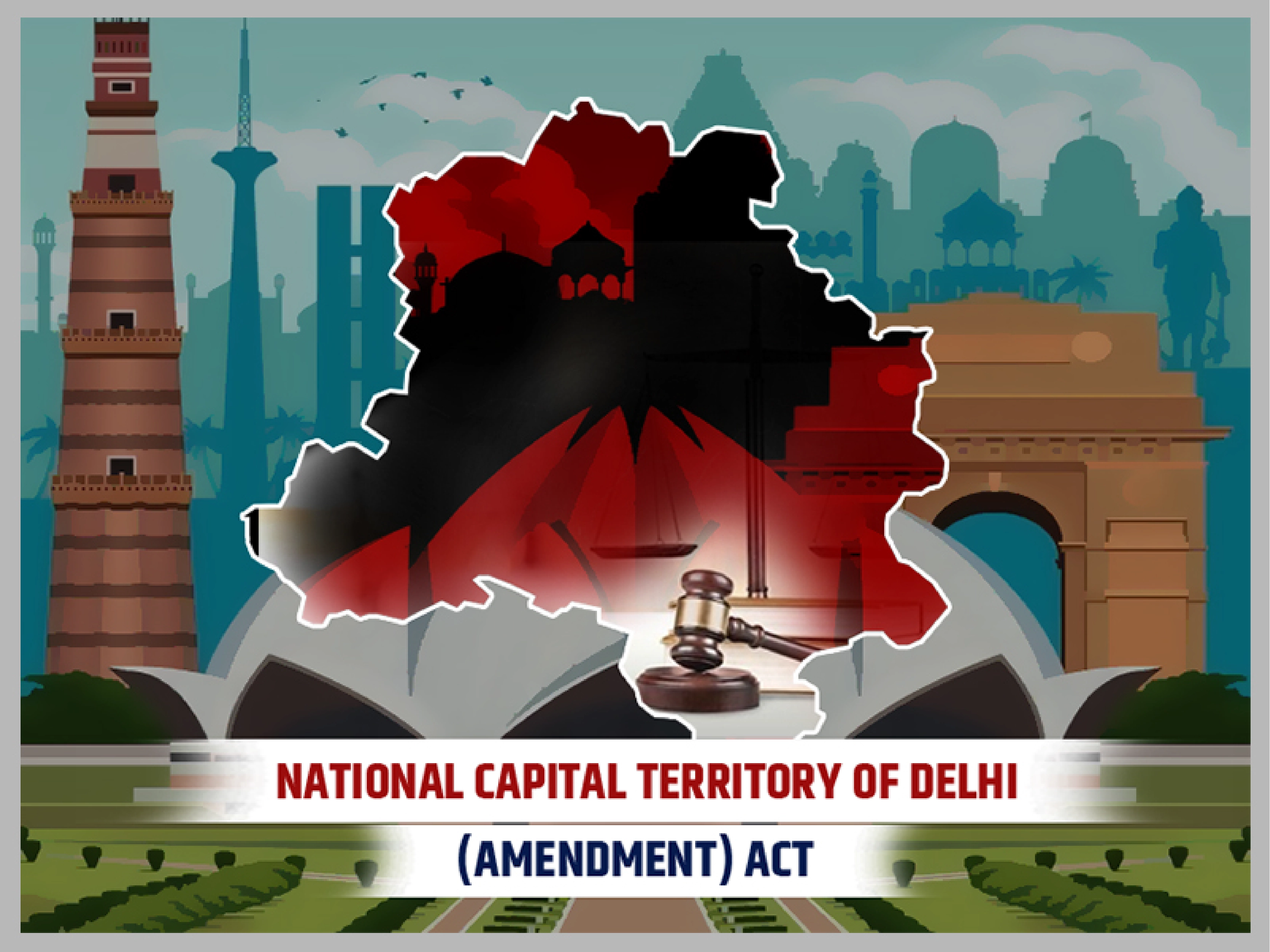
Government of National Capital Territory of Delhi (Amendment) Act, 2023 Issues and Way Forward

Learn about the Government of National Capital Territory of Delhi (Amendment) Act, 2023, its impact on Delhi’s governance, challenges to federalism and democracy, and the way forward for Centre-Delhi relations.

THEIASHUB
Get an Instant Call Back from Our Expert Mentors Now!
+91

Introduction

The Government of National Capital Territory of Delhi (Amendment) Act, 2023 has reignited the debate on Delhi’s governance structure, its autonomy, and the balance of power between the elected Delhi government and the Centre. The Act curtails the authority of the Delhi government over services and administration, expanding the role of the Lieutenant Governor (LG) and the National Capital Civil Services Authority (NCCSA). This raises serious concerns about federalism, democratic representation, and administrative efficiency.
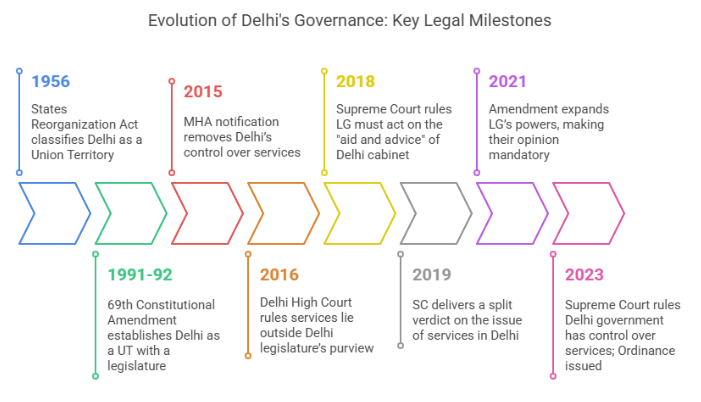
Timeline of Key Legislations and Judgements on Delhi’s Governance


Year

Development

1956

States Reorganization Act classifies Delhi as a Union Territory (UT).

1991-92

69th Constitutional Amendment (Article 239AA) establishes Delhi as a UT with a legislature. The Government of National Capital Territory of Delhi (Amendment) Act, 1991 is passed.

2015

MHA notification removes Delhi’s control over services, giving LG power over bureaucratic appointments and transfers.

2016

Delhi High Court rules that services lie outside the Delhi legislature’s purview.

2018

Supreme Court (Govt. of NCT of Delhi vs Union of India) rules that LG must act on the "aid and advice" of the Delhi cabinet.

2019

SC delivers a split verdict on the issue of services in Delhi.

2021

Government of National Capital Territory of Delhi (Amendment) Act, 1991 amended to expand LG’s powers, making their opinion mandatory on various matters.

2023

Supreme Court (Govt. of NCT of Delhi vs Union of India) rules that Delhi government has control over services. Central Government issues an Ordinance, excluding "services" from Delhi’s legislative purview. Government of National Capital Territory of Delhi (Amendment) Bill, 2023 is passed and receives Presidential assent.


Key Challenges with the Current Model of Governance

1. Undermines Federalism and Accountability

  • Centralization of Power: The Act empowers the NCCSA, which includes two Centre-appointed members, diluting Delhi’s control over civil services.
  • Disruption of Accountability: The Act weakens the triple chain of accountability linking civil services, ministers, legislature, and citizens.

2. Weakens Representative Democracy

  • More Power to the LG: The Act grants the LG exclusive discretionary powers in various domains, reducing the authority of the elected government.
  • Legislative Subordination: The Delhi Assembly is effectively overridden, contradicting the spirit of parliamentary democracy.

3. Dilution of Cabinet’s Collective Responsibility

  • Direct Bureaucratic Access to LG: The Act allows department secretaries to directly approach the LG, bypassing the Chief Minister and ministers.
  • This disrupts the principle of cabinet responsibility, weakening governance efficiency.

4. Administrative Inertia and Delays

  • Mandatory LG Consultation: The Delhi government must seek the LG’s opinion before implementing executive decisions, delaying policy execution.
  • This can lead to bureaucratic inefficiency and governance paralysis.

5. Increased Chances of Misuse and Disputes

  • Vague Terminology: The Act uses ambiguous terms like "sole discretionary power", creating legal uncertainty and room for interpretation-based disputes.

6. Difficulty in Fixing Responsibility

  • Overlapping Jurisdictions: The Act blurs the lines of authority, making it hard to hold officials accountable.
  • Confusion in Decision-Making: This can lead to policy paralysis and governance deadlocks.

7. Reversal of Supreme Court Verdicts

  • Contradicts 2018 & 2023 Supreme Court Rulings which had upheld Delhi’s authority over services.
  • The Act effectively nullifies the Supreme Court’s interpretation of Article 239AA, creating a legal conflict.

8. Against the Spirit of Federalism

  • Reduced Autonomy of Delhi Government: The amendments limit Delhi’s executive and legislative powers, shifting authority to the Centre and the LG.
  • This tilts the balance of power away from the elected government, raising concerns about Delhi’s quasi-statehood status.

Way Forward Towards Harmonious Centre-Delhi Relations

1. Strengthening Balanced Federalism

  • The Delhi and Union Governments must work in collaboration, following the principles of cooperative federalism.
  • Avoid politically motivated conflicts that hamper governance and affect citizens.

2. Encouraging Mature Statesmanship

  • Both the LG and the Chief Minister should respect each other’s constitutional roles and resolve disputes through dialogue and mutual understanding.

3. Respecting the Will of the People

  • Since the elected Delhi government represents the people, it should have greater control over policy decisions, ensuring democratic accountability.

4. Formation of a Joint Committee for Quick Decision-Making

  • A joint committee with representatives from both the LG’s office and the Delhi government can help analyze issues and resolve disputes swiftly.

5. Introducing Time-Bound Decision-Making

  • A fixed time limit for the LG to render opinions on government proposals can prevent administrative delays and ensure faster implementation.

6. Institutionalized Dispute Resolution Mechanism

  • Instead of frequent presidential interventions, an independent dispute resolution body should handle Centre-Delhi conflicts.
  • Other national capitals globally follow structured mechanisms for dispute resolution.

7. Establishing a Clear Responsibility Matrix

  • A structured framework should define clear responsibilities for various authorities, ensuring transparent and accountable governance.

8. Restoring the Legislative Assembly’s Powers

  • The Delhi Assembly’s law-making authority must be reinstated, ensuring legislative control over the executive’s actions.

Conclusion

The Government of National Capital Territory of Delhi (Amendment) Act, 2023 represents a significant shift in Delhi’s governance structure, raising concerns about federalism, democracy, and administrative efficiency. While the Centre has legitimate interests in managing the national capital, the elected Delhi government must have sufficient autonomy to govern effectively.

A balanced approach is necessary, ensuring cooperative federalism, respect for democratic principles, and a governance model that prioritizes citizen welfare over political power struggles. By implementing institutional reforms and fostering mutual cooperation, India can create a more effective and harmonious governance framework for Delhi.

UPSC QEP 2026 Batch 5 - English
Buy now View Details
Submit Your Details to Learn More
I agree to give my consent to receive updates through SMS/Email & WhatsApp*.

NEEV GS + CSAT Foundation 2026/27
Buy now View Details


Join theIAShub’s Mains Answer Writing Program

Refine your answer writing skills and elevate your UPSC preparation with personalized support and expert feedback.

Fill out the form to get started with the program or any other enquiries !
I agree to give my consent to receive updates through SMS/Email & WhatsApp*.

Best IAS Coaching In Delhi, UPSC Online & Offline Classes by IAShub

Are you dreaming of becoming an IAS officer? Then, IAShub can be your best guide. It is one of the Best IAS Coaching in Delhi. Many students who want to clear the UPSC exam join IAShub for learning. The institute gives both online and offline classes. Their teachers are experienced and helpful. They easily explain every topic. Students also get notes, tests, and tips to do well in the exam.

UPSC Online Classes by IAShub

IAShub is in Delhi and is trusted by many UPSC students. It offers coaching for every part of the UPSC exam – Prelims, Mains, and Interview. The classes are simple and easy to understand. The teachers are experts and guide students in the right way. IAShub is also known for its helpful notes, test series, and answer-writing practice. IAShub is the best coaching in Delhi and also gives UPSC Online Classes. This helps students from any place in India to learn. The online classes are live and also recorded. So, students can watch them anytime. These classes cover the full UPSC syllabus.

Key Offerings Provided by IAShub

Here are some important services provided by IAShub:

  • UPSC Prelims: IAShub teaches for Prelims with a focus on basics. It also gives daily current affairs and monthly magazines.
  • Classroom Courses: IAShub has classroom learning for students in Delhi. The environment is good and peaceful for study.
  • Live Classes: Students who live far can join live UPSC online classes. These classes are just like real classes.
  • QEP for Mains: The Quality Enrichment Program (QEP) is special for Mains preparation. It helps students write better and faster.
  • Answer Writing: Regular answer writing practice is given. Teachers also check answers and give tips to improve.
  • Free Resource: IAShub gives free notes by toppers and helpful Main Booster material.
  • Test Series: Test series are available for every subject. These help students know their weak points and improve.
  • Interview Guidance Session: IAShub also gives interview practice sessions with experts. These help students feel confident.

UPSC Exam Overview

The UPSC Civil Services Exam has three parts:

  • Prelims: It has two papers: General Studies and CSAT.
  • Mains: It has nine papers, including essays and optional subjects.
  • Interview: It tests the personality and confidence of the student.

This exam is tough, but with the right guidance, it becomes easy to manage. Students must study smart and stay regular.

How IAShub Helps in the UPSC Journey

IAShub supports students from the beginning to the end. It gives the right books, tests, and notes. The classes are easy to follow, and the teachers are always ready to help. Students get personal doubt sessions too. The test series and answer checking help students learn where they need to do better. Also, free study materials save time and money.
IAShub also guides students during the final stage – the interview. Experts take mock interviews and give useful tips. This full support makes IAShub one of the best IAS coaching in Delhi.

Best IAS Coaching In Delhi FAQs

Yes, IAShub offers live and recorded online classes. Students can attend from any part of India.

Classes are available in both English and Hindi, so students can choose the language they are comfortable with.

The classroom centre is located in Delhi. Students can visit and join offline batches there.

IAShub gives interview guidance sessions to help students prepare for the final round of UPSC.