


Explore the judicial evolution of Fundamental Rights and Directive Principles in India through landmark Supreme Court cases like Kesavananda Bharati, Minerva Mills
 theIASHub | 08 May, 2025

The Indian Constitution is a unique document that balances individual rights with the state's duty to ensure social justice. This balance is reflected in the interplay between Fundamental Rights and Directive Principles of State Policy (Part IV). While Fundamental Rights provide justiciable and enforceable rights to individuals, Directive Principles guide the state in making policies that promote social welfare but are not legally enforceable. Over the years, this conflict has led to several landmark Supreme Court cases, shaping the constitutional framework of India.
Fundamental Rights, enshrined in Articles 12 to 35, ensure individual freedoms and protect citizens against state action. They include the Right to Equality, Right to Freedom, Right against Exploitation, Right to Freedom of Religion, Cultural and Educational Rights, and Right to Constitutional Remedies. These rights are enforceable by courts, meaning individuals can challenge their violation.
Directive Principles, mentioned in Articles 36 to 51, serve as guidelines for the government to achieve socio-economic justice and establish a welfare state. They are inspired by the Irish Constitution and promote principles like equal distribution of wealth, protection of weaker sections, rural development, environmental protection, and promotion of education. However, unlike Fundamental Rights, DPSP are not enforceable by courts.
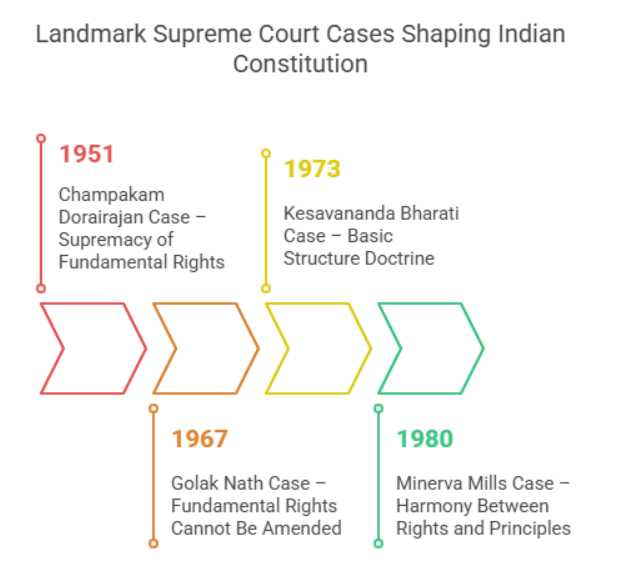
The debate over the supremacy of Fundamental Rights versus Directive Principles has been a significant constitutional issue, leading to several landmark judgments.
In State of Madras v. Champakam Dorairajan (1951), the Supreme Court ruled that Fundamental Rights have primacy over Directive Principles. The case arose when the Madras government introduced caste-based reservations in educational institutions, violating Article 29(2) (Right to Equality). The Court held that since DPSP are non-enforceable (Article 37), they cannot override Fundamental Rights. This judgment led to the First Constitutional Amendment (1951), which introduced Article 15(4) to allow reservations.
In I.C. Golak Nath v. State of Punjab (1967), the Supreme Court declared that Parliament cannot amend Fundamental Rights to implement DPSP. It ruled that Fundamental Rights form the "transcendental position" of the Constitution and cannot be abridged or diluted. This decision posed a challenge to social justice laws, leading to the enactment of the 24th Amendment (1971), which restored Parliament’s power to amend Fundamental Rights.
The Kesavananda Bharati v. State of Kerala (1973) case was a turning point in constitutional history. The Supreme Court ruled that while Parliament has the power to amend any part of the Constitution (including Fundamental Rights), it cannot alter its Basic Structure. This introduced the Basic Structure Doctrine, ensuring that core principles like democracy, rule of law, and judicial independence remain untouched. The case reaffirmed the need to balance Fundamental Rights and Directive Principles, allowing Parliament to amend rights but not destroy their essence.
In Minerva Mills v. Union of India (1980), the Supreme Court reinforced the coexistence of Fundamental Rights and Directive Principles. It declared that both are essential for achieving an egalitarian society and compared them to two wheels of a chariot. The Court struck down Section 4 of the 42nd Amendment, which gave unlimited power to Parliament to amend the Constitution, thereby maintaining the Basic Structure Doctrine.
The judiciary has evolved from an initial stance of Fundamental Rights' supremacy to a harmonized interpretation where both Fundamental Rights and Directive Principles complement each other. Today, courts strive to read DPSP into Fundamental Rights to achieve social justice without violating individual freedoms.
The conflict between Fundamental Rights and Directive Principles has shaped India's constitutional framework significantly. While Fundamental Rights protect individual liberties, DPSP ensures social and economic justice. The Supreme Court has played a crucial role in balancing both, ensuring that amendments and laws align with the Basic Structure of the Constitution. The evolution of this judicial interpretation highlights India’s commitment to a progressive and equitable legal system.



Refine your answer writing skills and elevate your UPSC preparation with personalized support and expert feedback.
Fill out the form to get started with the program or any other enquiries !





Are you dreaming of becoming an IAS officer? Then, IAShub can be your best guide. It is one of the Best IAS Coaching in Delhi. Many students who want to clear the UPSC exam join IAShub for learning. The institute gives both online and offline classes. Their teachers are experienced and helpful. They easily explain every topic. Students also get notes, tests, and tips to do well in the exam.
IAShub is in Delhi and is trusted by many UPSC students. It offers coaching for every part of the UPSC exam – Prelims, Mains, and Interview. The classes are simple and easy to understand. The teachers are experts and guide students in the right way. IAShub is also known for its helpful notes, test series, and answer-writing practice. IAShub is the best coaching in Delhi and also gives UPSC Online Classes. This helps students from any place in India to learn. The online classes are live and also recorded. So, students can watch them anytime. These classes cover the full UPSC syllabus.
Here are some important services provided by IAShub:
The UPSC Civil Services Exam has three parts:
This exam is tough, but with the right guidance, it becomes easy to manage. Students must study smart and stay regular.
IAShub supports students from the beginning to the end. It gives the right books, tests, and notes. The classes are easy to follow, and the teachers are always ready to help. Students get personal doubt sessions too. The test series and answer checking help students learn where they need to do better. Also, free study materials save time and money.
IAShub also guides students during the final stage – the interview. Experts take mock interviews and give useful tips. This full support makes IAShub one of the best IAS coaching in Delhi.
 Detailed Solutions & Explanations
Improve Your Answer Writing & Strategy
Detailed Solutions & Explanations
Improve Your Answer Writing & Strategy

