Right to Freedom of Religion in India Articles 25-28

Learn about the Freedom of Religion in India under Articles 25-28. Understand legal interpretations, anti-conversion laws, the hijab ban, and recent developments.

THEIASHUB
Get an Instant Call Back from Our Expert Mentors Now!
+91

The Freedom of Religion is a fundamental right enshrined in Articles 25-28 of the Indian Constitution. It guarantees every individual the right to profess, practice, and propagate their religion while maintaining a balance between personal faith and secular governance. These provisions ensure that religious freedom does not violate public order, morality, or health.
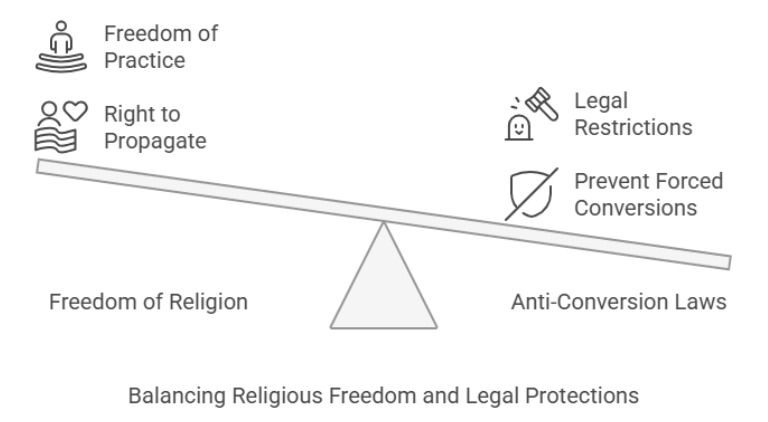
Article 25: Right to Practice and Propagate Religion


Scope of Article 25

Article 25 provides individuals the Freedom of Religion, allowing them to:

  • Profess their religious beliefs openly.

  • Practice rituals and traditions freely.

  • Propagate their religion to others.

However, this right is subject to public order, morality, and health, ensuring that religious practices do not harm society.

Religious Conversion and Supreme Court’s Stand

While Freedom of Religion includes the right to propagate beliefs, it does not allow forced conversions. The Supreme Court has ruled that:

  • Forced conversions can threaten national security.

  • Every person has the right to freedom of conscience.

Anti-Conversion Laws in India

To prevent forced religious conversions, several Indian states have implemented anti-conversion laws, including:

  • Madhya Pradesh

  • Gujarat

  • Uttarakhand

  • Chhattisgarh

  • Jharkhand

Religious Conversions and Charitable Activities

The Supreme Court, led by Justice M.R. Shah, ruled that charitable acts should not be misused to influence religious conversions. Freedom of Religion should not be exploited for personal or political gains.

Article 26: Freedom to Manage Religious Institutions

Collective vs. Individual Religious Rights

While Article 25 protects individual rights, Article 26 ensures the autonomy of religious institutions to:

  • Establish and maintain religious places.

  • Manage religious affairs without government interference.

  • Own and administer property for religious purposes.

Judicial Interpretation of Article 26

In Fathima Tasneem v. State of Kerala (2018), the Kerala High Court ruled that institutional religious rights can take precedence over individual religious rights in certain cases.

Uniform Civil Code (UCC) Debate

The 22nd Law Commission of India is considering a Uniform Civil Code (UCC) to unify personal laws. While some believe it promotes equality, others argue it may restrict Freedom of Religion.

Recent Development: Waqf (Amendment) Bill, 2024

The government introduced amendments to the Waqf Boards Act (1995), increasing state control over Waqf properties. Critics argue this move could infringe upon religious autonomy.
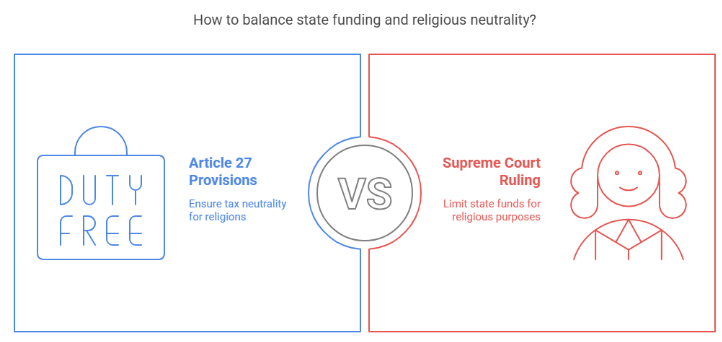
Article 27: No Tax for Religious Promotion


Article 27 ensures that no person is forced to pay taxes for promoting any particular religion.

State of Gujarat v. Islamic Relief Committee Case

The Supreme Court ruled that:

  • State funds cannot be used to restore religious shrines.

  • Compensation can only be provided for violations of the right to life, not for religious grievances.

Article 28: Religious Instruction in Educational Institutions

Key Provisions of Article 28

  • Article 28(1): No religious instruction in government-funded schools.

  • Article 28(2): Religious instruction is allowed in state-aided private institutions, but attendance cannot be forced.

  • Article 28(3): Religious institutions managing educational bodies are exempt from these restrictions.

Religious Freedom and the Hijab Controversy in Karnataka

Karnataka Hijab Ban Case

The Karnataka High Court ruled that:

  • The hijab is not an essential religious practice under Islam.

  • School uniforms are a reasonable constitutional restriction.

Doctrine of Essential Religious Practices

  • In Shirur Mutt Case (1954), the Supreme Court ruled that only essential religious practices are protected.

  • Muslim students challenged the hijab ban, citing Bijoe Emmanuel v. State of Kerala (1986), which protected students from being forced to sing the national anthem based on their religious beliefs.

Challenges in Enforcing Freedom of Religion

Despite constitutional protections, challenges remain:

  • Tensions between religious freedom and public order.

  • Misuse of religious conversions for political or social influence.

  • State intervention in religious institutions.

Way Forward: Strengthening Religious Freedom in India

To ensure a balanced approach, India should:

  • Strengthen legal protections against religious discrimination.

  • Promote interfaith dialogue to maintain communal harmony.

  • Ensure judicial independence in resolving religious conflicts.

  • Monitor violations of religious freedom through independent bodies.

Conclusion

Articles 25-28 of the Indian Constitution provide a comprehensive framework for religious freedom while ensuring that secular principles are upheld. Recent legal debates, such as the hijab ban and anti-conversion laws, continue to shape India’s Freedom of Religion. The challenge lies in maintaining a balance between individual rights, social harmony, and national security.


UPSC QEP 2026 Batch 5 - English
Buy now View Details
Submit Your Details to Learn More
I agree to give my consent to receive updates through SMS/Email & WhatsApp*.

NEEV GS + CSAT Foundation 2026/27
Buy now View Details


Join theIAShub’s Mains Answer Writing Program

Refine your answer writing skills and elevate your UPSC preparation with personalized support and expert feedback.

Fill out the form to get started with the program or any other enquiries !

I agree to give my consent to receive updates through SMS/Email & WhatsApp*.

Best IAS Coaching In Delhi, UPSC Online & Offline Classes by IAShub

Are you dreaming of becoming an IAS officer? Then, IAShub can be your best guide. It is one of the Best IAS Coaching in Delhi. Many students who want to clear the UPSC exam join IAShub for learning. The institute gives both online and offline classes. Their teachers are experienced and helpful. They easily explain every topic. Students also get notes, tests, and tips to do well in the exam.

UPSC Online Classes by IAShub

IAShub is in Delhi and is trusted by many UPSC students. It offers coaching for every part of the UPSC exam – Prelims, Mains, and Interview. The classes are simple and easy to understand. The teachers are experts and guide students in the right way. IAShub is also known for its helpful notes, test series, and answer-writing practice. IAShub is the best coaching in Delhi and also gives UPSC Online Classes. This helps students from any place in India to learn. The online classes are live and also recorded. So, students can watch them anytime. These classes cover the full UPSC syllabus.

Key Offerings Provided by IAShub

Here are some important services provided by IAShub:

  • UPSC Prelims: IAShub teaches for Prelims with a focus on basics. It also gives daily current affairs and monthly magazines.
  • Classroom Courses: IAShub has classroom learning for students in Delhi. The environment is good and peaceful for study.
  • Live Classes: Students who live far can join live UPSC online classes. These classes are just like real classes.
  • QEP for Mains: The Quality Enrichment Program (QEP) is special for Mains preparation. It helps students write better and faster.
  • Answer Writing: Regular answer writing practice is given. Teachers also check answers and give tips to improve.
  • Free Resource: IAShub gives free notes by toppers and helpful Main Booster material.
  • Test Series: Test series are available for every subject. These help students know their weak points and improve.
  • Interview Guidance Session: IAShub also gives interview practice sessions with experts. These help students feel confident.

UPSC Exam Overview

The UPSC Civil Services Exam has three parts:

  • Prelims: It has two papers: General Studies and CSAT.
  • Mains: It has nine papers, including essays and optional subjects.
  • Interview: It tests the personality and confidence of the student.

This exam is tough, but with the right guidance, it becomes easy to manage. Students must study smart and stay regular.

How IAShub Helps in the UPSC Journey

IAShub supports students from the beginning to the end. It gives the right books, tests, and notes. The classes are easy to follow, and the teachers are always ready to help. Students get personal doubt sessions too. The test series and answer checking help students learn where they need to do better. Also, free study materials save time and money.
IAShub also guides students during the final stage – the interview. Experts take mock interviews and give useful tips. This full support makes IAShub one of the best IAS coaching in Delhi.

Best IAS Coaching In Delhi FAQs

Yes, IAShub offers live and recorded online classes. Students can attend from any part of India.

Classes are available in both English and Hindi, so students can choose the language they are comfortable with.

The classroom centre is located in Delhi. Students can visit and join offline batches there.

IAShub gives interview guidance sessions to help students prepare for the final round of UPSC.