Election Commission Structure, Powers, and Key Challenges

Learn about the Election Commission, its role, challenges, and key reforms needed to ensure free and fair elections in India.

THEIASHUB
Get an Instant Call Back from Our Expert Mentors Now!
+91

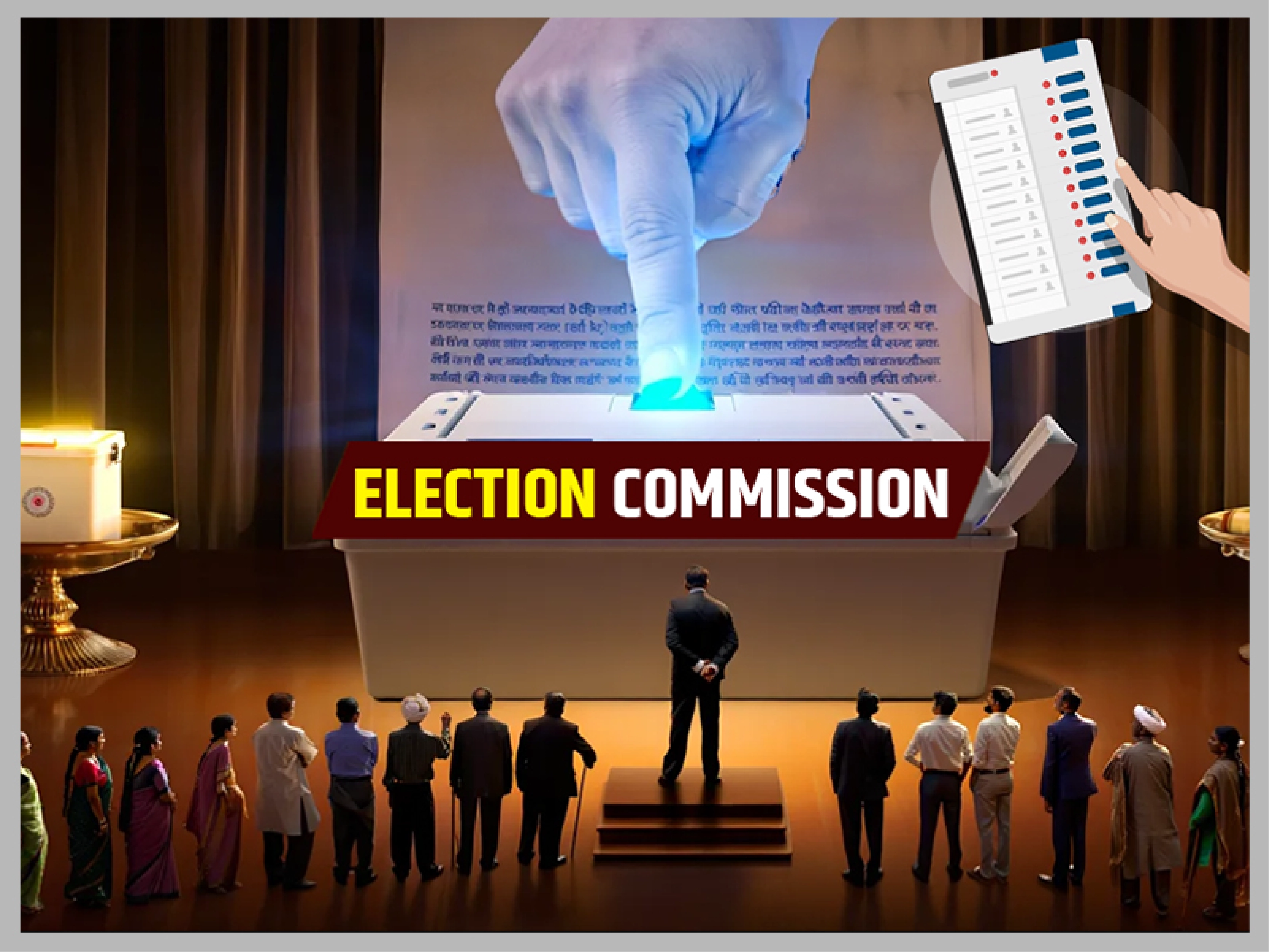
The Election Commission is a constitutional body under Article 324 of the Indian Constitution, responsible for conducting free and fair elections in India. It supervises elections to Parliament, state legislatures, and the offices of the President and Vice President. However, elections for Panchayats and Municipalities fall under the State Election Commissions, as per the 72nd and 73rd Constitutional Amendments of 1992. The Election Commission plays a vital role in strengthening democracy by ensuring transparency and electoral integrity.
Composition of the Election Commission


The Election Commission consists of a Chief Election Commissioner (CEC) and two Election Commissioners (ECs), all appointed by the President of India.
1. Evolution of the Election Commission

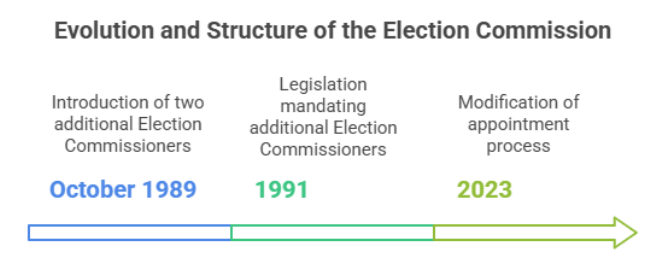
  • Until October 1989, the Election Commission had only one CEC.

  • In 1991, Parliament passed legislation mandating the appointment of two additional Election Commissioners.

2. Appointment Process

  • The President appoints the CEC and ECs under Article 324(2).

  • The appointment process was modified under the Chief Election Commissioner and Other Election Commissioners (Appointment, Conditions of Service, and Term of Office) Act, 2023.

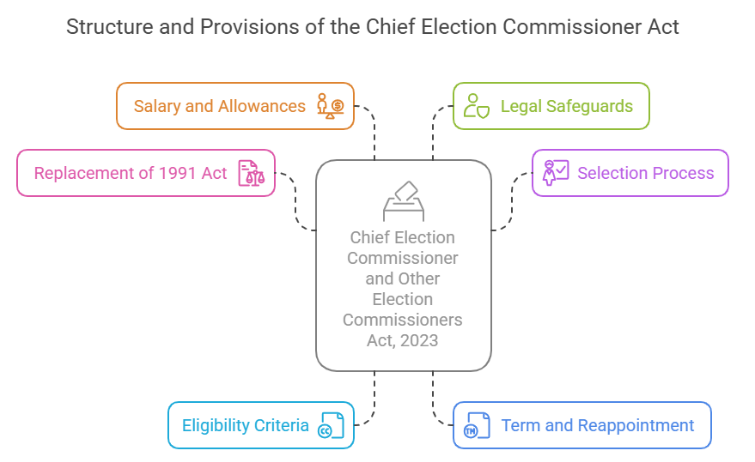
The Chief Election Commissioner and Other Election Commissioners Act, 2023


Key Features of the Act

  1. Replacement of 1991 Act: This Act replaces the Election Commission (Conditions of Service of Election Commissioners and Transaction of Business) Act, 1991.

  2. Selection Process: The Selection Committee recommends appointments to the President.

    • Members of the Selection Committee:

      • Prime Minister

      • A Cabinet Minister (nominated by the PM)

      • Leader of Opposition (or leader of the single largest opposition party in Lok Sabha)

  3. Search Committee: Headed by the Minister of Law and Justice, with two senior government officials preparing a panel of five names.

  4. Eligibility: Candidates must have held a post equivalent to Secretary to the Government of India and have experience in managing elections.

  5. Term and Reappointment:

    • Term of six years or until the age of 65 years, whichever is earlier.

    • No reappointment after completing a term.

    • If an Election Commissioner is promoted to CEC, the total tenure cannot exceed six years.

  6. Salary and Allowances: Equivalent to a Supreme Court Judge.

  7. Legal Safeguards: Courts cannot entertain civil or criminal cases against current or former CEC and ECs for actions taken in their official capacity.

  8. Removal Process: The CEC is removed like a Supreme Court judge, but ECs can be removed on the CEC’s recommendation.

Key Issues with the Act

  1. Government Dominance in Selection:

    • The PM and a Cabinet Minister dominate the Selection Committee, potentially leading to biased appointments.

    • If there is no Leader of Opposition, only ruling party members will be in the Selection Committee.

  2. Deviation from Supreme Court Guidelines (2023):

    • The SC had recommended a Selection Committee comprising the PM, Chief Justice of India, and Leader of Opposition, which is not followed in the Act.

  3. Search Committee’s Role is Undermined:

    • The Selection Committee can ignore the recommendations of the Search Committee, reducing its significance.

  4. Narrow Eligibility Criteria:

    • Limiting appointments to Secretary-level officers excludes other qualified individuals.

  5. Unequal Removal Protection:

    • While the CEC is protected, ECs can be removed based on CEC’s recommendation, affecting their independence.

Other Challenges Facing the Election Commission

1. Lack of Rule-Making Power

  • The Election Commission does not have the authority to frame election-related rules under the Representation of the People Act (RPA), 1951.

  • The power to make rules remains with the central government, limiting ECI’s autonomy.

2. Lack of Independent Secretariat

  • The Election Commission relies on the Department of Personnel and Training (DoPT) for officer appointments.

  • This dependency on the executive affects its operational independence.

3. Financial Autonomy

  • The Election Commission’s budget is not charged to the Consolidated Fund of India and is subject to parliamentary approval.

  • This can impact its functioning, especially during politically sensitive elections.

4. Dependence on Government Machinery

  • The Election Commission depends on the executive branch for security forces, logistics, and election administration, affecting its neutrality.

5. Lack of Power to Countermand Elections for Money Power

  • The Election Commission has limited authority to postpone or cancel elections in cases where money power influences voters.

Key Recommendations to Strengthen the Election Commission

  1. Depoliticize Appointments

    • A broad-based collegium should appoint the CEC and ECs, including the Prime Minister, Leader of Opposition, and Chief Justice of India.

  2. Equal Protection for All Election Commissioners

    • The Supreme Court has recommended that all Election Commissioners should have the same removal protections as the CEC.

  3. Automatic Promotion of Senior ECs to CEC

    • The senior-most Election Commissioner should automatically become CEC, ensuring continuity and reducing government interference.

  4. Financial Independence

    • The Election Commission’s budget should be directly charged to the Consolidated Fund of India, removing financial dependence on the government.

  5. Independent Secretariat for the ECI

    • The Election Commission should have its own independent secretariat, reducing reliance on government agencies for staffing and administration.

  6. Power to Frame Election Rules

    • The Election Commission should be empowered to make rules under the RPA Act, reducing dependence on the government.

  7. Power to Deregister Political Parties

    • The Election Commission should have the authority to deregister political parties that violate electoral laws.

  8. Timely Electoral Reforms

    • Recommendations by committees like the Law Commission (255th Report) and Goswami Committee should be implemented to enhance electoral integrity.

Conclusion

The Election Commission is the cornerstone of India’s democratic system, ensuring free and fair elections. However, concerns regarding government influence, lack of financial independence, and limited rule-making powers need urgent reforms. Strengthening the Election Commission’s autonomy through transparent appointments, financial independence, and enhanced powers will help uphold the sanctity of electoral democracy in India.



UPSC QEP 2026 Batch 5 - English
Buy now View Details
Submit Your Details to Learn More
I agree to give my consent to receive updates through SMS/Email & WhatsApp*.

NEEV GS + CSAT Foundation 2026/27
Buy now View Details


Join theIAShub’s Mains Answer Writing Program

Refine your answer writing skills and elevate your UPSC preparation with personalized support and expert feedback.

Fill out the form to get started with the program or any other enquiries !

I agree to give my consent to receive updates through SMS/Email & WhatsApp*.

Best IAS Coaching In Delhi, UPSC Online & Offline Classes by IAShub

Are you dreaming of becoming an IAS officer? Then, IAShub can be your best guide. It is one of the Best IAS Coaching in Delhi. Many students who want to clear the UPSC exam join IAShub for learning. The institute gives both online and offline classes. Their teachers are experienced and helpful. They easily explain every topic. Students also get notes, tests, and tips to do well in the exam.

UPSC Online Classes by IAShub

IAShub is in Delhi and is trusted by many UPSC students. It offers coaching for every part of the UPSC exam – Prelims, Mains, and Interview. The classes are simple and easy to understand. The teachers are experts and guide students in the right way. IAShub is also known for its helpful notes, test series, and answer-writing practice. IAShub is the best coaching in Delhi and also gives UPSC Online Classes. This helps students from any place in India to learn. The online classes are live and also recorded. So, students can watch them anytime. These classes cover the full UPSC syllabus.

Key Offerings Provided by IAShub

Here are some important services provided by IAShub:

  • UPSC Prelims: IAShub teaches for Prelims with a focus on basics. It also gives daily current affairs and monthly magazines.
  • Classroom Courses: IAShub has classroom learning for students in Delhi. The environment is good and peaceful for study.
  • Live Classes: Students who live far can join live UPSC online classes. These classes are just like real classes.
  • QEP for Mains: The Quality Enrichment Program (QEP) is special for Mains preparation. It helps students write better and faster.
  • Answer Writing: Regular answer writing practice is given. Teachers also check answers and give tips to improve.
  • Free Resource: IAShub gives free notes by toppers and helpful Main Booster material.
  • Test Series: Test series are available for every subject. These help students know their weak points and improve.
  • Interview Guidance Session: IAShub also gives interview practice sessions with experts. These help students feel confident.

UPSC Exam Overview

The UPSC Civil Services Exam has three parts:

  • Prelims: It has two papers: General Studies and CSAT.
  • Mains: It has nine papers, including essays and optional subjects.
  • Interview: It tests the personality and confidence of the student.

This exam is tough, but with the right guidance, it becomes easy to manage. Students must study smart and stay regular.

How IAShub Helps in the UPSC Journey

IAShub supports students from the beginning to the end. It gives the right books, tests, and notes. The classes are easy to follow, and the teachers are always ready to help. Students get personal doubt sessions too. The test series and answer checking help students learn where they need to do better. Also, free study materials save time and money.
IAShub also guides students during the final stage – the interview. Experts take mock interviews and give useful tips. This full support makes IAShub one of the best IAS coaching in Delhi.

Best IAS Coaching In Delhi FAQs

Yes, IAShub offers live and recorded online classes. Students can attend from any part of India.

Classes are available in both English and Hindi, so students can choose the language they are comfortable with.

The classroom centre is located in Delhi. Students can visit and join offline batches there.

IAShub gives interview guidance sessions to help students prepare for the final round of UPSC.