


Explore Directive Principles of State Policy Criticism, legal conflicts, and how India addresses DPSPs through government schemes and constitutional interpretation.
 theIASHub | 08 May, 2025

Directive Principles of State Policy Criticism focuses on analyzing the limitations, structural issues, and conflicts associated with DPSPs in India. While DPSPs aim to ensure social justice policies in India and promote a welfare state, their non-enforceable nature raises concerns. This article explains the key criticisms and highlights government efforts to implement these principles.
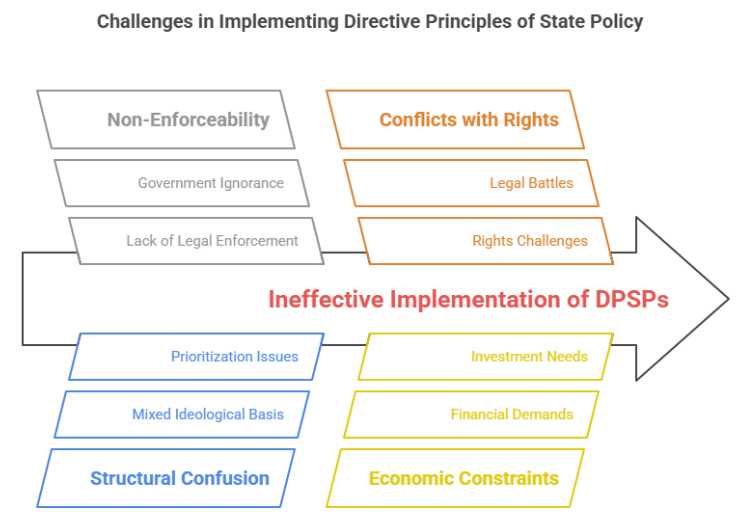
The primary Directive Principles of State Policy Criticism is their non-justiciable status. According to Article 37, DPSPs cannot be enforced in courts. Governments may ignore them due to limited resources or shifting political priorities, weakening their impact on real-world governance.
Another major Directive Principles of State Policy Criticism is their lack of a structured format. They combine Gandhian, socialist, and liberal ideas, leading to confusion in interpretation. Without a logical arrangement, prioritizing implementation becomes difficult for policymakers.
Some DPSPs have raised modern concerns:
Such issues add to the Directive Principles of State Policy Criticism due to their controversial impact in a pluralistic society.
Conflicts between DPSP and Fundamental Rights have triggered legal battles. For instance:
Cases like Kesavananda Bharati and NJAC verdict highlight how DPSPs sometimes challenge core rights, deepening Directive Principles of State Policy Criticism.
Many DPSPs demand massive financial support. Welfare schemes like free education, healthcare, and employment require substantial investment. This raises a valid Directive Principles of State Policy Criticism, as economic challenges in DPSP implementation hinder timely execution.
Despite ongoing Directive Principles of State Policy Criticism, governments have launched schemes addressing various directives.
While Directive Principles of State Policy Criticism exposes several flaws—non-enforceability, legal conflicts, vague structure, and economic barriers—it’s undeniable that DPSPs have guided significant reforms. Through proactive governance, targeted schemes, and judicial interpretation, India continues to balance its constitutional ideals. Understanding Directive Principles of State Policy Criticism helps policymakers and citizens improve implementation and drive welfare-based development.

Refine your answer writing skills and elevate your UPSC preparation with personalized support and expert feedback.
Fill out the form to get started with the program or any other enquiries !
Are you dreaming of becoming an IAS officer? Then, IAShub can be your best guide. It is one of the Best IAS Coaching in Delhi. Many students who want to clear the UPSC exam join IAShub for learning. The institute gives both online and offline classes. Their teachers are experienced and helpful. They easily explain every topic. Students also get notes, tests, and tips to do well in the exam.
IAShub is in Delhi and is trusted by many UPSC students. It offers coaching for every part of the UPSC exam – Prelims, Mains, and Interview. The classes are simple and easy to understand. The teachers are experts and guide students in the right way. IAShub is also known for its helpful notes, test series, and answer-writing practice. IAShub is the best coaching in Delhi and also gives UPSC Online Classes. This helps students from any place in India to learn. The online classes are live and also recorded. So, students can watch them anytime. These classes cover the full UPSC syllabus.
Here are some important services provided by IAShub:
The UPSC Civil Services Exam has three parts:
This exam is tough, but with the right guidance, it becomes easy to manage. Students must study smart and stay regular.
IAShub supports students from the beginning to the end. It gives the right books, tests, and notes. The classes are easy to follow, and the teachers are always ready to help. Students get personal doubt sessions too. The test series and answer checking help students learn where they need to do better. Also, free study materials save time and money.
IAShub also guides students during the final stage – the interview. Experts take mock interviews and give useful tips. This full support makes IAShub one of the best IAS coaching in Delhi.
 Detailed Solutions & Explanations
Improve Your Answer Writing & Strategy
Detailed Solutions & Explanations
Improve Your Answer Writing & Strategy

