Directive Principles of State Policy (DPSP) in India Features, Significance, and Amendments

Learn about the Directive Principles of State Policy (DPSP) in India, their features, significance, and amendments. Explore how DPSPs shape governance, social justice, and policy-making for a welfare state.

THEIASHUB
Get an Instant Call Back from Our Expert Mentors Now!
+91

The Directive Principles of State Policy (DPSP) form a crucial part of the Indian Constitution, serving as a guiding framework for governance. Inspired by the Irish Constitution, Directive Principles of State Policy (DPSP) is aimed at establishing a welfare state and promoting economic and social democracy. Although not legally enforceable, they provide policy direction for governments to ensure justice, equity, and public welfare.
Features and Significance of Directive Principles of State Policy (DPSP)


1. Social, Economic, and Political Justice

Directive Principles of State Policy (DPSP)s aim to create a just and equitable society by ensuring:
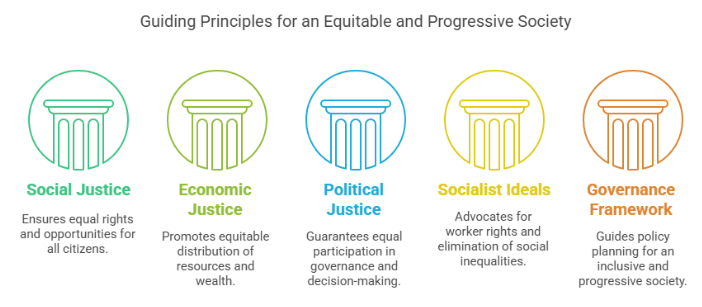
  • Social Justice: Equal rights and opportunities for all citizens.
  • Economic Justice: Equitable distribution of resources and wealth.
  • Political Justice: Equal participation in governance and decision-making.

2. Non-Justiciable Nature

  • Unlike Fundamental Rights, Directive Principles of State Policy (DPSP)s cannot be enforced by courts.
  • They act as moral obligations for governments to formulate policies that align with the Constitution’s vision.

3. Directive in Nature

  • DPSPs serve as policy guidelines for both central and state governments.
  • They help in shaping legislative and executive actions for social welfare and development.

4. Promotion of Socialist Ideals

  • Encourage equitable wealth distribution and elimination of social inequalities.
  • Advocate for worker rights, fair wages, and industrial participation.

5. Governance Framework for an Egalitarian Society

  • DPSPs guide long-term policy planning for an inclusive and progressive society.
  • They form the basis of several socio-economic reforms, such as land reforms, labor laws, and education policies.

6. Bridging the Gap Between Fundamental Rights and Implementation

  • While Fundamental Rights guarantee freedoms, DPSPs ensure state responsibility in making those rights meaningful.
  • For example, Right to Education (Article 21A) was derived from Article 45 Directive Principles of State Policy (DPSP), which originally suggested free and compulsory education.

Key Amendments in Directive Principles of State Policy (DPSP)


Over the years, DPSPs have been modified through constitutional amendments to address evolving socio-economic needs.

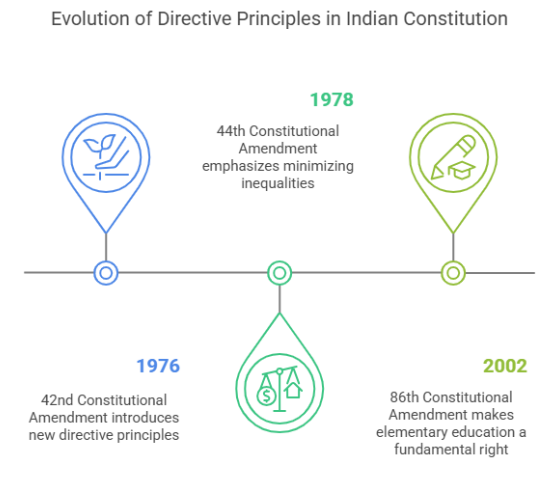
1. 42nd Constitutional Amendment (1976)

This major amendment introduced new directive principles to strengthen social justice and environmental protection:

  • Article 39A: Free legal aid for economically weaker sections.
  • Article 43A: Encouraged worker participation in industrial management.
  • Article 48A: Stressed environmental protection and conservation of forests and wildlife.

2. 44th Constitutional Amendment (1978)

  • Inserted Section 2 in Article 38, emphasizing the state’s duty to minimize inequalities in income, status, and opportunities.
  • Right to Property was removed as a Fundamental Right and placed under Article 300A, making it a legal right instead.

3. 86th Constitutional Amendment (2002)

  • Modified Article 45, making elementary education a fundamental right.
  • Introduced Article 21A, ensuring free and compulsory education for children between 6 to 14 years.

Conclusion

The Directive Principles of State Policy act as a moral and constitutional compass for governance, shaping laws and policies in education, economy, environment, and social justice. While they lack legal enforceability, their impact is evident in progressive reforms and welfare programs in India. As the nation evolves, periodic amendments and judicial interpretations continue to strengthen the role of Directive Principles of State Policy (DPSP) in shaping a just and equitable society.



UPSC QEP 2026 Batch 5 - English
Buy now View Details
Submit Your Details to Learn More
I agree to give my consent to receive updates through SMS/Email & WhatsApp*.

NEEV GS + CSAT Foundation 2026/27
Buy now View Details


Join theIAShub’s Mains Answer Writing Program

Refine your answer writing skills and elevate your UPSC preparation with personalized support and expert feedback.

Fill out the form to get started with the program or any other enquiries !

I agree to give my consent to receive updates through SMS/Email & WhatsApp*.

Best IAS Coaching In Delhi, UPSC Online & Offline Classes by IAShub

Are you dreaming of becoming an IAS officer? Then, IAShub can be your best guide. It is one of the Best IAS Coaching in Delhi. Many students who want to clear the UPSC exam join IAShub for learning. The institute gives both online and offline classes. Their teachers are experienced and helpful. They easily explain every topic. Students also get notes, tests, and tips to do well in the exam.

UPSC Online Classes by IAShub

IAShub is in Delhi and is trusted by many UPSC students. It offers coaching for every part of the UPSC exam – Prelims, Mains, and Interview. The classes are simple and easy to understand. The teachers are experts and guide students in the right way. IAShub is also known for its helpful notes, test series, and answer-writing practice. IAShub is the best coaching in Delhi and also gives UPSC Online Classes. This helps students from any place in India to learn. The online classes are live and also recorded. So, students can watch them anytime. These classes cover the full UPSC syllabus.

Key Offerings Provided by IAShub

Here are some important services provided by IAShub:

  • UPSC Prelims: IAShub teaches for Prelims with a focus on basics. It also gives daily current affairs and monthly magazines.
  • Classroom Courses: IAShub has classroom learning for students in Delhi. The environment is good and peaceful for study.
  • Live Classes: Students who live far can join live UPSC online classes. These classes are just like real classes.
  • QEP for Mains: The Quality Enrichment Program (QEP) is special for Mains preparation. It helps students write better and faster.
  • Answer Writing: Regular answer writing practice is given. Teachers also check answers and give tips to improve.
  • Free Resource: IAShub gives free notes by toppers and helpful Main Booster material.
  • Test Series: Test series are available for every subject. These help students know their weak points and improve.
  • Interview Guidance Session: IAShub also gives interview practice sessions with experts. These help students feel confident.

UPSC Exam Overview

The UPSC Civil Services Exam has three parts:

  • Prelims: It has two papers: General Studies and CSAT.
  • Mains: It has nine papers, including essays and optional subjects.
  • Interview: It tests the personality and confidence of the student.

This exam is tough, but with the right guidance, it becomes easy to manage. Students must study smart and stay regular.

How IAShub Helps in the UPSC Journey

IAShub supports students from the beginning to the end. It gives the right books, tests, and notes. The classes are easy to follow, and the teachers are always ready to help. Students get personal doubt sessions too. The test series and answer checking help students learn where they need to do better. Also, free study materials save time and money.
IAShub also guides students during the final stage – the interview. Experts take mock interviews and give useful tips. This full support makes IAShub one of the best IAS coaching in Delhi.

Best IAS Coaching In Delhi FAQs

Yes, IAShub offers live and recorded online classes. Students can attend from any part of India.

Classes are available in both English and Hindi, so students can choose the language they are comfortable with.

The classroom centre is located in Delhi. Students can visit and join offline batches there.

IAShub gives interview guidance sessions to help students prepare for the final round of UPSC.