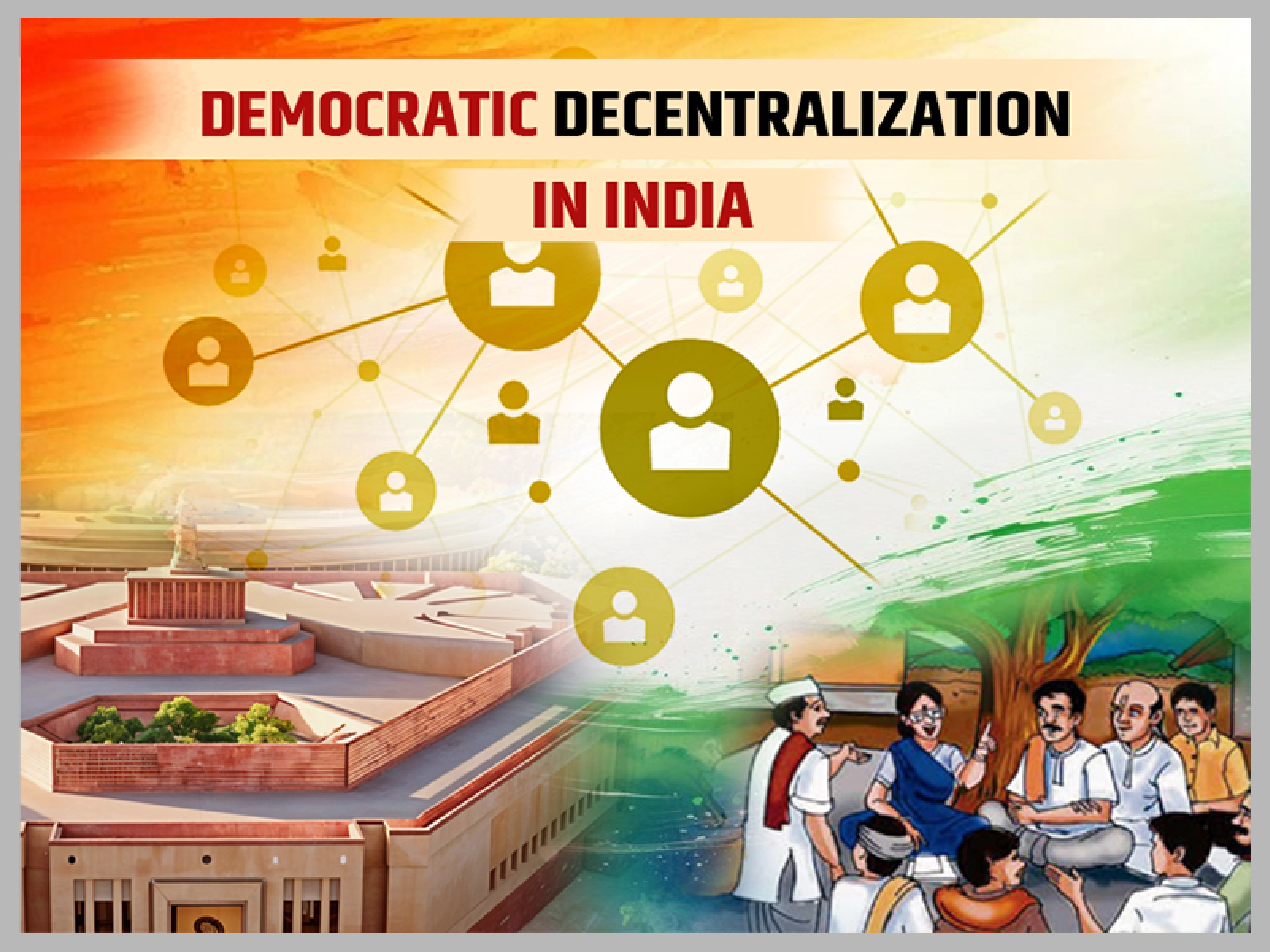
Democratic Decentralization in India Significance and Implementation

Learn about democratic decentralization in India, its significance, and constitutional provisions like the Panchayati Raj System, Urban Local Bodies, and PESA Act.

THEIASHUB
Get an Instant Call Back from Our Expert Mentors Now!
+91

Democratic decentralization in India has deep historical roots, tracing back to ancient times when local self-government played a crucial role in administration. However, as an organizational concept, it gained prominence with Lord Ripon's resolution of 1882. Since then, India has developed a robust decentralized governance framework, spanning over a century.

The concept of devolution of power in India refers to transferring political authority and decision-making powers from the central government to state governments and local bodies. This approach enhances governance efficiency, promotes regional representation, and strengthens grassroots democracy.

Significance of Democratic Decentralization

1. Effective Planning for Diverse Regions

Democratic decentralization enables tailor-made planning that addresses the unique needs of different regions and social groups. India is a diverse nation with multiple ethnic, religious, and linguistic communities. By decentralizing decision-making, regional authorities can create policies that reflect local priorities. This leads to:

  • Political Stability: Ensuring representation of all sections of society, including marginalized communities.
  • Greater Equity: More inclusive decision-making processes with fair representation of various political, religious, and tribal groups.
  • Lower Planning Costs: Decentralized governance reduces administrative costs and enhances public service delivery.

2. Strengthening Government-Public Relations

Decentralization bridges the gap between government officials and the local population, facilitating direct engagement. This proximity leads to:

  • Reduced Bureaucratic Delays: Minimizing red tape and making governance more responsive.
  • Better Policy Implementation: National policies can penetrate deeper into remote and rural areas.
  • Empowered Local Administration: Citizens have greater control over governance, leading to higher accountability.

3. Capacity Building and Institutional Development

Local self-government institutions develop their managerial and technical expertise through decentralized governance. This results in:

  • Stronger Local Institutions: Panchayats and municipal bodies evolve into effective administrative units.
  • Skill Enhancement: Government functionaries at the local level receive better training and exposure.
  • Community Participation: People get involved in decision-making, making governance more participatory.

4. Reducing Elite Domination

In a centralized system, policymaking is often influenced by elite groups. Democratic decentralization allows grassroots participation, ensuring that policies align with the needs of common people. Key benefits include:

  • Better Execution of Projects: Locals understand their region’s needs better than distant bureaucrats.
  • Efficient Monitoring and Evaluation: Community members can oversee development projects, reducing corruption.
  • Increased Transparency: Citizens hold local leaders accountable for governance and public spending.

5. Enhanced Focus on Development

A decentralized system allows senior government officials to focus on policy formulation and national development rather than day-to-day administration. This leads to:

  • Relief for Top Management: Higher authorities can devote more time to strategic governance.
  • Improved Innovation: Decentralized governance fosters creativity and flexibility in administration.
  • Efficient Resource Allocation: Local governments can distribute resources based on real-time community needs.

Democratic Decentralization in India: Constitutional Provisions

1. Panchayati Raj System (Rural Governance)

The 73rd Amendment Act of 1992 granted constitutional recognition to Panchayati Raj Institutions (PRIs), strengthening grassroots democracy. Key features include:

  • Three-Tier System: Gram Panchayat (village), Panchayat Samiti (block), and Zilla Parishad (district).
  • Regular Elections: Ensuring democratic functioning at all levels.
  • Reserved Seats: Special provisions for Scheduled Castes, Scheduled Tribes, and women.
  • Financial Empowerment: Panchayats receive direct financial allocations for development work.

2. Urban Local Bodies (Municipal Governance)

The 74th Amendment Act of 1992 provided constitutional status to Urban Local Bodies (ULBs), ensuring decentralized governance in cities and towns. Key provisions include:

  • Municipal Corporations, Councils, and Nagar Panchayats: Different governance structures based on urban population.
  • Direct Elections: Citizens elect municipal representatives for better accountability.
  • Empowerment of Mayors: Strengthened leadership at the municipal level.
  • Urban Development Planning: Focus on sustainable infrastructure, sanitation, and public welfare.

3. Panchayat Extension to Scheduled Areas (PESA) Act, 1996

The PESA Act, 1996 extended the 73rd Amendment to tribal-dominated areas in 10 Indian states with certain modifications. It ensures:

  • Autonomy for Tribal Governance: Protecting the cultural identity of indigenous communities.
  • Control Over Resources: Tribals have a say in land and forest management.
  • Customary Laws: Recognizing traditional dispute resolution mechanisms.

Challenges in Democratic Decentralization

Despite its advantages, decentralized governance in India faces several obstacles:

  • Financial Dependence: Local bodies often rely on state and central government funds.
  • Lack of Awareness: Many citizens are unaware of their rights and responsibilities.
  • Political Interference: Local governance is sometimes dominated by political elites.
  • Capacity Constraints: Many local institutions lack skilled personnel and proper infrastructure.

Conclusion

Democratic decentralization is a crucial aspect of India’s governance framework, ensuring greater participation, transparency, and efficiency. The 73rd and 74th Constitutional Amendments have institutionalized local governance, empowering rural and urban bodies. However, challenges remain in terms of financial independence and administrative efficiency. Strengthening local self-government through policy reforms and capacity-building initiatives will further enhance India’s democratic fabric.



UPSC QEP 2026 Batch 5 - English
Buy now View Details
Submit Your Details to Learn More
I agree to give my consent to receive updates through SMS/Email & WhatsApp*.

NEEV GS + CSAT Foundation 2026/27
Buy now View Details


Join theIAShub’s Mains Answer Writing Program

Refine your answer writing skills and elevate your UPSC preparation with personalized support and expert feedback.

Fill out the form to get started with the program or any other enquiries !

I agree to give my consent to receive updates through SMS/Email & WhatsApp*.

Best IAS Coaching In Delhi, UPSC Online & Offline Classes by IAShub

Are you dreaming of becoming an IAS officer? Then, IAShub can be your best guide. It is one of the Best IAS Coaching in Delhi. Many students who want to clear the UPSC exam join IAShub for learning. The institute gives both online and offline classes. Their teachers are experienced and helpful. They easily explain every topic. Students also get notes, tests, and tips to do well in the exam.

UPSC Online Classes by IAShub

IAShub is in Delhi and is trusted by many UPSC students. It offers coaching for every part of the UPSC exam – Prelims, Mains, and Interview. The classes are simple and easy to understand. The teachers are experts and guide students in the right way. IAShub is also known for its helpful notes, test series, and answer-writing practice. IAShub is the best coaching in Delhi and also gives UPSC Online Classes. This helps students from any place in India to learn. The online classes are live and also recorded. So, students can watch them anytime. These classes cover the full UPSC syllabus.

Key Offerings Provided by IAShub

Here are some important services provided by IAShub:

  • UPSC Prelims: IAShub teaches for Prelims with a focus on basics. It also gives daily current affairs and monthly magazines.
  • Classroom Courses: IAShub has classroom learning for students in Delhi. The environment is good and peaceful for study.
  • Live Classes: Students who live far can join live UPSC online classes. These classes are just like real classes.
  • QEP for Mains: The Quality Enrichment Program (QEP) is special for Mains preparation. It helps students write better and faster.
  • Answer Writing: Regular answer writing practice is given. Teachers also check answers and give tips to improve.
  • Free Resource: IAShub gives free notes by toppers and helpful Main Booster material.
  • Test Series: Test series are available for every subject. These help students know their weak points and improve.
  • Interview Guidance Session: IAShub also gives interview practice sessions with experts. These help students feel confident.

UPSC Exam Overview

The UPSC Civil Services Exam has three parts:

  • Prelims: It has two papers: General Studies and CSAT.
  • Mains: It has nine papers, including essays and optional subjects.
  • Interview: It tests the personality and confidence of the student.

This exam is tough, but with the right guidance, it becomes easy to manage. Students must study smart and stay regular.

How IAShub Helps in the UPSC Journey

IAShub supports students from the beginning to the end. It gives the right books, tests, and notes. The classes are easy to follow, and the teachers are always ready to help. Students get personal doubt sessions too. The test series and answer checking help students learn where they need to do better. Also, free study materials save time and money.
IAShub also guides students during the final stage – the interview. Experts take mock interviews and give useful tips. This full support makes IAShub one of the best IAS coaching in Delhi.

Best IAS Coaching In Delhi FAQs

Yes, IAShub offers live and recorded online classes. Students can attend from any part of India.

Classes are available in both English and Hindi, so students can choose the language they are comfortable with.

The classroom centre is located in Delhi. Students can visit and join offline batches there.

IAShub gives interview guidance sessions to help students prepare for the final round of UPSC.