Centre-State Relations in India Constitutional Framework, Challenges

Explore Centre-State relations in India, key challenges, financial issues, and solutions for improving governance, fiscal balance, and federal cooperation.

THEIASHUB
Get an Instant Call Back from Our Expert Mentors Now!
+91

Introduction

Centre-State relations in India define the distribution of power, responsibilities, and resources between the central and state governments. The Indian Constitution provides a federal structure with unitary features, ensuring governance through a balance of power. However, financial dependency, political tensions, and policy disagreements have led to conflicts between the Centre and states.
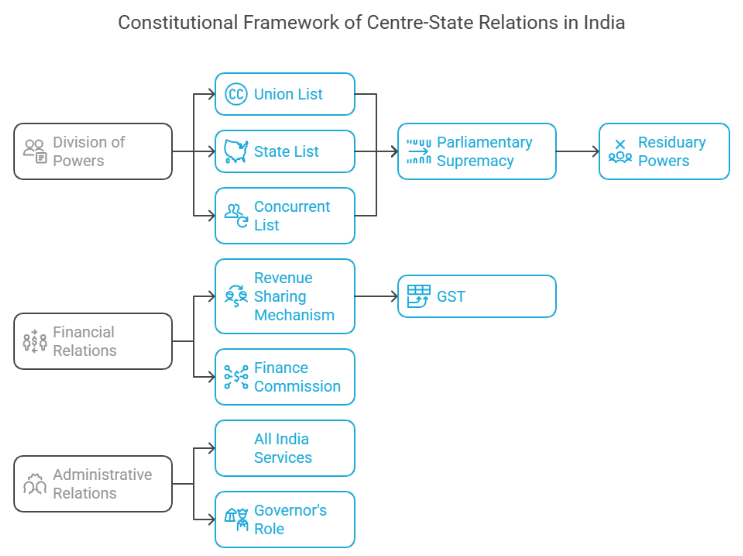
Constitutional Framework of Centre-State Relations in India


1. Legislative Relations (Articles 245-255)

Division of Powers: The Three Lists

  • Union List (97 subjects) – Controlled by the Centre (e.g., defence, foreign affairs, railways).
  • State List (66 subjects) – Exclusive jurisdiction of states (e.g., police, public health).
  • Concurrent List (47 subjects) – Shared jurisdiction (e.g., education, bankruptcy).

Parliamentary Supremacy

  • In case of conflict, Union law prevails over State law in the Concurrent List.
  • Residuary Powers: The Centre retains control over subjects not mentioned in any of the lists.

2. Financial Relations (Articles 268-293)

Revenue Sharing Mechanism

  • The Centre collects income tax, corporate tax, and excise duties.
  • States collect property tax, land revenue, and agricultural tax.
  • GST (Goods and Services Tax) has streamlined tax collection, but revenue-sharing remains contentious.

Finance Commission (Article 280)

  • Established every five years to recommend financial distribution between Centre and states.
  • Grants-in-aid are provided based on economic needs and performance.

3. Administrative Relations (Articles 256-263)

Centre’s Role in State Administration

  • All India Services (IAS, IPS, IFS): Officers are appointed by the Centre but serve in state governments.
  • Governor’s Role: Acts as a link between the Centre and states, but discretionary powers often lead to conflict.

Challenges in Centre-State Relations in India

1. Fiscal Imbalance

  • States lack financial autonomy and depend on the Centre for funds.
  • GST compensation delays and Centre’s veto power in the GST Council have intensified tensions.

2. Policy Implementation Disputes

National Education Policy (NEP 2020)

  • States argue that it does not account for regional education priorities.

Citizenship Amendment Act (CAA)

  • Some states refused to implement it due to concerns over regional diversity and social impact.

3. Role of Governors in State Politics

  • Governors have been accused of interfering in state affairs, leading to tensions.
  • The dismissal of state governments under Article 356 has often been seen as a political move rather than a constitutional necessity.

4. Dispute Resolution Challenges

Water-sharing disputes

  • Cauvery, Krishna, and Sutlej-Yamuna link disputes have led to long legal battles between states.

Judicial Interpretations

  • Constitutional disputes regarding power distribution often require judicial intervention.

5. Use of Central Investigative Agencies

  • The use of CBI, NIA, and ED to investigate state governments has raised concerns about political motives.
  • States like West Bengal, Kerala, and Maharashtra have accused the Centre of misusing investigative agencies.

6. Strong Centre vs. State Autonomy

  • The Supreme Court, in Kuldip Nayar vs Union of India (2006), upheld a strong Centre for national unity.
  • However, states believe that central interference weakens their autonomy and governance.

Way Forward

1. Enhancing Financial Autonomy for States

  • Implement a transparent revenue-sharing formula to ensure fair financial distribution.
  • Ensure timely GST compensation and balanced decision-making in the GST Council.

2. Redefining the Role of Governors

  • Governors should act impartially, following constitutional guidelines.
  • Consultation with state governments before appointing Governors can enhance trust.

3. Strengthening Dispute Resolution Mechanisms

  • Establish a Centre-State Coordination Committee to resolve disputes before escalation.
  • Strengthen Inter-State Councils and judicial arbitration to manage financial and territorial conflicts.

4. Encouraging Cooperative and Competitive Federalism

  • NITI Aayog should promote collaboration between the Centre and states.
  • States should be empowered to compete in economic development while ensuring fair resource allocation.

5. Regulating the Use of Central Investigative Agencies

  • The deployment of CBI, ED, and NIA in states should be regulated to prevent political misuse.
  • Independent oversight mechanisms can ensure fair investigations without compromising federal principles.

Conclusion

Centre-State Relations in India are critical for India’s governance and development. While the Constitution provides a strong framework, financial dependencies, policy disputes, and central interventions often create tensions. A balanced approach combining cooperative and competitive federalism can strengthen the federal structure, ensuring harmonious governance and national unity. Mutual trust, financial transparency, and institutional reforms will help address the challenges and improve Centre-State relations in India.


UPSC QEP 2026 Batch 5 - English
Buy now View Details
Submit Your Details to Learn More
I agree to give my consent to receive updates through SMS/Email & WhatsApp*.

NEEV GS + CSAT Foundation 2026/27
Buy now View Details


Join theIAShub’s Mains Answer Writing Program

Refine your answer writing skills and elevate your UPSC preparation with personalized support and expert feedback.

Fill out the form to get started with the program or any other enquiries !
I agree to give my consent to receive updates through SMS/Email & WhatsApp*.

Best IAS Coaching In Delhi, UPSC Online & Offline Classes by IAShub

Are you dreaming of becoming an IAS officer? Then, IAShub can be your best guide. It is one of the Best IAS Coaching in Delhi. Many students who want to clear the UPSC exam join IAShub for learning. The institute gives both online and offline classes. Their teachers are experienced and helpful. They easily explain every topic. Students also get notes, tests, and tips to do well in the exam.

UPSC Online Classes by IAShub

IAShub is in Delhi and is trusted by many UPSC students. It offers coaching for every part of the UPSC exam – Prelims, Mains, and Interview. The classes are simple and easy to understand. The teachers are experts and guide students in the right way. IAShub is also known for its helpful notes, test series, and answer-writing practice. IAShub is the best coaching in Delhi and also gives UPSC Online Classes. This helps students from any place in India to learn. The online classes are live and also recorded. So, students can watch them anytime. These classes cover the full UPSC syllabus.

Key Offerings Provided by IAShub

Here are some important services provided by IAShub:

  • UPSC Prelims: IAShub teaches for Prelims with a focus on basics. It also gives daily current affairs and monthly magazines.
  • Classroom Courses: IAShub has classroom learning for students in Delhi. The environment is good and peaceful for study.
  • Live Classes: Students who live far can join live UPSC online classes. These classes are just like real classes.
  • QEP for Mains: The Quality Enrichment Program (QEP) is special for Mains preparation. It helps students write better and faster.
  • Answer Writing: Regular answer writing practice is given. Teachers also check answers and give tips to improve.
  • Free Resource: IAShub gives free notes by toppers and helpful Main Booster material.
  • Test Series: Test series are available for every subject. These help students know their weak points and improve.
  • Interview Guidance Session: IAShub also gives interview practice sessions with experts. These help students feel confident.

UPSC Exam Overview

The UPSC Civil Services Exam has three parts:

  • Prelims: It has two papers: General Studies and CSAT.
  • Mains: It has nine papers, including essays and optional subjects.
  • Interview: It tests the personality and confidence of the student.

This exam is tough, but with the right guidance, it becomes easy to manage. Students must study smart and stay regular.

How IAShub Helps in the UPSC Journey

IAShub supports students from the beginning to the end. It gives the right books, tests, and notes. The classes are easy to follow, and the teachers are always ready to help. Students get personal doubt sessions too. The test series and answer checking help students learn where they need to do better. Also, free study materials save time and money.
IAShub also guides students during the final stage – the interview. Experts take mock interviews and give useful tips. This full support makes IAShub one of the best IAS coaching in Delhi.

Best IAS Coaching In Delhi FAQs

Yes, IAShub offers live and recorded online classes. Students can attend from any part of India.

Classes are available in both English and Hindi, so students can choose the language they are comfortable with.

The classroom centre is located in Delhi. Students can visit and join offline batches there.

IAShub gives interview guidance sessions to help students prepare for the final round of UPSC.