


Explore India's inter-state border disputes, their causes, challenges, and solutions. Learn how legal, political, and administrative measures can resolve conflicts effectively.
 theIASHub | 09 May, 2025
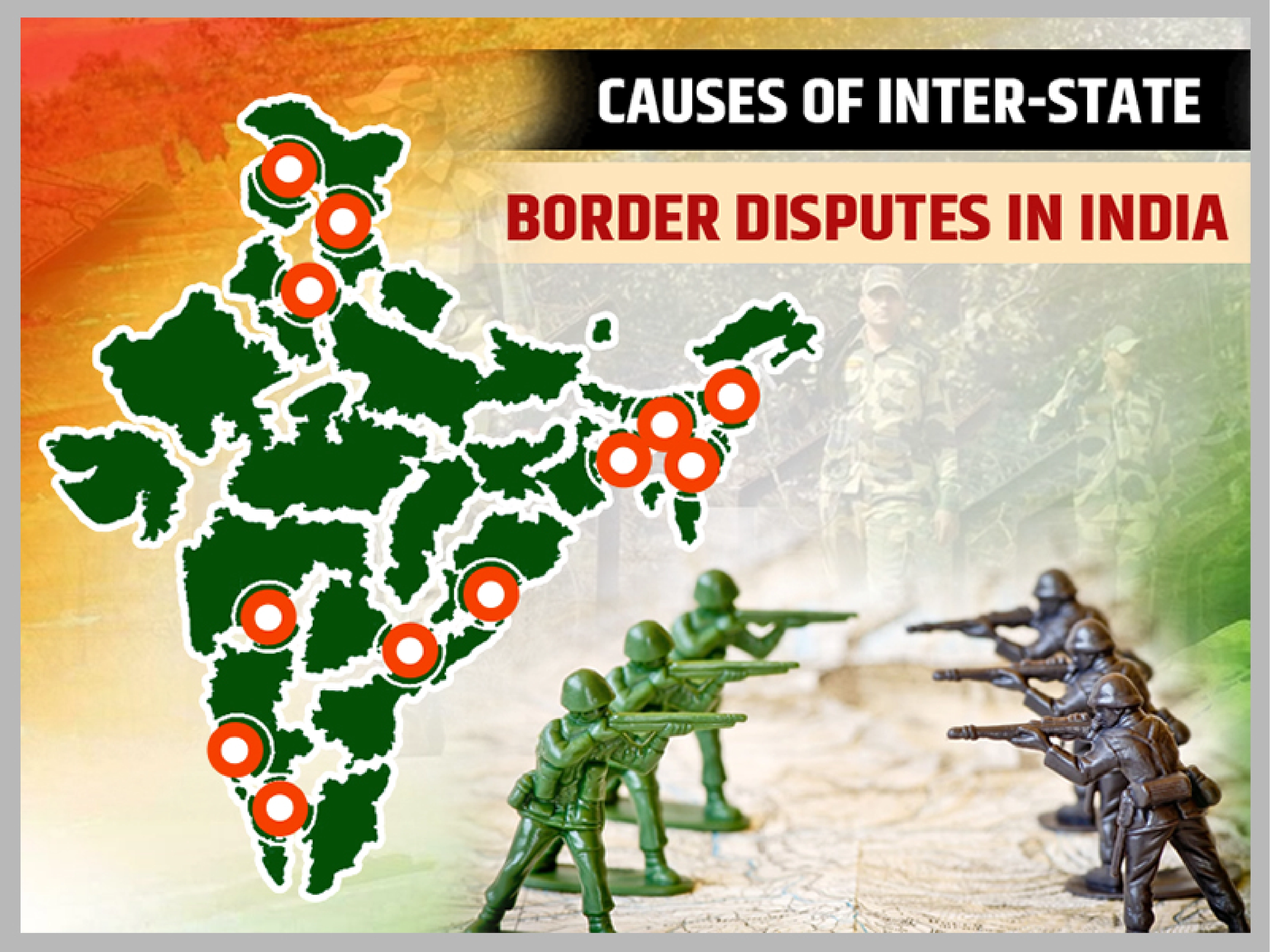

India's diverse geography and historical evolution have led to numerous inter-state border disputes. These conflicts disrupt governance, affect regional stability, and challenge the federal structure of the country. This article explores major inter-state border disputes, their causes, challenges in resolution, and potential solutions.
The long-standing dispute between Assam and Mizoram stems from differences in demarcation, particularly in the Cachar Hills and Karimganj areas.
Nagaland and Assam have clashed over territorial claims involving Dima Hasao, Karbi Anglong, and parts of Golaghat, leading to frequent tensions.
Meghalaya has challenged the Assam Reorganisation Act of 1971, which transferred certain areas of Mikir Hills (Karbi Anglong) to Assam.
Himachal Pradesh and Ladakh lay claim to Sarchu, a strategically important region on the Leh-Manali route.
This dispute revolves around claims over the Parwanoo region, affecting administrative control and development planning.
Maharashtra has long demanded the inclusion of Marathi-speaking areas of Belgaum district, which remains a contentious issue with Karnataka.
Unclear demarcations, conflicting historical records, and different interpretations contribute to border disputes.
Control over valuable resources such as land, water, minerals, and forests can spark disputes between states.
Governments may alter boundaries for political gains or appease interest groups, creating tensions.
Inaccurate records, outdated surveys, and demarcation errors lead to confusion and disagreements.
Settlement patterns often change over time, with populations moving into disputed areas, complicating territorial claims.
Industrialization and infrastructure projects can lead to territorial claims over development zones.
Linguistic and ethnic identities fuel regional demands, often leading to boundary conflicts.
While Article 131 allows judicial resolution of disputes, the Inter-State Council (Article 263) remains underutilized.
Lack of political will and bureaucratic inefficiencies prolong disputes, increasing tensions.
Even when settlements are reached, weak enforcement mechanisms hinder their implementation.
States often prioritize regional interests over national unity, delaying negotiations and dispute resolution.
A permanent commission should be established to address disputes and formulate fair resolutions.
Regular meetings under Article 263 can facilitate dialogue and conflict resolution among states.
Zonal councils should address common concerns such as border disputes, transportation, and socio-economic planning.
Special tribunals can expedite the resolution process and provide impartial judgments on border disputes.
Joint surveys at the district level can offer ground-level insights and foster localized solutions.
States must engage in constructive negotiations, keeping regional stability and national interests in mind.
Resolving inter-state border disputes requires a combination of legal, political, and diplomatic efforts. Establishing permanent mechanisms, fostering cooperative federalism, and promoting political commitment can ensure long-term solutions, thereby strengthening India's unity and governance.


Refine your answer writing skills and elevate your UPSC preparation with personalized support and expert feedback.
Fill out the form to get started with the program or any other enquiries !

Are you dreaming of becoming an IAS officer? Then, IAShub can be your best guide. It is one of the Best IAS Coaching in Delhi. Many students who want to clear the UPSC exam join IAShub for learning. The institute gives both online and offline classes. Their teachers are experienced and helpful. They easily explain every topic. Students also get notes, tests, and tips to do well in the exam.
IAShub is in Delhi and is trusted by many UPSC students. It offers coaching for every part of the UPSC exam – Prelims, Mains, and Interview. The classes are simple and easy to understand. The teachers are experts and guide students in the right way. IAShub is also known for its helpful notes, test series, and answer-writing practice. IAShub is the best coaching in Delhi and also gives UPSC Online Classes. This helps students from any place in India to learn. The online classes are live and also recorded. So, students can watch them anytime. These classes cover the full UPSC syllabus.
Here are some important services provided by IAShub:
The UPSC Civil Services Exam has three parts:
This exam is tough, but with the right guidance, it becomes easy to manage. Students must study smart and stay regular.
IAShub supports students from the beginning to the end. It gives the right books, tests, and notes. The classes are easy to follow, and the teachers are always ready to help. Students get personal doubt sessions too. The test series and answer checking help students learn where they need to do better. Also, free study materials save time and money.
IAShub also guides students during the final stage – the interview. Experts take mock interviews and give useful tips. This full support makes IAShub one of the best IAS coaching in Delhi.
 Detailed Solutions & Explanations
Improve Your Answer Writing & Strategy
Detailed Solutions & Explanations
Improve Your Answer Writing & Strategy

