Combative and Asymmetrical Federalism in India Challenges and Solutions

Learn about combative and asymmetrical federalism in India, challenges in Centre-State relations, financial disputes, and solutions for a stronger federal structure.

THEIASHUB
Get an Instant Call Back from Our Expert Mentors Now!
+91

Introduction

India’s federal structure is designed to maintain a balance between central authority and state autonomy. However, tensions often arise, leading to combative federalism, where the Centre and states are at loggerheads. Additionally, asymmetrical federalism grants special powers to certain regions, creating an uneven distribution of authority. While this system helps preserve diversity and regional stability, it also presents challenges that need to be addressed for a stronger and more cooperative federal framework.
Combative Federalism


What is Combative Federalism?

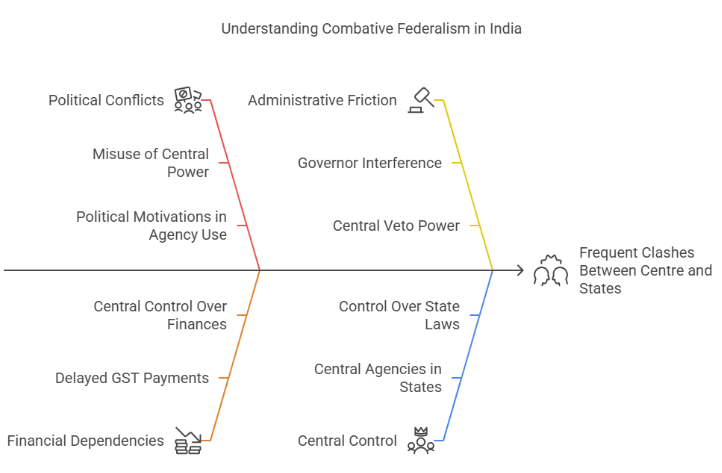
  • Definition: A system where the Centre and states frequently clash over governance, financial, and administrative issues, instead of cooperating.
  • Why it’s problematic: The Indian Constitution promotes cooperation and collaboration, but political conflicts, misuse of central power, and financial dependencies often create friction.

Examples of Combative Federalism in India

  1. Disputes over GST Compensation: States have expressed concerns over delayed payments and central control in GST revenue-sharing.
  2. Governor-State Clashes: Many states have accused Governors of acting as agents of the Centre, interfering in state governance.
  3. Use of Central Agencies Against State Governments: Investigative agencies like CBI, ED, and NIA are often deployed in states, raising questions of political motivations.
  4. Centre’s Control Over State Laws: The central veto power over state bills has been a point of contention.

Asymmetrical Federalism in India


What is Asymmetrical Federalism?

  • Asymmetrical federalism refers to a federal system where different regions have varying levels of autonomy due to historical, cultural, or political reasons.
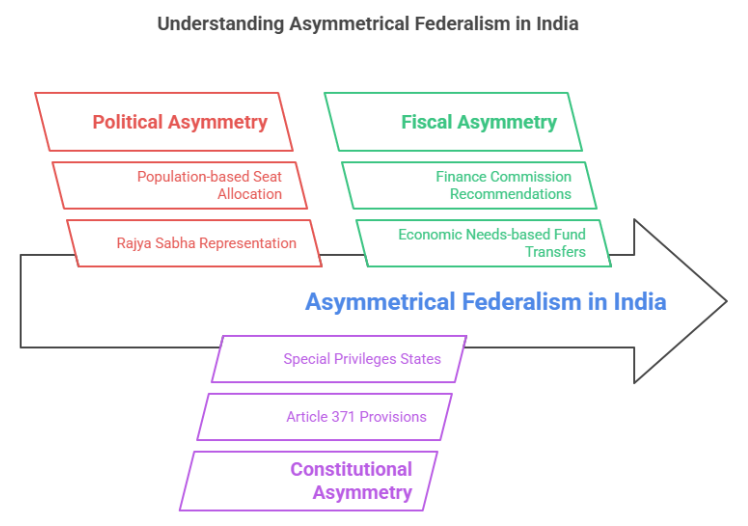
  • India’s asymmetrical federalism can be observed in political, constitutional, and fiscal aspects.

Types of Asymmetry in Indian Federalism

1. Political Asymmetry

  • Rajya Sabha Representation: States have seats based on their population size rather than equal representation.
    • Example: Uttar Pradesh has 31 seats, while Meghalaya and Mizoram have just 1 each.

2. Constitutional Asymmetry

  • Special provisions under Article 371 grant greater autonomy to certain states.
    • Example: Nagaland, Mizoram, and Jammu & Kashmir enjoy special privileges.

3. Fiscal Asymmetry

  • Finance Commission Recommendations: The Centre transfers funds to states based on economic needs, often creating fiscal dependency.
  • Grants and Revenue Distribution: Some states receive higher financial aid due to special provisions.

Why India Needs Asymmetrical Federalism

  1. Strengthens National Unity: Regional autonomy fosters a sense of ownership, reducing separatist tendencies.
  2. Upholds Diversity: Special provisions help protect vulnerable communities, reinforcing India’s "Unity in Diversity".
  3. Ensures Social Justice: Asymmetry allows historically disadvantaged states to receive special benefits.
  4. Strengthens Democracy: Guarantees better political representation for minority and tribal regions.
  5. Preserves Culture and Traditions: Article 371 empowers northeastern states to protect their customs and local laws.
  6. Counters Radicalization: Greater regional control allows better integration of communities into national development.

Challenges in Indian Federalism

1. State Formation and Boundary Alteration

  • The Centre’s authority to create, dissolve, or rename states raises concerns about state autonomy.

2. Role of Governors

  • Governors act as the Centre’s representatives, often clashing with state governments.
  • Allegations of political interference have weakened the federal structure.

3. Unequal Representation in Rajya Sabha

  • Unlike the US Senate, where every state has equal representation, India follows a population-based system, creating an imbalance.

4. Issues with All India Services

  • IAS, IPS, and IFS officers are appointed by the Centre but work under state governments.
  • States have limited control over administrative decisions regarding these officers.

5. Emergency Powers and President’s Rule (Article 356)

  • The Centre’s power to dismiss state governments under Article 356 has been misused in the past.

6. Financial Imbalance

  • States depend heavily on the Centre for funds, limiting financial independence.
  • The GST system, while improving revenue collection, has also reduced states’ fiscal autonomy.

7. Central Oversight Mechanisms

  • Election Commission, CAG, and Finance Commission operate under central control, reducing state independence.

Way Forward

1. Strengthening Inter-Governmental Relations

  • Encourage regular dialogue through the Inter-State Council and Zonal Councils.
  • Implement transparent financial distribution mechanisms to reduce dependency.

2. Reforming the Role of Governors

  • Governors should act impartially, following strict constitutional guidelines.
  • States should have a say in Governor appointments.

3. Ensuring Equitable Financial Distribution

  • Decentralize financial powers to grant states more autonomy.
  • Implement revised GST compensation mechanisms to ensure fair distribution.

4. Reducing Central Overreach in State Affairs

  • Limit the use of investigative agencies against state governments.
  • Define clear boundaries for Centre’s intervention in state governance.

5. Making the Rajya Sabha More Representative

  • Consider reforms to give smaller states more influence in decision-making.

6. Strengthening Federal Institutions

  • Establish a permanent Inter-State Council, as suggested by the Sarkaria Commission.
  • Create an Inter-State Dispute Resolution Mechanism to handle conflicts efficiently.

Key Commissions and Their Recommendations

1. First Administrative Reforms Commission (ARC)

  • Establish Inter-State Council under Article 263.
  • Enhance financial autonomy for states.

2. Sarkaria Commission

  • Limit the use of President’s Rule (Article 356).
  • Strengthen Zonal Councils for better state collaboration.

3. M.M. Punchhi Commission

  • Reduce Governor’s discretionary powers under Article 163.
  • Give states more flexibility in state list subjects.

4. National Commission to Review the Working of the Constitution (NCRWC)

  • Establish an Inter-State Trade and Commerce Commission under Article 307.
  • Give states more control in handling political breakdowns before invoking Article 356.

Conclusion

Combative and asymmetrical federalism are two critical aspects of India’s governance system. While asymmetry helps preserve diversity and stability, combative politics weakens cooperation between the Centre and states. A balance between strong central authority and regional autonomy is essential for maintaining national unity, promoting economic growth, and ensuring social justice. Strengthening financial autonomy, reforming Governor’s powers, and promoting inter-governmental collaboration will help fortify India’s federal structure.



UPSC QEP 2026 Batch 5 - English
Buy now View Details
Submit Your Details to Learn More
I agree to give my consent to receive updates through SMS/Email & WhatsApp*.

NEEV GS + CSAT Foundation 2026/27
Buy now View Details


Join theIAShub’s Mains Answer Writing Program

Refine your answer writing skills and elevate your UPSC preparation with personalized support and expert feedback.

Fill out the form to get started with the program or any other enquiries !

I agree to give my consent to receive updates through SMS/Email & WhatsApp*.

Best IAS Coaching In Delhi, UPSC Online & Offline Classes by IAShub

Are you dreaming of becoming an IAS officer? Then, IAShub can be your best guide. It is one of the Best IAS Coaching in Delhi. Many students who want to clear the UPSC exam join IAShub for learning. The institute gives both online and offline classes. Their teachers are experienced and helpful. They easily explain every topic. Students also get notes, tests, and tips to do well in the exam.

UPSC Online Classes by IAShub

IAShub is in Delhi and is trusted by many UPSC students. It offers coaching for every part of the UPSC exam – Prelims, Mains, and Interview. The classes are simple and easy to understand. The teachers are experts and guide students in the right way. IAShub is also known for its helpful notes, test series, and answer-writing practice. IAShub is the best coaching in Delhi and also gives UPSC Online Classes. This helps students from any place in India to learn. The online classes are live and also recorded. So, students can watch them anytime. These classes cover the full UPSC syllabus.

Key Offerings Provided by IAShub

Here are some important services provided by IAShub:

  • UPSC Prelims: IAShub teaches for Prelims with a focus on basics. It also gives daily current affairs and monthly magazines.
  • Classroom Courses: IAShub has classroom learning for students in Delhi. The environment is good and peaceful for study.
  • Live Classes: Students who live far can join live UPSC online classes. These classes are just like real classes.
  • QEP for Mains: The Quality Enrichment Program (QEP) is special for Mains preparation. It helps students write better and faster.
  • Answer Writing: Regular answer writing practice is given. Teachers also check answers and give tips to improve.
  • Free Resource: IAShub gives free notes by toppers and helpful Main Booster material.
  • Test Series: Test series are available for every subject. These help students know their weak points and improve.
  • Interview Guidance Session: IAShub also gives interview practice sessions with experts. These help students feel confident.

UPSC Exam Overview

The UPSC Civil Services Exam has three parts:

  • Prelims: It has two papers: General Studies and CSAT.
  • Mains: It has nine papers, including essays and optional subjects.
  • Interview: It tests the personality and confidence of the student.

This exam is tough, but with the right guidance, it becomes easy to manage. Students must study smart and stay regular.

How IAShub Helps in the UPSC Journey

IAShub supports students from the beginning to the end. It gives the right books, tests, and notes. The classes are easy to follow, and the teachers are always ready to help. Students get personal doubt sessions too. The test series and answer checking help students learn where they need to do better. Also, free study materials save time and money.
IAShub also guides students during the final stage – the interview. Experts take mock interviews and give useful tips. This full support makes IAShub one of the best IAS coaching in Delhi.

Best IAS Coaching In Delhi FAQs

Yes, IAShub offers live and recorded online classes. Students can attend from any part of India.

Classes are available in both English and Hindi, so students can choose the language they are comfortable with.

The classroom centre is located in Delhi. Students can visit and join offline batches there.

IAShub gives interview guidance sessions to help students prepare for the final round of UPSC.