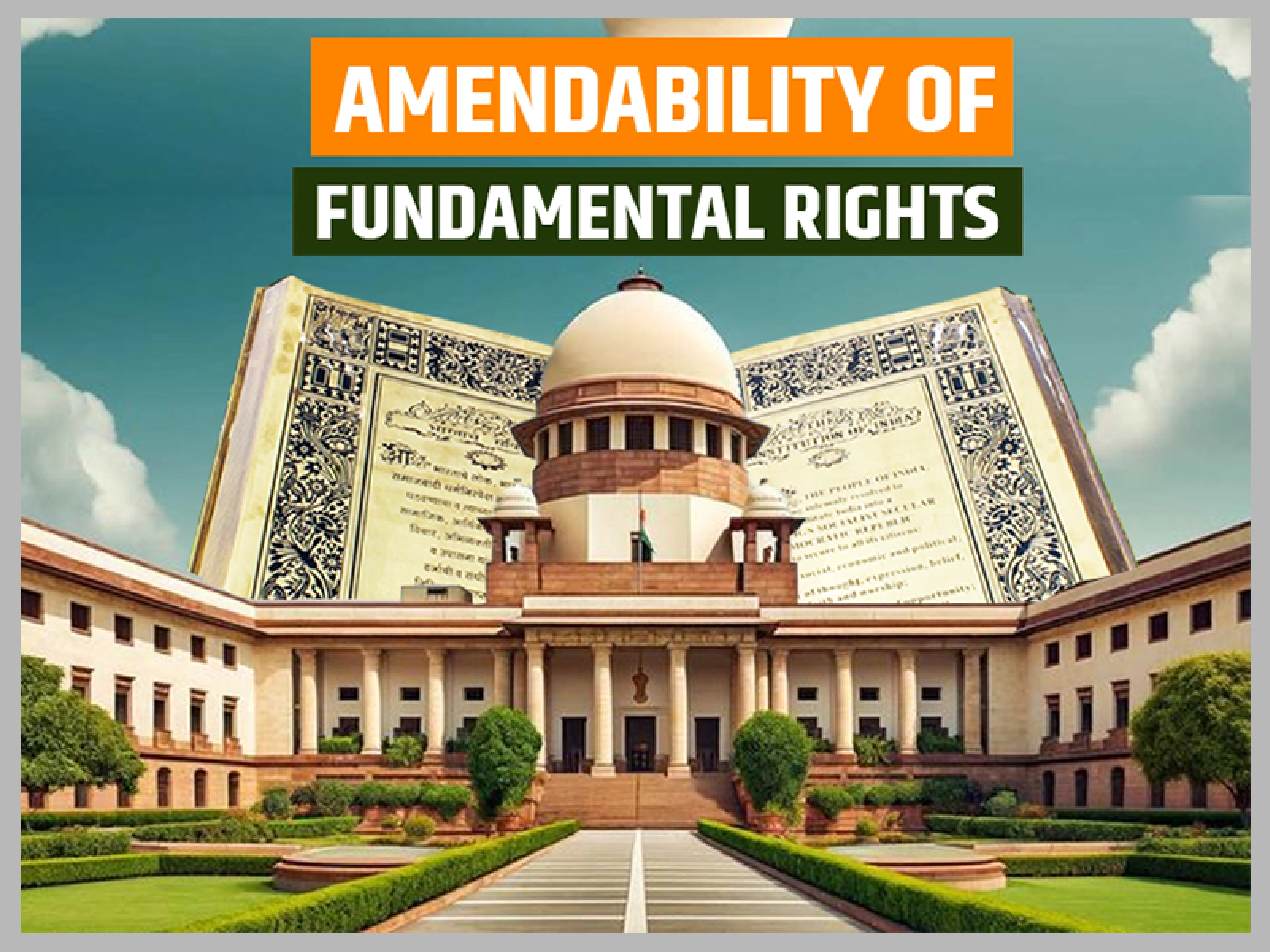
Amendability of Fundamental Rights Key Rulings and Challenges

Learn about the Amendability of Fundamental Rights in India, key Supreme Court rulings, challenges in enforcement, and the impact of the Basic Structure Doctrine.

THEIASHUB
Get an Instant Call Back from Our Expert Mentors Now!
+91

The Amendability of Fundamental Rights in India has been a subject of intense judicial scrutiny and debate. While these rights protect democracy, civil liberties, and individual freedom, questions arise about whether Parliament can amend or limit them. This article explores the amendability of Fundamental Rights, their significance, key Supreme Court rulings, challenges, criticisms, and the way forward.

Can Fundamental Rights Be Amended?

The power of Parliament to amend the Constitution under Article 368 has led to landmark judicial rulings.
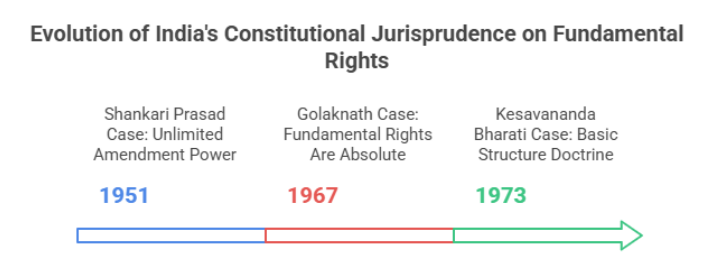

Shankari Prasad Case (1951): Unlimited Amendment Power

  • The Supreme Court ruled that Parliament can amend Fundamental Rights under Article 368.

  • It allowed modifications or restrictions on individual rights through constitutional amendments.

Golaknath Case (1967): Fundamental Rights Are Absolute

  • The Supreme Court overturned Shankari Prasad, ruling that Fundamental Rights are immutable.

  • It held that Parliament cannot abridge Fundamental Rights, ensuring their permanent protection.

Kesavananda Bharati Case (1973): The Basic Structure Doctrine

  • The Basic Structure Doctrine was introduced, limiting Parliament’s power.

  • While Parliament can amend Fundamental Rights, it cannot alter the Constitution’s Basic Structure.

  • Rights like Equality (Article 14) and Life (Article 21) are now part of the Basic Structure, protecting them from arbitrary amendments.

Significance of These Rulings

  • Ensures a balance between constitutional flexibility and protection of rights.

  • Prevents authoritarian laws from weakening Fundamental Rights.

Significance of Fundamental Rights


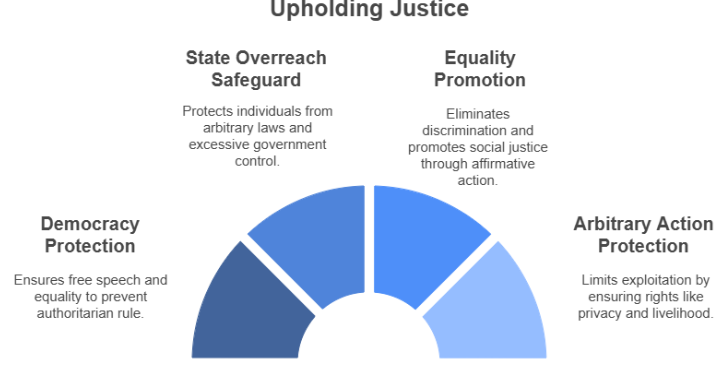
1. Protecting Democracy and Civil Liberties

  • Fundamental Rights prevent authoritarian rule by ensuring free speech, religious freedom, and equality.

2. Safeguarding Citizens from State Overreach

  • Protects individuals from arbitrary laws, discrimination, and excessive government control.

3. Promoting Equality and Social Justice

  • Articles 14-18 eliminate discrimination based on caste, religion, gender, or race.

  • Reservations and affirmative action help uplift marginalized communities.

4. Protection from Arbitrary Actions

  • Rights like Right to Privacy, Right to Livelihood also limit private sector exploitation.

Challenges in Implementing Fundamental Rights

1. Dependence on Judicial Interpretation

  • Courts define and interpret Fundamental Rights, leading to uncertainty and evolving definitions.

  • Issues like free speech restrictions, privacy concerns, and sedition laws remain debatable.

2. Judicial Delays

  • Overburdened courts delay the enforcement of rights, affecting human rights cases.

3. Suspension During National Emergency

  • Article 359 allows suspension of certain rights, limiting civil liberties.

  • However, Right to Life (Article 21) and Protection in Conviction (Article 20) remain untouchable.

4. Government Violations of Rights

  • Surveillance laws, sedition laws, and internet restrictions violate rights like freedom of speech.

  • The Right to Privacy is often breached through digital monitoring and data collection.

5. Unequal Access to Rights

  • Poor and marginalized communities face challenges in accessing legal remedies.

  • Economic disparity makes legal protection unequal across different sections of society.

6. Conflict Between Fundamental Rights and Directive Principles

  • Article 39(b) and 39(c) (related to economic justice) override Fundamental Rights.

  • This creates a legal conflict between individual rights (Article 14, Right to Equality) and state-led economic redistribution.

Criticism of Fundamental Rights

1. Limited Protection Against Private Entities

  • Fundamental Rights mainly restrict state actions, not private corporations.

  • Violations like privacy breaches by tech firms remain unregulated.

2. Excessive Restrictions on Rights

  • Freedom of Speech faces too many restrictions, including sedition, defamation, and public order laws.

  • The term "reasonable restriction" is not well-defined, leading to subjective court rulings.

3. Exclusion of Important Rights

  • Unlike modern constitutions, India’s Fundamental Rights do not explicitly include:

    • Right to Health

    • Right to Work

    • Right to a Clean Environment

  • These are part of Directive Principles of State Policy (DPSP), making them non-enforceable in courts.

4. Special Privileges for Certain Groups

  • MPs and MLAs enjoy legal protections not available to ordinary citizens.

  • This creates inequality in legal protections, contradicting equal rights.

5. Lack of a Consistent Legal Philosophy

  • British jurist Sir Ivor Jennings criticized India’s Fundamental Rights for lacking a unified legal philosophy.

  • He argued that the Constitution borrows from multiple legal systems without a coherent doctrine.

Way Forward: Strengthening Fundamental Rights

To make the Amendability of Fundamental Rights more effective, India should:

  • Enhance judicial efficiency to reduce delays in rights enforcement.

  • Clearly define reasonable restrictions to prevent misuse.

  • Expand rights to include health and livelihood, ensuring better social security.

  • Strengthen privacy laws to protect individuals from corporate and government surveillance.

Conclusion

The Amendability of Fundamental Rights remains a critical aspect of constitutional law in India. While landmark Supreme Court rulings like Kesavananda Bharati protect rights from arbitrary changes, challenges like judicial delays, government overreach, and conflicting laws continue to exist. Strengthening the interpretation, enforcement, and scope of Fundamental Rights is necessary to uphold democracy, equality, and justice in India.



UPSC QEP 2026 Batch 5 - English
Buy now View Details
Submit Your Details to Learn More
I agree to give my consent to receive updates through SMS/Email & WhatsApp*.

NEEV GS + CSAT Foundation 2026/27
Buy now View Details


Join theIAShub’s Mains Answer Writing Program

Refine your answer writing skills and elevate your UPSC preparation with personalized support and expert feedback.

Fill out the form to get started with the program or any other enquiries !
I agree to give my consent to receive updates through SMS/Email & WhatsApp*.

Best IAS Coaching In Delhi, UPSC Online & Offline Classes by IAShub

Are you dreaming of becoming an IAS officer? Then, IAShub can be your best guide. It is one of the Best IAS Coaching in Delhi. Many students who want to clear the UPSC exam join IAShub for learning. The institute gives both online and offline classes. Their teachers are experienced and helpful. They easily explain every topic. Students also get notes, tests, and tips to do well in the exam.

UPSC Online Classes by IAShub

IAShub is in Delhi and is trusted by many UPSC students. It offers coaching for every part of the UPSC exam – Prelims, Mains, and Interview. The classes are simple and easy to understand. The teachers are experts and guide students in the right way. IAShub is also known for its helpful notes, test series, and answer-writing practice. IAShub is the best coaching in Delhi and also gives UPSC Online Classes. This helps students from any place in India to learn. The online classes are live and also recorded. So, students can watch them anytime. These classes cover the full UPSC syllabus.

Key Offerings Provided by IAShub

Here are some important services provided by IAShub:

  • UPSC Prelims: IAShub teaches for Prelims with a focus on basics. It also gives daily current affairs and monthly magazines.
  • Classroom Courses: IAShub has classroom learning for students in Delhi. The environment is good and peaceful for study.
  • Live Classes: Students who live far can join live UPSC online classes. These classes are just like real classes.
  • QEP for Mains: The Quality Enrichment Program (QEP) is special for Mains preparation. It helps students write better and faster.
  • Answer Writing: Regular answer writing practice is given. Teachers also check answers and give tips to improve.
  • Free Resource: IAShub gives free notes by toppers and helpful Main Booster material.
  • Test Series: Test series are available for every subject. These help students know their weak points and improve.
  • Interview Guidance Session: IAShub also gives interview practice sessions with experts. These help students feel confident.

UPSC Exam Overview

The UPSC Civil Services Exam has three parts:

  • Prelims: It has two papers: General Studies and CSAT.
  • Mains: It has nine papers, including essays and optional subjects.
  • Interview: It tests the personality and confidence of the student.

This exam is tough, but with the right guidance, it becomes easy to manage. Students must study smart and stay regular.

How IAShub Helps in the UPSC Journey

IAShub supports students from the beginning to the end. It gives the right books, tests, and notes. The classes are easy to follow, and the teachers are always ready to help. Students get personal doubt sessions too. The test series and answer checking help students learn where they need to do better. Also, free study materials save time and money.
IAShub also guides students during the final stage – the interview. Experts take mock interviews and give useful tips. This full support makes IAShub one of the best IAS coaching in Delhi.

Best IAS Coaching In Delhi FAQs

Yes, IAShub offers live and recorded online classes. Students can attend from any part of India.

Classes are available in both English and Hindi, so students can choose the language they are comfortable with.

The classroom centre is located in Delhi. Students can visit and join offline batches there.

IAShub gives interview guidance sessions to help students prepare for the final round of UPSC.