


Understand the role, benefits, challenges, and latest reforms of co-operative societies in India. Explore their growing importance in rural development.
 theIASHub | 15 May, 2025

Co-operative societies are autonomous associations of people who unite voluntarily to meet their common economic, social, and cultural needs through a jointly owned and democratically controlled enterprise. These societies operate on the principles of mutual help, democratic governance, and collective ownership. According to the Ministry of Cooperation, India has over 8.5 lakh co-operative societies with more than 13 crore members.
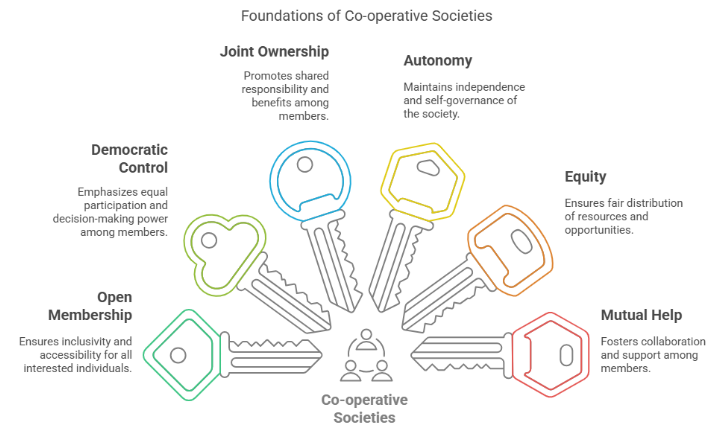
These principles help ensure that co-operative societies serve the needs of their members while promoting inclusive and equitable development.
Co-operative societies provide agricultural credit and financial assistance to farmers and traders. Sahkari banks in various states serve this purpose effectively.
Organizations like Shree Mahila Gruha Udyog (Lijjat Papad) highlight how co-operative societies help empower women by providing economic opportunities and financial independence.
Co-operative societies like Amul and Nandini generate rural employment and promote cottage industries. They also support key sectors such as agriculture (IFFCO, KRIBHCO), retail (TRIFED), and services (Indian Coffee House).
They help marginalised communities access housing and essential services, improve social capital, and reduce class conflicts. Consumer co-operatives also offer goods at subsidized rates.
Indian co-operative societies have global recognition. Institutions like the Ugandan Cooperative College collaborate with India for training and management education.
Failures like the Punjab & Maharashtra Co-operative Bank reflect the issue of weak governance. Most co-operative societies are small in size and limited in geographic reach.
They face resource constraints, lack professional management, weak audit systems, delayed elections, and poor accountability. Their concentration in a few states like Gujarat and Maharashtra creates regional imbalances.
Excessive control by government and dominance of political elites harm the democratic nature of co-operative societies. The influence of vested interests limits their inclusiveness.
Many citizens are unaware of the rules, benefits, and potential of co-operative societies, which restricts participation and trust.
Adopting a Model Co-operative Law, ensuring transparency, and implementing recommendations of committees like Mirdha and Brahm Prakash can enhance autonomy.
Training programs, professional involvement, and access to credit and subsidies are essential for the revival and expansion of co-operative societies.
Digital tools should be used in governance, banking, and service delivery. Promoting branding and value addition of products can boost credibility.
Efforts must be made to expand co-operative societies beyond western and southern India, with a special focus on increasing women’s participation.
The amendment aims to reform governance in multi-state co-operative societies. Key features include:




Refine your answer writing skills and elevate your UPSC preparation with personalized support and expert feedback.
Fill out the form to get started with the program or any other enquiries !
Are you dreaming of becoming an IAS officer? Then, IAShub can be your best guide. It is one of the Best IAS Coaching in Delhi. Many students who want to clear the UPSC exam join IAShub for learning. The institute gives both online and offline classes. Their teachers are experienced and helpful. They easily explain every topic. Students also get notes, tests, and tips to do well in the exam.
IAShub is in Delhi and is trusted by many UPSC students. It offers coaching for every part of the UPSC exam – Prelims, Mains, and Interview. The classes are simple and easy to understand. The teachers are experts and guide students in the right way. IAShub is also known for its helpful notes, test series, and answer-writing practice. IAShub is the best coaching in Delhi and also gives UPSC Online Classes. This helps students from any place in India to learn. The online classes are live and also recorded. So, students can watch them anytime. These classes cover the full UPSC syllabus.
Here are some important services provided by IAShub:
The UPSC Civil Services Exam has three parts:
This exam is tough, but with the right guidance, it becomes easy to manage. Students must study smart and stay regular.
IAShub supports students from the beginning to the end. It gives the right books, tests, and notes. The classes are easy to follow, and the teachers are always ready to help. Students get personal doubt sessions too. The test series and answer checking help students learn where they need to do better. Also, free study materials save time and money.
IAShub also guides students during the final stage – the interview. Experts take mock interviews and give useful tips. This full support makes IAShub one of the best IAS coaching in Delhi.
 Detailed Solutions & Explanations
Improve Your Answer Writing & Strategy
Detailed Solutions & Explanations
Improve Your Answer Writing & Strategy

