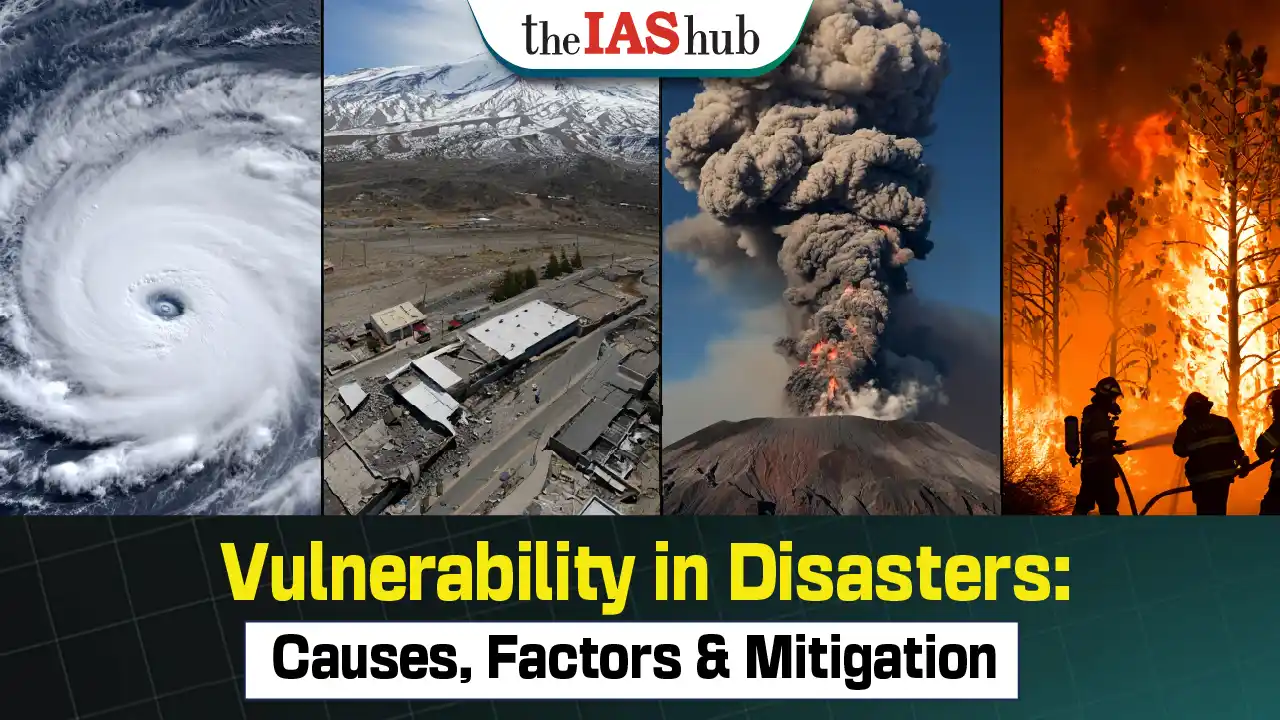
Vulnerability in Disasters: Causes, Factors & Mitigation

Explore the concept of vulnerability in disasters, its causes, key factors, and India’s high-risk profile. Learn how exposure, resistance, and resilience contribute to disaster impact and discover effective mitigation strategies to reduce disaster risk.

THEIASHUB
Get an Instant Call Back from Our Expert Mentors Now!
+91

Vulnerability is the human dimension of disasters and is the result of the range of economic, social, cultural, institutional, political, and psychological factors that shape people’s lives and the environment that they live in. Vulnerability describes the characteristics and circumstances of a community, system or assets that make it susceptible to the damaging effects of hazards.

Vulnerability= Exposure + Resistance + Resilience 

Exposure - at-risk property and population

Resistance- measures taken to reduce, avoid or prevent loss.

Resilience – the ability to recover the prior state or achieve desired post-disaster state.

Factors of Vulnerability

Factors of vulnerability

India’s Vulnerability Profile

  1. Due to its unique geo-climatic and socioeconomic conditions, India is significantly vulnerable to numerous natural and man-made disasters. These include floods, droughts, cyclones, earthquakes, landslides, avalanches, and forest fires. 
  2. 75% of its regions are disaster-prone, with 58.6% of landmass susceptible to earthquakes and 12% to floods and river erosion. Moreover, 68% of the cultivable area is drought-vulnerable, while hilly regions risk landslides and avalanches.
  3. India, one of the top ten disaster-prone countries worldwide, faces such risks due to several factors including adverse geo-climatic conditions, environmental degradation, population growth, and non-scientific development practices. Every distinctive region of the country, from the Himalayan region to the coastal zone, has its specific disaster risks.
  4. India's geological setup contributes to its increased vulnerability. For instance, the Himalayan region and adjacent plains are susceptible to earthquakes and landslides due to their geo-tectonic features. 
  5. Even the more stable peninsular India experiences occasional earthquakes. The alluvial plains of the Indus, Ganga, and Brahmaputra are similarly prone to seismic activities and floods due to their geological connections with the Himalayas.
  6. Western India, including Rajasthan, Gujarat, and parts of Maharashtra, frequently face droughts, which can extend country-wide with worsening monsoons. Oceanic pressure disturbances lead to coastal cyclones, and ongoing geo-tectonic movements risk tsunamis.
  7. India's disaster vulnerability is further aggravated by human activities such as deforestation, unscientific development, improper agricultural practices, unplanned urbanization, and large dam constructions on river channels. These factors accelerate disaster impact and frequency.
India’s Vulnerability Profile

Vulnerability lessened by interventions at a number of points

  • Impact avoidance - mitigation, action to eliminate risk during a disaster.
  • Increasing knowledge related to vulnerability and risk.
  • Increase capacities to cope or adopt.
  • Lessen sensitivities to exposure.
  • Lessen exposure to perturbations and stress.
  • Well-organized response.

Since we cannot reduce the occurrence and severity of natural hazards, reducing vulnerability is one of the main opportunities for reducing disaster risk. Since we cannot reduce the occurrence and severity of natural hazards, reducing vulnerability is one of the main opportunities for reducing disaster risk.


Vulnerability in Disasters: Causes, Factors & Mitigation FAQs

Vulnerability refers to the characteristics and conditions that make a community or system susceptible to the damaging effects of hazards.

Vulnerability equals exposure, resistance, and resilience.

India’s diverse geo-climatic and socioeconomic conditions make it prone to floods, earthquakes, droughts, cyclones, and more.

Through mitigation, increasing knowledge, improving coping capacities, and organized disaster response.

No, but reducing vulnerability is key to lowering overall disaster risk and impact.


UPSC QEP 2026 Batch 5 - English
Buy now View Details
Submit Your Details to Learn More
I agree to give my consent to receive updates through SMS/Email & WhatsApp*.

NEEV GS + CSAT Foundation 2026/27
Buy now View Details


Join theIAShub’s Mains Answer Writing Program

Refine your answer writing skills and elevate your UPSC preparation with personalized support and expert feedback.

Fill out the form to get started with the program or any other enquiries !

I agree to give my consent to receive updates through SMS/Email & WhatsApp*.

Best IAS Coaching In Delhi, UPSC Online & Offline Classes by IAShub

Are you dreaming of becoming an IAS officer? Then, IAShub can be your best guide. It is one of the Best IAS Coaching in Delhi. Many students who want to clear the UPSC exam join IAShub for learning. The institute gives both online and offline classes. Their teachers are experienced and helpful. They easily explain every topic. Students also get notes, tests, and tips to do well in the exam.

UPSC Online Classes by IAShub

IAShub is in Delhi and is trusted by many UPSC students. It offers coaching for every part of the UPSC exam – Prelims, Mains, and Interview. The classes are simple and easy to understand. The teachers are experts and guide students in the right way. IAShub is also known for its helpful notes, test series, and answer-writing practice. IAShub is the best coaching in Delhi and also gives UPSC Online Classes. This helps students from any place in India to learn. The online classes are live and also recorded. So, students can watch them anytime. These classes cover the full UPSC syllabus.

Key Offerings Provided by IAShub

Here are some important services provided by IAShub:

  • UPSC Prelims: IAShub teaches for Prelims with a focus on basics. It also gives daily current affairs and monthly magazines.
  • Classroom Courses: IAShub has classroom learning for students in Delhi. The environment is good and peaceful for study.
  • Live Classes: Students who live far can join live UPSC online classes. These classes are just like real classes.
  • QEP for Mains: The Quality Enrichment Program (QEP) is special for Mains preparation. It helps students write better and faster.
  • Answer Writing: Regular answer writing practice is given. Teachers also check answers and give tips to improve.
  • Free Resource: IAShub gives free notes by toppers and helpful Main Booster material.
  • Test Series: Test series are available for every subject. These help students know their weak points and improve.
  • Interview Guidance Session: IAShub also gives interview practice sessions with experts. These help students feel confident.

UPSC Exam Overview

The UPSC Civil Services Exam has three parts:

  • Prelims: It has two papers: General Studies and CSAT.
  • Mains: It has nine papers, including essays and optional subjects.
  • Interview: It tests the personality and confidence of the student.

This exam is tough, but with the right guidance, it becomes easy to manage. Students must study smart and stay regular.

How IAShub Helps in the UPSC Journey

IAShub supports students from the beginning to the end. It gives the right books, tests, and notes. The classes are easy to follow, and the teachers are always ready to help. Students get personal doubt sessions too. The test series and answer checking help students learn where they need to do better. Also, free study materials save time and money.
IAShub also guides students during the final stage – the interview. Experts take mock interviews and give useful tips. This full support makes IAShub one of the best IAS coaching in Delhi.

Best IAS Coaching In Delhi FAQs

Yes, IAShub offers live and recorded online classes. Students can attend from any part of India.

Classes are available in both English and Hindi, so students can choose the language they are comfortable with.

The classroom centre is located in Delhi. Students can visit and join offline batches there.

IAShub gives interview guidance sessions to help students prepare for the final round of UPSC.