Tsunami: Causes, Effects, Warning Systems, NDMA Guidelines in India

Tsunamis are massive sea waves caused by earthquakes, volcanic eruptions, or landslides. Learn about tsunami causes, effects, properties, warning systems, and NDMA guidelines for disaster preparedness and coastal safety in India.

THEIASHUB
Get an Instant Call Back from Our Expert Mentors Now!
+91

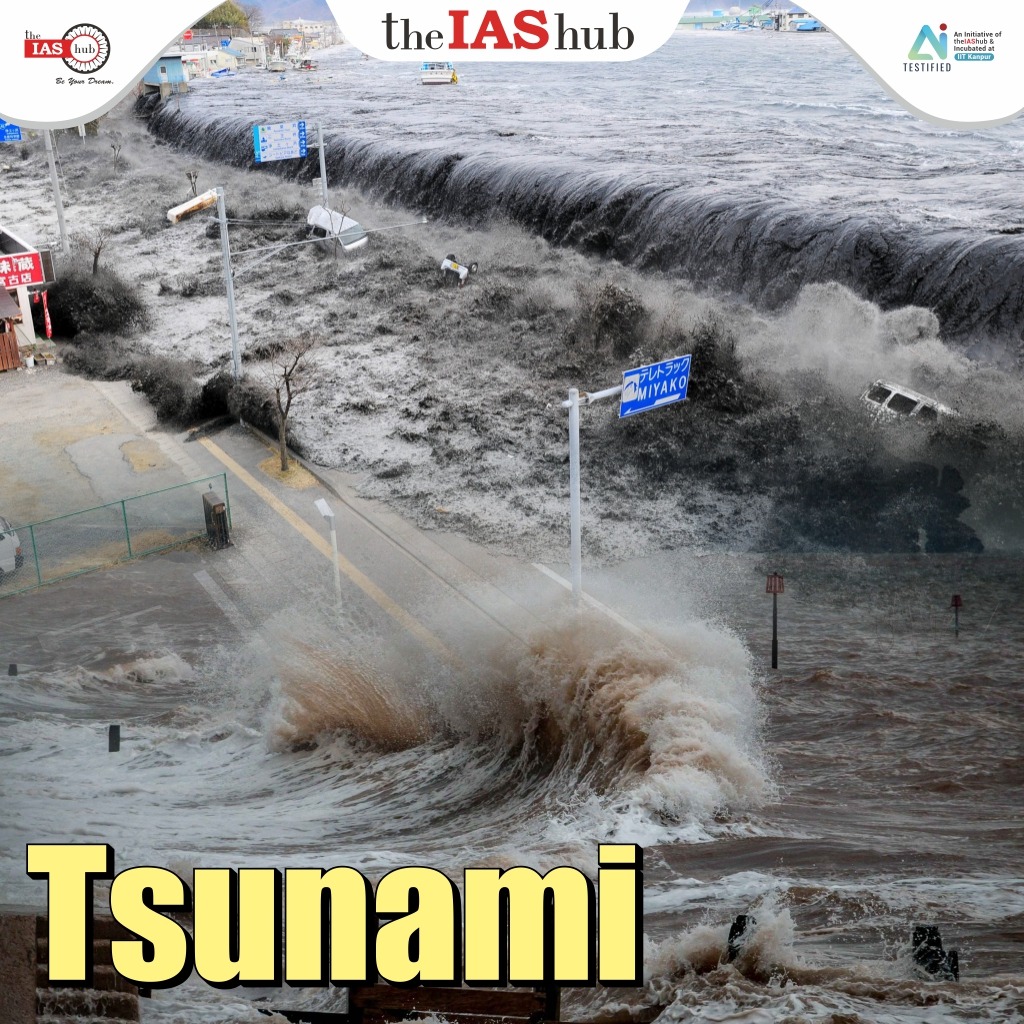
"Tsunami," from Japanese, means "Harbour wave." It's a series of large, long-wavelength waves in large bodies of water caused by major disturbances above or below the surface, or due to significant water displacement. Despite the name "tidal wave," lunar and solar gravitational forces do not cause tsunamis.

Causes of Tsunami

  • Tsunamis can occur due to earthquakes, volcanic eruptions, landslides, underwater explosions, and meteorite impacts. Notable subduction zones causing tsunamis include those off Chile, Nicaragua, Mexico, and Indonesia.

Formation of Tsunami Waves

  • Tsunami waves are formed by significant seabed displacements, such as in megathrust earthquakes, marine volcanic eruptions, or submarine landslides. Extra-terrestrial objects falling onto Earth can also cause destructive tsunamis.
  • Wave propagation includes gravity acting to return the sea surface to its original shape, creating ripples that race outward. As tsunamis enter shallow waters, they slow down and increase in height (shoaling effect). Tsunamis can appear suddenly and may involve several waves at intervals of several minutes.
  • Tsunami properties include wave crest, trough, height, amplitude, period, wavelength, and frequency. Normal waves involve horizontal (ocean currents and waves) and vertical (tides) motion, with the actual motion of the water beneath the waves being circular.
  • Tsunami warning systems can provide a three-hour notice of a potential tsunami following an earthquake. These systems monitor changes in water pressure, with data being transmitted to warning centers for analysis and issuing of warnings.
Tsunami

The Indian Tsunami Early Warning System (ITEWS) established in 2007 is an integrated network of seismic stations and tide gauges, with an operational warning center to detect tsunamis and provide timely advisories. Indian scientists can issue a tsunami warning within 10-20 minutes after an earthquake.


NDMA Guidelines on Tsunami

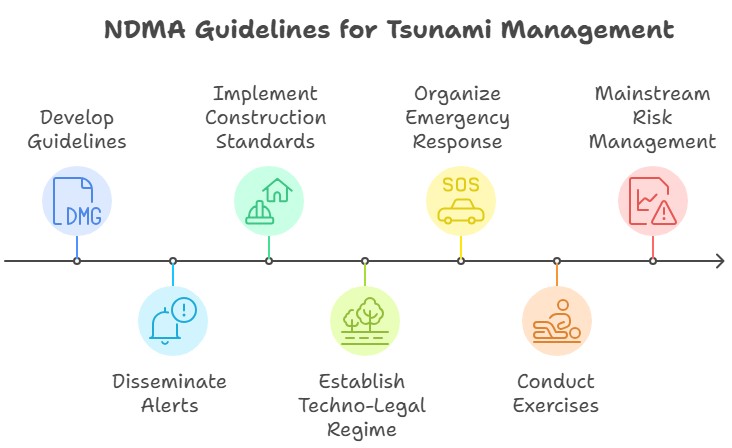
  • NDMA (National Disaster Management Authority) has developed guidelines to manage the risk of tsunamis through awareness generation, capacity building, education, training, and research & development.
  • The guidelines highlight the importance of effective dissemination of tsunami alerts and warnings to the appropriate agencies and vulnerable coastal communities, coordinated by the Indian National Center for Ocean Information Services.
  • The Bureau of Indian Standards is urged to roll out construction standards for tsunami-resistant designs of structures. These standards would guide new constructions and protection strategies for key infrastructure along the seafront.
  • The guidelines advocate for a robust techno-legal regime involving efficient land-use practices, bio shields, shelterbelt plantation, and mangrove regeneration, all with community involvement.
  • They call for a robust emergency response mechanism involving civil defense volunteers, home guards, State Disaster Response Forces, and the National Disaster Response Force.
  • The guidelines emphasize the importance of conducting exercises that include tsunami scenarios to enhance the efficiency and effectiveness of disaster management during an actual event.
  • Finally, they explore the provisions of the Disaster Management Act 2005 to mainstream the concern of tsunami risk management in disaster management plans at various levels.

Tsunami: Causes, Effects, Warning Systems, NDMA Guidelines in India FAQs

A tsunami is a series of large ocean waves caused by underwater disturbances such as earthquakes, volcanic eruptions, or landslides.

Earthquakes, volcanic eruptions, underwater landslides, and even meteorite impacts can trigger tsunamis.

ITEWS, established in 2007, is India’s integrated network of seismic stations and tide gauges that issues tsunami warnings within 10–20 minutes of an earthquake.

NDMA guidelines focus on awareness, capacity building, tsunami-resistant infrastructure, mangrove regeneration, and quick emergency response.

Through early warnings, evacuation drills, strong coastal infrastructure, bio-shields, and community involvement in disaster management.


UPSC QEP 2026 Batch 5 - English
Buy now View Details
Submit Your Details to Learn More
I agree to give my consent to receive updates through SMS/Email & WhatsApp*.

NEEV GS + CSAT Foundation 2026/27
Buy now View Details


Join theIAShub’s Mains Answer Writing Program

Refine your answer writing skills and elevate your UPSC preparation with personalized support and expert feedback.

Fill out the form to get started with the program or any other enquiries !

I agree to give my consent to receive updates through SMS/Email & WhatsApp*.

Best IAS Coaching In Delhi, UPSC Online & Offline Classes by IAShub

Are you dreaming of becoming an IAS officer? Then, IAShub can be your best guide. It is one of the Best IAS Coaching in Delhi. Many students who want to clear the UPSC exam join IAShub for learning. The institute gives both online and offline classes. Their teachers are experienced and helpful. They easily explain every topic. Students also get notes, tests, and tips to do well in the exam.

UPSC Online Classes by IAShub

IAShub is in Delhi and is trusted by many UPSC students. It offers coaching for every part of the UPSC exam – Prelims, Mains, and Interview. The classes are simple and easy to understand. The teachers are experts and guide students in the right way. IAShub is also known for its helpful notes, test series, and answer-writing practice. IAShub is the best coaching in Delhi and also gives UPSC Online Classes. This helps students from any place in India to learn. The online classes are live and also recorded. So, students can watch them anytime. These classes cover the full UPSC syllabus.

Key Offerings Provided by IAShub

Here are some important services provided by IAShub:

  • UPSC Prelims: IAShub teaches for Prelims with a focus on basics. It also gives daily current affairs and monthly magazines.
  • Classroom Courses: IAShub has classroom learning for students in Delhi. The environment is good and peaceful for study.
  • Live Classes: Students who live far can join live UPSC online classes. These classes are just like real classes.
  • QEP for Mains: The Quality Enrichment Program (QEP) is special for Mains preparation. It helps students write better and faster.
  • Answer Writing: Regular answer writing practice is given. Teachers also check answers and give tips to improve.
  • Free Resource: IAShub gives free notes by toppers and helpful Main Booster material.
  • Test Series: Test series are available for every subject. These help students know their weak points and improve.
  • Interview Guidance Session: IAShub also gives interview practice sessions with experts. These help students feel confident.

UPSC Exam Overview

The UPSC Civil Services Exam has three parts:

  • Prelims: It has two papers: General Studies and CSAT.
  • Mains: It has nine papers, including essays and optional subjects.
  • Interview: It tests the personality and confidence of the student.

This exam is tough, but with the right guidance, it becomes easy to manage. Students must study smart and stay regular.

How IAShub Helps in the UPSC Journey

IAShub supports students from the beginning to the end. It gives the right books, tests, and notes. The classes are easy to follow, and the teachers are always ready to help. Students get personal doubt sessions too. The test series and answer checking help students learn where they need to do better. Also, free study materials save time and money.
IAShub also guides students during the final stage – the interview. Experts take mock interviews and give useful tips. This full support makes IAShub one of the best IAS coaching in Delhi.

Best IAS Coaching In Delhi FAQs

Yes, IAShub offers live and recorded online classes. Students can attend from any part of India.

Classes are available in both English and Hindi, so students can choose the language they are comfortable with.

The classroom centre is located in Delhi. Students can visit and join offline batches there.

IAShub gives interview guidance sessions to help students prepare for the final round of UPSC.