Indian Ocean Region (IOR): Strategic Importance, India’s Role

Explore the strategic importance of the Indian Ocean Region (IOR), India’s maritime challenges, security initiatives, and steps to become a net security provider while safeguarding trade, resources, and regional stability.

THEIASHUB
Get an Instant Call Back from Our Expert Mentors Now!
+91

Introduction: The context of the discussion is the strategic importance of the Indian Ocean Region (IOR) in the world order, specifically in the Indian sub-continent. The discussion highlights the significance of the IOR, its diverse sub-regions, and its role as a major trade route and repository of natural resources.

What is Indian Ocean Region (IOR)?

  • The IOR broadly defines areas consisting of littoral states of the Indian Ocean.
  • It comprises sub-regions such as Australia, South East Asia, South Asia, Horn of Africa, and Southern and Eastern Africa.
  • The IOR is marked by cultural, social, political, and economic diversity.
Indian ocean

Significance of Indian Ocean Region (IOR)

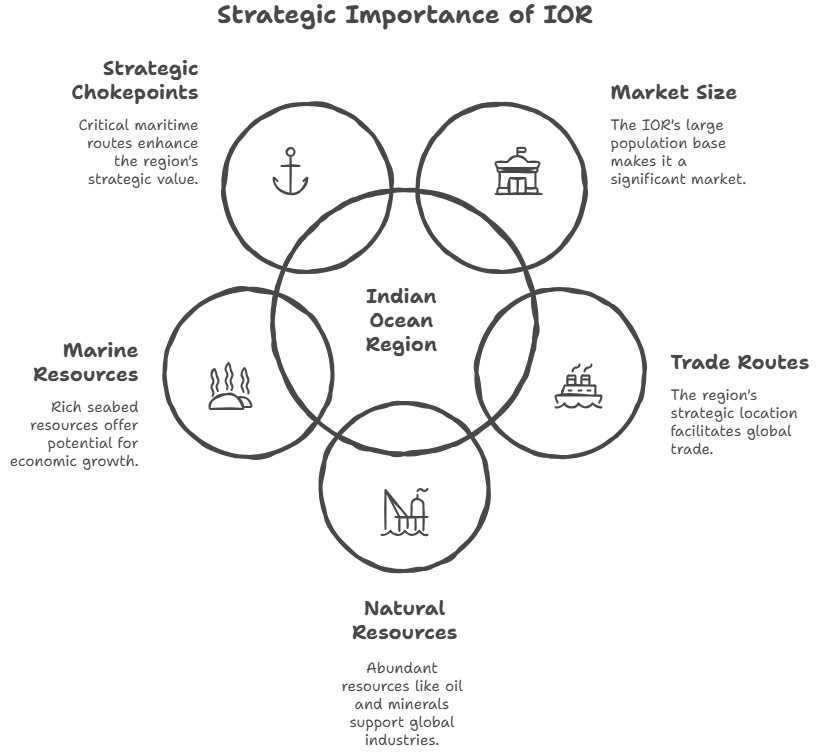
  • Biggest Market: The IOR littorals house over one-third of the world's population.
  • Trade Significance: More than half of global seaborne trade passes through the Indian Ocean, with nearly 70% going to countries external to the region.
  • Rich in Natural Resources: The IOR littoral states possess abundant raw materials, primarily oil, crucial for major manufacturing industries in developed and developing nations.
  • Ample Marine Resources: The IOR holds vast seabed resources, including oil, natural gas reserves, minerals, and abundant fish.
  • Maritime Choke-points: The presence of major maritime chokepoints and Sea Lanes of Communications (SLOCs) in the IOR contributes to its strategic importance.

Geo-Strategic Importance of Indian Ocean Region (IOR) to India

  • India is at the Centre: India's central position in the IOR presents both advantages and challenges.
  • Energy Security: India's "sea dependence" for oil is estimated to be around 93% due to total oil imports by sea, offshore oil production, and petroleum exports.
  • Dependence on Seas: Approximately 95% of India's trade volume and 68% of trade value are routed through the Indian Ocean.
  • Fishing and Aquaculture: India heavily relies on Indian Ocean resources, with fishing and aquaculture industries contributing to exports and employment for millions.
  • Huge Maritime Boundary: India's long coastline makes it vulnerable to potential threats emerging from the sea.
  • Hostile Neighbourhood: The 2008 Mumbai attack, carried out by terrorists arriving by sea, underscores the threat posed by the sea border.
  • Unforeseen and Non-conventional Threats: Non-traditional threats such as piracy, smuggling, illegal fishing, and human trafficking present challenges, emphasizing the need for a secure Indian Ocean to protect national interests.

Indian Ocean Region and the Net Security Provider Debate

  • Peaceful Seas: India has experienced largely peaceful seas in recent decades, with non-traditional threats like piracy and trafficking being the primary concerns.
  • Reasons to Take Up the Role:
    1. Obligation for the West: Becoming a net security provider is now a strategic obligation for India amid global economic turbulence and shifting US policies.
    2. Wisdom of Responsibility: India's emerging global power status brings with it a commensurate level of international responsibility.
    3. Void in Capability: Recognizing the existing void in capability, India needs to decide on taking up the role.

Indian Ocean Region Threat Mosaic: An Indian Perspective

  • Growing PLAN Presence: Chinese presence in ports like Gwadar, Hambantota, and Djibouti raises concerns.
  • Modernization of Pakistan Navy (PN): Pakistan Navy's rapid modernization, particularly in undersea warfare, with assistance from Turkey and China.
  • Shifting US Policy: US policies, particularly since Trump, have seen deviations from previous Indo-Pacific Region (IPR) strategies.
  • Non-Traditional Threats: Non-state forces, piracy, maritime terrorism, drug trafficking, climate change, and other non-traditional threats.

Impediments to India Becoming a Net Security Provider

  • Resource Availability vs. Requirement: India's finite resources and population size pose challenges amid a global downtrend.
  • Financial Capabilities: Robust financial backing is essential to materialize intentions and increase military hardware for net security provision.
  • Existing Civil-Military Relationship: Differences between ministries and civil-military leadership hinder strategic gains.
  • Nascent Jointmanship: Turf wars among the three services impede jointsmanship required for net security provision.
  • Non-alignment Policy: India's adherence to military non-alignment to retain strategic autonomy.
  • Primacy of Land Operations: India's focus on land boundaries with China and Pakistan and its participation in ongoing proxy wars.

Steps Taken by India in the Indian Ocean Region

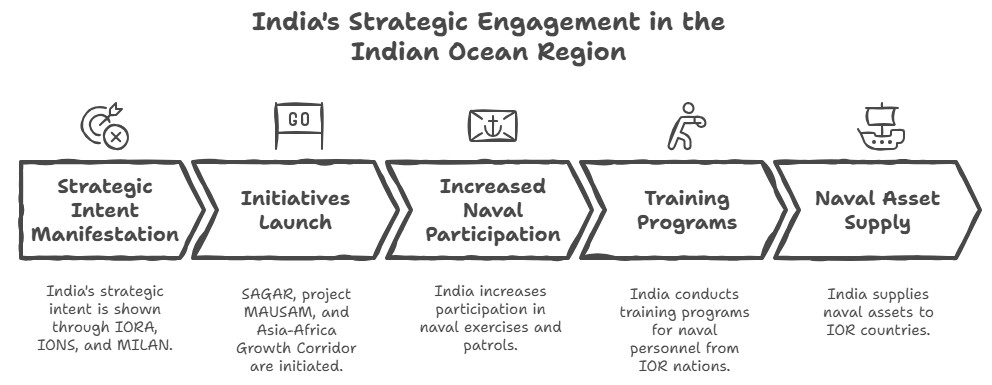
  • Indian Ocean Rim Association (IORA), Indian Ocean Naval Symposium (IONS), and naval exercises like MILAN manifest a strategic intent.
  • Initiatives like Security and Growth for All in the Region (SAGAR), project MAUSAM, and the proposed Asia-Africa Growth Corridor.
  • Increased participation in bilateral/multilateral naval exercises and Coordinated Patrol (CORPAT) with regional nations.
  • Training naval personnel from IOR nations through exchange programs.
  • Supplying naval assets to IOR countries.

Way Forward

  • Develop a comprehensive IOR strategy: Create a well-defined plan addressing security, economic cooperation, sustainability, and diplomacy in the Indian Ocean Region.
  • Enhance maritime domain awareness: Invest in advanced surveillance technologies and information-sharing mechanisms to monitor and secure maritime borders effectively.
  • Foster strategic partnerships: Strengthen cooperative security mechanisms, intelligence sharing, and capacity building initiatives with like-minded countries in the region.
  • Strengthen naval capabilities: Upgrade the fleet, invest in advanced platforms, and develop indigenous technologies to protect maritime interests.
  • Promote maritime diplomacy: Engage in regional forums, promote dialogue, and foster understanding and cooperation on maritime security issues.
  • Encourage sustainable blue economy practices: Support marine conservation, responsible fisheries, and renewable energy development for long-term environmental and economic benefits.

Conclusion

India's role as a net security provider in the IOR is a topic of debate. While India has experienced relatively peaceful seas, it faces emerging threats such as Chinese presence in strategic ports, modernization of the Pakistan Navy, shifting US policies, and non-traditional threats like piracy and maritime terrorism. Becoming a net security provider would require careful resource allocation, financial capabilities, enhanced civil-military coordination, and the development of joints man ship among the three services.

Indian Ocean Region (IOR): Strategic Importance, India’s Role FAQs

It includes littoral states of the Indian Ocean across South Asia, Southeast Asia, Africa, and Australia.

It is central to trade, energy security, fishing, and maritime influence in the Indian Ocean.

Piracy, maritime terrorism, smuggling, Chinese and Pakistani naval presence, and non-conventional threats.

SAGAR, IORA, IONS, MILAN exercises, MAUSAM project, and the Asia-Africa Growth Corridor.

By enhancing naval capabilities, strategic partnerships, maritime domain awareness, and promoting the blue economy.


UPSC QEP 2026 Batch 5 - English
Buy now View Details
Submit Your Details to Learn More
I agree to give my consent to receive updates through SMS/Email & WhatsApp*.

NEEV GS + CSAT Foundation 2026/27
Buy now View Details


Join theIAShub’s Mains Answer Writing Program

Refine your answer writing skills and elevate your UPSC preparation with personalized support and expert feedback.

Fill out the form to get started with the program or any other enquiries !

I agree to give my consent to receive updates through SMS/Email & WhatsApp*.

Best IAS Coaching In Delhi, UPSC Online & Offline Classes by IAShub

Are you dreaming of becoming an IAS officer? Then, IAShub can be your best guide. It is one of the Best IAS Coaching in Delhi. Many students who want to clear the UPSC exam join IAShub for learning. The institute gives both online and offline classes. Their teachers are experienced and helpful. They easily explain every topic. Students also get notes, tests, and tips to do well in the exam.

UPSC Online Classes by IAShub

IAShub is in Delhi and is trusted by many UPSC students. It offers coaching for every part of the UPSC exam – Prelims, Mains, and Interview. The classes are simple and easy to understand. The teachers are experts and guide students in the right way. IAShub is also known for its helpful notes, test series, and answer-writing practice. IAShub is the best coaching in Delhi and also gives UPSC Online Classes. This helps students from any place in India to learn. The online classes are live and also recorded. So, students can watch them anytime. These classes cover the full UPSC syllabus.

Key Offerings Provided by IAShub

Here are some important services provided by IAShub:

  • UPSC Prelims: IAShub teaches for Prelims with a focus on basics. It also gives daily current affairs and monthly magazines.
  • Classroom Courses: IAShub has classroom learning for students in Delhi. The environment is good and peaceful for study.
  • Live Classes: Students who live far can join live UPSC online classes. These classes are just like real classes.
  • QEP for Mains: The Quality Enrichment Program (QEP) is special for Mains preparation. It helps students write better and faster.
  • Answer Writing: Regular answer writing practice is given. Teachers also check answers and give tips to improve.
  • Free Resource: IAShub gives free notes by toppers and helpful Main Booster material.
  • Test Series: Test series are available for every subject. These help students know their weak points and improve.
  • Interview Guidance Session: IAShub also gives interview practice sessions with experts. These help students feel confident.

UPSC Exam Overview

The UPSC Civil Services Exam has three parts:

  • Prelims: It has two papers: General Studies and CSAT.
  • Mains: It has nine papers, including essays and optional subjects.
  • Interview: It tests the personality and confidence of the student.

This exam is tough, but with the right guidance, it becomes easy to manage. Students must study smart and stay regular.

How IAShub Helps in the UPSC Journey

IAShub supports students from the beginning to the end. It gives the right books, tests, and notes. The classes are easy to follow, and the teachers are always ready to help. Students get personal doubt sessions too. The test series and answer checking help students learn where they need to do better. Also, free study materials save time and money.
IAShub also guides students during the final stage – the interview. Experts take mock interviews and give useful tips. This full support makes IAShub one of the best IAS coaching in Delhi.

Best IAS Coaching In Delhi FAQs

Yes, IAShub offers live and recorded online classes. Students can attend from any part of India.

Classes are available in both English and Hindi, so students can choose the language they are comfortable with.

The classroom centre is located in Delhi. Students can visit and join offline batches there.

IAShub gives interview guidance sessions to help students prepare for the final round of UPSC.