
theIAShub
29 Jul, 2025

Table of Contents

Get an Instant Call Back from Our Expert Mentors!
Context
- Prime Minister in his Mann Ki Baat Programme remarked that Textile Sector has became a strength of the Countries Economy.
About the News
- He mentioned that over 3,000 textile start-ups are now active in India, many of which are promoting India’s handloom identity on a global scale.
- The Prime Minister pointed out that this year marks the 10th anniversary of National Handloom Day.
About Textile Sector in India
- Cotton Production and Employment
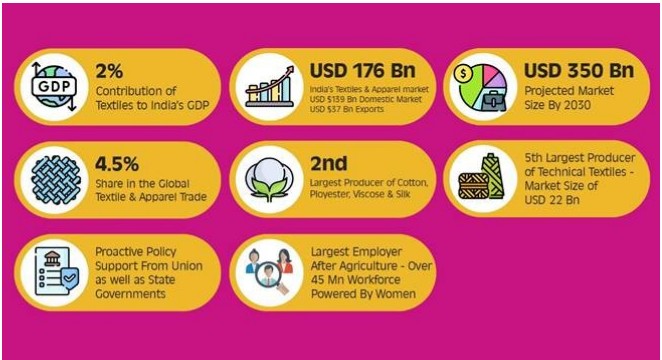
- India is the second-largest cotton producer globally, contributing 24% of global production.
- Cotton farming involves around 60 lakh farmers, primarily in Gujarat, Maharashtra, and Telangana.
- The cotton textile value chain, from fibre processing to garment manufacturing, employs over 4.5 crore people.
Man-Made Fibre (MMF) Industry
- India is also the second-largest producer of MMF, with Reliance Industries leading in polyester and Grasim Industries being the sole domestic producer of viscose.
- However, MMF consumption in India remains low at 3.1 kg per capita, compared to 12 kg in China and 22.5 kg in North America.
- Overall fibre consumption, including natural and synthetic fibres, is 5.5 kg per capita, below the global average of 11.2 kg.
MSME Clusters and Specialisations
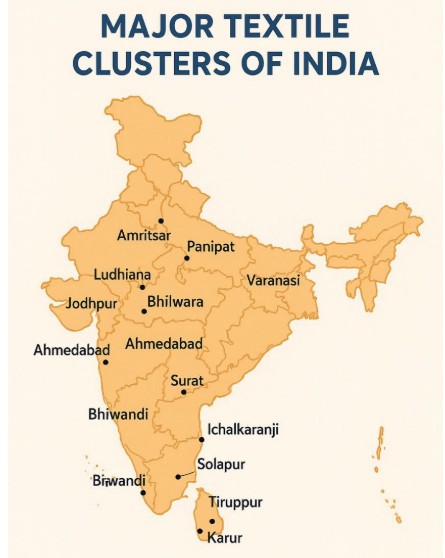
- Around 80% of India’s textile value chain operates within MSME clusters, each specializing in different textiles:
- Bhiwandi (Maharashtra) – Fabric production
- Tiruppur (Tamil Nadu) – T-shirts and undergarments
- Surat (Gujarat) – Polyester and nylon fabrics
- Ludhiana (Punjab) – Woolen garments.
Other Facets of the Sector
- Contribution: The textile and apparel industry contributes 2.3% to our GDP, 13% to industrial production, and 12% to exports.
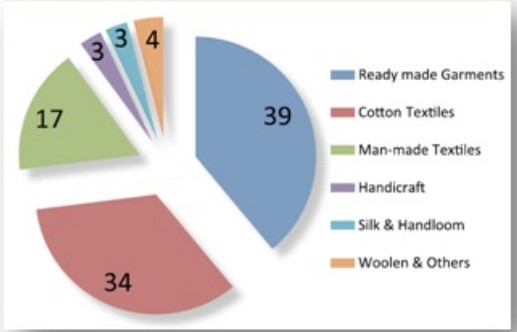
- Export Basket: India exported textile items worth US$ 34.4 billion in 2023-24, with apparel constituting 42%, followed by raw materials/semi-finished materials at 34% and finished non-apparel goods at 30%.
- Employment: It is the second largest employment generator, after agriculture, with over 45 million people employed directly.
- Nearly 80% of its capacity is spread across Micro, Small and Medium Enterprises (MSME) clusters in the country.
- Future Projections: Indian textile market currently ranks fifth globally, and the government is actively working to accelerate this growth to a rate of 15-20% over the next five years.
Challenges Faced by the Sector
- Fragmented Structure: Predominantly unorganised and decentralised, especially in the powerloom and handloom sectors.
- Outdated machinery in many units leads to: Low productivity, poor quality output and higher operational costs compared to global competitors (e.g., China, Bangladesh).
- Inadequate Infrastructure: Poor logistics, power shortages, and high cost of electricity.
- Environmental Concerns: Textile processing is water- and chemical-intensive.
- Non-compliance with environmental norms leads to factory closures and export bans.
- India trails China, Vietnam, and Bangladesh in textile exports due to higher production costs and a fragmented supply chain.
- In contrast, Vietnam exported $40 billion worth of apparel in 2023, benefiting from vertically integrated supply chains that lower manufacturing costs.
- India’s man-made fibre (MMF) sector suffers from high raw material costs.
- Quality control orders (QCOs) restrict imports of polyester and viscose fibres, forcing domestic yarn makers to rely on costlier local alternatives.
Government Initiatives for the Sector
- The Make in India initiative has catalyzed textile manufacturing and exports through key policy interventions, enhanced infrastructure, and incentives.
- Production Linked Incentive (PLI) Scheme for Textiles: To increase manufacturing in man-made fibre (MMF) and technical textiles.
- Financial incentives for large-scale textile manufacturers.
- PM MITRA (Mega Integrated Textile Region and Apparel) Parks: For developing integrated large scale and modern industrial infrastructure facilities for the total value-chain of the textile industry like spinning, weaving, processing, garmenting, textile manufacturing, processing & textile machinery industry.
- Current Status: A total of 7 Parks established in states of Gujarat, Maharashtra, Madhya Pradesh, Tamil Nadu, Karnataka, Uttar Pradesh, and Telangana.
- Amended Technology Upgradation Fund Scheme (ATUFS): It provides capital subsidies for technology upgradation.
- Samarth (Scheme for Capacity Building in Textile Sector): To provide skill training to workers in the textile industry, in partnership with the Ministry of Skill Development & Entrepreneurship.
- Textile Cluster Development Scheme (TCDS): To create an integrated workspace and linkages-based ecosystem for existing as well as potential textile units/clusters to make them operationally and financially viable.

2026-27 UPSC Mains English QEP Power Pages
View DetailsSubmit Your Details to Learn More



