Pendency of Cases in Indian Courts: Causes, Impact & Solutions

Explore the pendency crisis in Indian courts with over 5 crore pending cases. Learn about the causes, challenges, impact on justice delivery, and key reforms like e-courts, fast-track courts, and ADR to reduce delays.

upsc-daily-current-affairs
THEIASHUB
Get an Instant Call Back from Our Expert Mentors Now!
+91

Context

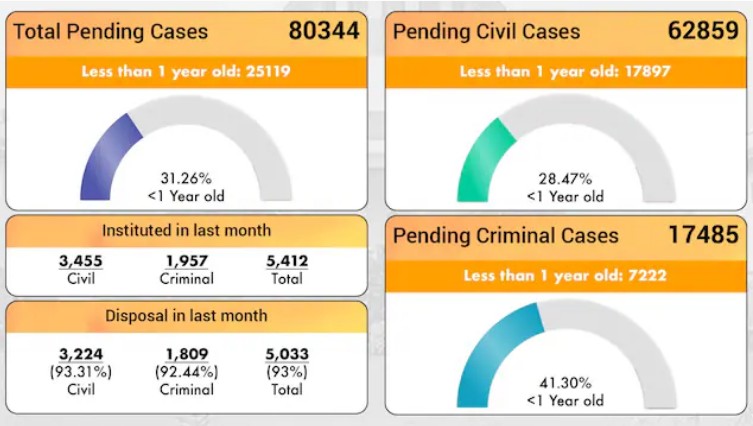
  • India’s judiciary faces a pendency crisis with over 5 crore cases across Supreme Court, High Courts, and District Courts.
  • The President Of India has termed this as Black Court Syndrome.
Present Pendency of Cases and other Facets

  • 4.6 crore in District Courts, 63.3 lakh in High Courts, 86,700 in Supreme Court.
  • India operates with just 15 judges per 10 lakh population vs. Law Commission’s 50.
  • Only 38.7% civil cases are disposed within a year in district courts vs. 70.6% for criminal cases.
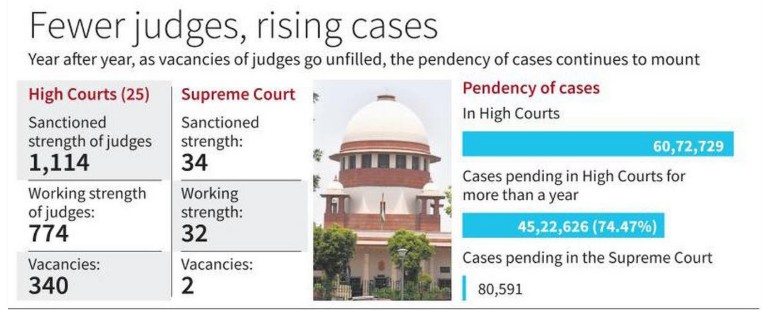
  • 5,665 judge positions vacant across courts; only 79% of sanctioned strength filled.
Reasons behind Pendency of Cases

  • Insufficient Judges: India has one of the lowest judge-to-population ratios globally.
  • Judiciary operates at 79% capacity. 5,665 posts vacant out of 26,927 sanctioned
  • Increased Litigation: The growing number of litigants and cases, coupled with the increasing population and socio-economic complexities, contributes to the rise in the number of cases.
  • Delays in the Justice System: There are delays due to procedural inefficiencies, adjournments, and delays in filing of evidence, which further prolong case resolutions.
  • Lack of Infrastructure: Many courts, especially in rural areas, are under-equipped and under-staffed, making it difficult to handle the growing number of cases efficiently.
  • Bureaucratic and Administrative Challenges: The judicial process can sometimes be slowed down by inefficiencies in the system, including paperwork, administrative delays, and a lack of modernization in court processes.
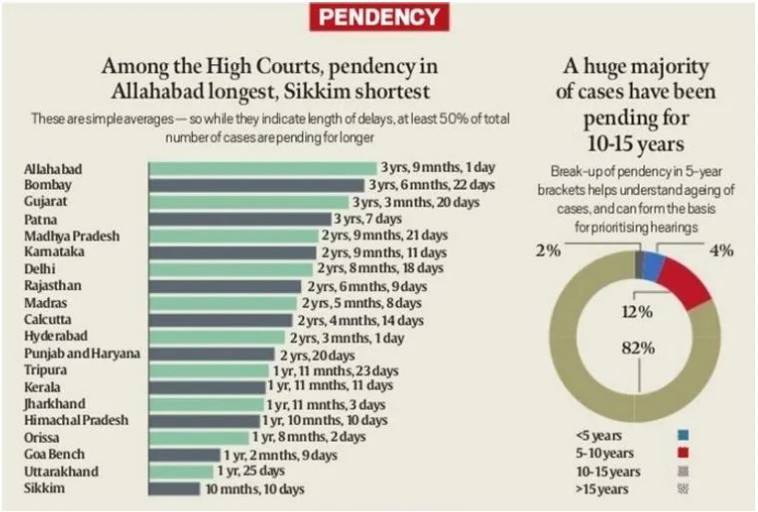
  • Only 38.7% of civil cases in district courts resolved within a year.
  • 20% stretch beyond 5 years, mainly in property, family, or contract disputes.
Impact of the issue

  • Delay in Justice: The backlog results in long delays in cases, and justice is often delayed for years.
  • Increased No. of Undertrials: The number of undertrials (accused awaiting trial) in prisons has increased, prisons are running at an over-capacity of 114%. 
  • Increased Costs: The delay in cases causes financial strain on the litigants and the government. It can also result in the erosion of public confidence in the judicial system.
  • Overburdened Judges: Judges are often overburdened with cases, leading to burnout and further delays.

Efforts to Address the issue

  • Judicial Reforms: It includes increasing the number of judges, modernizing court infrastructure, and implementing e-courts and technology to speed up hearings.
  • Alternate Dispute Resolution (ADR): ADR mechanisms like arbitration, mediation, and conciliation are being promoted to resolve disputes outside of the traditional court system.
  • E-Courts and Technology: The E-Courts Project has been an important initiative to digitize court proceedings and allow online hearings. This helps in streamlining case management and reducing physical backlogs.
  • Fast Track Courts: Special courts or fast-track courts have been set up to handle specific types of cases like corruption, crimes against women, and long-pending cases to expedite the process.

Efforts that can be taken

  • Increase the number of judges: One way to reduce the backlog of cases is to increase the number of judges in the Indian judiciary. This will allow more cases to be heard and decided more quickly.
  • The Law Commission of India (1987) recommended increasing the number of judges to 50 per million people. This was reiterated by the Supreme Court (2001) and the Standing Committee on Home Affairs (2002).
  • Expand alternative dispute resolution methods: Alternative dispute resolution methods, such as mediation and arbitration, can resolve disputes more quickly and efficiently than traditional court proceedings.
  • Streamline the legal process: Efforts can be made to streamline the legal process, such as by using technology to manage cases and eliminate unnecessary steps. Example: e-courts projects.
  • Strengthen the enforcement of court orders: Ensuring that court orders are enforced can help to reduce the backlog of cases, as individuals and institutions will be more likely to comply with court orders if they know that they will be held accountable for failing to do so.


UPSC QEP 2026 Batch 5 - English
Buy now View Details
Submit Your Details to Learn More
I agree to give my consent to receive updates through SMS/Email & WhatsApp*.

NEEV GS + CSAT Foundation 2026/27
Buy now View Details


Join theIAShub’s Mains Answer Writing Program

Refine your answer writing skills and elevate your UPSC preparation with personalized support and expert feedback.

Fill out the form to get started with the program or any other enquiries !

I agree to give my consent to receive updates through SMS/Email & WhatsApp*.

Best IAS Coaching In Delhi, UPSC Online & Offline Classes by IAShub

Are you dreaming of becoming an IAS officer? Then, IAShub can be your best guide. It is one of the Best IAS Coaching in Delhi. Many students who want to clear the UPSC exam join IAShub for learning. The institute gives both online and offline classes. Their teachers are experienced and helpful. They easily explain every topic. Students also get notes, tests, and tips to do well in the exam.

UPSC Online Classes by IAShub

IAShub is in Delhi and is trusted by many UPSC students. It offers coaching for every part of the UPSC exam – Prelims, Mains, and Interview. The classes are simple and easy to understand. The teachers are experts and guide students in the right way. IAShub is also known for its helpful notes, test series, and answer-writing practice. IAShub is the best coaching in Delhi and also gives UPSC Online Classes. This helps students from any place in India to learn. The online classes are live and also recorded. So, students can watch them anytime. These classes cover the full UPSC syllabus.

Key Offerings Provided by IAShub

Here are some important services provided by IAShub:

  • UPSC Prelims: IAShub teaches for Prelims with a focus on basics. It also gives daily current affairs and monthly magazines.
  • Classroom Courses: IAShub has classroom learning for students in Delhi. The environment is good and peaceful for study.
  • Live Classes: Students who live far can join live UPSC online classes. These classes are just like real classes.
  • QEP for Mains: The Quality Enrichment Program (QEP) is special for Mains preparation. It helps students write better and faster.
  • Answer Writing: Regular answer writing practice is given. Teachers also check answers and give tips to improve.
  • Free Resource: IAShub gives free notes by toppers and helpful Main Booster material.
  • Test Series: Test series are available for every subject. These help students know their weak points and improve.
  • Interview Guidance Session: IAShub also gives interview practice sessions with experts. These help students feel confident.

UPSC Exam Overview

The UPSC Civil Services Exam has three parts:

  • Prelims: It has two papers: General Studies and CSAT.
  • Mains: It has nine papers, including essays and optional subjects.
  • Interview: It tests the personality and confidence of the student.

This exam is tough, but with the right guidance, it becomes easy to manage. Students must study smart and stay regular.

How IAShub Helps in the UPSC Journey

IAShub supports students from the beginning to the end. It gives the right books, tests, and notes. The classes are easy to follow, and the teachers are always ready to help. Students get personal doubt sessions too. The test series and answer checking help students learn where they need to do better. Also, free study materials save time and money.
IAShub also guides students during the final stage – the interview. Experts take mock interviews and give useful tips. This full support makes IAShub one of the best IAS coaching in Delhi.

Best IAS Coaching In Delhi FAQs

Yes, IAShub offers live and recorded online classes. Students can attend from any part of India.

Classes are available in both English and Hindi, so students can choose the language they are comfortable with.

The classroom centre is located in Delhi. Students can visit and join offline batches there.

IAShub gives interview guidance sessions to help students prepare for the final round of UPSC.