
theIAShub
05 Aug, 2025

Table of Contents

Get an Instant Call Back from Our Expert Mentors!
Context
- NITI Aayog on 4th August launched the Report on ‘Unlocking a $200 Billion Opportunity: Electric Vehicles in India,’ which presents a timely and comprehensive assessment of current challenges while highlighting major unlocks essential to accelerate India’s Electric Mobility transition.
Key Points
- India aims to attain a 30% share of electric vehicles, in the total vehicles sold, by 2030.
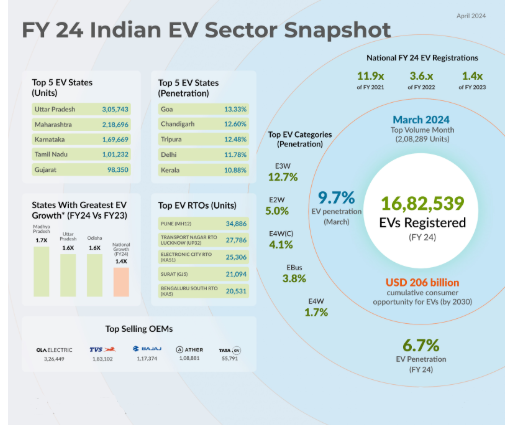
- Sales of EVs in India went up from 50,000 in 2016 to 2.08 million in 2024 as against global EV sales having risen from 918,000 in 2016 to 18.78 million in 2024.
- India’s EV penetration was only about one – fifth of the global penetration in 2020, but has picked up to over two-fifth of the global penetration in 2024.
Progress In EV sector as per Report
- Adoption of EV has been increasing in India but has been slower than the pace in some of the leading countries like the US, EU and China.
- India is doing well with electric two-wheelers and electric-three wheelers. With regard to electric buses, it has made some progress but with electric cars it has been slow. Long haul electric trucks have virtually not taken off.
- India has progressed to only about 7.6 % of the sales in 2024 being electric, which is far behind its target of 30% by 2030. Thus, it has taken nearly 10 years to reach a penetration level of 7.6% and now needs to increase this share by over 22% in the next 5 years alone.
Challenges Highlighted
- Challenges of financing vehicles, especially electric buses and electric trucks
- Inadequacy of charging facilities on one hand and low utilization of existing public charging facilities on the other
- Lack of adequate awareness regarding EV performance among public and private stakeholders.
- Inadequate data and regulatory gaps hinder evidence-based decision making.
E-Mobility Sector in India
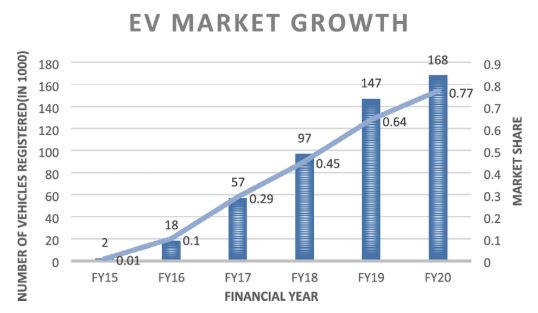
- EV Sales Growth: EV registrations in 2021: 330k units, a 168% rise from 2020.
- 2- and 3-wheelers dominate sales (48% and 47%, respectively).
- Factors Driving EV Adoption: Rising oil prices and environmental awareness.
- Geographical Distribution: Uttar Pradesh leads in EV registrations (20%).
- 2-wheelers: Karnataka, Tamil Nadu, Maharashtra, Telangana, Rajasthan.
- 3-wheelers: Uttar Pradesh, Bihar, Assam, Delhi (75% of sales).
- EV Growth Projections: By 2027, EVs are expected to reach 39% of total vehicle sales.
- Limited charging infrastructure: 1,742 stations (2021), projected 100,000 by 2027.
- Investment & Employment: EV industry attracted USD 6 billion in 2021, projected USD 20 billion by 2030.
- Potential to create 1 crore direct and 5 crore indirect jobs by 2030.
Significance of EV Sector for India
- Reducing Air Pollution: According to the ‘World Air Quality Report 2023’, India was declared as the third-most polluted country in 2023, after Bangladesh and Pakistan.
- EVs produce zero tailpipe emissions, significantly reducing pollutants like nitrogen oxides (NOx) and particulate matter (PM 2.5), improving air quality and public health.
- Energy Security: India’s import dependence soared to 87.7% in 2023-24, up from 87.4%, according to Petroleum Planning and Analysis Cell (PPAC).
- Electric mobility will help reduce dependence on imported oil by utilizing domestic sources of renewable energy like solar and wind for EV charging, enhancing the country’s energy security.
- Combating Climate Change: India is committed to reducing its carbon emissions under the Paris Agreement. The transport sector is one of the largest sources of greenhouse gas emissions.
- The shift to EVs aligns with India’s goal of achieving net-zero emissions by 2070, as electric vehicles have lower lifecycle emissions compared to conventional vehicles, especially when powered by renewable energy.
- Boosting Economic Growth: The EV sector is creating a robust ecosystem for manufacturing, battery production, and EV components, driving innovation and entrepreneurship.
- Strengthening Domestic Manufacturing: The government’s push for local manufacturing of EVs and their components, especially under the “Make in India” initiative, can strengthen India’s position as a global manufacturing hub.
Challenges
- High Upfront Cost of EVs: The cost of electric vehicles, especially electric cars, remains higher than conventional internal combustion engine (ICE) vehicles. This is primarily due to the expensive battery technology.
- Despite falling battery costs, the high upfront costs deter middle-class and lower-income consumers.
- Inadequate Charging Infrastructure: India has a limited network of public charging stations, which hampers long-distance travel and makes EV ownership less convenient.
- According to the government, the top nine cities in India will need 18,000 public EV charging stations by 2030.
- Battery Technology: India imports most of its EV batteries and the raw materials (like lithium, cobalt), making the country reliant on foreign suppliers and vulnerable to price fluctuations in global markets.
Way Forward
- Enhancing Infrastructure Development: Accelerate the rollout of public and private charging stations, including fast chargers and wireless charging facilities, to reduce range anxiety and support long-distance travel.
- Boost Battery Manufacturing: Expand domestic manufacturing of advanced chemistry cells (ACCs) and EV components to reduce import dependency and lower costs, as supported by the PLI schemes.
- Establish comprehensive battery recycling and disposal systems to manage end-of-life batteries effectively and minimize environmental impact.
- Ensure Policy Consistency: Maintain a consistent and supportive policy environment for EV adoption, including clear guidelines on subsidies, incentives, and infrastructure development.
- Transitioning to Renewable Energy: Transitioning to renewable energy sources such as solar and wind power is essential to fully realize the environmental advantages of electric vehicles (EVs).
- Government initiatives like the National Green Hydrogen Mission, Global Biofuel Alliance (GBA), and PM-KUSUM aim to strengthen India’s renewable energy production capacity.

2026-27 UPSC Mains English QEP Power Pages
View DetailsSubmit Your Details to Learn More



