
theIAShub
02 Aug, 2025
Table of Contents

Get an Instant Call Back from Our Expert Mentors!
Context
- Recently, the Minister of Agriculture informed the Parliament about the Vision of New Agriculture policy and Government Priorities.
Government Integrated Strategy for Comprehensive Agriculture Sector
Government Aims to
- Increase crop production/ productivity
- Reduce cost of production
- Remunerative prices for farmer’s produce to enhance their incomes.
- Agricultural diversification
- Developing post-harvest value addition infrastructure.
- Adaptation to climate change for sustainable agriculture and mitigate against crop losses
Recent growth in Agriculture Sector
- The Gross Value Added (GVA) agricultural growth rate in the Agriculture & allied sector in 2024-25 over 2023-24 is 4.6%, as per provisional estimate of Ministry of Statistics and Programme Implementation.
About Agriculture Policy of India
- The Government designs agricultural policies of India to raise agricultural production and productivity and enhance farmers’ income and living standards within a definite time frame.
- The Agricultural Policy of India is formulated for the all-round and comprehensive development of the agricultural sector.
- The Agricultural Policy aims to address key issues such as resource management, technology adoption, and market access.
- By promoting sustainable practices, improving infrastructure, and supporting innovation, the Agricultural Policy seeks to create a robust and resilient agricultural sector that can meet both current and future challenges.
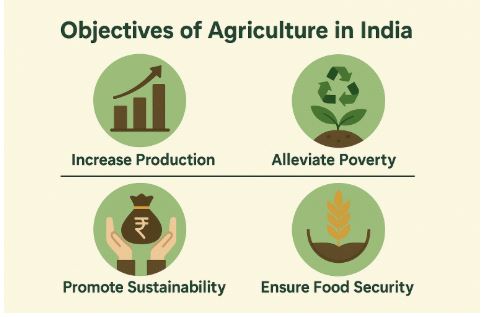
Objectives of Agriculture policy in India
- Raising the Productivity of Inputs such as HYV seeds, fertilisers, pesticides, and irrigation projects.
- Raising Value-added per Hectare by improving agricultural productivity in general and the productivity of small and marginal holdings in particular.
- Protecting the Interests of Poor and Marginal Farmers by abolishing intermediaries through land reforms and expanding institutional credit support to poor farmers.
- Modernising the Agricultural Sector involves introducing modern technology into agricultural operations and applying improved farm inputs like HYV seeds and fertilisers.
- Checking Environmental Degradation of the natural base of Indian agriculture.
- Promoting Agricultural Research and Training Facilities and disseminating the benefits of such research among farmers by establishing a close linkage between research institutions and farmers.
Major Components of Agriculture Policy in India
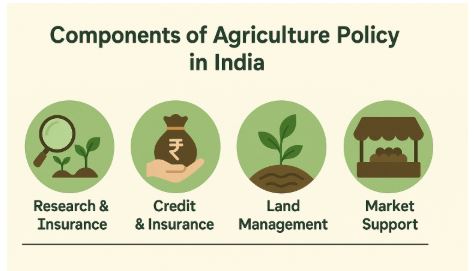
- Improving Input Productivity – The Agricultural Policy involves enhancing the efficiency and effectiveness of agricultural inputs such as High-Yielding Variety (HYV) seeds, fertilizers, pesticides, and irrigation.
- By optimizing the use of these inputs, the policy aims to increase crop yields and overall productivity.
- Value Addition and Crop Diversification – Value addition refers to increasing the value of agricultural products through processing, packaging, and other means, which helps farmers achieve better prices and higher incomes.
- Crop diversification involves growing a variety of crops rather than relying on a single crop.
- Supporting Poor and Marginal Farmers – The Agricultural Policy aims to address the needs of poor and marginal farmers through various measures.
- This includes land reforms to abolish intermediaries, expanding institutional credit to provide financial support, and providing subsidies or incentives to make farming more accessible and sustainable for those with limited resources.
- Modernizing Agricultural Practices – Modernizing agricultural practices involves introducing and adopting advanced technologies and methods in farming.
- The Agricultural Policy includes the use of precision agriculture, mechanization, and modern irrigation systems.
- Environmental Protection and Soil Health – Ensuring environmental protection involves implementing practices that prevent soil erosion, water depletion, and pollution.
- Soil health is maintained through techniques like crop rotation, organic farming, and the use of cover crops.
- The Agricultural Policy aims to sustain agricultural productivity over the long term while minimizing negative impacts on the environment.
- Agricultural Research and Extension Services – Agricultural research focuses on developing new technologies, crop varieties, and farming techniques to improve productivity and sustainability.
- Extension services involve disseminating this research to farmers through training programs, advisory services, and demonstration plots.
- Removing Bureaucratic Obstacles – This component of the Agricultural Policy addresses the need to streamline administrative processes and reduce bureaucratic hurdles that hinder agricultural progress.
- By simplifying procedures related to land acquisition, subsidy distribution, and credit access, the Agricultural Policy aims to make it easier for farmers and agricultural institutions to operate effectively and independently.
Spatial Pattern of Agriculture Development
- Distinct spatial patterns of endowments, cultures, and histories have conditioned the evolution of different agricultural development practices across India.
- After Independence, the Government’s immediate goal was to boost foodgrain production by:
- Shifting focus from cash crops to food crops.
- Intensifying cropping on existing cultivated land.
- Expanding cultivated areas by bringing uncultivated and fallow land into production.
- This strategy initially led to increased foodgrain production, but by the late 1950s, agricultural output began to stagnate.
- To overcome this problem, the Intensive Agricultural District Programme (IADP) and the Intensive Agricultural Area Programme (IAAP) were launched.
- However two consecutive droughts during the mid-1960s resulted in a a food crisis in the country.
- As a result, the food grains were imported from other countries across the world.
- Then, a significant step in the form of the ‘Green Revolution’ was taken to ensure food security in the country.
Conclusion
- The Agriculture of India represents a strategic effort to transform the agricultural sector through targeted reforms and initiatives.
- By emphasizing improvements in input productivity, crop diversification, and environmental protection, the policy aims to foster a more productive and sustainable agricultural landscape.
- As India continues to navigate the complexities of economic liberalization and global competition, the policy’s focus on enhancing productivity, supporting farmers, and addressing bureaucratic barriers will be crucial for securing a prosperous future for agriculture and ensuring the well-being of the nation’s farmers.

2026-27 UPSC Mains English QEP Power Pages
View DetailsSubmit Your Details to Learn More



