
theIAShub
23 Jul, 2025

Table of Contents

Get an Instant Call Back from Our Expert Mentors!
Context
- India targets 100 GW nuclear power by 2047 for a more sustainable energy future and for the Viksit Bharat Goal by 2047.
About India’s Nuclear Power for 2047
- The Union Budget 2025–26 signals a major shift in India’s energy strategy by setting an ambitious target of 100 GW nuclear power capacity by 2047, a sharp rise from the current 8.18 GW.
- This aligns with the dual national goals of Viksit Bharat by 2047 and achieving net-zero emissions by 2070.
- To advance this vision, the Nuclear Energy Mission has earmarked ₹20,000 crore to develop at least five indigenous Small Modular Reactors (SMRs) by 2033.
- Achieving these goals will require private sector participation, which in turn demands reforms in the Atomic Energy Act, 1962 and the Civil Liability for Nuclear Damage Act, 2010.
- Beyond legal reforms, a broader mindset shift is essential to transition nuclear energy from a government-led domain to a public-private growth engine.
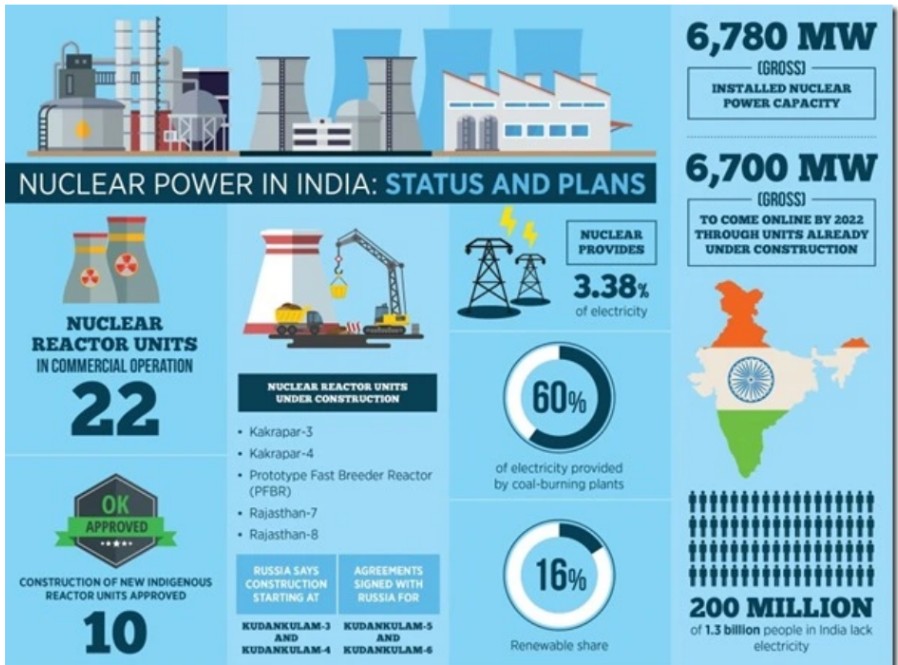
India’s Nuclear Power Journey
- India’s nuclear programme began early, with the Apsara reactor established in 1956 and nuclear power development initiated at Tarapore in 1963.
- Dr. Homi Bhabha had envisioned 8 GW of nuclear power by 1980.
- However, geopolitical events such as the 1962 war with China, India’s refusal to join the Nuclear Non-Proliferation Treaty in 1968, and its 1974 Peaceful Nuclear Explosion led to international isolation and export restrictions.
- India focused on indigenising nuclear technology, eventually developing 220 MW Pressurised Heavy Water Reactors (PHWRs), which used natural uranium.
- Post-1998 nuclear tests and subsequent diplomatic engagement led to India being recognised as a responsible nuclear power.
- It culminated in a waiver from the Nuclear Suppliers Group (NSG), allowing renewed international cooperation.
- Despite this, India’s Civil Liability for Nuclear Damage Act (CLNDA) discouraged foreign participation in building new nuclear plants, leaving Russia as the only active partner under a pre-CLNDA agreement, constructing six VVER-1000 reactors at Kudankulam.
Nuclear Power: Key to India Green Transition
- To achieve developed nation status by 2047, India must grow its per capita income from $2,800 to $22,000 and its GDP from $4 trillion to over $35 trillion.
- Since economic growth is closely linked with energy consumption, India’s electricity generation capacity — currently 480 GW, split equally between fossil fuels and renewables — must grow fivefold.
- However, renewable energy sources like solar and wind are intermittent and currently contribute only a fraction of total electricity generation.
- In 2024, despite comprising half the capacity, renewables generated just 240 TWh, while coal plants provided 75% of the total power.
- India’s climate commitments — including net zero emissions by 2070, 500 GW of non-fossil energy by 2030, and 50% energy demand met through renewables — restrict future dependence on fossil fuels.
- With renewables expected to meet only 20-25% of demand even with advanced storage solutions, nuclear energy emerges as a crucial alternative.
Challenges to India’s Nuclear Expansion
Restrictive Measures
- Atomic Energy Act, 1962 restricts nuclear operations to government entities.
- CLNDA, 2010’s supplier liability clause deters foreign/private participation
Regulatory Gaps
- Atomic Energy Regulatory Board (AERB) lacks legal independence and previous reform Bill lapsed in 2011.
Financing Hurdles
- Capital cost of $2 million/MW for PHWRs vs. <$1 million/MW for coal.
- Lack of green financing eligibility; limited PPP/JV frameworks.
Tariff Disputes and Regulation
- Disputes like NPCIL vs Gujarat Urja Vikas Nigam raise questions about whether nuclear tariffs should follow the Electricity Act framework.
- With private players entering, clear and predictable tariff-setting mechanisms are essential.
Incentivising Nuclear Investments
- Reclassify as Renewable: Though low-carbon, nuclear is not officially labelled “renewable.” Reclassifying it would unlock tax benefits and access to green financing instruments.
- Viability Gap Funding & PPAs: Long-term power purchase agreements and targeted funding support will make nuclear investments more attractive.
- Foreign Direct Investment (FDI): The sector should be opened up to FDI — possibly up to 49% — to maintain Indian control while bringing in global capital.
Conclusion
- India’s civil nuclear journey must now transition from cautious evolution to bold reform. With strategic, legislative, and financial restructuring, nuclear energy can be India’s backbone for green, secure, and inclusive growth. Achieving 100 GW by 2047 is not just an energy target — it’s a cornerstone of India’s aspiration for development and climate leadership.

2026-27 UPSC Mains English QEP Power Pages
View DetailsSubmit Your Details to Learn More



