
theIAShub
31 Jul, 2025
Table of Contents

Get an Instant Call Back from Our Expert Mentors!
Context
- During Former Bangladesh's Prime Minister Sheikh Hasina's visit to India Dhaka and New Delhi agreed on some crucial matters related to the transboundary river water issues. However the real challenge is the Ganges Water Treaty of 1996. which will expire in 2026
Background and Historical Context
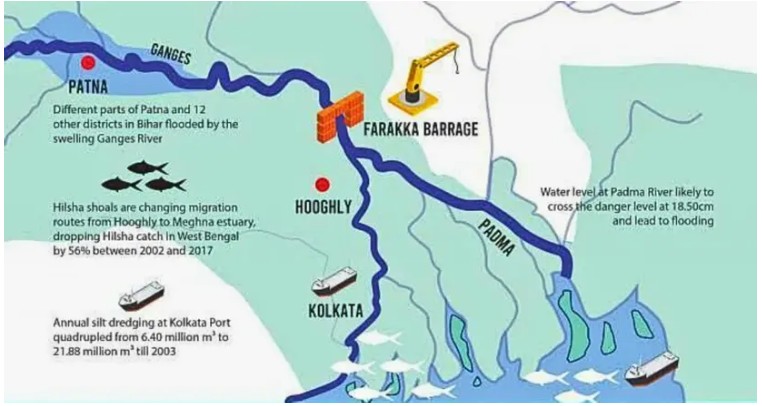
- The GWST, signed on December 12, 1996, between India and Bangladesh, governs the sharing of the Ganges River's waters at the Farakka Barrage, located in West Bengal, India, approximately 18 km from the Bangladesh border.
- The treaty was a significant diplomatic achievement, resolving decades of disputes over the Ganges waters that had strained bilateral relations since Bangladesh's independence in 1971.
Historical Tensions
- The Ganges water dispute began with India's construction of the Farakka Barrage, completed in 1975, to divert water to the Hooghly River to improve navigation at the Kolkata port by flushing out silt.
- Bangladesh, downstream, argued that the barrage reduced water flow, adversely affecting its agriculture, fisheries, navigation, and causing environmental issues like salinity intrusion in the Sundarbans.
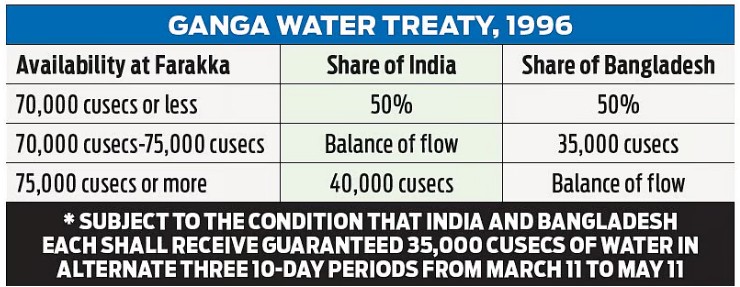
- 1996 Treaty: Signed during a period of improved India-Bangladesh relations, the treaty establisheda30-year framework (1996-2026) for sharing Ganges waters during the dry season (January 1 to May31).
- It allocates water based on the river's flow at Farakka, measured in 10- day periods, with a 50:50 sharing when flows are around 70,000-75,000 cusecs.
Water Shortages in Bangladesh
- Bangladesh has frequently received less water than stipulated, particularly during the driest months (March-April).
- For instance, in 2016 and 2018, Bangladesh received significantly less than its allocated share due to low river flows, impacting agriculture and livelihoods in the Ganges-dependent southwest region.
- Environmental and Socioeconomic Impacts: Reduced water flow has led to increased salinity in Bangladesh's coastal regions, affecting agriculture, fisheries, and the Sundarbans ecosystem.
- Navigation and groundwater availability in Bangladesh have also been compromised, exacerbating economic challenges in the Ganges-dependent regions.
India's Upstream Activities
- India's construction of upstream dams, barrages, and irrigation projects (e.g., in Bihar and Uttar Pradesh) has reduced the Ganges' flow at Farakka, impacting the treaty's efficacy.
- Bangladesh has raised concerns about India's National River Linking Project, particularly the proposed diversion of water from the Ganges to other Indian rivers, which could further reduce downstream flows.
Geopolitical and Bilateral Dynamics
- India's Position: As the upper riparian state, India holds significant control over the Ganges' flow. Its domestic water needs (e.g., for agriculture and urban use in Uttar Pradesh and Bihar) often take precedence, complicating negotiations. India has also resisted internationalizing water disputes, preferring bilateral talks.
- Bangladesh's Concerns: As the lower riparian state, Bangladesh is vulnerable to India's upstream actions. The country seeks a legally binding, long-term agreement that guarantees minimum flows and addresses environmental impacts.
- Political Context: The article notes that the GWST was signed during a period of strong bilateral ties under Bangladesh's Awami League government and India's supportive stance.
- However, political changes in either country could affect negotiations. For instance, Bangladesh's push for a Teesta water-sharing agreement (still unresolved due to India's internal political constraints) could influence GWST talks.
Steps that can be taken to ensure Sustainable Water Flow post 2026
- Early Negotiations: India and Bangladesh should begin talks well before 2026 to avoid last-minute disputes. These talks should involve technical experts, policymakers, and stakeholders from both countries.
- Climate-Resilient Framework: The treaty should account for climate change impacts, with flexible allocation mechanisms and provisions for joint climate adaptation projects.
- Data Sharing and Transparency: Real-time data exchange on water flows and upstream activities would enhance trust and compliance.
- Stakeholder Engagement: Involving local communities, environmentalists, and scientists in both countries could ensure that the treaty addresses socioeconomic and ecological concerns.

2026-27 UPSC Mains English QEP Power Pages
View DetailsSubmit Your Details to Learn More



