Five Years of National Education Policy 2020: Key Reforms, Achievements & Challenges

Explore five years of India's National Education Policy (NEP) 2020, highlighting major reforms in school and higher education, digital learning, teacher training, skill development, and the challenges that hinder its full implementation.

upsc-daily-current-affairs
THEIASHUB
Get an Instant Call Back from Our Expert Mentors Now!
+91

Context

  • The Government of India has completed five years of implementation of the National Education Policy 2020, marking substantial progress in curriculum reforms, digital integration, teacher training, and equitable access to quality education.
  • However, much of its ambitious vision for overhauling school and higher education remains unfulfilled. 
  • Delays caused by Centre-state disagreements and institutional bottlenecks have slowed implementation across the country.
Historical Context

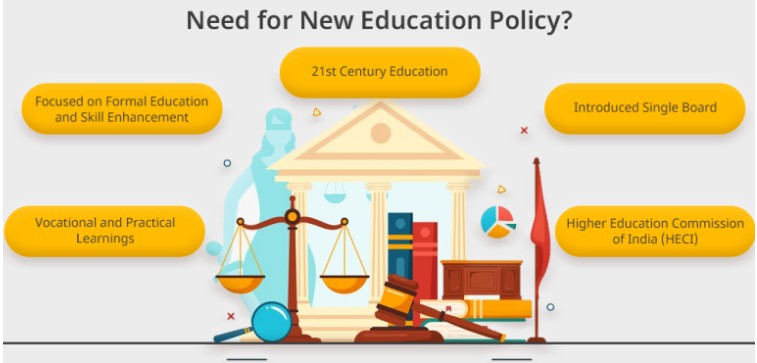
  • Legacy of Colonial System: The British education model was designed to create clerks, not innovators. It was job-centric and not skill-oriented.
  • Need for Reform: Post-independence, minor changes were made, but a comprehensive restructuring was missing.
  • NEP 2020 was envisioned to address these systemic gaps and align Indian education with 21st-century needs.
Vision and Objectives of NEP 2020

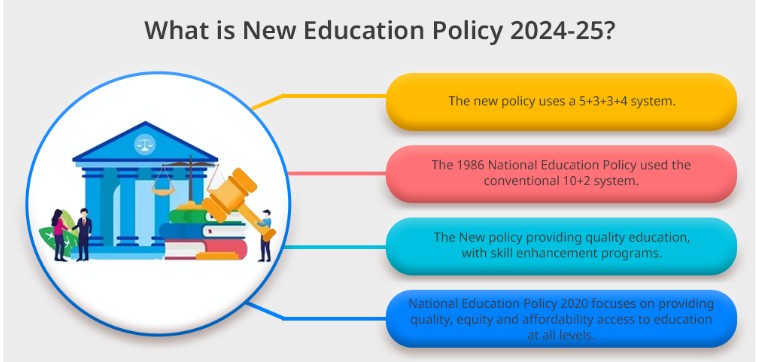
  • Practical & Skill-based Education: Move away from rote learning.
  • Holistic Development: Build value-based, tech-savvy, and globally competitive citizens.
  • Inclusive Access: Bridge rural-urban, gender, and socio-economic divides.
  • Public Investment Target: Increase spending to 6% of GDP.

Changes Bought by the Policy

  • The traditional 10+2 structure has been replaced by a 5+3+3+4 system: foundational (pre-primary to class 2); preparatory (classes 3–5); middle (6–8), and secondary (9–12). 
  • The 2023 National Curriculum Framework laid out outcomes for each stage. 
  • NCERT released new textbooks (classes 1–8), merging subjects like his
  • NEP aims for universal pre-primary education by 2030. NCERT’s Jaadui Pitara kits and a national ECCE curriculum are now in use. 
  • Delhi, Karnataka, and Kerala are enforcing a minimum age of six for class 1, improving readiness but reducing enrolments. 
  • However, better Anganwadi training and infrastructure are still needed.
  • Assessment Reform
    • CBSE Class 10 board exams to be conducted twice a year from 2026.
    • Introduction of formative assessments and internal assessments.
  • Skill Development in Schools
    • Skill modules introduced in Classes 9–12.
    • 138 skill job roles approved till 2025.
    • Vocational education expanded: From 1,850 (2014–15) to 29,342 schools (2024–25).

Higher Education Reforms

  • Curriculum and Credit Reforms
    • National Higher Education Qualification Framework (NHEQF)
    • Multiple Entry-Exit System, Academic Bank of Credits
    • PM Vidya Lakshmi for financial aid
    • 40% credit transfer through SWAYAM
  • Institutional Expansion
    • 7 new IITs, 8 IIMs, 13 AIIMS, 354 Eklavya Schools
    • MBBS seats nearly doubled in a decade
      • 2014: 54,348 seats | 2025: 1,18,190 seats
  • Digital Education Ecosystem
    • Diksha, SwayamPrabha, PM e-Vidya, e-Pathshala
    • Content in 126 Indian and 7 foreign languages
    • Over 25,000 hours of broadcast in 29 languages
  • Teacher Training and Governance
    • NISHTHA 3.0 for teacher training
    • Over 26 lakh master trainers trained
    • SAMARTH: Digital governance for Higher Education Institutions (HEIs)
    • To allow flexibility in higher education, the NEP introduced the Academic Bank of Credits (ABC) and the National Credit Framework (NCrF). 
    • Learners can exit after one, two, or four years with a certificate, diploma, or degree. CBSE is piloting this credit model in schools as wel

Foundational Learning under NIPUN Bharat

  • Launched in 2021, NIPUN Bharat targets literacy and numeracy by class 3. 
  • A recent survey shows 64% average language proficiency and 60% in math—progress, but still below universal goals.

Challenges

  • Implementation gaps at state level
  • Digital divide in rural and tribal regions
  • Teacher shortages and uneven quality of training
  • Alignment of vocational education with employability

Way Forward

  • Strengthen decentralised capacity-building at the state and district levels
  • Foster public-private partnerships for infrastructure and skilling
  • Ensure inclusivity for differently-abled and disadvantaged groups
  • Establish strong monitoring and feedback mechanisms
  • Promote research and innovation through increased funding and autonomy to institutions.


UPSC QEP 2026 Batch 5 - English
Buy now View Details
Submit Your Details to Learn More
I agree to give my consent to receive updates through SMS/Email & WhatsApp*.

NEEV GS + CSAT Foundation 2026/27
Buy now View Details


Join theIAShub’s Mains Answer Writing Program

Refine your answer writing skills and elevate your UPSC preparation with personalized support and expert feedback.

Fill out the form to get started with the program or any other enquiries !

I agree to give my consent to receive updates through SMS/Email & WhatsApp*.

Best IAS Coaching In Delhi, UPSC Online & Offline Classes by IAShub

Are you dreaming of becoming an IAS officer? Then, IAShub can be your best guide. It is one of the Best IAS Coaching in Delhi. Many students who want to clear the UPSC exam join IAShub for learning. The institute gives both online and offline classes. Their teachers are experienced and helpful. They easily explain every topic. Students also get notes, tests, and tips to do well in the exam.

UPSC Online Classes by IAShub

IAShub is in Delhi and is trusted by many UPSC students. It offers coaching for every part of the UPSC exam – Prelims, Mains, and Interview. The classes are simple and easy to understand. The teachers are experts and guide students in the right way. IAShub is also known for its helpful notes, test series, and answer-writing practice. IAShub is the best coaching in Delhi and also gives UPSC Online Classes. This helps students from any place in India to learn. The online classes are live and also recorded. So, students can watch them anytime. These classes cover the full UPSC syllabus.

Key Offerings Provided by IAShub

Here are some important services provided by IAShub:

  • UPSC Prelims: IAShub teaches for Prelims with a focus on basics. It also gives daily current affairs and monthly magazines.
  • Classroom Courses: IAShub has classroom learning for students in Delhi. The environment is good and peaceful for study.
  • Live Classes: Students who live far can join live UPSC online classes. These classes are just like real classes.
  • QEP for Mains: The Quality Enrichment Program (QEP) is special for Mains preparation. It helps students write better and faster.
  • Answer Writing: Regular answer writing practice is given. Teachers also check answers and give tips to improve.
  • Free Resource: IAShub gives free notes by toppers and helpful Main Booster material.
  • Test Series: Test series are available for every subject. These help students know their weak points and improve.
  • Interview Guidance Session: IAShub also gives interview practice sessions with experts. These help students feel confident.

UPSC Exam Overview

The UPSC Civil Services Exam has three parts:

  • Prelims: It has two papers: General Studies and CSAT.
  • Mains: It has nine papers, including essays and optional subjects.
  • Interview: It tests the personality and confidence of the student.

This exam is tough, but with the right guidance, it becomes easy to manage. Students must study smart and stay regular.

How IAShub Helps in the UPSC Journey

IAShub supports students from the beginning to the end. It gives the right books, tests, and notes. The classes are easy to follow, and the teachers are always ready to help. Students get personal doubt sessions too. The test series and answer checking help students learn where they need to do better. Also, free study materials save time and money.
IAShub also guides students during the final stage – the interview. Experts take mock interviews and give useful tips. This full support makes IAShub one of the best IAS coaching in Delhi.

Best IAS Coaching In Delhi FAQs

Yes, IAShub offers live and recorded online classes. Students can attend from any part of India.

Classes are available in both English and Hindi, so students can choose the language they are comfortable with.

The classroom centre is located in Delhi. Students can visit and join offline batches there.

IAShub gives interview guidance sessions to help students prepare for the final round of UPSC.