
1. World Meteorological Organization (WMO) Study on Global Warming
World Meteorological Organization (WMO) Study on Global Warming: Recently, the World Meteorological Organization (WMO) reported that global temperatures have remained 1.5°C above pre-industrial levels for nearly two consecutive years.
o This marks a stark warning, as the Paris Agreement urged nations to limit warming to 1.5°C as a 20-year average.
- About Paris Agreement: A legally binding international treaty on climate change, adopted by 196 Parties at COP21 in Paris on 12 December 2015, and came into force on 4 November 2016.
o Its main objective is to limit global temperature rise to well below 2°C above pre-industrial levels and to pursue efforts to restrict it to 1.5°C.
o The 1.5°C target has gained urgency in recent years, as scientific findings from the IPCC indicate that surpassing this threshold could trigger more intense droughts, heatwaves, and extreme rainfall events.
o To stay within the 1.5°C limit, global greenhouse gas emissions must peak before 2025 and fall by 43% by 2030.
o The Agreement is a landmark in climate diplomacy, uniting all countries for the first time in a binding commitment to tackle climate change and adapt to its consequences.
o It functions through a five-year cycle of increasing climate ambition. Countries submit Nationally Determined Contributions (NDCs) outlining actions to cut emissions and build climate resilience. Each new NDC should be more ambitious than the previous one.
o At COP27, countries were urged to revisit and strengthen their 2030 NDC targets by the end of 2023 to better align with the 1.5°C goal, while considering national circumstances.
o Countries are also encouraged to submit Long-Term Low Emission Development Strategies (LT-LEDS), which provide a vision for sustainable, low-emission development. While not mandatory, LT-LEDS complement NDCs by framing them within a long-term planning context.
2. 16th Finance Commission cycle (2026-31)
16th Finance Commission cycle (2026-31): Recently, the Union Ministry of Finance mandated that no Centrally Sponsored Scheme (CSS) or Central Sector Scheme (CS) will be appraised for continuation in the 16th Finance Commission cycle (2026–31) without undergoing a third-party evaluation.
- About 16th Finance Commission: Starting on April 1, 2026, is chaired by Dr. Arvind Panagariya. It addresses key responsibilities including equitable resource distribution, grants-in-aid principles, and strengthening local governance.
o The Commission also focuses on disaster management financing and urbanization challenges.
o Established under Article 280 of the Indian Constitution, the Finance Commission is a constitutional body tasked with recommending the division of tax revenues between the central and state governments every five years.
o It plays a vital role in maintaining fiscal federalism, ensuring good governance, and addressing economic disparities among states.
o The Commission consists of a Chairman and four members with expertise in finance, economics, or public administration.
3. Nomadic Elephant
Nomadic Elephant : The Indian Army contingent is going to participate in the 17th edition of the India-Mongolia Joint Military Exercise ‘Nomadic Elephant’, scheduled to take place in Ulaanbaatar, Mongolia
- About Nomadic Elephant : A bilateral military exercise between India and Mongolia, conducted nearly every year, with the hosting duties alternating between the two countries.
o Primary Focus: Counter-insurgency operations, Counter-terrorism operations and Operations in semi-urban and mountainous terrains
o Conducted under the framework of Chapter VII of the United Nations Mandate
- Objectives:
o Strengthen Military Cooperation: Enhance defense relations by sharing knowledge and experiences in military tactics and strategies.
o Joint Training: Conduct combined exercises focusing on counter-terrorism and counter-insurgency operations.
o Enhance Interoperability: Improve coordination and ability to operate together, especially in United Nations peacekeeping missions.
4. Maharatna, Miniratna + other
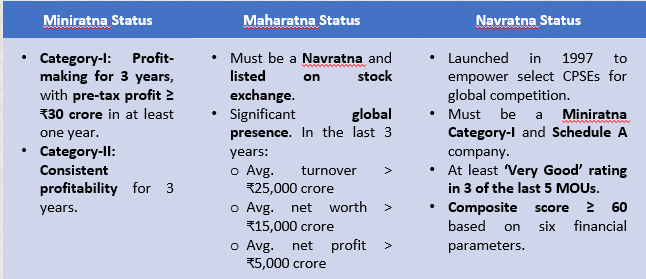
Maharatna, Miniratna + other: Recently, in a significant recognition of their performance and transformation, the Defence Minister approved the grant of Miniratna (Category-I) status to three Defence Public Sector Undertakings (DPSUs): Munitions India Limited (MIL), Armoured Vehicles Nigam Limited (AVNL), and India Optel Limited (IOL).
- About:
5. ECINET
ECINET: Recently, the Election Commission of India (ECI) announced plans to operationalize its new integrated digital platform, ECINET, during the upcoming Assembly byelections and ahead of the Bihar Assembly elections later this year.
- About ECINET : A unified digital platform developed by the Election Commission of India to integrate over 40 existing apps and portals into a single-window system for streamlined election management.
o Selected modules will be deployed during the June 19 byelections in five Assembly constituencies across four states, with full implementation planned before the Bihar Assembly elections later this year.
o The platform aims to reduce fragmentation, improve efficiency, and provide user-friendly access for electors, officials, political parties, and civil society.
o It will eliminate the need for multiple app downloads by offering a single portal for all election-related services with an aesthetic interface and simplified user experience.
o ECINET will integrate applications like: Voter Helpline App, Voter Turnout App, cVIGIL, Suvidha 2.0, ESMS, Saksham and KYC App.
6. Global Adult Tobacco Survey (GATS2)
Global Adult Tobacco Survey (GATS2) : Recently, the Global Adult Tobacco Survey (GATS2) reported that approximately 42% of Indian men and 14% of women use tobacco.
- Key Highlights : India has 70% of the world’s smokeless tobacco users; bidis dominate in rural/low-income groups, while cigarettes are rising even in villages.
o Tobacco use causes high rates of cancers, especially oral cancer, with India leading male cancer deaths globally.
o Tobacco cost India more than ₹1.75 lakh crore in 2017-18, mostly from smoking, straining health and family finances.
o GST on tobacco (35%) is below the WHO’s recommended 75%, and rising incomes plus industry tactics keep prices low.
o MPOWER represents six evidence-based strategies recommended by WHO to reduce tobacco demand: Monitor tobacco use
- Protect people from tobacco smoke,
- Offer help to quit,
- Warn about dangers
- Enforce bans on advertising and promotion
- Raise taxes on tobacco.
7. Gond and Madhubani Paintings
Gond and Madhubani Paintings : Recently, a group of artists participating in the Artists in Residence programme at Rashtrapati Bhavan met the President of India, showcasing the rich heritage of traditional Indian art forms.
- Gond Painting: Originates from the Gond tribes in Madhya Pradesh, Maharashtra, Andhra Pradesh, and Chhattisgarh.
o Themes focus on nature—animals, forests, sun, moon, stars—and mythological stories featuring deities like Bhima and Parvati and mythical creatures such as the Shachi bird.
o Uses natural materials like charcoal, colored soil, and plant sap.
o Painted on mud walls, cloth, or paper using twigs and leaves.
o Each artist has a unique style with distinctive patterns (dots, fine lines, curved lines, dashes, fish scales) that combine to form complex images.
- Madhubani Painting: Originated in the Mithila region of Bihar, traditionally practiced by women.
o Depicts Hindu mythology, epics like the Ramayana, daily life, and festivals such as Holi and Tussar.
o Features deities like Krishna, Durga, and Saraswati, symbolizing fertility and auspiciousness.
o Traditionally painted on mud walls and cloth; now also on paper and canvas.
o Uses natural pigments like turmeric, lamp black, and cow dung.
o Known for precise linework, double outlines, and intricate geometric patterns.
8. Ker Sangri
Ker Sangri: Recently, Rajasthan’s iconic dish Ker Sangri was officially awarded a Geographical Indication (GI) tag, acknowledging its distinct origin and cultural significance tied to the arid Thar Desert region.
- About Ker Sangri: A traditional Rajasthani dish made from sangri pods (from khejri trees) and ker berries, found in the dry Thar Desert.

o The berries are bitter raw but become tasty after soaking, boiling, and cooking with spices and curd, giving the dish a spicy and tangy flavor.
o It is healthy, rich in fiber and nutrients, and usually eaten with bajra roti and ghee.
o The khejri tree is important to the Bishnoi community, who protect it as a symbol of life.

2026-27 UPSC Mains English QEP Power Pages
View DetailsSubmit Your Details to Learn More



