

- India-Nepal Relations: History, Significance, Challenges & Future Prospects
- India-Bangladesh Relations
- India Pakistan Relations: History, Conflicts, Trade & Peace Efforts
- Pakistan Political Crisis
- Indus Water Treaty
- India-Sri Lanka Relations
- India-Afghanistan Relations: Strategic Ties, Challenges & Future Prospects
- India-China Relations: Border Disputes, Trade, and Strategic Challenges
- India-Bhutan Relations
- India Myanmar Relations
- India-Maldives Relations
- Indian Ocean Region (IOR): Strategic Importance, India’s Role
- India’s No First Use (NFU) Nuclear Policy: Doctrine, Debate & Future Path
- India-Russia Relations: Strategic Partnership, Defence, Trade & Energy Cooperation
- India- US Relations
- India-Canada Relations
- India-African Union Relations
- India-Egypt Relations
- BIMSTEC
- Shanghai Cooperation Organisation (SCO)
- G20's International Financial Architecture
- The 14th BRICS Summit: Promoting Stability, Cooperation, and Global Recovery
- India and the United Nations Security Council (UNSC)
- India's Commitment to Gender Parity
- Counter-Terrorism Committee Executive Directorate (CTED)
- WTO's Ministerial Conference (MC12) and the
- Global Push for De-Dollarization
- Global Oil Dynamics: OPEC, OPEC+, and India's Stand for Equitable Pricing
- About Pravasi Bhartiya Divas
1. India-Nepal Relations: History, Significance, Challenges & Future Prospects
India-Nepal’s Relation was founded on the age-old connection of history, culture, tradition and religion, these relations are close, comprehensive and multidimensional and are pronounced more in political, social, cultural, religious and economic engagements with each other. The two countries established diplomatic relations on 17 June 1947.

Significance of Nepal for India
Economic Significance
- Trade: Nepal's geographical proximity to five Indian states makes it an important trade partner for economic exchange.
- Energy security: India and Nepal share transboundary Himalayan rivers with immense hydropower potential.
- Nepali exports: India has a significant demand for Nepali exports, particularly Pashmina textiles. India exports to Nepal was US$8.53 Billion during 2022.
Strategic Significance
- Buffer state: Nepal serves as a buffer state against possible aggression from China.
- Internal Security: Nepal's cooperation is crucial in curbing cross-border infiltrations and drug trade.
Cultural Significance
- Pilgrimage sites: Nepal's numerous Hindu and Buddhist religious sites attract a large number of Indian pilgrims.
- Common religion: Both countries have a Hindu population of around 80%, which promotes cultural integration.
- Diaspora: There is a significant Nepali diaspora in India, while Indian workers contribute to Nepal's workforce.
Bilateral Relationship in India-Nepal Relations
- India and Nepal share a unique friendship characterized by an open border and deep-rooted people-to-people contacts based on kinship and culture.
- India's focus on Nepal revolves around non-partisan support for inclusive economic development, interdependence, communication links, people-to-people contacts, and capitalizing on economic complementarities, particularly in the hydropower sector.
- The historical, geographical, cultural, religious, and economic linkages between India and Nepal help manage security concerns within acceptable limits.
Economic Relationship in India-Nepal Relations
- Trade: India is the Nepal's largest trade partner, contributing to more than two-thirds of merchandise trade.
- Investment: Indian firms constitute a significant portion of foreign direct investment in Nepal, accounting for over 30% of the total approved investments.Approximately 150 Indian ventures are operating in Nepal.
- Agriculture: In 2018, the 'India-Nepal New Partnership in Agriculture' was launched to foster collaborative projects in agricultural research, development, and education.
Water Resource Cooperation: A bilateral mechanism established in 2008 facilitates discussions on cooperation in water resources, flood management, inundation, and hydropower.
|
Defence and Security in India-Nepal Relations
- India has been assisting the modernization of the Nepal Army by providing equipment and training.
- Nepalese defense personnel attend training courses in various Indian Army institutions.
- The 'Indo-Nepal Battalion-level Joint Military Exercise SURYA KIRAN' is conducted alternately in India and Nepal.
Connectivity and Development in India-Nepal Relations
- The Nepal-Bharat Maitri Pashupati Dharamshala in Kathmandu was inaugurated in 2018.
- Bangladesh, Bhutan, India and Nepal (BBIN) Motor Vehicle Agreement for the Regulation of Passenger, Personal and Cargo Vehicular Traffic.
- The establishment of Integrated Check Ports along the borders, including Birgunj and Biratnagar, has facilitated trade and transit.
Energy in India-Nepal Relations
- India and Nepal have had a Power Exchange Agreement since 1971 to meet the power requirements in border areas, utilizing each other's transmission infrastructure.
- Currently, India supplies approximately 600 MW of power to Nepal.
- The first high-capacity cross-border power transmission line between Muzaffarpur (India) and Dhalkebar (Nepal), with funding from the Government of India, was completed in 2016.
- An agreement on 'Electric Power Trade, Cross-border Transmission Interconnection and Grid Connectivity' was signed between India and Nepal in 2014.
Education and Culture in India-Nepal Relations
- Approximately 600,000 Indians reside in Nepal.
- The Government of India provides around 3,000 scholarships annually to Nepalese nationals for various courses.
- The B.P. Koirala India-Nepal Foundation was established in 1991 to promote educational, cultural, scientific, and technical cooperation between the two countries.
- The Swami Vivekananda Centre for Indian Culture, set up in Kathmandu in 2007, showcases Indian culture.
Challenges in India-Nepal Relations
Territorial Disputes
Kalpani
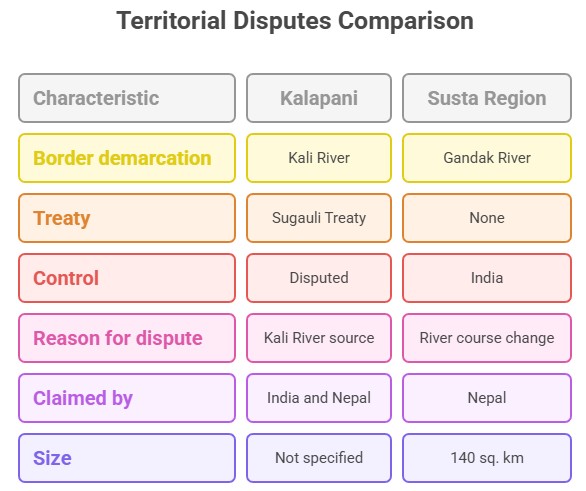
- The Kali River in the Kalapani region demarcates the border between India and Nepal.
- The Treaty of Sugauli signed by the Kingdom of Nepal and British India (after the Anglo-Nepalese War) in 1816 located the Kali River as Nepal’s western boundary with India.
- The discrepancy in locating the source of the Kali River led to boundary disputes between India and Nepal, with each country producing maps supporting its own claims.
Susta Region
- It is about 140 sq. km of land in Uttar Pradesh at the Nepal border in the Terai area. India has control of the territory. Nepal claims this territory.
- The change of course by the Gandak River is the main reason for disputes in the Susta area.
Issues with Peace and Friendship Treaty
- The 1950 Treaty of Peace and Friendship is viewed as a sign of an unequal relationship and an Indian imposition.
- The idea of revising and updating the treaty has been mentioned in Joint Statements but progress has been sporadic.
The Demonetization Irritant
- In November 2016, India withdrew high-value currency notes, and many Nepali nationals who were legally entitled to hold Indian currency were left without a way to exchange their demonetized bills.
- The Nepal Rastra Bank holds a significant amount of demonetized Indian currency, and the fate of the report submitted by the Eminent Persons Group (EPG) remains unknown.
China's Intervention
- China has gradually increased its influence in Nepal, filling the space left by India.
- China sees Nepal as a key partner in its Belt and Road Initiative (BRI) and wants to invest in Nepal's infrastructure.
- The growing cooperation between Nepal and China could undermine Nepal's position as a buffer state between India and China.
Internal Security
- The lightly policed Indo-Nepal border poses a major concern for India, as it can be exploited by terrorist outfits and insurgent groups from the north-eastern part of India.
Trust and Ethnic Differences
- Trust deficit has widened between India and Nepal due to perceived delays in implementing various projects.
- Certain ethnic groups in Nepal harbor anti-India sentiments, believing that India interferes too much in Nepal's internal affairs.
Solutions
- Mutual empathy: There should be a willingness among political leaders, bureaucracies, and civil society on both sides of the border to understand each other's perspectives.
- Diverse and balanced approaches: A clearer understanding of the past, present trends, and new roadmaps for upgrading ties should be developed.
- New and innovative approaches: India should respect Nepal's identity and work towards a sense of equality.
Way forward
- Dialogues for Territorial Disputes: Rhetoric on territorial nationalism should be avoided, and quiet dialogue should be initiated to explore feasible solutions. India should be a sensitive and generous partner.
- Sensitizing Towards Nepal: India should engage proactively with Nepal through people-to-people interactions, bureaucratic engagement, and political interactions.
- It should maintain a policy of non-interference in Nepal's internal affairs.
- Strengthening Economic Ties: The power trade agreement should build trust between India and Nepal, as hydropower can effectively manage peak demand in India.
- Investing in Nepalese hydropower can save the need for building new power plants and reduce pollution.
- Investments from India: Nepal should welcome Indian investments and address concerns raised by certain groups opposing foreign investments.
Conclusion
India and Nepal need formal mechanisms to resolve boundary issues, drawing inspiration from successful resolutions in other regions. People-to-people interactions and updated discourse are crucial, considering Nepal's federated governance and changing demographics.
2. India-Bangladesh Relations
Introduction: India was the first country to recognize Bangladesh as a separate and independent state and established diplomatic relations with the country immediately after its independence in December 1971.
Geopolitics
- Strategic Neighbour: Bangladesh is India's most strategic neighbour from the perspective of India's Northeast. India's "Act East Policy" can only be realized with the support of Dhaka.
Connectivity
- India and Bangladesh are connected through road, rail, and river links. Infrastructure projects like the India-Bangladesh Friendship Bridge and Payra Deep Seaport contribute to enhanced connectivity.
- Maitri Setu: The construction of the Maitri Setu bridge over the Feni River, connecting Tripura State in India with Bangladesh, has established it as the "Gateway of North East" with access to the Chittagong Port, just 80 kilometers from Sabroom.
- India-Bangladesh inland waterway route: This route connects Tripura with the National Waterways of India via Bangladesh.
Security
- Counteracting Radical Activities: Bangladesh's proximity to India raises concerns about it becoming a launchpad for religious radical terror activities. India's relationship with Bangladesh is also linked to its relationship with China, as India seeks to prevent Bangladesh from becoming part of China's strategic encirclement.
Trade
- Strong Trade Partnership: Bangladesh is currently India's largest trade partner in South Asia. To boost bilateral trade, India has provided several concessions to Dhaka, including duty-free access for Bangladeshi products in Indian markets.
- Both countries enjoy preferential treatment in terms of tariff concession in each other's market due to their participation in the South Asian Free Trade Area (SAFTA).
- A proposed agreement, the Bangladesh-India Comprehensive Economic Partnership Agreement, aims to encompass trade in goods, services, and investments.
- In 2022, bilateral trade between India and Bangladesh reached US$18.2 billion, making Bangladesh India's top trading partner in the region. India ranks as the 12th largest commercial partner for Bangladesh.
- Major exports: India's key exports to Bangladesh include petroleum, cotton yarn, wheat, and other commodities. Bangladesh's major exports to India consist of pure vegetable oils, non-knit men's clothes, and planes, helicopters, and/or spaceships.
- Investment: India has invested over $3 billion in Bangladesh, while Bangladesh has invested $1 billion in India, ranking 12th among investing countries.
Financial Assistance
- Extending a Helping Hand: India has consistently offered support to Bangladesh in times of crises. During the COVID-19 pandemic, India provided medical training, test kits, medicines, and vaccine consignments to assist Bangladesh.
Security Cooperation
- Tackling Militancy: The successful security cooperation between India and Bangladesh has played a crucial role in countering militancy, particularly in tackling the activities of the Jamaat-ul-Mujahideen Bangladesh militant group.
Settlement of Boundaries
- Resolving Boundary Disputes: The resolution of land and maritime boundary disputes stands out as a major achievement in the bilateral relationship. India accepted a UN ruling and gave up a significant area in the Bay of Bengal, granting Bangladesh access to resource-rich waters.
- The Land Boundary Agreement (LBA) signed in 2015 facilitated the transfer of 111 enclaves between the two nations.
Bangladesh's Remarkable Growth
- Economic Transformation: Bangladesh, formed from the poorest regions of Pakistan, has made significant strides since its independence in 1971, allowing the country to redefine its economic and political identity.
- Garment Industry: The garment industry, driven by women workers, played a pivotal role in Bangladesh's economic growth, enabling it to capture global export markets.
- Diversification of Labor: Bangladesh's less stringent labor laws and increased participation of women in the workforce contributed to its economic success.
- Focus on Developmental Metrics: Bangladesh's emphasis on improving social and political metrics, such as health, sanitation, financial inclusion, and women's political representation, has fuelled its rapid growth.
- Inclusive Growth: Financial inclusion and gender parity have been important factors in Bangladesh's growth, with a smaller proportion of dormant bank accounts and higher gender parity rankings compared to India.
Irritants in the Relationship
- Illegal Migration: Illegal migration from Bangladesh has been a persistent problem for India since the partition of Bengal.
- Chinese Influence: Bangladesh's growing affinity towards China, driven by significant trade, infrastructure, and defense investments, has raised concerns for India.
- NRC Conundrum: The National Register of Citizens (NRC) in India has left out a significant number of Assamese residents, labeling them as "illegal immigrants from Bangladesh." India seeks their repatriation to Bangladesh.
- Rohingya Issue: India's remarks on the Rohingya crisis in 2017 strained relations with Bangladesh, which has been burdened with providing shelter to over a million refugees.
- River Disputes: India and Bangladesh have been unable to reach an agreement on optimizing the use of waters from six rivers, including the long-pending Teesta water-sharing agreement. In 2011, an agreement was reached to regulate the water flow, allocating 42.5% to India, 37.5% to Bangladesh, and leaving 20% unallocated.
- The construction and operation of the Farakka Barrage by India remain a point of contention between the two nations.
Importance of India-Bangladesh Relationship
- South Asian Geopolitics: India relies on Bangladesh's support for initiatives such as the Bangladesh, Bhutan, India, and Nepal (BBIN) and Bay of Bengal Initiative for Multi-Sectoral Technical and Economic Cooperation (BIMSTEC). These initiatives complement India's outreach in Southeast Asia.
- Connectivity: Bangladesh's strategic location acts as a bridge between mainland India and the north-eastern states, offering shorter routes to the sea for landlocked states.
- Countering China: Bangladesh's relationship with China provides it with bargaining power vis-à-vis India. A neutral Bangladesh ensures containment of China's assertiveness in the region.
- Fight against Terrorism: Bangladesh's cooperation in sub-regional connectivity initiatives has become crucial as Pakistan's refusal to cooperate has rendered SAARC ineffective. Bangladesh stood in solidarity with India by joining ranks with Bhutan after India decided to skip the SAARC Summit in 2016.
|
Do you know?
|
Concerns
- Teesta Waters Issue: The continuous protest by the Mamata Banerjee-led West Bengal government remains a significant problem.
- National Register of Citizens (NRC): 1.9 million people in Assam have been excluded from the NRC and are being labeled as illegal immigrants from Bangladesh.
- Bangladesh's Stance: Bangladesh firmly asserts that no migrants traveled illegally to Assam during the 1971 war of independence, and the NRC may jeopardize their relations.
- Rohingya Issue: India's remarks in 2017 on the Rohingya issue have been upsetting for Bangladesh, which has been sheltering over a million Rohingya refugees fleeing persecution.
- China's Influence: Bangladesh heavily relies on China for military hardware, and China's economic footprint in the country is expanding.
- Slow Implementation and Bureaucratic Challenges: Although India approved three Lines of Credit to Bangladesh since 2010, totaling $7.362 billion for development projects, only $442 million has been disbursed due to bureaucratic red tape. Bangladesh's slow implementation has also contributed to this issue.
- Exim Bank Approval Requirement: India's requirement for the disbursement process to be approved by the Exim Bank has not been helpful either.
|
Recent Initiatives and Agreements |
|
|
Border Security |
- Land Boundary Agreement of 2015 |
|
Connectivity |
- Agreement on the use of Chattogram and Mongla ports |
|
Vaccine Maitri |
- Donation of 109 ambulances |
|
Developmental Support |
- Approval of 3 lines of credit amounting to $7.4 billion |
|
Youth |
- Special 'Swarna Jayanti Scholarships' for Bangladeshi youth |
|
Cooperation in S&T |
- Collaboration in artificial intelligence |
Way Forward
- Deepening Relationship with Bangladesh: Strengthening the relationship with Bangladesh is imperative in the face of shifting geo-economics.
- Economic Success and Partnership: Bangladesh's growing economic success, with an 8 percent growth rate, makes it a vital partner in the region.
- Mature Bilateral Ties: Bangladesh-India relations have reached a stage of maturity, and future bilateral ties are expected to grow stronger. India should take the lead in addressing the existing issues.
- Unacceptable Equations: Equating Bangladesh to fundamentally theocratic Muslim nations like Pakistan and Afghanistan is unacceptable to Bangladeshis, who prioritize religious and racial harmony.
- Potential for Growth: There is potential for India-Bangladesh ties to advance to the next level through cooperation, coordination, and consolidation.
- Mutually Beneficial Partnership: India's continued partnership with Bangladesh benefits both countries, contributing to economic growth and improved developmental parameters.
- Water Management: With 54 transboundary rivers shared between the two countries, effective water management is key to prosperity.
- Border Management: Ensuring effective border management is essential for maintaining a tranquil, stable, and crime-free border.
Conclusion
India-Bangladesh relations have the potential to grow stronger, but it is crucial to address existing issues, deepen cooperation, and prioritize mutual prosperity. Effective border management, resolution of disputes like Teesta, and collaboration on the Rohingya issue are key for a robust and harmonious partnership between the two countries.
3. India Pakistan Relations: History, Conflicts, Trade & Peace Efforts
India Pakistan Relations: India has followed a consistent and principled policy towards Pakistan i.e.: in keeping with its “Neighbourhood First Policy”, India seeks normal neighbourly relations with Pakistan in an environment free from terror, hostility and violence;
India-Pakistan Relations: Reasons of Conflict
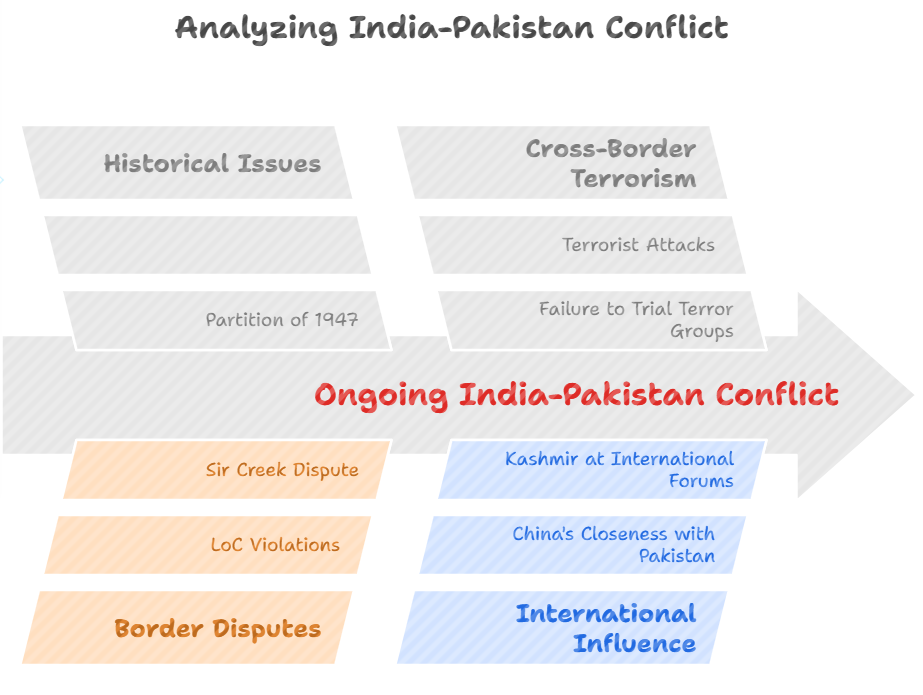
- Historical Reasons: The division of India and Pakistan in 1947, which led to the creation of separate countries based on religious lines, laid the foundation for ongoing tensions.
- Kashmir Issue: Both countries claim sovereignty over the region, and it has been a focal point of armed conflicts and tensions. The issue remains unresolved, and efforts to find a peaceful solution have been challenging.
- Border Dispute: The LoC serves as the de facto border between the two countries, and violations and skirmishes along the border have resulted in casualties and escalated tensions.
- Cross-Border Terrorism: Pakistan has been accused of supporting and harboring militant groups that carry out terrorist activities in India. Several major terrorist attacks, such as the 2008 Mumbai attacks, the 2019 Pulwama attack, Uri attack (2016), Poonch-Rajouri Attack (2023) and 2016 Pathankot attack have been attributed to groups operating from Pakistani territory.
- Failure to Trial Terror Groups: India has repeatedly urged Pakistan to take stronger action against terrorist organizations operating from its soil. However, the lack of progress in prosecuting individuals responsible for attacks, such as the Mumbai attacks, has been a significant point of contention.
- Revocation of Article 370: Unilateral actions taken by both countries have added to the conflict. For example, India's decision to revoke the special status of J&K in 2019 and Pakistan's subsequent measures, such as downgrading diplomatic relations and suspending bilateral trade, have further strained relations.
- Lack of Trade Cooperation: Limited trade cooperation between India and Pakistan has hampered economic ties and people-to-people exchanges. The low volume of bilateral trade and the failure to implement measures to boost trade have prevented the potential benefits of economic integration.
- Fishermen Disputes: Disputes over the maritime boundary and the arrest of fishermen from both countries crossing into each other's waters have added to the tensions. The issue of Sir Creek in the Kutch region remains unresolved, exacerbating the problem.
- International Influence: The involvement of external powers and their interests in the region, particularly China's growing closeness with Pakistan, has also impacted the India-Pakistan relationship. The Kashmir issue has been raised at international forums, increasing the complexity of the conflict.
|
India-Pakistan 2003 Ceasefire Agreement
|
India-Pakistan Relations: Need for Peace Efforts
There is a pressing need for peace efforts to address the causes of conflict and establish better relations between India and Pakistan. The following are some reasons why peace efforts are crucial:
- Regional Stability: The conflicts and tensions between the two countries have broader implications and can impact the entire region's peace and prosperity.
- Economic Cooperation: Enhanced trade and connectivity can lead to economic growth, job creation, and improved living standards for the people of both countries.
- Countering Terrorism: Cooperation in counterterrorism efforts is crucial for the stability and security of the region.
- Resolution of Outstanding Issues: Addressing the core issues, such as the Kashmir dispute and border disputes, through peaceful dialogue can lead to long-term solutions and reduce tensions.
- Humanitarian Concerns: Peace efforts can address humanitarian concerns, such as the treatment of prisoners and fishermen from both countries who are caught in the conflict.
Recent Peace Initiatives
There have been recent peace initiatives between India and Pakistan, aimed at reducing tensions and fostering dialogue. Some of these initiatives include:
- Ceasefire Agreement: In February 2021, India and Pakistan reaffirmed their commitment to a ceasefire along the Line of Control, providing a significant reduction in border tensions.
- Track-II Diplomacy: Various unofficial channels, including Track-II diplomacy, have played a crucial role in fostering people-to-people contact and dialogue between India and Pakistan. Such efforts create space for constructive engagement and bridge the gap between official positions.
- Border Agreements: Both countries have reaffirmed their commitment to the 2003 ceasefire agreement along the Line of Control (LoC) to reduce border tensions.
- Joint Judicial Committee: The Joint Judicial Committee, which focuses on humanitarian issues of fishermen and prisoners, has been revived to address the concerns of both sides.
- Kartarpur Sahib Corridor Agreement: The agreement allows visa-free travel for Indian pilgrims to the Kartarpur Sahib Gurudwara in Pakistan, promoting people-to-people contact and religious tourism.
- Relaxation of Airspace Denial: India allowed the aircraft of the Pakistan Prime Minister to use Indian airspace during his visit to Sri Lanka, indicating a positive gesture.
- Trade Measures: Some measures have been taken to improve trade relations, such as lifting the ban on the import of medicines between the two countries.
India-Pakistan Relations: Trade Overview
|
India's exports to Pakistan
|
Pakistan's exports to India In 2021, Pakistan exported goods worth $2.08 million to India.
Exports decreased from $42.5 million in 1995 to $2.08 million in 2021. |
Way forward
To achieve lasting peace between India and Pakistan, the following steps can be considered:
- Broader Vision: Both countries should adopt a broader vision of regional cooperation and integration, focusing on shared economic prosperity and people-to-people contact.
- Core Issue Dialogue: Engaging in sustained dialogue and addressing the core issues, including the Kashmir dispute, can help find mutually acceptable solutions and build trust.
- International Cooperation: Engaging with the international community, including regional organizations like SAARC, can provide platforms for dialogue and mediation to resolve conflicts and promote peace. Pakistan's inclusion in the FATF Grey list can restrict its access to international markets, posing challenges to its faltering economy.
- Sustained Diplomacy: There is a need for sustained diplomatic efforts from both sides, with a focus on dialogue, trust-building, and conflict resolution, to pave the way for a peaceful coexistence. UN designation of Masood Azhar as a global terrorist will intensify the pressure on Pakistan to freeze the organization's assets and weaken the presence of Jaish-e-Mohammed.
Conclusion
It is essential to recognize that the path to peace will require patience, compromise, and a genuine commitment to resolving differences. However, the benefits of peace between India and Pakistan outweigh the challenges, making it a goal worth pursuing.
|
4. Pakistan Political Crisis
Introduction: Pakistan's ongoing political crisis has reached a crescendo with former Prime Minister Imran Khan's arrest and its fallout. This has created a civil war like situation leading to a perpetual collapse of the country.
Issues for India
- Leadership Vacuum: The lack of stable leadership in Pakistan has hindered formal diplomatic talks and deepened distrust.
- Terrorism Challenge: India has employed diplomatic and military strategies to address terrorism emanating from Pakistan, but a lasting solution has not been achieved.
- Nuclear Hangover: India's responses, including surgical strikes, have been influenced by the nuclear threat posed by Pakistan.
- Short-lived Deterrence: Deterrence created by India's actions has been short-lived due to Pakistan's atomic weapons capabilities.
Imperatives for India
- Economic Crisis: Pakistan's economic challenges have prompted introspection among military leaders, providing a window for dialogue.
- Growing Extremism: The threat of religious extremism is viewed as a greater concern for Pakistan's national security than India.
- Capitalize on the Conundrum: India must leverage the current conundrum in Pakistan for strategic advantage.
- Resumption of Dialogue: India should explore the small window of opportunity to resume meaningful dialogue with Pakistan.
- Alert Policy Imperatives: India should cautiously respond to the peace message from Pakistan's army chief.
- Comprehensive Strategy: India needs to devise a comprehensive strategy, considering all facets of the Pakistan issue.
- Balancing China: Given China's close ties with Pakistan, India should carefully manage its relationship with China.
Conclusion
- Navigating the Pakistan conundrum requires India's astute and strategic approach.
- By capitalizing on the ongoing crisis, resuming dialogue, and formulating a comprehensive strategy, India can address the challenges posed by Pakistan's rogue state status, contribute to regional stability, and protect its national interests.
5. Indus Water Treaty
Introduction: India has issued a notice to Pakistan seeking a review and modification of the Indus Waters Treaty (IWT). It cited Pakistan’s “intransigence” in resolving disputes over the Kishanganga and Ratle (on Chenab River) hydropower projects, both in Jammu and Kashmir.
Understanding the Indus Water Treaty
- Background: The Indus Waters Treaty, brokered by the World Bank and signed in 1960, divides the Indus river system between India and Pakistan.
- Water control division: India was given control over the Beas, Ravi, and Sutlej rivers, while Pakistan received control over the Indus, Chenab, and Jhelum rivers.
Basis of the Treaty: Equitable Water-Sharing
- Partition and negotiations: The treaty became necessary after the partition of India in 1947 to divide the Indus river system.
- Sharing formula: The sharing formula allocated 80.52% of the aggregate water flows in the Indus system to Pakistan, demonstrating India's generosity as an upper riparian.
- Financial support: India provided Rs 83 crore in pounds sterling to Pakistan for building replacement canals from the western rivers.
Rights Accorded to India
- Water usage: India has limited irrigation use rights and unrestricted rights for power generation, domestic, industrial, and non-consumptive purposes on the western rivers.
- Regulations for projects: The treaty lays down specific regulations for the construction of water and hydropower projects.
- Hydroelectricity generation: India has the right to generate hydroelectricity through run-of-the-river projects on the western rivers, subject to design and operation criteria.
- Pakistan's objections: Pakistan has the right to raise objections to the designs of Indian hydroelectric projects on the western rivers.
Significance and Survival of the Treaty
- Symbol of peaceful coexistence: The treaty exemplifies the possibility of peaceful coexistence despite a troubled relationship between India and Pakistan.
- Resilience during conflicts: The treaty has endured three major wars between India and Pakistan.
- India's generosity: India's willingness to share waters and refrain from weaponizing them has contributed to the treaty's survival.
- Economic importance for Pakistan: About 80% of Pakistan's agriculture relies on the waters of the Indus and other riparian rivers.
- Global reputation: Maintaining the treaty upholds India's image as a reliable global partner.
Considerations and Need for a Rethink
- Potential leverage for India: India could escalate a water war with Pakistan in response to state-sponsored terrorism, severely affecting Pakistan's economy.
- Humanitarian concerns: Initiating a water war could result in floods or droughts that harm ordinary Pakistanis while the political elites continue to live luxuriously.
- PM Modi's stance: PM Modi's statement, "Blood and waters cannot flow together," suggests a need to balance security concerns with humanitarian considerations.
Way Forward
- India's responsible role: India has demonstrated its commitment to abiding by the provisions of the treaty as an upper riparian.
- Re-evaluation and negotiation: India should consider re-evaluating or renegotiating certain provisions of the treaty to address evolving security challenges and changing dynamics.
- Balancing interests: A balanced approach should ensure that the treaty continues to benefit ordinary people while addressing India's security concerns.
- Addressing terrorism: Just as water affects ordinary Pakistanis, terrorism affects Indians, highlighting the need for comprehensive efforts to combat terrorism.
Conclusion
The Indus Waters Treaty provides an opportunity for both countries to engage in constructive dialogue, ensuring the equitable sharing of water resources while addressing the broader challenges of security, development, and regional cooperation.
6. India-Sri Lanka Relations
India is Sri Lanka's closest neighbour. The relationship between the two countries is more than 2,500 years old and both sides have built upon a legacy of intellectual, cultural, religious and linguistic interaction.Areas of Cooperation:
Economic Co-operation:
- Sri Lanka's exports to India too witnessed an over 21% increase assisted by increased exports of animal feed (19.26%), Arecanuts (95.96%) and textile (47.76%) during January to June 2022.
- India has become Sri Lanka's largest trading partner, with a total bilateral merchandise trade of US$5.45 billion in 2021, marking a significant rise of about 48% compared to the previous year.
- India-Sri Lanka Free Trade Agreement (ISFTA) was signed in 1998 and entered into force in March 2000.
- India is also one of the largest contributors to Foreign Direct Investment in Sri Lanka. India has been the largest source market of tourists visiting Sri Lanka, prior to the pandemic.
- In response to the financial challenges posed by COVID-19, the Reserve Bank of India (RBI) recently entered into an agreement with Sri Lanka to provide a $400 million currency exchange facility.
Development Cooperation:
- At the same time India emphasized on the rights and welfare of the Tamil minority.
- India provides humanitarian assistance for the reconstruction in the Northern provinces: Housing infra, rehabilitation of the Northern Railway lines.
- India has already made FDI investments exceeding US$2.2 billion in Sri Lanka, as reported by the Central Bank of Sri Lanka. In 2021, India attracted the highest amount of FDI, amounting to $142 million.
Present Crisis India’s role:
- India has emerged as Sri Lanka’s main financial backer and without Indian aid, especially with regard to fuel, the Sri Lankan economy would have ground to a halt.
- SLINEX (Sri Lanka–India Naval Exercise) Indian Army and the Sri Lankan Army, Exercise MITRA SHAKTI : based on counter insurgency and counter terrorism operations.
Issues:
Fisherman issue:
- Both Indian and Sri Lankan fishermen have been fishing into the Palk Bay area for centuries.
- Problem emerged only after a maritime agreement was signed by India and Sri Lanka in 1974: both India and Sri Lanka agreed to stop fishing in each other’s waters.
- In 1974 and 1976 treaties were signed between the two countries to demarcate the International Maritime Boundary Line (IMBL).
- The 1976 bilateral arrangement bans international fishing and shipping. However, the agreement could not stop the fishermen from fishing in these waters, as fishermen know no boundary.
Katchatheevu Island Issue:
- It is an uninhabited off-shore island in the Palk Strait.
- During British rule, it was administered jointly by India and Sri Lanka.
- In the early 20th century, Sri Lanka claimed territorial ownership over the islet, so in 1974 India ceded the island to Sri Lanka, through a joint agreement.
- Two years later through another accord, India further gave up its fishing rights in the region.
Current developments:
- For the northern fishermen, it is the destructive fishing method of bottom trawling that is more of a concern than marine boundaries adopted by Indian fishermen.
- Fishermen associations have been demanding the Union government to reconsider the 1974 agreement with the Sri Lankan government with regard to handing over Katchatheevu to the island nation.
Mechanisms:
- India and Sri Lanka agreed to set up a Joint Working Group (JWG) on Fisheries in 2016 between India and Sri Lanka as the mechanism to help find a permanent solution to the fishermen issue.
- The IMBL is imaginary, but it was geo-tagged and is visible to the fishermen, due to Global Positioning System (GPS) sets.
Individual steps:
- The IMBL is imaginary, but it was geo-tagged and is visible to the fishermen, due to Global Positioning System (GPS) sets.
- Sri Lanka has banned deep sea trawling
- India has launched a project to promote deep-sea fishing launched as part of the umbrella Blue Revolution Scheme.
The China Factor: Debt trap diplomacy
- The solution lies in transition from trawling to deep-sea fishing.
- 10 % of the Sri Lanka loan is owed to China. During the Mahinda Rajapaksha tenure (2005-2015) tilt towards China was evident.
- This era saw projects such as the Hambantota port and Colombo port City granted to the Chinese. The construction of the Hambantota port was completed and operations began in 2010.
- For the Hambantota port project, Sri Lanka borrowed $301 million from China with an interest rate of 6.3%, while the interest rates on soft loans from the World Bank and the Asian Development Bank are only 0.25–3%. Interest rates of India’s line of credit to the neighbouring countries are as low as 1%, or even less in some cases.
- During the Current government: The Hambantota port has been handed over to China on 99 year lease as part of a debt for equity swap.
Ethnic Issues:
- Composition of Population: Sinhalese people: Sinhala language, Theravada Buddhists: majority of population Tamil People: Minority (11%): brought as labourers by the British Sri Lankan Tamils benefited from the British rule English-speaking Tamils to the civil service and other professions on a merit basis
- Discrimination against the Tamils: Tamils were disenfranchised in 1949. The 1956 Sinhala Only Act: institutionalised the discrimination
- Liberation Tigers of Tamil Eelam (LTTE) was formed in 1976: Demanded separate state in north-east Sri Lanka. Involved in armed conflict/civil war with Sri Lankan govt from 1983-2009
India’s approach towards the Ethnic Issue:
- Indo- Sri Lanka Accord 1987: It sought to collectively address all the three contentious issues between India and Sri Lanka: strategic interests, people of Indian origin in Sri Lanka and Tamil minority rights in Sri Lanka.
- It led to India's direct involvement in the counter-insurgency operation in Sri Lanka. According to the terms of the accord, Sri Lankan forces would withdraw from the north and the Tamil rebels would disarm.
- This agreement envisaged the creation of provincial councils with autonomy enabled by the 13th amendment to the Sri Lankan constitution. It created provincial councils in Sri Lanka.
- The accord underline India’ military assistance to Sri Lanka on which the Indian Peace Keeping Force came to be inducted in Sri Lanka.
- The situation turned into a military confrontation between the IPKF and the Liberation Tigers of Tamil Eelam (LTTE), which refused to disarm and join the political mainstream.
- Assassination of Rajiv Gandhi 1991 further changed India’s attitude towards the ethnic conflict in Sri Lanka: from active to passive role.
- During the course of the conflict, India supported the right of the Government of Sri Lanka to act against terrorist forces.
- At the same time India emphasized on the rights and welfare of the Tamil minority.
- Supported 13th amendment act. India is involved in the resettlement and rehabilitation efforts in the Northern and Eastern provinces of Sri Lanka with Tamil Population.
7. India-Afghanistan Relations: Strategic Ties, Challenges & Future Prospects
It has been referred to as the "Graveyard of Empires" and has been a central player in the historical "Great Games." The Gandhar-Bharat Sambandha, also known as Afghanistan-India connections, highlights the diplomatic ties between the two countries. The Taliban takeover of Afghanistan has significant ramifications for South Asia and leaves India’s foreign-policy and security interests at considerable risk.
India-Afghanistan Relations A Quick Recap
- India and Afghanistan have a long history of cooperation, dating back to the 1950 Treaty of Friendship.
- Despite the challenges posed by the Taliban's capture of Kabul in 1996, India re-engaged with Afghanistan after the Taliban's ousting in 2001.
- India has since made significant investments and commitments, amounting to over USD 3 billion, to cultivate strong economic and defense ties with Afghanistan.
Importance of India-Afghanistan Relations for India
Economy
- Preferential Trade Agreement (2003): The signing of the Preferential Trade Agreement in 2003 led to India granting significant duty cuts, ranging from 50% to 100%, on a specific category of Afghan dry fruits.
- Initiatives in 2016: In 2016, the Prime Minister of India put forth proposals for mutual collaboration, including the supply of high-quality and affordable pharmaceuticals, as well as joint efforts in the development of solar energy. As a result of these initiatives, a second aviation route between India and Afghanistan was established.
- India has provided Afghanistan with $4 billion in development aid between 2002 and 2021.
Developmental Aid
|
Security
- A stable Afghanistan is crucial for regional and domestic security and stability for India. It acts as a buffer between India and extremist groups operating in the region.
- Afghanistan's stability is vital in countering state-sponsored terrorism emanating from Pakistan-supported groups.
- During the Fourth Regional Security Dialogue on Afghanistan, the Indian National Security Advisor (NSA) emphasized strengthening Afghanistan's capacity to combat terrorism.
Counterterrorism
- Afghanistan has been a breeding ground for terrorism, posing a threat to India's security. India has been a victim of state-sponsored terrorism supported by groups based in Afghanistan.
- A stable Afghanistan is essential for effectively countering these terrorist threats.
Natural Resources
- Afghanistan possesses significant untapped mineral resources worth around $1 trillion. These resources include minerals such as iron, copper, gold, and rare earth elements.
- Access to Afghanistan's mineral wealth can fuel India's industrial and economic growth.
Connectivity
- Afghanistan serves as a crucial gateway for India's connectivity with Central Asia. Projects like the Chabahar Port in Iran enhance India's trade and economic ties with the region.
- India-Afghanistan Air Freight Corridor: Opened in 2017 to facilitate trade and economic activities.
- Developing transport and energy corridors through Afghanistan strengthens regional connectivity and facilitates India's access to resource-rich Central Asia.
- In 2016, India signed a deal with Iran entailing $8 billion investment in Chabahar port and industries in Chabahar Special Economic Zone.

Energy Ambitions
- Afghanistan's strategic location makes it an important transit route for energy projects.
- India sees Afghanistan as a vital component of the Turkmenistan-Afghanistan-Pakistan-India (TAPI) pipeline project.
- Access to energy resources in Central Asia through Afghanistan addresses India's growing energy needs.
Strategic Influence
- India's engagement in Afghanistan helps counterbalance Pakistan's influence in the region.
- It provides a platform for India to shape the political landscape and support Afghan government stability.
- By assisting in nation-building, India safeguards its interests and prevents Afghanistan from becoming a safe haven for anti-India elements.

Challenges in India-Afghanistan Relations
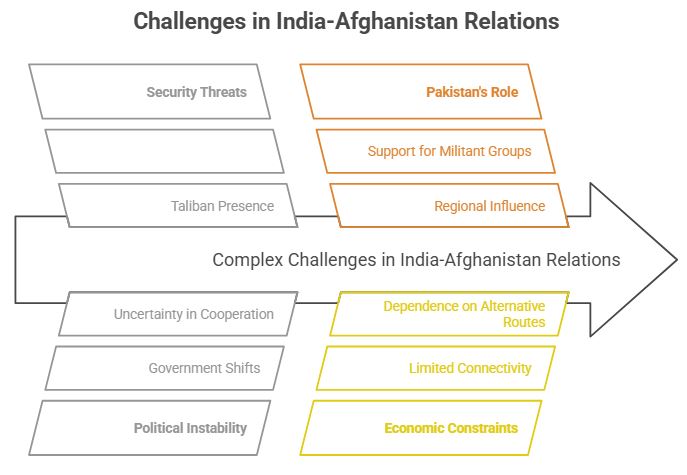
- Security Threats: The volatile security situation in Afghanistan, including the presence of terrorist groups like the Taliban, poses a direct security threat to India.
- Political Instability: Political instability and shifts in government dynamics create uncertainty for sustained cooperation between India and Afghanistan.
- Pakistan's Role: Pakistan's role in Afghanistan, including its support for militant groups, remains a significant challenge for India's engagement in the region.
- Economic Constraints: Economic and infrastructural constraints, such as limited connectivity and dependence on alternative trade routes, hinder economic cooperation between India and Afghanistan.
- Humanitarian Concerns: The return of the Taliban raises concerns about human rights and the humanitarian crisis in Afghanistan, creating challenges for India's involvement.
- Regional Rivalries: Regional rivalries and power dynamics add complexity to India's engagement in Afghanistan and pose challenges to effective cooperation.
|
Way forward
- Strengthening Regional Cooperation: Enhancing cooperation and coordination among regional players is crucial for stability and progress in Afghanistan.
- Supporting Afghan-led Peace Process: India should support an Afghan-led and Afghan-owned peace process to achieve lasting peace and stability in the region.
- Enhancing Economic Engagement: India should focus on enhancing economic cooperation, trade, and investment with Afghanistan to promote sustainable development.
- Providing Humanitarian Assistance: India should continue to provide humanitarian assistance to address the urgent needs of the Afghan people, especially in areas such as healthcare, education, and infrastructure development.
- Strengthening Security Cooperation: Collaborating with Afghan security forces and other regional partners to address security threats and counterterrorism is essential for ensuring stability in the region.
Conclusion
India’s Afghan policy must be based on a clear-cut understanding of India’s strategic goals in the region, and the regional and global strategic environment. Though it is a bit late, yet India has taken the right decision by engaging the amenable section of the Afghan Taliban.
8. India-China Relations: Border Disputes, Trade, and Strategic Challenges
India-China Relations have long been complex and multifaceted, characterized by a combination of cooperation, competition, and border disputes. The two Asian giants, with their vast populations, economies, and regional influence, share a significant border and have a history of diplomatic engagements, trade ties, and occasional tensions. The border disputes, particularly in the Western and Eastern sectors, have been a major point of contention, leading to military standoffs and occasional clashes.
Border Dispute in India-China Relations
- Traditional Boundaries: The Himalayas historically acted as a natural boundary between India and China.
- Line of Actual Control (LAC): The disputed 3488 km border is separated by the LAC, which was established after the 1962 war.
- Border in Different Sectors: The border spans across four Indian states and two union territories, with different sectors having varying levels of disputes.

Reasons for Unresolved Border Disputes in India-China Relations
- Geographical Constraints: The difficult terrain, harsh climate, and complex topography make it challenging to demarcate the border accurately.
- Cartographic Issues: British-era agreements and maps have left many areas unmarked or arbitrarily marked, leading to conflicting claims.
- Pressure Tactics: China's use of the border dispute as a pressure tactic and its timing of aggression in response to certain events.
- China-Pakistan Relations: China's reluctance to settle border disputes with India due to its close ties with Pakistan and implications for the Kashmir region.
- Lack of Trust: Differences in long-term regional aspirations and lack of mutual trust hinder cooperation and resolution.
- Other Contentious Issues: Divergent stances on Tibet, Kashmir, and other global forums, as well as nationalist sentiments, contribute to the complexity.
India's Measures in Border Areas
- Infrastructure Development: India has invested in critical border infrastructure, including strategic roads, bridges, and communication networks.
- Strengthening Border Forces: Deployment of the Indo-Tibetan Border Police (ITBP) and the induction of Rafale jets to enhance border security.
- International Cooperation: Collaborating with Japan and promoting connectivity projects in the Northeast region to counter Chinese influence.
|
Vibrant Villages Programme
|
Bilateral Trade and India-China Relations
- Increasing Deficit: The trade deficit for 2021-22 reached $73.31 billion, with imports at $60.27 billion and exports at $8.77 billion.
- Growth in Bilateral Trade: Annual two-way trade exceeded $100 billion in 2021, with India's imports accounting for the majority.
- Background of Trade Ties: Trade between India and China surged since the early 2000s, driven by Indian imports of Chinese machinery and equipment.
- Dependency on Chinese Goods: Significant imports from China in machinery, organic chemicals, automotive parts, and fertilizers, integrating China into India's manufacturing supply chain.
- Active pharmaceutical ingredients, auto components, and a large number of medical supplies (since 2020) are other notable imports.
- India's Export to China: China is a major destination for Indian exports, ranking third, but India's share in China's total exports is relatively low. Over the past two years, Indian exports to China have witnessed a remarkable growth rate of over 50%.
- However, the majority of these exports comprise raw commodities such as ores, cotton, and seafood, rather than finished goods.

India's Evolving Economic Relations with China
- The economic relations between India and China have undergone significant changes in the past two years.
- New Delhi has emphasized that it cannot be business as usual while tensions persist along the border. As a result, tighter restrictions have led to a decline in Chinese investment in India.
- Chinese investment in technology and telecommunications start-ups have come to a halt. Prohibitions on 200 apps and restrictions on Chinese firms' participation in 5G trials have been imposed.
- Increased scrutiny of Chinese firm, including tax investigations on companies like Xiaomi, has been initiated by India.
- New Delhi is contemplating a long-term plan to reduce import reliance and identified 12 sectors to boost India's global supplier status and reduce import bill.
Considerations and Implications
- View on Trade Deficit: Trade deficits/surpluses are not direct indicators of a weaker or stronger domestic economy.
- Interconnected Trade Dependencies: India's trade imbalance with China should be viewed in the context of interdependencies, such as imports of ingredients for pharmaceuticals and growing seafood exports to China.
- Challenges of Persistent Trade Deficits: Concerns about foreign exchange reserves availability and the need to enhance domestic production capacity.
India’s Trade War with China
- Negative Consequences: Banning trade with China would primarily harm the Indian poor, punish Indian producers and exporters, and negatively impact sectors like pharmaceuticals.
- Limited Impact on China: A ban on trade with China would have minimal repercussions for China's overall trade, while hurting India's economy.
- Broader Engagement: India's integration with Chinese investments in technology startups and the importance of maintaining policy credibility and attracting foreign investment.
- Trade War and Border Dispute: Turning a border dispute into a trade war is unlikely to resolve the underlying issues, and it would disproportionately harm India.
|
Controversial dams over River Brahmaputra
|
Way forward
- Diplomatic Engagement: Maintain regular high-level meetings and negotiations to address issues and build trust.
- Border Management: Strengthen border management mechanisms to prevent tensions and ensure peace and stability.
- Economic Cooperation with Caution: Balance economic cooperation while protecting domestic industries and reducing dependence on Chinese imports.
- Enhancing Strategic Alliances: Strengthen partnerships with like-minded countries to balance China's influence and promote regional stability.
- Defense Preparedness: Strengthen defense capabilities to protect national interests and maintain deterrence.
Conclusion
- Political Consultations for Peaceful Resolution: Political commitment and mutual dialogue are essential for resolving border disputes between India and China.
- Military Communication: Maintaining effective military-to-military communication can help prevent and resolve border-related issues, ensuring peace and tranquility.
9. India-Bhutan Relations
Introduction: India and Bhutan have had long-standing diplomatic, economic and cultural relations. India and Bhutan share a long-standing diplomatic, economic, and cultural relationship. The two countries are bound by the Treaty of Friendship, which was renegotiated in 2007 to establish a more equal partnership.
What is the Treaty of Friendship?
- 1949 Treaty: The Treaty of Friendship was signed between Bhutan and India on August 8, 1949. It aimed to ensure peace and non-interference in each other's internal affairs.
- 2007 Treaty: India and Bhutan renegotiated the treaty in 2007, replacing the provision that required Bhutan to seek India's guidance on foreign policy. The new treaty emphasized sovereignty and cooperation based on mutual interests.
Significance of Bhutan to India
- Buffer to China: Bhutan serves as a buffer state between India and China, sharing a border with China. Its strategic location is crucial for India's security interests.
- Vital Connectivity: The Chumbi Valley, located at the tri-junction of Bhutan, India, and China, is vital for India's connectivity as it lies close to the "Chicken's neck" in North Bengal.
- Security in North-East: Bhutan has cooperated with India in addressing security concerns in India's north-eastern region by assisting in flushing out militant groups.
- Chinese Inroad: China is interested in establishing diplomatic relations with Bhutan and has territorial claims in western Bhutan. India's close relationship with Bhutan is essential to counter Chinese influence.
|
India-Bhutan Ties: A Timeline
|
China Factor in Ties: China Preying on Small Neighbours
- Importance of Bhutan: Both India and China attach strategic importance to Bhutan. Chinese territorial claims near the Siliguri Corridor pose a security challenge for India.
- Border Settlement and Diplomatic Relations: China reportedly links border settlement with Bhutan establishing trade and diplomatic relations. Bhutan's participation in China's Belt and Road Initiative (BRI) could be a potential concern for India.
Need of Bhutan for India
- Trusted Ally: Bhutan has been India's most trusted ally in South Asia and has prioritized India's security interests.
- Security Cooperation: Bhutan's active cooperation in tackling Indian militants in its jungles showcases its commitment to maintaining regional security.
- Avoiding Chinese Influence: Bhutan's decision to not attend China's Belt and Road Initiative forum demonstrates its alignment with India's concerns regarding Chinese influence.
Various Cooperation Developments
- Maitri Initiative: Bhutan was the first country to receive COVID-19 vaccines under India's Vaccine Maitri Initiative.
- Financial Connectivity: The launch of the RuPay card and BHIM app has enhanced financial connectivity between India and Bhutan.
- Start-Up Ecosystem: India and Bhutan have connected their start-up systems through structured workshops, fostering innovation and entrepreneurship.
- E-Library Project: The E-Library project has facilitated education and knowledge-sharing between the two countries.
Major Irritants in Ties
- Lack of Investment: India has not invested significantly in Bhutan and other neighbouring countries, which is critical for building genuine goodwill and trust.
- Desire for Wider Engagement: Bhutan desires a wider engagement beyond India's borders and seeks to be treated as an equal, sovereign nation-state.
Conclusion
The friendship between India and Bhutan is built on shared values, trust, and mutual respect. It is essential for India to address Bhutan's aspirations, increase people-to-people contact, and respect Bhutan as an equal, sovereign nation to further strengthen the India-Bhutan friendship.
10. India Myanmar Relations
Introduction: India-Myanmar relations are rooted in shared historical, ethnic, cultural and religious ties. As the land of Lord Buddha, India is a country of pilgrimage for the people of Myanmar. The geographical proximity of the two countries has helped develop and sustain cordial relations and facilitated people-to-people contact. India and Myanmar share a long land border of over 1600 km and a maritime boundary in the Bay of Bengal.
- Historical, Ethnic, and Cultural Ties: India and Myanmar share deep historical, ethnic, cultural, and religious connections.
-
- India is a pilgrimage destination for many people in Myanmar, and the geographical proximity has facilitated cordial relations and people-to-people contact.
- The Treaty of Friendship signed in 1951 further solidified their relationship.
- India's Interests: India recognizes the importance of maintaining a good working relationship with the Myanmar government for its diplomatic and strategic initiatives. This is particularly crucial in light of China's attempts to use Myanmar as a geopolitical base against India.

Strategic Relations
- Geographical Location: Myanmar's strategic location makes it a bridge between South Asia and Southeast Asia. India and Myanmar have engaged in cooperation to counteract drug trafficking and insurgent groups along their shared border.
- Naval Cooperation: India has extended cooperation to Myanmar in the maritime domain. The handover of INS Sindhuvir, a submarine, to the Myanmar Navy demonstrates the deepening ties between the two countries.
Economic Relations
- Regional Cooperation: India and Myanmar are members of BIMSTEC, SAARC, and the Mekong-Ganga Cooperation, which have facilitated closer ties and increased influence among Southeast Asian nations.
- Infrastructure Projects: Several infrastructure projects, such as the India-Myanmar-Thailand Trilateral Highway, Kaladan Multi-modal Transit Transport Network, and the planned Special Economic Zone at the Sittwe deep-water port, have strengthened economic cooperation.
- Humanitarian Assistance: India has provided timely and effective assistance to Myanmar during natural disasters, demonstrating its commitment to supporting its neighbor.
|
India-Myanmar Trade Relations
|
China factor in India’s ties
- Chinese Influence: China has its own designs for Myanmar and seeks to use it as part of its "string of pearls" strategy against India. China has provided significant funding for infrastructure projects in Myanmar, creating a potential debt trap for the country.
- Political Interference: China has also exerted political influence, as seen in its support for the military coup in Myanmar. This raises concerns about China's control over Myanmar's political machinery.
- Trade Dependence: Myanmar's trade with China far outweighs its trade with India. China has become Myanmar's largest trading partner, while India's bilateral trade with Myanmar remains comparatively lower. This trade dependence on China could further strengthen China's influence in Myanmar.
Impact of the Coup
- India's Relationship: The military coup in Myanmar has not significantly changed India's relationship with the country. India has built ties with the Tatmadaw (Myanmar's military) over the years, and the handing over of the submarine to Myanmar demonstrates the deepening engagement.
- China's Influence: China has been the largest supplier of weapons to Myanmar, but recent tensions between the Tatmadaw and China, including accusations of support for insurgent groups, have created an opportunity for India to strengthen its position.
Road to Democracy in Myanmar
- India's Dual Policy: India has historically pursued a dual policy of engaging with the Myanmar military while advocating for democratic reforms. This approach recognizes the Tatmadaw's role in maintaining stability in Myanmar.
- Democratic Realist Policy: India's policy in Myanmar is guided by the centrality of democracy. While India supports democratic reforms, it also acknowledges the need for pragmatic adjustments to engage with the military.
Way Forward
- Preserving Trust: India needs to maintain trust with the Myanmar military while continuing to pressure for the restoration of democratic order. High-level engagement and communication are essential to ensure that India's core concerns are respected.
- International Coordination: India must coordinate its position internationally and develop a common platform to encourage Myanmar's return to democracy. The support of ASEAN and Japan is crucial in this regard.
- Democratic Realist Policy: India's democratic realist policy should guide its actions in Myanmar, taking into account the changing geopolitical dynamics and the rise of China. Pragmatic adjustments will be necessary to pursue India's interests while advocating for democratic values.
Conclusion
While India strives for democratic reforms, it also recognizes the need to engage with the military to maintain stability and protect its own interests. The evolving dynamics in Myanmar and the region will require India to navigate carefully and balance its democratic ideals with pragmatic considerations.
11. India-Maldives Relations
Introduction: India and Maldives share ethnic, linguistic, cultural, religious and commercial links steeped in antiquity and enjoy close, cordial and multi-dimensional relations. India was among the first to recognise Maldives after its independence in 1965 and to establish diplomatic relations with the country.
India recently commissioned the Indian grant-in-aid UTF (Uthuru Thila Falhu- Island) Harbour Project, the coastal surveillance radar system, in the Maldives. The project is a significant milestone in the growing defense ties between the two countries.
What is the UTF Project?
- The UTF project was announced during External Affairs Minister S Jaishankar’s visit in February 2021.
- It is among the biggest Indian grant-in-aid projects in the Maldives.
- It is aimed at developing a maintenance and repair hub for naval vessels and will help the Maldives become self-sufficient.
A quick recap of bilateral ties
Economic:
- Trade agreement signed between India and Maldives in 1981. India is Maldives' 4th largest trade partner.
- India becomes Maldives' second-largest trading partner in 2021, experiencing a 31% growth in bilateral trade despite the pandemic.
- Bilateral trade between India and Maldives in 2021 stands at US$ 323.9 million with the trade balance in favor of India.
- India provides US$ 250 million financial assistance to Maldives in September 2020 to support its economic recovery.
Defence:
- India offers the highest number of training opportunities for the Maldivian National Defence Force (MNDF), fulfilling approximately 70% of their defence training needs.
- A comprehensive Action Plan for Defence signed in April 2016 to strengthen the defence partnership.
- Noteworthy initiatives in the defence sector include the establishment of the Composite Training Centre for MNDF, implementation of the Coastal Radar Surveillance System, and construction of the new Ministry of Defence Headquarters.
Disaster management:
- India provides substantial aid to the Maldives after the 2004 tsunami and the 2014 Male water crisis. Customized training programs for the MNDF Fire and Rescue Service offered in India.
Developmental Cooperation:
- India implements notable development projects in the Maldives, such as the Indira Gandhi Memorial Hospital, Maldives Institute of Technical Education, and the National College for Policing and Law Enforcement (NCPLE).
- Connectivity project: India provides US $500 million in assistance for the Greater Male Connectivity Project (GMCP), the largest civilian infrastructure project in Maldives, connecting Male to three neighboring islands.
- Currency Swap: A Bilateral US Dollar Currency Swap Agreement of $400 million signed between RBI and Maldives Monetary Authority (MMA) in 2019.
Covid related assistance:
- A 14-member Rapid Response Medical team deployed in the Maldives in March 2020 to guide and train Maldivian authorities and personnel in tackling the Corona threat.
- Operation Sanjeevani: A special IAF plane airlifts 6.2 tonnes of essential medical supplies from India to Maldives on 2 April 2020 as part of GoI's efforts to help friendly countries in tackling the Covid-19 threat.
Causes for Anti-India Sentiments
- Political Instability: Anti-Indian sentiments emerged when Abdulla Gayoom became president in 2013, using them for political mobilization and tilting towards China.
- Controversy over Helicopter Gift: The opposition portrayed the gift of two Dhruv Advanced Light Helicopters by India for search-and-rescue operations as a military presence in the country.
- Confidential Agreements: Agreements signed between the Ibrahim Solih government and India were not publicly discussed in the Maldives Parliament, leading to concerns.
- Alleged Interference in Domestic Politics: Unsubstantiated perceptions and allegations have arisen regarding Indian diplomats stationed in Maldives interfering in domestic affairs.
Major Irritants in Ties
- Political Instability: India is concerned about the impact of political instability in the region on its security and development.
- Increasing Radicalization: The number of Maldivians drawn towards terrorist groups such as the Islamic State (IS) and Pakistan-based jihadist groups has been growing.
- Inclination towards Terror: Radicalism in the Maldives increases the possibility of Pakistan-based terror groups using remote Maldivian islands as a launch pad for attacks against India and Indian interests.
- Chinese Affinity: China's strategic influence in the region has grown, and the Maldives has become a significant component of China's "String of Pearls" construct in South Asia.

Recent Gestures by India
- 2014 Male Drinking-Water Crisis: India provided immediate help during the drinking water crisis in Malé by sending heavy lift transporters carrying bottled water.
- 2020 COVID-19 Crisis: India extended financial, material, and logistical support to Maldives during the COVID-19 crisis and airlifted essential medicines and hospital consumables.
- Greater Male Connectivity Project: India announced the signing of a $500-million infrastructure project for the construction of the Greater Malé Connectivity Project (GMCP), involving the construction of a bridge and causeway link.
Maldives' Significance for India
- Increasing Maritime Cooperation: The Indian Ocean has witnessed a rise in maritime economic activity, and the Maldives plays a crucial role in the region's geopolitical competition.
- Toll Gate in Indian Ocean: The Maldives is situated at the hub of commercial sea-lanes in the Indian Ocean, with a significant volume of India's international trade passing through the region.
- Naval Cooperation: Maldives is an important partner in India's role as the net security provider in the Indian Ocean Region.
- Important SAARC Member: Maldives is a member of SAARC and SASEC, contributing to regional cooperation and economic integration.
- People-to-People Contact: There is a significant population of Maldivian students in India, aided by a liberal visa-free regime. Medical tourism is also prominent.
- Major Tourist Destination: Tourism is the backbone of the Maldivian economy, attracting Indian tourists and providing job opportunities.
Way Forward
- India must continue to be an important partner of the Maldives and remain attentive to developments in the country.
- India should play a key role in ensuring regional security in South Asia and the surrounding maritime boundaries within the Indo-Pacific security space.
- The Indian government should not take the support of a limited population for granted and actively work towards strengthening ties with the Maldives.
Conclusion
India and Maldives share a strong bilateral relationship, but there have been instances of anti-India sentiments. The restoration of ties under President Ibrahim Mohamed Solih has contributed to strengthening the relationship.
12. Indian Ocean Region (IOR): Strategic Importance, India’s Role
Introduction: The context of the discussion is the strategic importance of the Indian Ocean Region (IOR) in the world order, specifically in the Indian sub-continent. The discussion highlights the significance of the IOR, its diverse sub-regions, and its role as a major trade route and repository of natural resources.
What is Indian Ocean Region (IOR)?
- The IOR broadly defines areas consisting of littoral states of the Indian Ocean.
- It comprises sub-regions such as Australia, South East Asia, South Asia, Horn of Africa, and Southern and Eastern Africa.
- The IOR is marked by cultural, social, political, and economic diversity.

Significance of Indian Ocean Region (IOR)
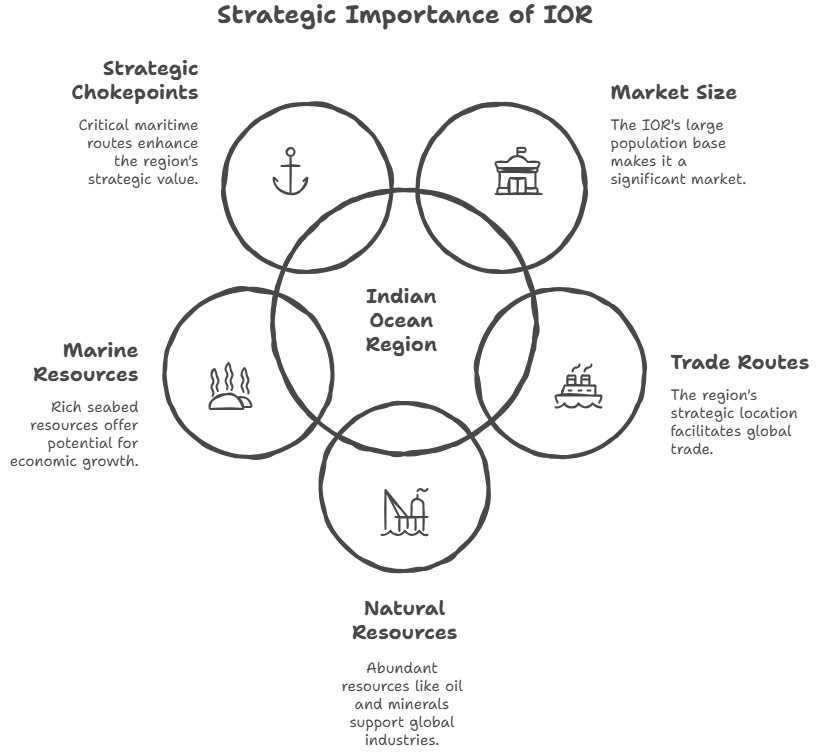
- Biggest Market: The IOR littorals house over one-third of the world's population.
- Trade Significance: More than half of global seaborne trade passes through the Indian Ocean, with nearly 70% going to countries external to the region.
- Rich in Natural Resources: The IOR littoral states possess abundant raw materials, primarily oil, crucial for major manufacturing industries in developed and developing nations.
- Ample Marine Resources: The IOR holds vast seabed resources, including oil, natural gas reserves, minerals, and abundant fish.
- Maritime Choke-points: The presence of major maritime chokepoints and Sea Lanes of Communications (SLOCs) in the IOR contributes to its strategic importance.
Geo-Strategic Importance of Indian Ocean Region (IOR) to India
- India is at the Centre: India's central position in the IOR presents both advantages and challenges.
- Energy Security: India's "sea dependence" for oil is estimated to be around 93% due to total oil imports by sea, offshore oil production, and petroleum exports.
- Dependence on Seas: Approximately 95% of India's trade volume and 68% of trade value are routed through the Indian Ocean.
- Fishing and Aquaculture: India heavily relies on Indian Ocean resources, with fishing and aquaculture industries contributing to exports and employment for millions.
- Huge Maritime Boundary: India's long coastline makes it vulnerable to potential threats emerging from the sea.
- Hostile Neighbourhood: The 2008 Mumbai attack, carried out by terrorists arriving by sea, underscores the threat posed by the sea border.
- Unforeseen and Non-conventional Threats: Non-traditional threats such as piracy, smuggling, illegal fishing, and human trafficking present challenges, emphasizing the need for a secure Indian Ocean to protect national interests.
Indian Ocean Region and the Net Security Provider Debate
- Peaceful Seas: India has experienced largely peaceful seas in recent decades, with non-traditional threats like piracy and trafficking being the primary concerns.
- Reasons to Take Up the Role:
- Obligation for the West: Becoming a net security provider is now a strategic obligation for India amid global economic turbulence and shifting US policies.
- Wisdom of Responsibility: India's emerging global power status brings with it a commensurate level of international responsibility.
- Void in Capability: Recognizing the existing void in capability, India needs to decide on taking up the role.
Indian Ocean Region Threat Mosaic: An Indian Perspective
- Growing PLAN Presence: Chinese presence in ports like Gwadar, Hambantota, and Djibouti raises concerns.
- Modernization of Pakistan Navy (PN): Pakistan Navy's rapid modernization, particularly in undersea warfare, with assistance from Turkey and China.
- Shifting US Policy: US policies, particularly since Trump, have seen deviations from previous Indo-Pacific Region (IPR) strategies.
- Non-Traditional Threats: Non-state forces, piracy, maritime terrorism, drug trafficking, climate change, and other non-traditional threats.
Impediments to India Becoming a Net Security Provider
- Resource Availability vs. Requirement: India's finite resources and population size pose challenges amid a global downtrend.
- Financial Capabilities: Robust financial backing is essential to materialize intentions and increase military hardware for net security provision.
- Existing Civil-Military Relationship: Differences between ministries and civil-military leadership hinder strategic gains.
- Nascent Jointmanship: Turf wars among the three services impede jointsmanship required for net security provision.
- Non-alignment Policy: India's adherence to military non-alignment to retain strategic autonomy.
- Primacy of Land Operations: India's focus on land boundaries with China and Pakistan and its participation in ongoing proxy wars.
Steps Taken by India in the Indian Ocean Region
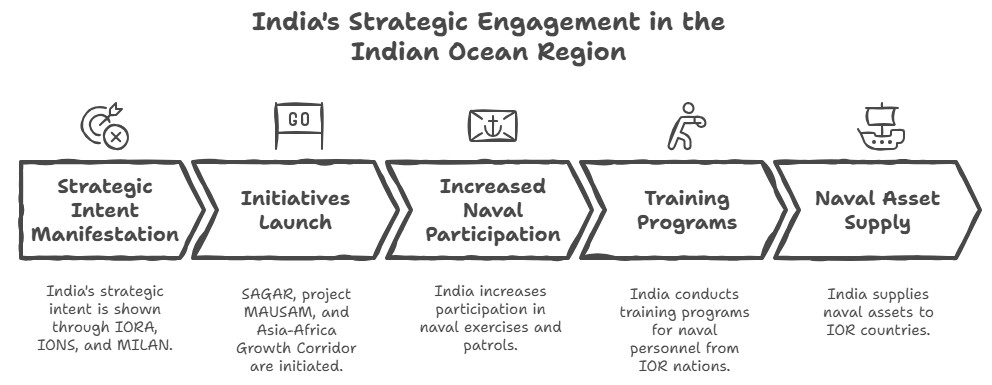
- Indian Ocean Rim Association (IORA), Indian Ocean Naval Symposium (IONS), and naval exercises like MILAN manifest a strategic intent.
- Initiatives like Security and Growth for All in the Region (SAGAR), project MAUSAM, and the proposed Asia-Africa Growth Corridor.
- Increased participation in bilateral/multilateral naval exercises and Coordinated Patrol (CORPAT) with regional nations.
- Training naval personnel from IOR nations through exchange programs.
- Supplying naval assets to IOR countries.
Way Forward
- Develop a comprehensive IOR strategy: Create a well-defined plan addressing security, economic cooperation, sustainability, and diplomacy in the Indian Ocean Region.
- Enhance maritime domain awareness: Invest in advanced surveillance technologies and information-sharing mechanisms to monitor and secure maritime borders effectively.
- Foster strategic partnerships: Strengthen cooperative security mechanisms, intelligence sharing, and capacity building initiatives with like-minded countries in the region.
- Strengthen naval capabilities: Upgrade the fleet, invest in advanced platforms, and develop indigenous technologies to protect maritime interests.
- Promote maritime diplomacy: Engage in regional forums, promote dialogue, and foster understanding and cooperation on maritime security issues.
- Encourage sustainable blue economy practices: Support marine conservation, responsible fisheries, and renewable energy development for long-term environmental and economic benefits.
Conclusion
India's role as a net security provider in the IOR is a topic of debate. While India has experienced relatively peaceful seas, it faces emerging threats such as Chinese presence in strategic ports, modernization of the Pakistan Navy, shifting US policies, and non-traditional threats like piracy and maritime terrorism. Becoming a net security provider would require careful resource allocation, financial capabilities, enhanced civil-military coordination, and the development of joints man ship among the three services.
13. India’s No First Use (NFU) Nuclear Policy: Doctrine, Debate & Future Path
No first use (NFU) refers to a pledge or a policy by a nuclear power not to use nuclear weapons. It is a means of warfare unless first attacked by an adversary using nuclear weapons. Earlier, the concept had also been applied to chemical and biological warfare.
No First Use in India’s Context
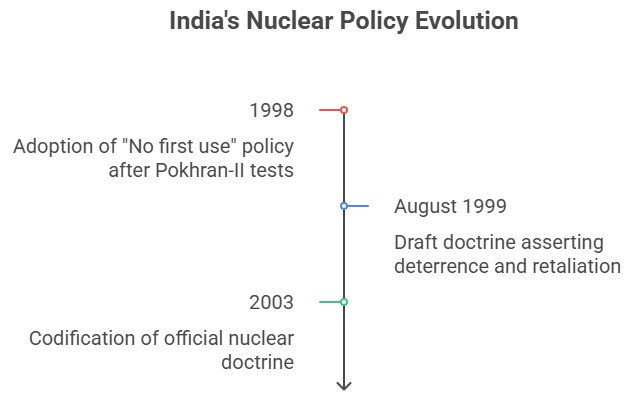
- India first adopted a “No first use” policy after its second nuclear tests Pokhran-II, in 1998.
- In August 1999, the govt. released a draft of the doctrine which asserts that nuclear weapons are solely for deterrence and that India will pursue a policy of “retaliation only”.
- India’s official nuclear doctrine is codified in a 2003 document, which takes cues from the 1999 draft doctrine.
- Since then, there has been no official communiqué about India’s nuclear policy from the government.
India’s No First Use Doctrine
Since 2003, India’s nuclear doctrine has had three primary components:
No First Use
- India will only use nuclear weapons in response to a nuclear attack on Indian Territory, or Indian forces.
- A caveat is made about their possible use in response to a chemical or biological attack.
- In a 2010 speech, then national security advisor Shivshankar Menon described India’s nuclear doctrine as “no first use against non-nuclear weapon states”.
Massive Retaliation
- India’s response to a first strike will be massive, to cause ‘unacceptable damage’.
- While the doctrine doesn’t explicitly espouse a counter-value strategy (civilian targets), the wording implies the same.
Minimum Credible Deterrence
- The number and capabilities of India’s nuclear weapons and delivery systems should merely be sufficient to ensure intolerable retaliation, also keeping in mind first-strike survival of its relatively meagre arsenal.
- It underlines NFU with an assured second strike capability, and falls under minimal deterrence as opposed to mutually assured destruction.
Cognizance with Political Authority
- Nuclear retaliatory attacks can only be authorised by the civilian political leadership through the Nuclear Command Authority.
- The Nuclear Command Authority comprises a Political Council and an Executive Council. The Political Council is chaired by the PM.
Debate on Revoking the No First Use Policy
- Raksha Mantri’s statement is a part of a pattern reflecting a need to critically evaluate India’s nuclear doctrine, as voiced by other defence ministers and retired bureaucrats and military officials.
Arguments Against Revoking No First Use
India’s image as a responsible nuclear power is central to its nuclear diplomacy
- Global reputation: Nuclear restraint has allowed New Delhi to get accepted in the global mainstream. From being a nuclear pariah for most of the Cold War, within a decade of Pokhran 2, it has been accepted in the global nuclear order.
- Say in global regimes: It is now a member of most of the technology denial regimes such as the Missile Technology Control regime and the Wassenaar Arrangement.
- Membership of NSG: It is also actively pursuing full membership of the Nuclear Suppliers Group. Revoking the ‘no first use’ pledge would harm India’s nuclear image worldwide.
A purely retaliatory nuclear use is easier to operationalize
- Nuclear pre-emption: It is a costly policy as it requires massive investment not only in weapons and delivery systems but also intelligence, surveillance and reconnaissance (ISR) infrastructure.
- Increase in nuclear capabilities: Similarly, first use of nuclear weapons would require a massive increase in India’s nuclear delivery capabilities. There is yet no evidence suggesting that India’s missile production has increased dramatically in recent times.
- Complete deterrence is a myth: India’s ISR capabilities would have to be augmented to such a level where India is confident of taking out most of its adversary’s arsenal and this is nearly an “impossible task”.
India would have to alter its nuclear alerting routine
- India’s operational plans for its nuclear forces involve a four-stage process.
- Nuclear alerting would start at the first hints of a crisis where decision-makers foresee possible military escalation.
- This would entail assembly of nuclear warheads and trigger mechanisms into nuclear weapons.
- The second stage involves dispersal of weapons and delivery systems to pre-determined launch positions.
- The third stage would involve mating of weapons with delivery platforms.
- The last and final stage devolves the control of nuclear weapons from the scientific enclave to the military for their eventual use.
Other Factors
- Structural changes: If India has to switch from NFU, it will have to make substantial changes to existing nuclear structures, alert levels, deployment and command and control arrangements.
- Increase in strategic weapons: This will involve a sizeable increase in delivery systems and warheads.
Arguments in Favour of Reviewing No First Use
Nuclear disarmament is still a myth
- India has been serious about nuclear disarmament.
- India’s nuclear weapons have been a result of compulsions arising out of a nuclearised and hostile neighbourhood.
- In the long-term, a nuclear weapons-free world would best serve the Indian national security interests, keeping aside moral considerations.
- A nuclear weapons-free region including China is close to impossible.
Quest for a nuclear rethink
- The case to revoke the NFU pledge has also been made keeping in mind India’s other nuclear adversary: China.
- Given the increasing asymmetry of conventional military power between the two countries, some analysts believe that India should revoke its NFU policy.
- Where India’s fails to deter China conventionally, it should leverage its nuclear capability.
- In 2016, then Raksha Mantri Mr. Parrikar raised doubts on India’s adherence to the policy of ‘no first use’ by saying that New Delhi cannot “bind itself” to ‘no first use’ for eternity.
- Political leaders have tried to insert an element of ambivalence into India’s nuclear doctrine.
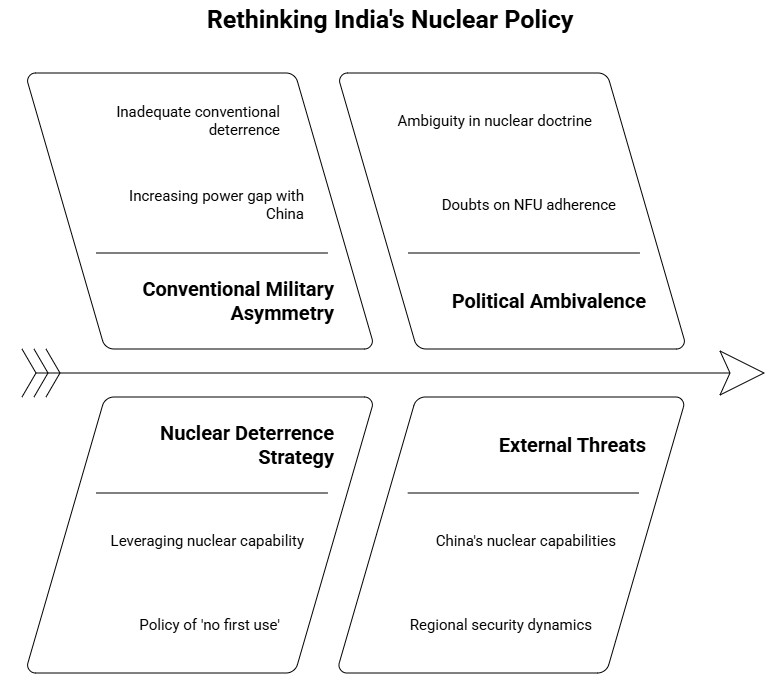
Advantages provided by No First Use
- Averting a nuclear crisis: The main advantage of NFU is that it minimizes the probability of nuclear use.
- More losses than wins: Instead, if both are NFU powers, there is greater probability of political leaders stepping back from the brink – for they know that a nuclear war cannot
- Significance extended to diplomacy: Notably, there is considerable convergence regarding the belief of nuclear weapons being restricted to the political realm.
Why should India not revoke No First Use?
- Havoc: The notions of revoking erroneously embrace the idea that a nuclear war can be fought and won. This is utterly false.
- No un-conventional threats: Pakistan does not pose a conventional threat that India cannot counter. Given that, they are likely to persist with terrorism, which is a low-cost option.
- Huge military investments: On the other hand, India’s conventional military power, shaped to fight a limited war, is challenged to impose its will under the nuclear shadow.
- Terrorism/Terror-state has no cognizance: Our foregoing NFU cannot prevent Pakistan from using terrorism as a tool of its India policy.
- Global credibility: On the contrary, it enables Pakistan and other adversaries to invite international intervention in what India maintains as a bilateral issues.
Evaluating the doctrine
- Success in establishing deterrence: Our policy of No First Use has many upsides, not all of them related to nuclear conflict.
- No undue celebration over nukes: The official doctrine today exists merely as a press release summarizing few points, with all other statements made offhand, with no great depth to them.
- Dialogue and diplomacy are India’s tools: Whether we have to turn to these different strategies, or simply make minor changes to our existing doctrine remains to be seen.
- Non-posturing: This debate is indicative of a larger effort of comprehensively evaluating India’s nuclear doctrine, and not only posturing.
Way Forward
- Periodic review not revocation: All doctrines need periodic reviews and India’s case is no exception.
- Non-proliferation: Indian doctrine does not support first use of nuclear weapons as it gives ample warning to the adversary of India’s intentions.
- Rational analysis of situation: If Indian policymakers do indeed feel the need to review the nation’s nuclear doctrine, they should be cognizant of the costs involved in so doing.
- Constructive debate: A sound policy debate can only ensure if the costs and benefits of a purported policy shift are discussed and debated widely.
Conclusion
As India reviews its nuclear doctrine, it is important to consider the costs and benefits of potential policy shifts and engage in constructive debate to ensure a sound and informed decision-making process.
14. India-Russia Relations: Strategic Partnership, Defence, Trade & Energy Cooperation
Russia has been an enduring and trusted partner for India, and the development of their bilateral relations has been a cornerstone of India's foreign policy. Since the signing of the "Declaration on the India-Russia Strategic Partnership" in October 2000, the relationship between India and Russia has taken on a new dimension, marked by increased levels of cooperation across various domains.
Historical Background of India-Russia Relations
Soviet Legacy

- The historical roots of this relationship can be traced back to the early 20th century, with Indian freedom fighters drawing inspiration from the Russian Revolution.
- During the Cold War, India and the Soviet Union formed a strong alliance in strategic, military, economic, and diplomatic spheres.
- After the dissolution of the Soviet Union, Russia continued this close relationship, resulting in a Special Strategic Relation between the two countries.
The Indo-Soviet Treaty of Peace, Friendship, and Cooperation, along with Soviet support, aided India's successful operations in 1971.
India-Russia Strategic Partnership
- India and Russia maintain various institutionalized dialogue mechanisms, operating at both political and official levels, to ensure regular interaction and follow-up on cooperation initiatives.
- This partnership was further elevated to a "Special and Privileged Strategic Partnership" in 2010.
Challenges and the Post-Covid Scenario
- Recent years have seen challenges in the India-Russia relationship, exacerbated by Russia's close ties with China and Pakistan. The post-Covid scenario has further impacted the partnership.
Five Pillars of India-Russia Relations
The India-Russia relationship has evolved and gained strength based on five key pillars:
- Similar political and strategic perceptions: India and Russia share common perspectives on global affairs.
- Intensive military-technical cooperation: Defense collaboration between the two nations has been robust.
- Strong economic bonds: Economic ties between India and Russia have been substantial.
- Deep ties in science and technology: India and Russia have fostered significant cooperation in the fields of science and technology.
- People-to-people and cultural links: The relationship between the people of India and Russia has been characterized by cultural exchanges and mutual understanding.
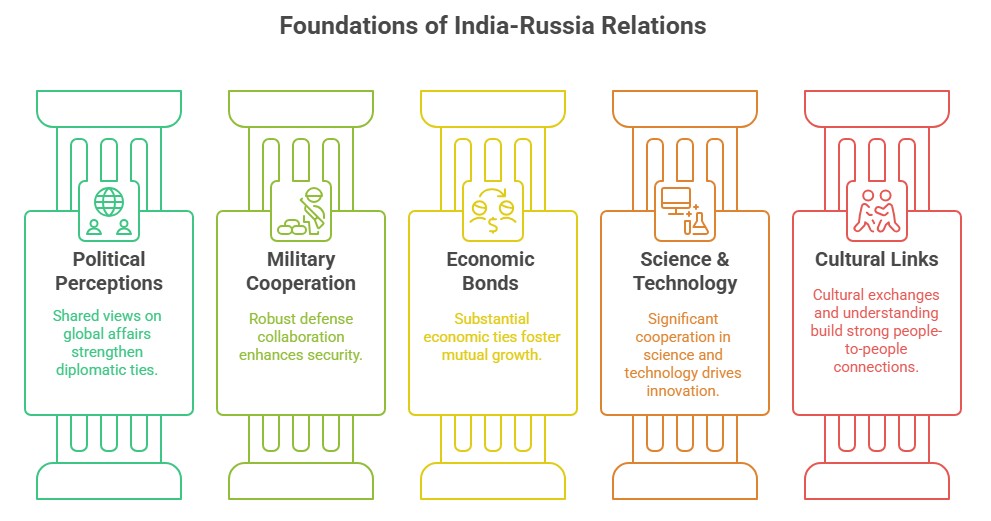
Areas of Cooperation in India-Russia Relations
Political Cooperation
- Annual Summit: The meeting between the Prime Minister of India and the President of the Russian Federation stands as the pinnacle of institutionalized dialogue, solidifying the Strategic Partnership between the two nations.
- 17th Annual Summit: Adoption of a Joint Statement titled 'Partnership for Global Peace and Stability' and a 'Roadmap of Events' to commemorate the 70th anniversary of diplomatic relations established in 2017.
- 19th Annual Summit in 2018: It welcomed the India-Russia Business Summit in New Delhi and the conclusion of a contract for the supply of the S-400 Long Range Surface to Air Missile system to India.
- President Putin's Executive Order (2019): Awarding PM Narendra Modi Russia's highest state decoration, The Order of St. Andrew the Apostle, for his significant contribution to the development of the privileged strategic partnership and friendly ties between Russia and India.
- Support for UNSC seat to India: Russia has also supported India’s claim for a permanent seat in UNSC and stood by India on the J & K issue thereby blocking Pakistan’s attempt to internationalize the issue.
Levels of Political Interactions
- BRICS Summit & SCO Summit: It provide platforms for bilateral interaction and discussion of regional issues.
- Regular high-level interactions: Occur between India and Russia through the Intergovernmental Commissions on Trade, Economic, Scientific, Technological and Cultural Cooperation (IRIGC-TEC) and on Military-Technical Cooperation (IRIGC-MTC).
Economic Cooperation
- Trade: India-Russia trade hit a record $39.8 billion in 2022–23. The surge in bilateral trade came in the backdrop of India’s huge purchase of discounted Russian oil.
- Mutual goals by 2025: Both countries aim to increase bilateral investment to US$50 billion and bilateral trade to US$30 billion by 2025.
- India's Participation in the Eastern Economic Forum: Extending $1 Billion Line of Credit for the Development of Far-Right Region of Russia
- Collaboration in the diamond industry: The Gem & Jewellery Export Promotion Council of India struck a deal with Alrosa, the world's largest diamond mining company, for direct sourcing of rough diamonds.
- Investment projects: They include Imperial Energy Tomsk, Sakhalin I, Volzhsky Abrasive Works Volgograd, Commercial Indo Bank, Kamaz Vectra, Shyam Sistema Telecom Ltd, Sberbank, and VTB.
Diaspora and Cultural Exchanges in India-Russia Relations
- Indian Student Enrolment: Approximately 4,500 Indian students are currently enrolled in medical and technical institutions in the Russian Federation.
- Hindustani Samaj: The oldest Indian organization in Russia, functioning since 1957.
- Russian students learning Hindi: Around 1500 Russian students are regularly taught Hindi in approximately 20 Russian institutions, including prominent universities and schools.
- Programmes like 'Namaste Russia': It promote educational collaboration between India and Russia, facilitated through institutes like Jawaharlal Nehru Cultural Centre.
- Festival of India in Russia: Held from September 2018 to March 2019 in 22 cities, featuring 34 performances by 10 groups. Showcased the finest Indian music, dance, cuisine, and spiritual traditions.
- Exhibition honoring Mahatma Gandhi: The State Duma of the Russian Federation inaugurated an exhibition on October 2, commemorating Mahatma Gandhi's 150th birth anniversary and his connection with Russian writer Leo Tolstoy.
Defence Cooperation in India-Russia Relations
- Evolution of Cooperation: India-Russia defence cooperation has transitioned from a buyer-seller framework to joint research, development, and production.
- Notable Defence Equipment: Examples include the BrahMos Missile System, Fifth Generation Fighter Aircraft, SU-30 aircraft, T-90 tanks, and frigates.
- Agreements: During the 17th Annual Summit, agreements were concluded for the supply of S-400 air defence systems, construction of frigates (Krivak Class), and joint venture manufacturing of Kamov-226T helicopters under the 'Make in India' initiative.
- Military Hardware: India has acquired advanced military hardware from Russia, such as the S-400 Triumf, Kamov Ka-226 helicopters, T-90S Bhishma tanks, and INS Vikramaditya aircraft carrier.
- Bilateral Exercises: Joint military exercises, including the 'INDRA' exercise, play a significant role in defence cooperation.
- Arms imports: Russia is responsible for 58% of India's total arms imports, followed by Israel (15%) and the USA (12%).
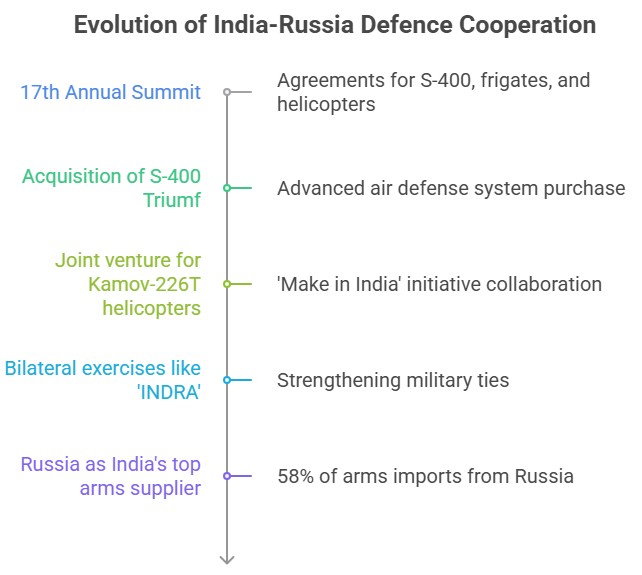
Nuclear Cooperation in India-Russia Relations
- Strategic Vision: The Department of Atomic Energy (DAE) of India and Russia's Rosatom signed a strategic vision document in December 2014 to strengthen cooperation in peaceful atomic energy applications.
- Nuclear Power Plants: Russia has constructed two nuclear power plants at Kudankulam, and agreements have been signed for the construction of additional units.
Energy and Infrastructure
- Indian Investments: Indian companies have invested close to $5.5 billion in Russia's Oil and Gas sector.
- Transport Corridor: The North South International Transport Corridor (INSTC) aims to reduce transportation time and costs between the two countries, boosting economic ties.
- Natural gas: Russia possesses one of the largest reserves of natural gas globally. ONGC Videsh, an Indian company, has acquired a 20% stake in the Sakhalin oil and gas plant.
- St. Petersburg Declaration: Both countries agreed to jointly explore hydrocarbons in the Arctic area. Russia's "Pivot to Asia" strategy and India's Draft Arctic Policy demonstrate the convergence between the two nations. The development of resources in the region will be facilitated by the Northern Sea Route.
Space, Science, and Technology
- Framework Agreement: In 2007, India and Russia signed a framework agreement on cooperation in peaceful uses of outer space, including satellite launches, GLONASS navigation, remote sensing, and societal applications.
- New Initiatives: Recent initiatives include the India-Russia Bridge to Innovation, cooperation in telemedicine, creation of a Traditional Knowledge Digital Library (TKDL), and the Russia India Network (RIN) of universities.
Terrorism
- Cooperation against Terrorism: The Agreement on Cooperation in Combating Terrorism and Organized Crime, signed during a visit by an Indian delegation to Russia in November 2017, aims to jointly fight evolving risks and threats.
- Exchange of Information: The agreement reinforces the relationship between India and Russia through the exchange and sharing of information, expertise, and best practices.
- Support for CCIT: Russia supports India's proposal for the Comprehensive Convention on International Terrorism (CCIT).
Cyber Security
- International Information Security Agreement: India has an Agreement on Cooperation in International Information Security with Russia.
- Combating Radicalization: India and Russia collaborate closely to combat radicalization through social media platforms.
- Quantum Technology Collaboration: The Russian Quantum Center (RQC) has shown interest in collaborating with India to offer quantum technology, specifically quantum cryptography, to enhance cybersecurity in sectors like banking and national security.

Significance of India-Russia Relations to India
Strategic Advantage
- Russia's Strategic Assets: Russia possesses strategic bombers and has veto power in the UNSC, acting as a counterweight against global hegemony.
- Countering Threats: Russia has effectively countered China and Pakistan's attempts to undermine India's territorial integrity in the past.
- Historical Support: The Soviet Union and Russia have historically supported India on the Kashmir issue, while India has maintained a balanced position on Ukraine.
- International Support: Russia's support is crucial for India's aspirations for permanent membership in the UN Security Council, inclusion in the Nuclear Suppliers Group, technology control regimes, and the Asia Pacific Economic Cooperation (APEC).
- Access to Resources: Russia can provide access to Central Asian Republics rich in resources like Uranium, Oil & Gas.
- Contributions to India: Russia has contributed to the development of India's nuclear, defense, space, and heavy industry sectors and has been a friend during critical moments, such as the 1971 Indo-Pakistan war.
Defence Procurement
- Major Arms Supplier: India has imported over $36 billion worth of arms from Russia, accounting for more than 70% of its total imports between 1992 and 2015.
- Nuclear Submarine Lease: India's only nuclear submarine, INS Chakra, is leased from Russia, and negotiations for leasing another Akula class nuclear submarine are in the final stages.
- Building Indigenous Defense Sector: Russia supports India in building an indigenous defense sector through technology transfer and joint R&D.
- Technology Transfer Advantage: Russia remains a better source for easier technology transfer than the USA in terms of material technologies and strategic raw materials inheritance.
Energy
- Meeting Energy Demands: India's relations with Russia are important to meet its increasing energy demands, as it lacks direct access to energy-rich Central Asian Republics.
- Investments in Energy Projects: India has made investments in energy projects like Sakhalin I to increase its energy imports from Russia.
- Nuclear Technology: Russia's nuclear technology is essential for India to achieve its renewable energy targets.
Recent Developments and Challenges
- Growing Ties with Other Countries: India's growing ties with the US, France, and Israel, and the emergence of the Indo-US collaboration pose a challenge to the relevance of Russia for India.
- Uneasiness with Russia-Pakistan Cooperation: Russia's increasing military cooperation and sale of military equipment to Pakistan create uneasiness for India.
- Russia-China Axis: Russia's deepening relations with China and their joint military exercises and economic partnerships affect India's maneuvering space in the region.
- Shifting Approach on Regional Issues: Shifts in Russia's approach towards regional issues, such as the AfPak issue, and its changing policies raise concerns for India.
- Diversification of Defense Equipment: India's defense equipment diversification, including deals with France and Israel, reduces its reliance on Russia.
Way Forward
- Visible Defence Deals: India should conclude visible, high-value defense deals with Russia and maintain a strong military relationship.
- Participation in Eurasian Economic Union: India's potential participation in the Eurasian Economic Union can benefit all members of the grouping.
- Establishing Rupee-Rouble Payment Mechanism: A new rupee-rouble payment mechanism should be established to facilitate trade in local currencies, bypass US sanctions, and enhance competitiveness.
- Promoting Trilateral Cooperation: Mutually beneficial trilateral cooperation between Russia, China, and India (RIC) should be promoted to reduce mistrust between India and China.
- Ensuring Stability in Afghanistan: India and Russia should work together to achieve stability and security in Afghanistan through an Afghan-led and Afghan-owned peace process.
- Seizing Defence Market Opportunities: Russia should seize the opportunity to become a major player in India's defence market as part of the "Make in India" initiative.
Conclusion
India and Russia share a long-standing relationship that is crucial for India's economic, energy, and geopolitical interests. Strengthening this relationship and finding a new logic for the "special relationship" should be pursued with energy and enthusiasm by both sides.
15. India- US Relations
Introduction
- Prime Minister Narendra Modi received a ceremonial welcome at the White House's South Lawn by President Joe Biden and First Lady Jill Biden.
- The visit highlighted the focus on establishing a "next generation partnership" between India and the United States.
Key highlights of the Visit
- Co-production of GE 414 Jet Engines for Tejas Mk2 Aircraft: GE and HAL signed a MoU for co-production of jet engines for the indigenous Tejas Mk2 light combat aircraft.
- Purchase of Armed Drones and Defense Industrial Innovation Collaboration: India announced the purchase of armed drones and collaboration in defense industrial innovation through the 'INDUS-X' platform.
- Investment by Micron Technology in Chip Assembly and Test Facility: Micron Technology planned to invest in a new chip assembly and test facility in Gujarat, supported by the Indian government and Gujarat State government.
- Strengthening Space Cooperation and Mission to International Space Station: India joined a framework for space exploration and agreed to a mission to the International Space Station in 2024.
- Visa Renewal Program and Consulate Openings: A pilot program for domestic visa renewal for certain petition-based temporary workers was announced. The program aimed to streamline visa processes and could potentially expand to cover skilled visas like H1b and L Visas.
- Initiative on Critical and Emerging Technologies (iCET): The iCET serves as a framework for India-US cooperation in critical and emerging areas of technology. It was launched in January 2023 to strengthen the strategic partnership and drive technology and defence collaboration between the two countries.
History of India-US Relations
- Changing Perception: The US initially viewed India's possession of nuclear weapons as a barrier to deepening bilateral and regional cooperation. However, in the early 2000s, Washington recognized the importance of an active and constructive relationship with India.
- Expanding Engagement: Over the past two decades, the India-US relationship has expanded in various dimensions, including political, diplomatic, economic, and military.
Areas of Cooperation
Political & Diplomatic
- Leadership-Level Exchanges: Regular exchanges at the leadership level have been conducted, such as the visit of US Secretary of State Antony J. Blinken to India in July 2021.
- 2+2 Ministerial Dialogue: The India-US 2+2 Ministerial Dialogue, involving the heads of Foreign and Defense Ministries, reviews bilateral ties in defense, strategic, security domains, as well as regional and global issues.
Defence
- Indo-US Ties: The relationship between India and the United States in defense has strengthened significantly. Current defense trade between the two countries stands at $119.42 billion.
- US as India's major Arms Provider: The United States is now the fourth largest supplier of arms to India. India conducts most joint military exercises with the USA.
- Fundamental Defense Agreements:
- GSOMIA (General Security of Military Information Agreement): Signed in 2002 for military information exchange.
- LEMOA (Logistics Exchange Memorandum of Agreement): Agreed in 2016, allowing the use of each other's military bases.
- COMCASA (Communications Compatibility and Security Agreement): Signed in 2018 to enhance interoperability and technology export.
- BECA (Basic Exchange and Cooperation Agreement): Signed in 2020 to share advanced military technology and logistics.
Trade Relations
- Trade Surplus with the United States: In 2022-23, India had a trade surplus of $28 billion with the United States. Bilateral trade reached $119.42 billion, an increase from $80.51 billion in 2020-21.
- Growing Defense Trade
- The Indian service sector, especially the IT industry, heavily relies on the US markets.
- Trade Deal: Aiming for $500 billion in bilateral trade, both countries are working on a 'mini trade deal' due to stalled FTA negotiations.
- Digital Tax: India and the US have agreed on a transitional approach regarding equalization levy (EL) or digital tax.
Strategic Energy Partnership (SEP) in Energy sector
- The energy dialogue between India and the US has been elevated to the level of a strategic energy partnership (SEP).
- The US-India Climate and Clean Energy Agenda 2030 Partnership was launched during the Leaders' Summit on Climate in 2021.
- Partnership for the 2030 Agenda: A partnership has been established between the United States and India to work towards the 2030 Agenda.
- Strategic Clean Energy Partnership (SCEP): The SCEP has undergone a redesign.
- India-US Civil Nuclear Energy Cooperation: The cooperation on civil nuclear energy between India and the US has been reviewed. The Gas Task Force has been renamed as the India-US Low Emissions Gas Task Force.
- Civil Nuclear Cooperation (2008): Preparatory work has commenced in India for the construction of six AP 1000 reactors by Westinghouse, which will make it one of the largest projects of its kind.
- The Memorandum of Understanding for collaboration on the Global Centre for Nuclear Energy Partnership (GCNEP) between India and the US has been extended by ten years in 2020.
Strategic Partnership
- The strategic partnership between India and the US has been strengthened, particularly in response to the rise of China and its aggressive behavior in the Indo-Pacific region.
- The 2+2 Ministerial Dialogue has been institutionalized and efforts are being made to strengthen the QUAD, aiming for a peaceful, stable, and rules-based order in the Indo-Pacific.
- Indo-Pacific Economic Framework for Prosperity (IPEF): India and the US are partnering on the IPEF to enhance economic connectivity, resilience, and fairness in the region.
- I2U2 Dialogue: The I2U2, comprising India, the United States, Israel, and the United Arab Emirates, serves as a strategic dialogue mechanism.
QUAD
- India is categorized as a 'vital partner' in the Indo-Pacific region according to the USA's Indo-Pacific Strategy report.
- The Blue Dot Network has been established to certify projects that adhere to international standards and align with principles of openness, inclusivity, transparency, sustainability, and regulations.
- The Blue Dot Network holds strategic importance as it is part of the US's Indo-Pacific strategy, aimed at countering China's ambitious Belt and Road Initiative (BRI).
- Counterterrorism, maritime security, and cyber security are essential pillars of the strategic partnership between India and the US.
- Key agreements in the 2+2 Ministerial Dialogue focus on various areas of cooperation, including global partnerships, Indo-Pacific cooperation, mutual prosperity, innovation, resilient supply chains, climate, environment, clean energy, science, technology, cybersecurity, space, global health, defense and security, counterterrorism, counter narcotics, education, and people-to-people ties.
India as a Net Security Provider
- The concept of 'Indo-Pacific' has positioned India as an emerging Net Security Provider.
- India's role includes collective action in humanitarian assistance and disaster relief, monitoring shipping, and countering China's imperialist policies in the region.
Other
- Diaspora/People-to-People Ties: Indian-American Community: With around 4.2 million Indian Americans residing in the US, the Indian diaspora contributes to strengthening people-to-people ties between the two countries.
- International Cooperation: Multilateral Engagement: India and the US closely cooperate at various multilateral organizations, including the United Nations, G-20, ASEAN Regional Forum, IMF, World Bank, and WTO.
- Scientific Collaboration: The Indo-US Science and Technology Forum (IUSSTF) plays a crucial role in strengthening cooperation in science and technology.
- Space Cooperation: India collaborates with NASA and other US institutions on space exploration and satellite projects.
Areas of Concern
- Role in the Indian Ocean Region: India's collaboration with the US may impact its position as a net security provider in the region.
- Intellectual Property Rights: India's IP regime is under scrutiny for adequate protection and enforcement.
- Generalized System of Preferences: Termination of India's GSP benefits affects sectors like pharmaceuticals, textiles, and automotive parts.
- Religious Freedom allegations and Data Localization: US criticism of India's religious freedom and data localization policies.
- Trade-related concerns
- Pending Bilateral Investment Treaty:
- India's Tariff Regime: The United States has longstanding concerns regarding India's tariff regime, particularly in agriculture, where the average tariff rates are relatively high.
- Steel and Aluminum Tariffs and Retaliatory Tariffs: India opposes the persistent steel and aluminum tariffs imposed by the United States under "Section 232" since 2018. In response, India applied retaliatory tariffs after losing its GSP eligibility.
- Digital Services Tax (DST): United States and India reached a "political agreement" on DST treatment.
- U.S. Generalized System of Preferences (GSP): India was excluded from the U.S. GSP program in 2019 due to market access issues.
- Services industry challenges: Competitiveness and market access: Both countries face hurdles in services industries. US corporations encounter obstacles such as limits on foreign ownership and local presence requirements in India.
- Agricultural obstacles: Sanitary and phytosanitary (SPS) barriers: In the United States, SPS obstacles hinder India's agricultural exports. Both sides perceive each other's agricultural support schemes as market distortions, leading to collaboration at the TPF.
- Intellectual Property concerns: India on the "Special 301" list: The United States included India in its 2021 "Special 301" report, prioritizing IP issues.
- "Forced" Localization dispute: India's domestic support measures for sugar and sugarcane: In 2022, India appealed against a WTO ruling that deemed its domestic support measures for sugar and sugarcane inconsistent with global trade norms.
- Investment dynamics: FDI reforms: India has implemented FDI reforms, including increased foreign equity caps for insurance and e-commerce platforms. Additionally, a streamlined FDI approval system has been launched.
- Defense trade considerations: Technology-sharing and co-production projects: India seeks increased technology-sharing and co-production opportunities, while the United States desires further reforms in India's defense offsets policy and higher FDI limits in the defense sector.
- Geostrategic implications:
- Afghanistan's potential impact on Kashmir: The US withdrawal from Afghanistan poses a risk of destabilization, which could have spillover effects in Kashmir.
- Indo Pacific perspectives: India focuses primarily on the Indian Ocean, while the United States places greater emphasis on the Pacific Ocean.
- Middle East dynamics: The Trump Administration's Maximum Pressure strategy on Iran has affected India-Iran relations, leading Iran to strengthen ties with China.
- Russia-Ukraine conflict: While the US imposed sanctions on Russia, India maintained a non-aligned position on the issue.
- China-related suspicions: Both countries harbor occasional suspicions toward each other regarding potential future cooperation with China, which hampers the establishment of deep and long-term deals.
- Climate change considerations:
- Failure in meeting financial commitments: The USA and other developed countries have failed to fulfill their financial and other commitments to support developing nations.
- Differences over Net Zero emission targets: Disagreements have arisen over the concept of "Net Zero emissions," with the USA advocating for it globally, while India believes it falls short of meeting earlier targets, despite its commitment to Net Zero.
- Data sovereignty concerns:
- India's stance on the Osaka Track: In 2019, India boycotted the Osaka Track on the Digital Economy, which advocated for legislation enabling free data movement across countries. India opposed this approach as it infringed upon its sovereignty.
Is US wooing India to act against China?
- Decoupling with China: The US has been actively engaging with India, but its approach is not solely aimed at provoking India to act against China.
- Indo-pacific narrative: The US recognizes India as a significant player in shaping the regional dynamics of the Indo-Pacific and seeks to build a comprehensive partnership based on shared interests.
- Unleashing the economic potential: The US recognizes India's economic potential and seeks to deepen economic ties.
- Convergence over diverse issues: This involves maintaining freedom of navigation, resolving disputes peacefully, and upholding the principles of international law.
Way forward
- Multipolar Rule-Based World: Collaborate to create a multipolar rule-based world order, promoting shared interests and values.
- Counter Terrorism Cooperation: Strengthen cooperation on counterterrorism, leveraging the changing dynamics in the region.
- Digital Ecosystem: Foster cooperation in emerging technologies, artificial intelligence, and cybersecurity to address policy differences and drive progress.
- Investment Promotion: Enhance two-way foreign direct investments and provide incentives for private sector investments.
16. India-Canada Relations
India-Canada Relations: A quick recap
- India established diplomatic relations with Canada in 1947.
- In recent years, both countries have been working to enhance bilateral cooperation in a number of areas of mutual importance.
Significant collaborations
- Trade: Canada is India’s second largest export destination and is the third largest source of imports for India. It is a major source of FDI for India, with total investments of nearly USD 5.5 billion.
- Investment: India and Canada have strong bilateral relations which have been further strengthened by the India–Canada Foreign Investment Promotion and Protection Agreement (FIPA), signed in 2009.
- Collaboration on STEM: India and Canada are also engaged in several joint development projects in the areas of science and technology, health, education, and climate change.
- Energy: India and Canada have recently signed a Joint Declaration on Cooperation in the Field of Renewable Energy.
- Security: India and Canada are also cooperating in the field of defence, with joint military exercises and training programs.
- Global institutional reforms: India and Canada are members of the Commonwealth of Nations and the G20, and cooperate on several international issues.
Recent souring of ties
Racist Policies- Canada’s perceived shift away from its traditional stance of neutrality has put at odds with India’s traditional non-alignment policy.
- Additionally, Canada’s criticism of India’s human rights record has been seen as offensive by many in India, leading to strained diplomatic relations.
- Additionally, Canada’s failure to exempt India from visa requirements has also been seen as a sign of disrespect.
- Over 100,000 Canadians recently took part in voting for the Khalistan Referendum in Brampton, Ontario on 19 September which was organised by pro-Khalistani.
- Visuals on social media showed a huge number of men, women queueing up to vote in for Khalistan Referendum.
- Indian government had warned Canadian govt against the anti-India forces growing in the country.
- However, the Canadian government refused to stop them from expressing their views by holding the Khalistan Referendum and linking it with a “peaceful and democratic” process.
- Trade decline: India-Canada bilateral trade has been declining since 2013 and currently stands at around $7 billion. There is room to increase this trade and investments in both directions.
- Illegal immigration: Canada has been increasingly concerned about illegal immigration from India, as well as the backlog in processing applications for legal immigration, both of which have caused tension between the two countries.
- No security consensus: India and Canada have been working to enhance their defense and security ties, but the two countries have yet to sign a formal security agreement.
- Under-utilized agriculture: Canada and India have been in negotiations to open up the agricultural sector to more trade, but disagreements over import restrictions and subsidies continue to be a major obstacle.
- Human rights allegations on India: India and Canada have also clashed over human rights issues, with Canada criticizing India’s policies on religious minorities, freedom of speech, and other human rights issues.
Why is Canada suddenly recognizing India’s importance?
Indo-Pacific Strategy- First is Canada’s Indo-Pacific Strategy that was issued last November. While it calls China “an increasingly disruptive global power,” it describes India as Canada’s “critical partner” for its regional and global objectives. This is music to Indian ears.
- Indeed, this 23-page report mentions India 27 times, underlining their “shared tradition of democracy and pluralism, a common commitment to a rules-based international system.”
- Canada and India have strong economic ties, with two-way merchandise trade between the two countries reaching $9.5 billion in 2019.
- Canada is also India's second-largest source of foreign direct investment, and Indian investments in Canada have grown significantly in recent years.
- Canada and India also have strong people-to-people ties, with the Indian diaspora in Canada estimated to be more than one million strong.
- Sikhs constitute a significant proportion of the Indian diaspora, they make up less than one percent (a little over 500,000) of Canada’s total population.
- Cultural tourism is boosting between the two countries.
- This newfound enthusiasm was visible in the press release issued in Canberra on the eve of the Canadian foreign minister’s visit to India.
- India’s growing strategic, economic and demographic importance makes it a critical partner for Canada in the Indo-Pacific.
- In turn, Canada can be a reliable supplier of critical minerals, a stronger partner in the green transition, as well as a major investor.
Why is Canada important for India?
- Destination for Indian students: Canada is one of the top sources for foreign students for Indian universities. India is the second largest source of immigrants to Canada.
- 2nd largest trade partner: Canada is India's second-largest trading partner, and trade between the two countries has been growing steadily.
- Vibrant diaspora: Canada is home to a large and vibrant Indian diaspora, and the two countries enjoy strong people-to-people ties.
- Source of FDI: Canada is also an important source of foreign direct investment for India, and provides an important source of capital to Indian businesses.
- Liberal visas and citizenship: Canada is also an important source of skilled immigrants for India and is a popular destination for students and professionals from India.
- Trade partnership: Both nations look forward to their proposed Early Progress Trade Agreement (EPTA) before they finalize their CEPA.
Way forward
- Strengthening diplomatic ties: India and Canada should work towards strengthening their diplomatic ties, by engaging in more frequent diplomatic exchanges and dialogue. This could include increasing the number of high-level visits between both countries, and exploring opportunities for collaboration in areas such as trade, investment, and education.
- Enhancing trade relations: India and Canada should focus on enhancing their bilateral trade relations, by exploring the potential for increased exports and investment. This could involve investing in joint initiatives that promote economic growth, as well as taking steps to reduce barriers to trade and investment.
- Nurturing people-to-people ties: India and Canada should aim to encourage more people-to-people exchanges between the two countries. This could include increasing the number of students and scholars studying and teaching in each other’s countries, as well as promoting cultural exchanges and tourism.
- Enhancing security cooperation: India and Canada should work together to enhance their security cooperation, by increasing information sharing and collaboration on countering terrorism, cyber-security, and other common security threats.
- Technology collaboration: India and Canada should explore new areas of collaboration, such as in the fields of renewable energy, space exploration, and artificial intelligence. This could involve engaging in joint research and development initiatives, as well as exploring opportunities for joint ventures.
Conclusion
- The India-Canada relationship has experienced both periods of collaboration and recent challenges.
- The historical ties between the two countries, including India's support for Canada's independence and Canada's recognition of India's struggle for freedom, have laid a foundation for bilateral cooperation.
17. India-African Union Relations
Introduction: Prime Minister Modi has proposed inclusion of the African Union (AU) into the G20 grouping — effectively making it G21. He has written to G20 leaders to propose that the African Union be given “full membership at the upcoming Delhi Summit of G20, as requested by them”.
Present Status of Ties- Institutionalization of relations: The India-Africa Forum Summit serves as the framework for India-Africa relations under South-South Cooperation.
- Expanded diplomatic presence: India announced the opening of embassies in 18 African countries, strengthening diplomatic ties.
- Economic engagement: Bilateral trade between India and Africa has grown significantly, with India becoming Africa's third-largest trade partner.
- Investment and development cooperation: Indian investments in Africa have increased, with the country being the seventh-largest investor in the region.
- Lines of Credit (LoC): India's concessional LoCs support development projects in Africa, with 182 projects sanctioned, amounting to US$10.5 billion.
- Bilateral cooperation: Collaboration includes areas such as solar energy, climate change, information technology, maritime security, counter-terrorism, and military training.
- Soft power projection: India's ITEC program offers scholarships to African students, and the Indian diaspora contributes to cultural exchange.
Significance of Africa
Geostrategic Importance- Proximity to India: Africa's Horn region is critical for India's security due to emerging threats like radicalism, piracy, and organized crime.
- Diversifying energy sources: Africa can help India diversify its energy sources, aligning with the Integrated Energy Policy.
- Rich resources: Africa possesses valuable minerals, metals, and abundant agricultural land, addressing India's need for food security and resources.
- Market and investment opportunities: Africa provides a space for Indian investments and trade expansion, fostering economic cooperation.
|
India-Africa Trade: Key Stats
|
Geopolitical Considerations
- Support for UNSC seat: Africa's support is crucial for India's aspiration to gain a permanent seat on the UN Security Council.
- Projection of soft and hard power: India showcases its soft and hard power in Africa, contributing to its global influence.
- Peacekeeping and capacity building: India actively participates in UN peacekeeping operations and supports capacity building in African countries, strengthening bilateral ties.
Various Challenges
- Declining trade and investment: Bilateral trade and Indian investments in Africa have witnessed fluctuations, demanding efforts to enhance economic ties.
- Short-term focus: LoCs have primarily funded small-scale projects, lacking a broader development perspective.
- Competition from other powers: India faces competition from other countries like China, Brazil, and Russia, engaging Africa in various sectors.
- Lack of synchronization: Development instruments like LoCs, grants, and capacity-building initiatives operate independently, lacking coordination.
- Instances of racial attacks: Incidents of violence against African students in India pose challenges to people-to-people connections.
Chinese Challenge in Africa
- China's extensive investments in Africa have significantly impacted the region across infrastructure, finance, natural resources, and maritime interests.
- Access to resources, untapped markets, and support for the "One China Policy" drive China's engagement.
Strategies for India
- Develop a focused Africa strategy: India should formulate a comprehensive strategy for the next decade, identifying key areas of cooperation.
- Focus on capacity building: Investing in human capital is crucial for sustainable development in Africa.
- Collaborate with civil society organizations and diaspora: Indian organizations and the diaspora can play a vital role in implementing development projects at lower costs.
- Ensure timely project completion: Efforts should be made to expedite LoC projects, learning from countries with better implementation records.
Steps taken so far
- Indian Technical and Economic Cooperation (ITEC) program: India's ITEC program provides technical assistance to African countries, with around 50% of ITEC slots reserved for Africa.
- Asia-Africa Growth Corridor: The AAGC, a cooperation agreement between India, Japan, and African countries, aims for inclusive development.
- Pan African e-Network: The PAeN facilitates tele-education and telemedicine in Africa, contributing to technological advancement.
- Maritime cooperation: India's collaboration with African nations in the maritime domain, exemplified by joint exercises, promotes regional security.
- Peacekeeping operations: India actively participates in UN peacekeeping operations in Africa, supporting African counter-terrorism efforts and capacity building.
- Duty-free tariff preferential scheme: India's scheme benefits African nations, and the India-Africa Forum Summit plays a vital role in strengthening ties.
- India Africa Defence Ministers conclave: Initiatives like this enhance defence cooperation and bilateral relations.
Way Forward
- Enhance mutual engagement: Organize the pending fourth India-Africa Forum Summit to further strengthen the relationship.
- Allocate fresh financial resources: Allocate new resources for grants and concessional loans, prioritizing economic relations.
- Focus on emerging sectors: Develop collaborations in health, space, and digital technologies to give a 21st-century dimension to the partnership.
- Continued support in peacekeeping: Sustain India's contributions to peacekeeping, counter-terrorism, and capacity building in Africa.
- Improve experiences of Africans in India: Ensure the safety and well-being of Africans studying or working in India, promoting people-to-people connections.
- Promote development-friendly private investments: Align development cooperation with commercial interests to support mutually beneficial projects.
- Strengthen international cooperation: Collaborate with international allies to address the China challenge in Africa, emphasizing partnership-based approaches.
18. India-Egypt Relations
Introduction: Egyptian President Abdel Fattah al-Sisi conferred PM Modi with the 'Order of the Nile' award, the nation's highest state honour. This is the 13th such highest state honour that various countries across the world have conferred upon PM Modi. PM Modi was in Egypt on a two-day state visit. This is his first tour to Egypt and the first bilateral visit by an Indian PM to the country since 1997.
Historical Background of the Relationship:
- Ancient civilizations: India and Egypt, two of the world's oldest civilizations.
- Friendship between leaders: Mahatma Gandhi and Saad Zaghloul shared common goals of independence.
- Founders of Non-Aligned Movement: strengthening their relationship during the Cold War.
- Solidarity in conflicts: India supported Egypt during the 1956 Suez Crisis and stood by Egypt and the Arabs after the Six-Day War in 1967.
Significance of the Relations
- Gateway to Europe and Africa: Egypt's strategic location along with the Suez Canal positions it as a gateway to both Europe and Africa, making it an important market for India.
- Shared vision of non-alignment: Nehru and Nasser's personal equation and their roles in the non-aligned movement strengthened the ties between India and Egypt.
- Moderate voice in the Islamic world: India perceives Egypt as a moderate and friendly voice within the Islamic world, presenting opportunities for collaboration between the two Global South partners.
- Historical cooperation: India and Egypt had close ties, including arms shipments during the Suez Crisis and discussions on nuclear cooperation and a joint fighter project in the past.
- Counter-terrorism efforts: Egypt, under President Sisi, has been praised for its strong stance against Islamic extremism, aligning with India's fight against terrorism.
Current State of Bilateral Relations
Political Relations
- Historical understanding: India and Egypt have a long history of close political cooperation, both bilaterally and in regional and global issues.
- Founding members of Non-Aligned Movement: Both countries were founders of the Non-Aligned Movement and have cooperated closely in multilateral fora.
- Mechanisms of dialogue: Bilateral institutional dialogues, including the Joint Working Group on Cyber Issues and Joint Committee Meetings on S&T and Counter Terrorism, enhance cooperation.
Economic Relations
- Trade volume: Bilateral trade has increased significantly, reaching US$4.55 billion in 2018-19 and remaining robust even during the pandemic.
- Wheat export: India's inclusion in Egypt's accredited countries for wheat supply strengthens trade ties and addresses wheat shortage concerns.
- Investments: Around 50 Indian companies have invested in Egypt, contributing to economic cooperation.
- Technical cooperation: Benefiting Egyptian officials through initiatives like ITEC, ICCR, and IAFS scholarships.
Defence Relations: Cordial defence relations and Joint military exercises.
Cultural Relations
- The Indian community in Egypt consists of around 3,200 individuals, with Indian students studying at Al Azhar University.
- Cultural cooperation: The Maulana Azad Centre for Indian Culture (MACIC) promotes cultural exchange through activities such as language classes, seminars, and exhibitions.
- Popularity of yoga: In Egypt International Day of Yoga celebrated with enthusiasm.
Limitations in the Relationship
- Low bilateral trade: China's bilateral trade with Egypt surpasses India's, highlighting the need to enhance economic engagement.
- Defence trade deficiencies: Indian defence manufacturers still face limitations in meeting Egypt's defence needs, leading Egypt to explore other sources.
- People-to-people connections: Strengthening ground-level relations is challenging due to limited direct people-to-people connections and the absence of a significant Indian diaspora.
Outcomes from the Current Visit
- Consolidating new coalition: India's renewed engagement with Egypt aims to strengthen its coalition with moderate Sunni states in the Middle East, promoting peace and stability.
- Elevating bilateral ties: India and Egypt agree to elevate their bilateral ties to a strategic partnership, covering various aspects, including politics, security, defence, energy, and economy.
- Enhanced cooperation: Focus areas include defence industries, counter-terrorism intelligence sharing, strengthening food and pharma supply chains, and increasing bilateral trade.
- Media content exchange: The Media Authority of Egypt and Prasar Bharati will exchange content, facilitating cultural exchange between the two countries.
Way Forward
- Deeper economic engagement: India should prioritize deeper economic engagement with Egypt, aligning it with strategic imperatives.
- Proactive industry approach: Industry bodies like CII, FICCI, and ASSOCHAM can play a proactive role in promoting Egypt as an investment destination.
- Government-industry collaboration: for impactful economic cooperation.
19. BIMSTEC
Introduction: BIMSTEC has proved to be a bridge of friendship connecting the people of South and South-east Asia. Much recently, the 26th Founding Day of BIMSTEC will be celebrated. BIMSTEC is a regional organization comprising seven Member States in South and Southeast Asia.
Established in 1997, it aims to promote regional unity and cooperation. Member States include Bangladesh, Bhutan, India, Nepal, Sri Lanka, Myanmar, and Thailand. The Permanent Secretariat is located in Dhaka, Bangladesh.
Significance of BIMSTEC for India
- Strategic Importance: BIMSTEC aligns with India's "Neighbourhood First" and "Act East" policies, strengthening regional cooperation.
- Regional Integration: Connecting South and Southeast Asia and Enhancing Trade and Transport Links
- Trade and Economic Cooperation: BIMSTEC Free Trade Agreement (FTA) Facilitates trade liberalization and market access among member states.
- Development of Northeast India: Integration with Southeast Asia and Access to Southeast Asian Markets
- Energy Security and Resource Cooperation - Harnessing Energy Resources: Explores and utilizes the rich energy resources in the Bay of Bengal region.
- Security Cooperation: Countering Terrorism and Transnational Crime: Enhances intelligence sharing, border security, and joint counter-terrorism efforts.
- Challenges in BIMSTEC - Geopolitical Challenges: Indo-China Regional Rivalry and there is a Perception of Indian Dominance
- Incomplete Free Trade Agreement (FTA) - Lack of Progress: Despite signing the Framework Agreement for a Free Trade Agreement (FTA) 18 years ago, there has been limited progress in achieving a comprehensive FTA within BIMSTEC.
- Connectivity Deficits: BIMSTEC faces challenges in terms of inadequate physical connectivity, including roads, railways, air links, river routes, and coastal shipping connections.
- Delayed Progress on Blue Economy: BIMSTEC has recognized the importance of the Blue Economy, but concrete actions and initiatives in this domain are yet to materialize.
- Limited Engagement of Business Chambers and Corporate Leaders: Incomplete Private Sector Involvement
- Bilateral Issues and Conflicts:
- Rohingya Crisis and Border Conflicts: Ongoing challenges, such as the Rohingya refugee crisis between Myanmar and Bangladesh and border conflicts between Myanmar and Thailand, pose hurdles to the smooth functioning and cooperation within BIMSTEC.
- Unsolved Maritime Disputes: Long-standing maritime disputes, including the issue of Indian fishermen crossing the maritime border into Sri Lanka, remain unresolved, affecting regional cooperation and coordination.

Way forward: Enhance multimodal connectivity, Promote digital integration, Prioritize green and sustainable development, Promote blue economy cooperation, Strengthen disaster resilience and Encourage academic and research collaboration
Conclusion: BIMSTEC holds immense potential for regional cooperation, economic growth, and security in South and Southeast Asia. India's active engagement, leadership, and commitment to addressing challenges will play a crucial role in realizing the benefits of this sub-regional organization.
20. Shanghai Cooperation Organisation (SCO)
Introduction: The Shanghai Cooperation Organization (SCO) is a permanent international intergovernmental organization. It was established in June 2001 in Shanghai, China, by the Republic of Kazakhstan, the People's Republic of China, the Kyrgyz Republic, the Republic of Uzbekistan, the Russian Federation, and the Republic of Tajikistan.
Membership
- The SCO currently has nine members: China, India, Kazakhstan, Kyrgyzstan, Pakistan, Russia, Uzbekistan, Tajikistan, and Iran.
- During the23rd Summit, Iran officially joined the SCO as the Ninth Member Country.
Challenges
China's rise- Limited institutional mechanisms
- Divergent interests and disagreement: The SCO comprises member states with different political systems, economic models, and strategic priorities, leading to internal conflicts and disagreements.
- Limited geographical scope: The SCO's focus on Eurasia and neighboring regions restricts its engagement with global issues and challenges.
- Western skepticism and criticism: Western countries criticize the SCO for its lack of democratic credentials, support for authoritarian regimes, and internal conflicts and border disputes among members.
Conflicts Among Member Countries
- India-China border issues, India-Pakistan tensions over terrorism, Kyrgyzstan-Tajikistan border issues, Instability in the Afghanistan-Pakistan border area and Scrutiny of the SCO's peace-promoting abilities
Importance of the SCO for India
- Economic Cooperation: to strengthen economic ties with Central Asian countries, which possess abundant natural resources and diversification of economic partnerships
- Energy Security: With vast reserves of oil and gas, Central Asia offers an opportunity for India to enhance its energy security.
- Cultural Cooperation - Designation of cultural capital: The SCO member countries have agreed to designate one city each year as the tourism and cultural capital, with "Kashi" (Varanasi) being the first cultural capital under this initiative.
- Counterterrorism: The SCO places significant emphasis on cooperation in countering terrorism.
Highlights of the SCO Summit 2023
- Indian External Minister's viewpoint: Dr. Jaishankar highlighted the significance of multilateral cooperation within the SCO to address regional and global issues.
- Pakistan-India relations: The SCO meeting marked the first visit of a Pakistani Foreign Minister to an international forum held in India in 12 years. Although bilateral talks were not expected, speculations arose about a potential thaw in relations.
- Assessment of decisions: The SCO Foreign Ministers assessed the status of upcoming decisions to be approved at the SCO Summit in July, addressing regional and geopolitical issues.
Indian Viewpoints
- Food Security: India emphasizes the promotion of millets to address concerns related to food security, considering the ongoing global energy and food crisis. The SCO's support could contribute to designating 2023 as the International Year of Millets.
- Connectivity: India urges complete rights of passage among SCO member states to improve connectivity and establish dependable supply chains in the region.
- Tourism: Varanasi has been named the SCO Tourism and Cultural Capital for 2022–2023, promoting cultural and historical heritage and encouraging exchanges between India and SCO member nations.
- Working Group on Alternative Medicine: The World Health Organization (WHO) launched its Global Center for Alternative Medicines in Gujarat, India, establishing the first and only conventional medicine center worldwide.
- Cultural ties: India's cultural ties with SCO members, particularly the Central Asian Republics, are highlighted through these initiatives.
Conclusion
The SCO offers significant benefits to India, including economic cooperation, energy security, cultural exchanges, and counterterrorism efforts. However, the SCO's internal contradictions remain a cause for concern. While China's growing regional influence may impact Russia, the two countries have formed a closer partnership, maintaining strategic division in Central Asia. Together, they aim to deter Western powers from interfering in the region.
21. G20's International Financial Architecture
Introduction: The G20, a forum of major economies, recognizes the importance of strengthening the international financial architecture. Under the G20 finance track, the International Financial Architecture Working Group plays a vital role in addressing challenges and enhancing stability.
International Financial Architecture Working Group
- The International Financial Architecture Working Group operates under the G20 finance track.
- Its aim is to strengthen the international financial architecture and address challenges faced by vulnerable countries.
- The Ministry of Finance and the Reserve Bank of India, along with France and South Korea as co-chairs, jointly moderate the discussions.
Central Bank Digital Currencies (CBDCs) Event
- In conjunction with the Working Group meeting, a G20 event on CBDCs is scheduled.
- The event aims to share country experiences and deepen understanding of the wider implications of CBDCs.
- It provides a platform to discuss opportunities and challenges related to CBDC implementation.
India Assumes G20 Presidency
- India takes over the G20 Presidency on December 1, 2022, succeeding Indonesia.
- In 2023, India will host the G20 Leaders' Summit for the first time, aiming to find pragmatic global solutions and embody the spirit of 'Vasudhaiva Kutumbakam' (World is One Family).
Priorities Set by India's Presidency
- Green Development: G20 Action Plan to Accelerate Progress on Sustainable Development Goals (SDGs).
- Climate Finance & LiFE: G20 High-Level Principles on Lifestyles for Sustainable Development, emphasizing the interlinkages between development, climate, and environment.
- Inclusive & Resilient Growth: Fostering accelerated and inclusive growth for all.
- Technological Transformation & Digital Infrastructure: Advancing technological innovation and digital public infrastructure.
- Reforming Multilateral Institutions: Prioritizing reforms in WTO, WHO, and other UN bodies for a modernized multilateral system.
- Women-led Development: Promoting women-led development as a new growth narrative.
Analysis of India's Priorities
- Reflecting India's Culture: The chosen priorities align with India's pluralistic traditions and cultural heritage.
- Inclusive Infrastructure: The priorities focus on inclusive development of infrastructure.
- Challenging International Mechanisms: The priorities aim to challenge and reform mechanisms within WTO, WHO, and other UN bodies.
- LiFE Initiative: The priorities emphasize individual participation in environmental conservation through the LiFE initiative.
- Women Empowerment: The priorities prioritize women's participation and leadership in development.
Significance of India's Presidency
- Leading at a Crucial Time: India's leadership comes during a critical period of global recovery from the pandemic and the Russia-Ukraine conflict.
- Global South Representation: With Indonesia and Brazil, India's Presidency represents the Global South, addressing concerns inhibiting its development.
- Global Peacemaker Role: India's Presidency is seen as an opportunity for peace-making efforts between Russia and Ukraine.
- Disaster Management: India can provide leadership in disaster risk reduction through the G20's Working Group on Disaster Risk Reduction.
- Addressing Global Health Challenges: India's Presidency can address global health challenges and strengthen global governance for pandemic prevention.
- Supporting Developing Countries: The Presidency aims to meet the needs of developing countries, small island developing states (SIDS), least developed countries (LDCs), and vulnerable nations.
- India-EU Cooperation: G20 serves as a platform for India and Europe to collaborate on reformed multilateralism, climate action, and resolving the Russia-Ukraine conflict.
- Economic Importance for BIMSTEC: India's Presidency is economically crucial for BIMSTEC countries like Bangladesh and Myanmar, enhancing trade ties and regional multilateral cooperation.
Successes Under India's Leadership
- Focus on African Development: India highlights the unique developmental imperatives of the African continent.
- Broad-based Participation: India promotes civic participation through 'Jan Bhagidari,' involving youth, women, businesses, and civil society in G20 initiatives.
- Upholding Values: India's G20 Presidency upholds the principles of 'Vasudhaiva Kutumbakam' (One Earth, One Family, One Future) for global welfare.
- Highlighting Kashmir's Potential: By hosting a G20 meeting in Kashmir, India showcases the region's tourism potential and asserts its geopolitical stand.
- Advocacy for the Global South: India's support for the Global South is driven by the aim of equitable resource distribution, democratic world order, and improved living conditions for all.
Conclusion
- The G20's International Financial Architecture Working Group plays a crucial role in strengthening the global financial system.
- Under India's chairmanship, discussions aim to enhance stability, address challenges, and maximize support for vulnerable countries.
- The events organized during India's G20 Presidency facilitate awareness and participation, while the upcoming G20 Finance Ministers and Central Bank Governors Meeting in Bengaluru will shape key priorities for global economic governance.
22. The 14th BRICS Summit: Promoting Stability, Cooperation, and Global Recovery
|
What is BRICS?
|
Significant Facts of BRICS
- BRICS Plus: The concept of "BRICS Plus" was introduced, inviting countries from different regions to participate in the summit.
- Brasilia Outcome: The Brasilia Declaration outlined the shared worldview and the spectrum of work undertaken by the leaders.
- New Development Bank (NDB) projects: The NDB, a flagship achievement of BRICS, has financed 44 projects with a lending amount of $12.4 billion in just five years.
- Local Currency Bond Fund: BRICS governments are working towards establishing a Local Currency Bond Fund, building on the success of the Contingent Reserve Arrangement, to strengthen financial cooperation.
14th BRICS Summit: Key Highlights and Initiatives
Theme: Fostering High-quality BRICS Partnership, Ushering in a New Era for Global Development
Adopting the Beijing Declaration:
- BRICS expresses support for talks between Russia and Ukraine
- Willingness to aid in humanitarian efforts through the United Nations and the International Committee of the Red Cross (ICRC) in Ukraine
- Concerns raised about the situation in Taliban-held Afghanistan
Discussions on Key Issues:
- Humanitarian Situation in Ukraine: BRICS expresses concern about the humanitarian situation in and around Ukraine. Support for the UN Secretary-General, UN Agencies, and ICRC in providing humanitarian assistance based on principles of humanity, neutrality, and impartiality
- Terrorism: BRICS emphasizes that the UN Security Council holds the authority to impose sanctions regarding terrorism. Strong stance against the use of Afghan territory as a safe haven for terrorists or for launching attacks on other countries
Initiatives: Denial of Safe Haven to Corruption and Framework for Consumer Protection in E-commerce
23. India and the United Nations Security Council (UNSC)
Introduction: The United Nations Security Council (UNSC) is a principal organ of the United Nations responsible for maintaining international peace and security. It possesses significant powers, including the establishment of peacekeeping operations, international sanctions, and authorization of military action. The UNSC is the only UN body with the authority to issue binding resolutions.
India's participation in the UNSC
- Eighth tenure: India is currently serving its eighth term as a non-permanent member of the UNSC.
- Previous tenures: India served as a non-permanent member in 1950-51, 1967-68, 1972-73, 1977-78, 1984-85, 1991-92, and 2011-12.
- Presidency opportunity: Each non-permanent member has the chance to operate as the president of the UN Security Council during its two-year term.
Need for UNSC Reforms
Non-representative nature
- Lack of representation: The current structure of the UNSC does not adequately represent the developing world and global needs, with excessive power held by the P5.
- Demand for inclusion: Countries like India, Brazil, Germany, and Japan (G4) have put forward their claims for permanent membership, citing their contributions and strong cases for inclusion.
Rigid framework
- Amendment requirement: Reforms to the UNSC necessitate amendments to the UN charter, as stated in Article 108.
- Consensus from all members: Any reform requires the support of at least two-thirds of UN member states and unanimous agreement from all permanent members.
Misuse of Veto power
- Varying stances: The P5 members' support for expansion varies based on their national interests, with most P5 members except China agreeing to India's inclusion.
- Reform challenges: Even if one P5 member disagrees with any reform, it becomes impossible to enact changes to the UNSC.
Unanimity in Decisions
- Inability to reach consensus: The UNSC has failed to achieve consensus on major global security issues, leading to interventions by individual countries without UNSC resolutions.
- Examples: Instances include the US entry into the Iraq war and the Warsaw Pact's war in Afghanistan, where the UNSC could not agree on a course of action.
- Selective resolutions: The UNSC tends to pass strong resolutions against weaker countries, weak resolutions against stronger countries, and no resolutions against P5 nations.
Rise of bilateralism
- Intractable differences: Differences between the US, China, and Russia have become entrenched and difficult to resolve.
- Expansive claims: China has emerged as a great power, asserting expansive claims and working to fulfill them.
- Closer ties: Russia has moved closer to China, further complicating global dynamics.
Relevance of the UNSC
- Principal organ for global peace: The UNSC plays a crucial role in maintaining international peace and security as one of the six principal organs of the United Nations.
- Global order watchdog: It is responsible for accepting new members to the United Nations and approving changes to the UN Charter.
- Maintenance of peace: The UNSC possesses powers to establish peacekeeping operations, impose international sanctions, and authorize military action.
Way forward
- Correcting power imbalances: Urgent action is needed to address the power disparities between the P5 and the rest of the world.
- Expansion: The UNSC should expand from five to ten permanent members, including the addition of G4 countries and South Africa.
- Equitable representation: This expansion would ensure equitable regional representation and balance between the developing and developed world.
- Minimizing impact of reforms: Expanding the P5 without veto power would have limited impact on resolving the underlying problems necessitating reforms.
- Rationalizing the Veto: The veto power should be abolished altogether to ensure a more democratic decision-making process.
- Dealing with a hostile China: India needs to navigate the challenges posed by China and the emergence of a unipolar Asia cantered around China.
24. India's Commitment to Gender Parity
Introduction: India recently deployed a platoon of women peacekeepers in Abyei, bordering Sudan and South Sudan, as part of the Indian Battalion in the United Nations Interim Security Force.
UN Mandate and Role of Female Engagement Teams (FETs)
- The United Nations has called upon member states to deploy female engagement teams (FETs) with infantry battalion groups in UN Missions.
- The objective is to address the specific needs of women and children who suffer the most in conflict situations.
- FETs undertake various tasks, including joint patrols, engaging in dialogue with local women and girls, providing assistance during humanitarian crises, gathering information, and managing perceptions.
|
India's Commitment to Gender Parity
|
UN Security Council Resolution 1325 (UNSCR1325)
|
Action for Peacekeeping (A4P) Initiative
|
Conclusion: By showcasing "Nari Shakti" (women power) in peacekeeping missions, India contributes to the UN's efforts towards gender parity and the empowerment of women in peace and security.
25. Counter-Terrorism Committee Executive Directorate (CTED)
Introduction: India recently hosted a significant meeting of the United Nations Security Council’s Counter Terrorism Committee (UNSC-CTC) to address terror-financing through cryptocurrency and the use of drones in modern terrorism. The UNSC-CTC was established in response to the 9/11 terror attacks and aims to enhance global counter-terrorism capabilities.
Background
- Its primary objectives include criminalizing terrorism financing, freezing terrorist-related assets, and promoting international cooperation to counter terrorist activities.
|
India proposed a five-point agenda at the meeting:
|
Emerging Challenges for India
|
|
India's Counter-Terrorism Initiatives
|
Global Counter-Terrorism Efforts
|
26. WTO's Ministerial Conference (MC12) and the
Introduction: Recently, the World Trade Organization (WTO) concluded its 12th Ministerial Conference, also known as the "Geneva Package."
Key Outcomes of the 12th Ministerial Conference
The recent Ministerial Conference witnessed notable achievements in several crucial areas:
- Curtailing Harmful Fishing Subsidies
- Global Food Security: In a binding decision, the conference exempted food purchased by the UN's World Food Programme (WFP) for humanitarian purposes from any export restrictions.
- This commitment underscores the importance of trade in addressing global food security challenges, while also discouraging bans on food exports.
- E-commerce Transactions: Discussions revolved around the realm of electronic transactions (ETs), encompassing online deliveries such as music, e-books, films, software, and video games and foster a conducive environment for digital trade.
Conclusion
- The 12th Ministerial Conference of the WTO presented both achievements and challenges. While progress was made in curbing harmful fishing subsidies, ensuring global food security, addressing e-commerce transactions, and COVID-19 vaccine production, concerns regarding the scope of agreements and the impact on developing economies remain.
27. Global Push for De-Dollarization
Introduction: BRICS Collective's Common Currency: BRICS nations aim to establish a common currency, reducing reliance on the US dollar and challenging its dominance in the global financial system. De-Dollarization in Response to Western Sanctions: Russia and China advocate for de-dollarization to decrease vulnerability to Western sanctions and assert economic independence.
Background of the News: Rethinking the Global Currency
- Talks of Creating a New Currency: Diminishing Dollar Influence Discussions about a new global currency emerge, seeking to reduce the dominance of the US dollar in international trade and financial transactions.
- Urgency Amplified by the Russia-Ukraine Conflict: emphasizing the vulnerability of countries to dollar-based sanctions.
- Alternative Payment Methods: BRICS nations explore non-dollar and non-euro payment methods, aiming to establish a diversified and inclusive financial system.
What is De-Dollarisation?
- Dollar's Influence: Disproportionate Control and Sanctions Tool The US dollar grants disproportionate influence to the US and is used as a tool for imposing economic sanctions.
- Defying Dollar Hegemony: Russia and China's Stand Russia and China resist dollar hegemony, aiming to reduce dependence on the dollar and explore alternative currencies for international transactions.
- Substituting the Dollar: finding substitutes for its use in trading oil and commodities.
- Impacts of Sanctions: Freezing Reserves and Expulsion from Payment Systems Sanctions imposed on countries like Russia have led to freezing reserves and exclusion from international payment systems, prompting the need for de-dollarisation.
- Global Shift: Trading in National Currencies (e.g., Rupee and Yuan) Countries like India and China shift towards trading in their national currencies, signalling a global shift away from the dollar.
Impact of De-Dollarization
- Decrease in Demand for the US Dollar
- Weakening US Influence in global financial affairs.
- Volatility in Currency Exchange Rates may affect international trade and make it more challenging.
- Potential Benefits for Other Currencies such as the euro and yuan, leading to increased demand and international usage.
India's Plan: Internationalization of the Rupee
- Increasing Use of Rupee in Cross-Border Transactions: India aims to increase the use of the rupee in cross-border transactions as part of its internationalisation strategy.
- Reserve Bank of India's Mechanisms: The RBI has implemented mechanisms to facilitate and simplify rupee-based international trade.
- Growing Interest in Rupee Trade Mechanism: Several nations have shown interest in learning about the rupee trade mechanism, indicating a potential shift towards trading in rupees.
Advantages
- Reducing Currency Risk
- Resilience to External Shocks
- Reduced Need for Holding Foreign Exchange Reserves
- Increased Bargaining Power Indian businesses can enjoy increased bargaining power, strengthening the country's global economic standing.
Challenges
- Diminished Role for Convertible Currencies: A reduced role for convertible currencies may result in lower reserve accretion, posing challenges for countries in managing their reserves.
- Volatility in Domestic Financial Markets: Non-residents' holdings of rupee-denominated assets can contribute to volatility in domestic financial markets, affecting stability.
Conclusion
- Signing Rupee Trade Agreements: India should sign more rupee trade agreements, particularly with countries facing deficits, to improve bilateral trade prospects.
- Reducing Reliance on the US Dollar: By reducing reliance on the US dollar and promoting the use of the rupee, India seeks to reshape trade dynamics and decrease vulnerability to dollar fluctuations.
- Small Steps Towards Change: While the rupee may not become a global reserve currency like the dollar, increased usage in bilateral trade paves the way for a new trade paradigm.
28. Global Oil Dynamics: OPEC, OPEC+, and India's Stand for Equitable Pricing
Introduction:
The Organization of the Petroleum Exporting Countries (OPEC)
- Founded at the Baghdad Conference in Iraq in 1960 by Iran, Iraq, Kuwait, Saudi Arabia, and Venezuela, OPEC is a permanent, intergovernmental organization.
- OPEC plays a pivotal role in the global oil industry, accounting for about 44% of worldwide oil production and 81.5% of the world's "proven" oil reserves.
- 13 member countries with Qatar and Ecuador withdrawing in 2019 and 2020, respectively.
The OPEC+ Alliance
- Includes OPEC and non-OPEC countries, such as Azerbaijan, Bahrain, Brunei, Kazakhstan, Malaysia, Mexico, Oman, Russia, South Sudan, and Sudan.
- These countries, together with OPEC, work to control the global oil supply, with Russia being particularly influential as the third-largest oil supplier globally.
- Formed in 2017 to decrease production and boost prices in response to low oil prices.
The Functions and Impacts of OPEC+
OPEC+ oversees several key functions that significantly impact the global oil market:
- Oil Production Regulation:
- Price Control:.
- Market Monitoring: .
- Coordination: Member countries collaborate on decisions regarding oil production, pricing policies, and other factors influencing the global oil market.

Recent Developments and Market Dynamics
- The global oil market faced fluctuations due to the COVID-19 pandemic.
- OPEC+ has been instrumental in managing these changes, adjusting production and prices to maintain stability.
Impact on India and Possible Alternatives
- Impact on India: As a significant oil importer, OPEC+ decisions greatly impact India's economy. Production cuts by OPEC+ can increase the import bill and potentially trigger inflation.
Possible Alternatives for India
- Increasing crude imports from other countries, like Russia.
- Investing more in alternative energy sources.
- Integrating petroleum products into the goods and services tax structure.
- Promoting energy-efficient use of vehicles.

Global Oil Politics and India's Role
Global Oil Politics
- The global oil market is characterized by a complex interplay of geopolitics and economic interests.
- Agreements such as the 2020 production cut agreement between OPEC and Russia significantly affect the global oil market.
India's Role
- India is a major consumer of OPEC oil. Notably, any production cut by OPEC and its allies affects India's energy security efforts.
- However, countries like Saudi Arabia have agreed to supply crude oil at lower rates to refiners in India, offering some respite.
- India has consistently advocated for responsible pricing in global oil markets.
- Proposes ending the "Asian Premium," a surcharge that OPEC countries impose on Asian countries. India's position reflects the shifting dynamics of the global oil market, especially the increased demand for crude oil in Asia.
The Asian Premium and Its Implications
Understanding the Asian Premium
- The "Asian Premium" is an extra charge imposed on Asian countries for oil sales.
- Typically, around $1-$2 per barrel higher than prices for Europe and the U.S.
Implications of the Asian Premium
- India, which sources 85% of its crude oil supplies from OPEC member countries, has been vocal about opposing this premium.
- India has sought cooperation with China and other Asian countries to challenge the Asian Premium, reflecting the shifting dynamics of the global oil market.
The Shale Revolution and Shift in Oil Flow
Shift in Crude Flow
- Traditionally, the flow of crude was from West Asia to North America.
- With the shale revolution, the flow has shifted to Asia.
Impact of the Shale Revolution
- The shale revolution refers to the significant increase in the production ofshale oil and gas in the U.S.
- The boom led to the U.S. becoming one of the world's largest oil producers.
- It has reduced U.S. dependence on West Asian oil, shifting the market focus towards Asia.
The Role of Benchmarks in Global Oil Pricing
Major Benchmarks in the Global Market- There are three significant benchmarks in the global oil market:
-
- Brent: Representing the European market
- West Texas Intermediate (WTI): Representing the U.S. market
- Dubai/Oman: Representing the Middle East and Asian market
- Benchmarks play a crucial role in determining oil prices.
- However, prices based on the Dubai/Oman benchmark lack the flexibility of the Brent and WTI, due to the absence of derivative trading, leading to higher prices for Asia (Asian Premium).
Conclusion
- OPEC and OPEC+ play a significant role in global oil production and pricing, significantly impacting economies like India.
- As the world grapples with the effects of the COVID-19 pandemic, the role of these organizations remains crucial in maintaining the stability of the global oil market.
- The issue of the Asian Premium and the shifting dynamics of the global oil market present new challenges and opportunities for countries like India.
- The drive for responsible pricing and the shift towards more sustainable energy sources could shape the future .
29. About Pravasi Bhartiya Divas
Introduction: Prime Minister Narendra Modi inaugurated the 17th Pravasi Bharatiya Divas Convention on January 9, 2023, in Indore, Madhya Pradesh. With the theme "Diaspora: Reliable partners for India’s progress in Amrit Kaal”. A commemorative postage stamp called 'Go Safe, Trained' was released to emphasize safe and legal migration.
About Pravasi Bhartiya Divas
- Pravasi Bharatiya Divas is observed on January 9th in India to honor the contributions of the Indian community living abroad. Mahatma Gandhi's arrival in Mumbai on January 9th, 1915, is also commemorated on this day.
- The event is sponsored by the Federation of Indian Chambers of Commerce and Industry (FICCI), the Ministry of Overseas Indian Affairs, and the Confederation of Indian Industry (CII).

2026-27 UPSC Mains English QEP Power Pages
View DetailsSubmit Your Details to Learn More



