
- Evolution of Indian Constitution: Historical Journey & Key Features
- Preamble of Indian Constitution: Values, Features & Importance
- Fundamental Rights in Indian Constitution Articles 12 to 35
- Directive Principles of State Policy (DPSP) in India: Importance, Amendments & Implementation
- Indian Citizenship: CAA 2019, NRC, NPR, OCI, and Constitutional Provisions
- Comparative Analysis of Indian Constitution with US, Russia, UK, and France
- Federalism in India: Evolution, Features & Centre-State Relations
- Devolution of Powers and Finances to Local Levels in India: Challenges and Solutions
- Separation of Powers in India & MPLADS Scheme: Principles, Overlaps, Issues & Reforms
- Indian Parliament
- Indian Judiciary: Structure, Independence, Challenges & Recent Developments
- Pressure Groups in India: Types, Role, Benefits & Challenges
- Constitutional Bodies
- Statutory Bodies in India 2025: Lokpal and Lokayukta: Powers, Issues, Reforms
- Regulatory Bodies
1. Evolution of Indian Constitution: Historical Journey & Key Features
Indian Constitution: A constitution is a comprehensive framework of laws and regulations that establishes the structure of a state's government. It delineates the roles and interactions of various governmental institutions.
Historical Underpinnings of the Indian Constitution
The Constitution of India is a product of a historical process that draws upon a rich array of constitutional antecedents.
- It represents a seamless blend of historical legacy and progressive change, embodying a continuum of development.
|
Important British Acts during colonial time |
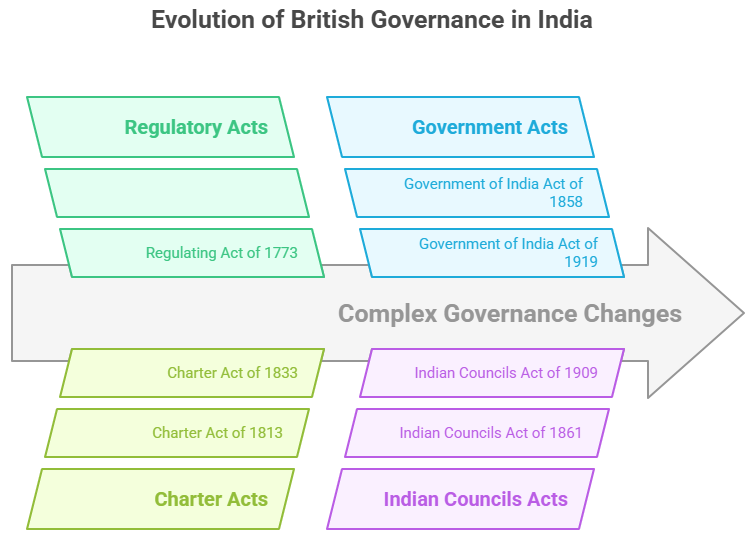
Regulating Act of 1773, Charter Act of 1833, Indian Councils Act of 1861, Government of India Act of 1919, Government of India Act of 1935 etc. |
|
Constituent Assembly |
Formation: December 9, 1946 Duration: From December 1946 to November 1949 Adoption of Constitution: November 26, 1949 |
|
Amendments |
Provide flexibility, address deficiencies, reflect social change, enhance democracy, protect fundamental rights, meet international obligations, and ensure constitutional stability. |
|
Basic Structure Doctrine |
Originated: Kesavananda Bharati v. State of Kerala case in 1973. |
|
Current Role |
The Constitution has been amended to address evolving needs, but its core principles remain intact. |
Evolution of the Indian Constitution
British colonial rule in India shaped the bedrock of the Indian Constitution:
- Regulating Act of 1773: Changed the post of Governor of Bengal to “Governor-General of Bengal” and Supreme Court at Calcutta. Prohibited private trade and bribery by Company servants. Strengthened British Government control over the Company.
- Pitt's India Act of 1784: Introduced double government system: Court of Directors for commercial affairs, Board of Control for political affairs. Designated Company's Indian territories as "British possessions in India. "Enhanced political control of British Government over the Company.
- Charter Act of 1813: Abolished trade monopoly of East India Company, except for tea and China trade. Allowed Christian missionaries for spreading Western education. Strengthened British Government's regulation and oversight of the Company.
- Charter Act of 1833: Replaced the Governor-General of Bengal with the Governor-General of India. Changed laws made under previous acts from "Regulations" to "Acts. "Ended the commercial activities of the East India Company, making it purely an administrative body.
- Charter Act of 1853: Separated legislative and executive functions of the Governor-General's council. Established the Indian (Central) Legislative Council, functioning as a mini-Parliament. Introduced the spirit of open competition for civil services.
- Government of India Act of 1858: Transferred the governance of India from the East India Company to the British Crown. Introduced the office of the Viceroy of India, replacing the Governor-General. Established the Secretary of State for India as a member of the British Cabinet.
- Indian Councils Act of 1861: Introduced representative institutions by including Indians in the law-making process. Restored legislative powers to the Bombay and Madras presidencies. Recognized the portfolio system and empowered the Viceroy to issue ordinances.
- Indian Councils Act of 1892: Increased the number of non-official members in central and provincial legislative councils. Expanded the functions of legislative councils, including budget discussions and questioning the executive. Promoted greater Indian participation in the legislative process.
- Indian Councils Act of 1909 (Morley-Minto Reforms): Enlarged the size of legislative councils, both central and provincial. Introduced separate electorates, legalizing communal representation. Allowed Indians to join the executive councils of the Viceroy and Governors.
- Government of India Act of 1919 (Montagu-Chelmsford Reforms): Introduced diarchy, dividing subjects into transferred and reserved categories. Established bicameral legislatures with direct elections. Extended separate electorates for Sikhs, Christians, Anglo-Indians, and Europeans.
- Government of India Act of 1935:Proposed an All-India Federation (not implemented) and introduced provincial autonomy. Divided subjects into federal, provincial, and residuary lists. Extended separate electorates for depressed classes, women, and labourers.
- Indian Independence Act of 1947: It declared India as an independent and sovereign state, effective from August 15, 1947. The act facilitated the partition of India, resulting in the creation of two dominions: India and Pakistan. Additionally, it empowered the Constituent Assemblies to draft and adopt a constitution, and to repeal any law or act, including the Independence Act itself.
Constituent Assembly
- Vision, ideals, and philosophy of constituent assembly of India -The Indian Constitution is founded on the principles of creating a fair and equal society that respects individual freedom.
- Enactment and enforcement of the constitution by the assembly: Dr. B.R. Ambedkar presented a motion on November 26, 1949, marking the significant day when the Indian people, through the Constituent Assembly, adopted, enacted, and bestowed upon themselves the Constitution of India.
- January 26, 1950, was selected as the official "date of commencement" for the Constitution.
Critics have raised several concerns about the Constituent Assembly, highlighting the following issues:
- Lack of Representation: The members of the Constituent Assembly were not directly elected through universal adult franchise.
- Lack of Sovereignty: The assembly was formed based on British Government proposals and conducted its sessions with their permission, undermining its independence and sovereignty.
- Domination by Congress Members: The Constituent Assembly was dominated by the Indian National Congress, raising concerns about political diversity and exclusion.
- Influence of Lawyers and Politicians: The dominance of lawyers and politicians in the Constituent Assembly resulted in a lengthy and technical Constitution, potentially making it less accessible to the public.
|
Samvidhan Divas: Celebrating India's Constitution Samvidhan Divas, observed on 26th November annually, honors the adoption of the Constitution of India, representing the nation's dedication to its fundamental principles and values. |
Features of the Indian Constitution
The Indian Constitution is not merely a rulebook for governing the nation, but a visionary blueprint that sought to uphold the ideals of dignity and Swaraj (self-rule) that emerged during the Indian national movement.
Salient features of the Indian Constitution
The Indian Constitution is a remarkable blend of various constitutional frameworks from over 60 countries.
- Blend of Rigidity and Flexibility, Synthesis of Parliamentary Sovereignty and Judicial Supremacy, Quasi-Federal System with Unitary Bias, Fundamental Rights, Directive Principles, and Fundamental Duties, Universal Adult Franchise, Single Citizenship, Emergency Provisions, Independent Judiciary and Constitutional Bodies, Three-Tier Government, Indian Model of Secularism.
Sources of Indian Constitution
Convention, judicial interpretation, and the written portion of the composition from a variety of sources mainly from the Government of India Act, 1935.
|
Countries |
Features taken |
|
Ireland |
Directive Principles of State Policy, Ability Representation in the Rajya Sabha, and the process for electing the Indian President |
|
USA |
Fundamental Rights |
|
UK |
Parliamentary system of Government |
|
Germany |
Emergency provision |
|
South Africa |
Two-thirds majority amendment procedure in Parliament and election of Rajya Sabha members |
Conclusion
The Constituent Assembly drafted the Constitution for Independent India, creating a legal framework and India-specific systems that granted dignity to millions of people. We can conclude that even though indirectly elected, the Constituent Assembly was representative in the sense that it consisted of the people from all sections of the Indian society. Although with some limitations, constituent assembly drafted a comprehensive constitution.
2. Preamble of Indian Constitution: Values, Features & Importance
Preamble of the Constitution of India is an introductory statement that lays out the fundamental principles and goals of the Constitution. It reflects the aspirations and values of the Indian people and provides a guiding framework for interpreting and implementing the Constitution.
Important Aspects of the Preamble
Sovereign: Sovereignty refers to the independent authority of a state, free from external control. It includes internal sovereignty (lawmaking) and external sovereignty (territory).
- Example: Amid China's military expansion, PM Modi reaffirmed India's commitment to protect sovereignty and promote peaceful resolution of maritime disputes based on international law.
Socialist: Inserted by 42nd Amendment Act in 1976, the term "Socialist" made explicit the implicit ideals of socialism already present in the Constitution.
- Indian socialism advocates a mixed economy with coexistence of public and private sectors.
- Example: Providing all people food security, universal access to education, health and housing. To provide them, government has implemented various initiatives such as MGNREGA, Ayushman Bharat Yojana etc.
- In the case of D.S. Nakara v. Union of India (1983), the Supreme Court held that the primary objective of a socialist state is to eradicate inequality in income, status, and the standard of living.
- Regarding the inclusion of 'socialist,' Dr B.R. Ambedkar argued in Constituent Assembly debates that it goes against the essence of democracy to decide within the Constitution the type of society in which the people of India should live.
Secular: In India, a secular state implies equal protection of all religions by the State. It was incorporated into the Constitution through the 42nd Amendment Act in 1976.
- Fundamental Rights (Articles 14, 15, 16, 25, 26, 27, 28, 29, and 30) safeguard individual and collective religious rights.
- The Directive Principles of State Policy include Article 44, which promotes the concept of a Uniform Civil Code.
- Example: India has no state religion.
- Dr B.R. Ambedkar reasoned in Constituent Assembly debates that the term 'secular' was unnecessary in the Preamble because the entire Constitution embodied the concept of a secular state.
|
Democratic:
|
Republic:
|
|
Justice:
|
Liberty:
|
Equality:
|
Fraternity:
- Fraternity means a sense of common brotherhood of all Indians — if Indians being one people.
- It is the principle which gives unity and solidarity to social life.
- Example: In ‘AIIMS Students’ Union V. AIIMS’, the court observed that the Preamble to the Constitution of India secures as one of its objects “fraternities” assuring the dignity of the individual and the unity and integrity of the nation to “we the people of India”.
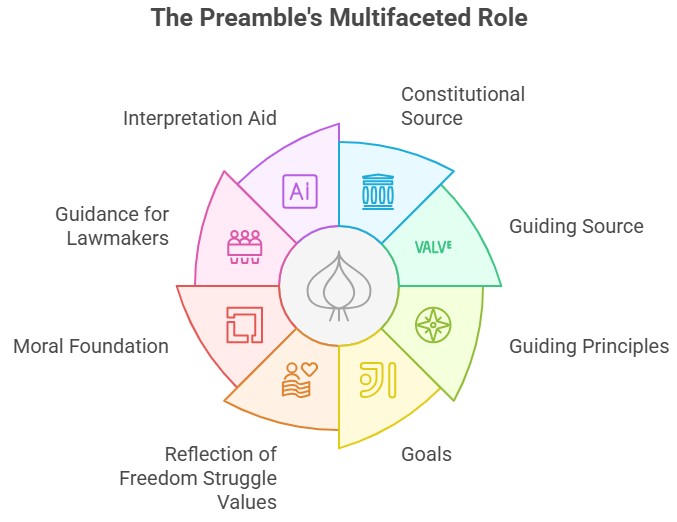
Importance of the Preamble
- Constitutional Source: It represents the origin of the Constitution, reflecting the authority of the Indian people.
- Guiding Source: It embodies the fundamental values and aspirations of the Constitution's creators, serving as a guiding philosophy.
- Guiding Principles: It serves as a compass, providing guiding principles for the Constitution and influencing the formulation of Fundamental Rights and Directive Principles of State Policy.
- Goals: The Preamble declares the objective of establishing India as a Sovereign Democratic Republic, committed to achieving justice, liberty, equality, and fraternity for all its citizens.
- Reflection of Freedom Struggle Values: It serves as a reminder of the values that guided the freedom struggle and their relevance to the present generation.
- Represents Moral Foundation of Free India: It signifies India's intent for humanitarian values rather than materialistic achievements.
- Guidance for Lawmakers: It acts as a constant reminder for lawmakers and policymakers while formulating legislation and public policies.
- Interpretation Aid: It helps interpret ambiguous language in Articles of the Constitution.
Whether Preamble can be amended?
- Berubari Union Case (1960): The Supreme Court (SC) ruled that the Preamble cannot be considered as a part of the Constitution and therefore cannot be amended.
- Kesavananda Bharati Case (1973):SC clarified that the Preamble is indeed a part of the Constitution and can be amended, as long as it does not violate the basic structure of the Constitution.
- Union Government Vs LIC of India Case (1995): SC reaffirmed that the Preamble is an integral part of the Constitution, but its provisions are not directly enforceable in court.
- Private member Bill in 2021: Former Minister KJ Alphons introduced a bill in Rajya Sabha to amend the Indian Constitution's preamble, seeking to replace "socialist" with "equitable" and make other changes.
- The bill aims to promote a more inclusive and fair society.
Amendments Made to the Preamble
- 42nd Amendment Act (1976): The Preamble was amended only once to include the terms Socialist, Secular, and Integrity.
- Plea Filed to Remove 'Socialist' and 'Secular' from Indian Constitution's Preamble:
- Allegations in the Plea: It is argued to violate the principles of freedom of speech and expression (Article 19(1)(a)) and the right to freedom of religion (Article 25).
- The plea suggests that the concept of 'Dharma' is distinct from the notion of religion in India and that the socialist and secular terms are not in harmony with India's religious sentiments and socio-economic conditions.
Conclusion
- The Preamble of the Indian Constitution, as a guiding light, reflects the core values and aspirations of the people. The initiative by the Karnataka government to teach the preamble to students emphasizes the importance of understanding and embracing the principles that shape the nation's identity.
3. Fundamental Rights in Indian Constitution Articles 12 to 35
Fundamental Rights are defined in Part III of the Constitution and are guaranteed to all persons without any discrimination.
- Six Fundamental Rights given in the constitution
Importance of Fundamental Rights in Democracy
- Promotes democratic value
- It protects the liberties and freedom of the citizens against any invasion by the state.
- Individual development: Essential for the all-round development (material, intellectual, moral and spiritual) of the individuals and the country.
- Prevents: Establishment of the authoritarian and dictatorial rule in the country.
- Limits tyranny: It acts as a limitation on the tyranny of the executive and arbitrary laws of the legislature.
- Rule of Law: They aim at establishing ‘a government of laws and not of men’.
Key Features of Fundamental Rights
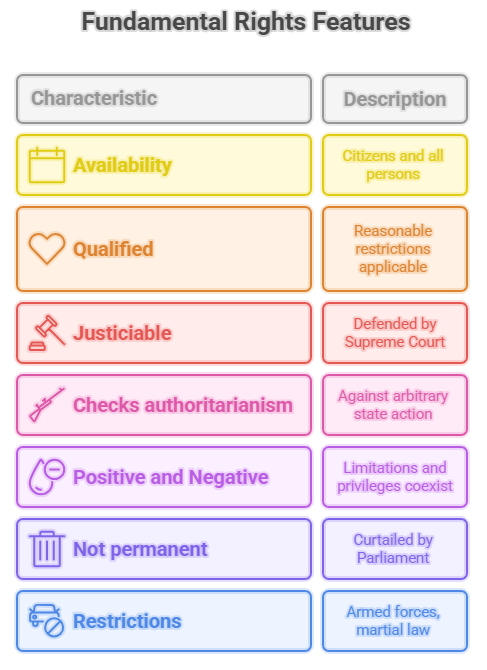
- Availability: Some of the FRs are available only to the citizens (Article 15, 16, 19, 29, 30) while others are available to all persons whether citizens, foreigners or legal persons like corporations or companies.
- Not absolute but qualified: Reasonable restrictions can be imposed by the state based on reasonableness as they are not absolute but qualified.
- Justiciable in nature: They are defended and guaranteed by the Supreme Court.
- Checks authoritarianism: Most of them are available against the arbitrary action of the State, with a few exceptions like of private individuals.
- Positive and Negative in nature: Some of them are negative in character, i.e., place limitations on the authority of the State, while others are positive in nature, conferring certain privileges on the persons.
- Neither sacrosanct nor permanent: They can be curtailed or repealed by Parliament without affecting the ‘basic structure’ of the Constitution or can be suspended during national emergency.
- Restrictions: Their application can be restricted:
- To the members of armed forces, para-military forces, police forces, intelligence agencies and analogous services can be restricted or abrogated by the Parliament (Article 33).
- While martial law is in force in any area (Article 34)
Fundamental Rights in India
All Fundamental Rights from Articles 12 to 35 are discussed below;
|
S.No. |
Fundamental Right |
Articles |
Key Features |
|
1 |
Right to Equality |
Articles 14–18 |
Equality before law, prohibition of discrimination, equality of opportunity |
|
2 |
Right to Freedom |
Articles 19–22 |
Freedom of speech, expression, assembly, association, movement, residence |
|
3 |
Right against Exploitation |
Articles 23–24 |
Prohibition of human trafficking and child labor |
|
4 |
Right to Freedom of Religion |
Articles 25–28 |
Freedom of conscience and right to practice and propagate religion |
|
5 |
Cultural and Educational Rights |
Articles 29–30 |
Protection of culture, language, and rights of minorities |
|
6 |
Right to Constitutional Remedies |
Article 32 |
Right to move the Supreme Court for enforcement of Fundamental Rights |
|
7 |
Definition of the State and Application |
Articles 12–13 |
Defines ‘State’ and ensures laws inconsistent with Fundamental Rights are void |
|
8 |
Saving of Laws under certain conditions |
Articles 33–35 |
Parliament’s power to modify Fundamental Rights for armed forces or public order |
Article 12: It defines the term ‘state’ for the purposes of Part III.
- Article 12 and applicability on United Nation (UN): The Delhi High Court has ruled earlier that the UN is not a State under Article 12 and hence cannot be brought under the jurisdiction.
- Article 12 and PM CARES fund: The Centre recently informed the Delhi High Court in a plea seeking to declare the fund a ‘state’ under Article 12 that:
- PM CARES Fund is set up as a public charitable trust and is not created under the Constitution or any law made by the Parliament or the state.
|
Judiciary under Article 12
Related cases:
|
Article 13: It declares that any law that is inconsistent with or in derogation of any of the fundamental rights shall be void. Thus, it expressively provides for the doctrine of judicial review.
- The power of Judicial Review: Supreme Court (Article 32) and the High Courts (Article 226).
- Personal laws and Article 13: The judiciary in various decisions had avoided to take decisions on personal matters as these are related to religion and are sensitive issues.
- Nevertheless, there have been instances where courts have had set aside the personal laws, e.g., triple talak in India,
Right to Equality (Articles 14–18) under Fundamental Rights
Article 14 (Equality before law)
- The State shall not deny to any person Equality before Law or Equal Protection of Law within the territory of India.
- Article 14 forbids class legislation but permits reasonable classification of persons, objects and transactions by the law. But the classification should not be arbitrary, artificial or evasive. Ex: Women & children, socially and economically backward classes, SC and ST etc.
- The Citizenship (Amendment) Act and Article 14: S. R. Bommai Case (1994)- The Supreme Court held that no law can be enacted by the Parliament or by a state legislature on the basis of religion.
- NHAI case (2021): The SC held that every action of the state must be fair, failing which, it will fall foul of the fundamental right to equality enshrined in Article 14 of the Constitution.
- The Supreme Court has held that every action of the state must be fair, failing which it will fall foul of the fundamental right to equality enshrined in Article 14 of the Constitution.
Article 15 (Prohibition of discrimination on certain grounds)
It has two provisions:
- The State shall not discriminate against any citizen on grounds only of religion, race, caste, sex, place of birth or any of them.
- No citizen shall be subject to any disability, liability, restriction or condition on grounds only of religion, race, caste, sex, place of birth or any of them:
Reservation policy in India
- Current reservation status in India: SC (15%), ST (7.5%), OBC (27%), PwD (3%) and EWS (10%).
- Indra Sawhney Case (1992): Upheld 27% quota in government jobs for backward classes with elimination of Creamy Layer, is constitutionally valid.
- The total reservation shall not exceed 50% of seats and they shall only confine to initial appointments and not to promotions.
- M. Nagaraj Case (2006): Validated reservations for SCs and STs to include promotions with three conditions for stats:
- To provide proof for the backwardness of the class benefitting from the reservation.
- To collect quantifiable data showing inadequacy of representation of that class in public employment.
- To show how reservations in promotions would further administrative efficiency.
- Jarnail Singh Case (2018): SC held that the government need not collect quantifiable data to demonstrate backwardness of SC/STs to provide reservations for them in promotions.
|
Exceptions to Article 15: Special provision for women and children, for the advancement of any socially and educationally backward classes of citizens or SCs & STs. |
- Supreme court on 103rd AA (EWS): In a 3-2 majority, the SC upheld the 103rd CAA providing EWS reservation. With this, the Court extended the net of reservation benefits to include solely economic backwardness.
- Reservation to OBCs in the local bodies (Triple Test): Allahabad High Court ordered the UP government to hold urban local body elections without reservation for Other Backward Classes (OBCs) because the ‘triple test’ requirement for the quota had not been fulfilled.
- The triple test (outlined in Vikas Kishanrao Gawali vs. State of Maharashtra and others, 2021) requires the government to complete three tasks. These include:
- To set up a dedicated commission to conduct a rigorous empirical inquiry into the nature and implications of the backwardness in local bodies,
- To specify the proportion of reservation required in local bodies in light of recommendations of the commission, so as not to fall foul of overbreadth,
- To ensure reservation for SCs/STs/OBCs taken together does not exceed an aggregate of 50% of the total seats.
Way Forward for Reservations in India
Revisiting Reservation: A Step Towards Transformative Constitutionalism:
- Justice Bela M. Trivedi, in the majority judgment of EWS quota, highlights the importance of setting a time span for the reservation policy.
- After 75 years of Independence, she suggests a reevaluation of the system in the larger interest of society, as a progressive move towards transformative constitutionalism.
Article 16 (Equality of opportunity in matters of public employment)
- No citizen can be discriminated against or be ineligible for any employment or office under the State on grounds of only religion, race, caste, sex, descent, place of birth or residence.
- Exception: Parliament can prescribe residence as a condition for certain employment or appointment in a state or union territory or local authority or other authority.
- Demand for local reservation: Various states have passed a law mandating reservation of jobs in the private sector for locals of that states. E.g., Andhra Pradesh, Haryana etc.
Way Forward
- Protecting Workplace Diversity: The Centre should discourage such legislation that jeopardizes workplace diversity.
- Preserving Social Fabric: Imposing insularity through such law’s risks immobilizing the talented young workforce and disrupting the social fabric.
- Preventing Unstoppable Consequences: Urgent central intervention is necessary to prevent a downward spiral that could have far-reaching and irreversible consequences.
|
Declining Investment Appeal and Local Reservation Issue in Haryana Investment Share:
Rise of Anti-Migrant Legislation in India:
|
Article 17: Abolition of Untouchability
- It abolishes ‘untouchability’ and forbids its practice in any form. The enforcement of any disability arising out of “uuntouchability” shall be an offence punishable in accordance with law.
- Protection of Civil Rights Act, 1955: It enlarged the scope and made penal provisions more stringent given under the uuntouchability (Offences) Act, 1955.
- Scheduled Castes and Tribes (Prevention of Atrocities) Act, 1989: For prevention of atrocities on SCs and STs and practice of untouchability by increased surveillance.
- Maharashtra's law against social boycott: The new law disallows social boycott in the name of caste, community, religion, rituals or customs.
|
Case |
Key Points |
|
Subhash Kashinath Mahajan Case (2018) |
Supreme Court banned immediate arrest for insulting or injuring SC/ST members Allowed anticipatory bail for those booked for committing atrocities against SC/ST |
|
SC and ST (Prevention of Atrocities) Act, 2018 |
|
|
Prithvi Raj Chouhan Case (2020) |
|
Way Forward: To achieve Article 17's vision of eradicating untouchability and caste discrimination:
- Promote awareness and education????Strengthen legal framework????Empower marginalized communities????Encourage social integration????Combat prejudice and stereotypes????Support grassroots movements????Sensitize government machinery????Strengthen monitoring and reporting????Foster social solidarity????Embrace inclusive policies.
Article 18: Abolition of Titles
- It abolishes titles and provides certain conditions including:
- It prohibits the state from conferring any title on any citizen or a foreigner (except a military or academic distinction).
- It prohibits a citizen of India from accepting any title from any foreign state.
- A foreigner holding any office of profit or trust under the state cannot accept any title from any foreign state without the consent of the President of India.
- No citizen or foreigner holding any office of profit or trust within the territory of India can accept any present, emolument or office from or under any foreign State without the consent of the president.
Right to Freedom (Articles 19–22) as Fundamental Rights
Article 19 (Protection of certain rights regarding freedom of speech, etc.)
Article 19: Fundamental freedoms in Indian Constitution
- Freedom of speech and expression????Freedom of assembly????Freedom of association????Freedom of movement????Freedom of residence and settlement????Freedom of profession, occupation, trade, or business.
Restrictions apply in the interest of sovereignty, public order, morality, or India's integrity.
|
Freedom of Movement: It has two dimensions Internal movement (right to move inside the country) – Protected by Article 19.External movement (right to move out of the country and right to come back to the country) – Protected under Article 21. |
- Expansion of scope of Article 19: The SC recently in a 4-1 majority ruling said that “a fundamental right under Article 19/21 can be enforced even against persons other than the State or its instrumentalities”.
- Significance: The court, extending free speech against private citizens, opens up a range of possibilities in Constitutional law.
- It extended the ground for seeking these rights against other citizens.
- This interpretation could also bring an obligation on the state to ensure private entities also abide by Constitutional norms.
- These questions could hypothetically range from seeking enforcement of privacy rights against a private doctor to seeking the right to free speech against a private social media entity.
Sedition Law
- Section 124A: Section 124A of the Indian Penal Code penalizes a crime against the state.
- It defines the crime as bringing “into hatred or contempt, or excites or attempts to excite disaffection towards the government established by law in India.”
- Kedar Nath Singh Case (1962): Supreme court upheld the constitutional validity of sedition law, but restricted its scope for misuse and held that criticism of the government cannot be labelled sedition unless accompanied by violence.
- 22nd Law Commission in its 279th report has recommended that the provision of sedition (Section 124A) be retained with procedural safeguards and enhanced jail term. It broadly recommended three things:
- Widening the scope of sedition;
- Adding a higher quantum of punishment, and
- Incorporating ‘procedsural safeguards’ to prevent misuse.
Reasons to retain the Sedition Law
- To safeguard the unity and integrity of India: India’s internal security, including Maoist extremism, militancy and ethnic conflict necessitate retaining the law on sedition.
- Realities differ in every jurisdiction: Courts of competitive jurisdictions, like the US, the UK, etc. have made mere cosmetic changes have been affected in the law of sedition, without taking away the core substance of the offence.
- Existence of counter-terror legislations: The existence of anti-terror legislations does not by “implication cover all elements of the offence and envisaged under Section 124A of IPC.
- Sedition being a colonial legacy: Merely ascribing the term ‘colonial’ to a law or institution does not by itself, ascribe it to an idea of anachronism.
Criticism of the Law: On ground of curtailing freedom of speech, colonial legacy, downgrading democracy, misuse.
|
Shreya Singhal Case (2015): The Supreme Court struck down Section 66A and held that the Section was not saved by virtue of being a 'reasonable restriction' on the freedom of speech under Article 19(2).
|
Supreme Court Upholds Free Speech Rights of Ministers:
- On January 3, 2023, the Supreme Court ruled that "additional restrictions" should not be imposed on the right to free speech of Ministers.
- The Court also stated that the government cannot be held vicariously liable for disparaging remarks made by Ministers, even if those comments are related to state affairs or intended to protect the government.
Way Forward: An effective legal framework against hate speech is what is needed more than one to penalise speech or writing that targets the government.
Article 20 (Protection in respect of conviction for offences)
- It grants protection against arbitrary and excessive punishment to an accused person, whether citizen or foreigner or legal person like a company or a corporation. It contains following provisions.
- It has provided for: No ex-post-facto law, No double jeopardy & No self-incrimination.
- The SC recently refused to hear a plea by Delhi Deputy Chief Minister seeking bail in the excise policy case approaching it directly under Article 32 of the Constitution when the remedy of moving the High Court under Section 482 of the CrPC was available to him.
- The court had rejected the arguments that he had a right against self-incrimination.
|
Cases related to self-incrimination:
|
Article 21 (Protection of life and personal liberty)
- No person shall be deprived of his life or personal liberty except according to procedure established by law.
|
Important Judgements Related to the Right to life
|
Capital Punishment and Right to life
- Bachan Singh v State of Punjab (1980): Upheld the constitutionality of capital punishment on the condition that the punishment will be awarded in the “rarest of the rare” cases which was reiterated in Mithu v State of Punjab (1982) ruling.
- Machhi Singh And Others vs State of Punjab (1983): Introduced “collective conscience” into the capital sentencing framework and laid down five categories, wherein the community would “expect the holders of judicial power to impose death sentence, because collective conscience was sufficiently outraged”.
- Recently SC gave two new opinions on capital punishment:
- Need of adequate sentencing hearing: The catena of judgments on sentencing hearings talks about a “meaningful, real and effective hearing” for the accused before awarding the death sentence, wherein the accused can have an “opportunity to adduce material relevant for the question of sentencing.”
- Methods of hanging: Hanging by the neck to execute the death sentence can be declared unconstitutional if there is scientific material favoring a different method of execution as less painful and “more consistent with human dignity”.
- Former Chief Justice of India’s Bold Initiatives in Death Penalty Law:
- Chief Justice U.U. Lalit has taken significant steps to address anomalies in the operation of the death penalty law.
- Through creative directions and guidelines, he has shown sensitivity towards death-row prisoners and worked towards corrections.
- This approach has continued under his leadership, as seen in the Prakash Vishwanath and Mohd. Firoz cases.
Right to Privacy versus right to be forgotten
- Meaning: It, essentially, means that a person has the right to get their personal information removed from public resources if they wish so.
- Delhi High Court in Jorawer Singh Mundy v Union of India: Recognized that a person's personal and professional life can be hampered if appropriate relief is not granted against publication or republication of data. It also directed to remove the judgements of acquittal and google was asked to block the content from coming up in a search.
- Right to be forgotten and Indian Laws: There is no formal legislation in India yet that scrutinizes the need for the Right to be Forgotten. However, the judicial precedent leads towards acceptance of the right.
- The new Personal Data Protection Bill attempts to provide the citizens with more autonomy over their data and encapsulates the theory behind the EU's General Data Protection Regulation.
- Srikrishna Committee’s report: Included the concept of Right to forgotten under the Personal Data Protection Bill, 2019, with following features: the right to restrict or prevent the continuing disclosure.
- Global Practice: Right to be forgotten has been codified under the European Union’s General Data Protection Regulation (GDPR) in addition to the right to erasure.
Environment and Article 21: Article 21 guarantees fundamental right to life. Right to healthy environment is important attribute of right to live with human dignity.
- The right to live in a healthy environment as part of Article 21 of the Constitution was first recognized in the case of Rural Litigation and Entitlement Kendra vs. State, 1988 (Popularly known as Dehradun Quarrying Case).
- M.C. Mehta v. Kamal Nath: Any disruption of the basic environment elements of air, water, and soil, which are necessary for life, would be a threat to life under Article 21.
- Subhash Kumar v. State of Bihar (1991): Held that Article 21 includes the right to a wholesome environment.
- Virender Gaur v. State of Haryana (1994): It was held that enjoyment of life and right to live with dignity includes the protection and preservation of the environment and without it, life could not be enjoyed.
- Precautionary Principle: It states that the government must anticipate, prevent, and combat environmental deterioration.

- The SC recognized the Precautionary Principle as an important component of sustainable development and derived its application from Articles 21, 48A, and 51A(g) of the Constitution.
- Philosophy of biocentrism: It holds that the natural environment has its own set of rights which is independent of its ability to be exploited by or to be useful to humans.
- Biocentrism often comes into conflict with its contrarian philosophy, namely anthropocentrism.
- Public Trust Doctrine (PTD): It is a doctrine that governs the management of natural resources and the environment and has root in Roman law.
- It acts as a public property doctrine by limiting the government’s actions over public property.
- According to this doctrine, the public is treated as the beneficiaries while the government is their trustee.
- SC recently upheld the doctrine and said: The State was only a trustee holding the wealth safe for its ultimate beneficiary, the public. The principle of sustainable development remains a vital check on unbridled expansion.
Right to shelter: Delhi HC said “Homeless does not live but merely exist and life as envisaged by Article 21 of the Constitution is unknown to them”.
- Slum-dwellers do not stay in slums out of choice. Their choice of residence is the last-ditch effort at securing, for themselves, what the Constitution regards as an inalienable adjunct to the right to life under Article 21, viz. the right to shelter and a roof over their heads. As to whether the roof provides any shelter at all is, of course, another matter altogether,”.
Right to Health: Rajasthan Government recently passed the “Right to Health Bill”, which gives every resident of the state the right to avail free services at all public health facilities.
- The Right to Health is in sync with the constitutional guarantee of right to life under Article 21, and other components of the Directive Principles.
- A constitutional ‘Right to Health’ at the national level will transform not only the health and well-being of our people but will act as a leap for the economic and developmental progress of the nation.
- In 2021, Villupuram Member of Parliament urged the Centre to introduce a Bill in Parliament to amend Article 21 of the Constitution and make healthcare as a fundamental right for all citizens.
Article 22 (Protection against arrest and detention in certain cases)
- Article 22 has two parts: First is when a person who is arrested or detained under an ordinary law and second when a person is arrested or detained under a preventive detention law.
- Preventive detention: Cannot exceed three months unless an advisory board reports sufficient cause for extended detention.
- No democratic country in the world has made preventive detention as an integral part of the Constitution.
Supreme Court Limits Preventive Detention:
- In 2022, the Supreme Court restricts the use of preventive detention to exceptional circumstances, cautioning against its misuse in ordinary law and order situations.
Right Against Exploitation (Articles 23–24) under Fundamental Rights
Article 23 (Prohibition of traffic in human beings and forced labour)
- It prohibits traffic in human beings, beggar (forced labour) and other similar forms of forced labour.
- Exception: It permits the State to impose compulsory service for public purposes, as for example, military service or social service, for which it is not bound to pay.
- PUDR vs. Union of India: The Court held that the right against forced labour included the right to a minimum wage.
- The compulsion of economic circumstance which leaves no choice of alternatives to a person in want and compels a person to provide labour or service is no less a form of forced labour than any other, and its remedy lay in a constitutional guarantee of the minimum wage.
Article 24 (Prohibition of employment of children in factories, etc.)
- It prohibits the employment of children below the age of 14 years in any factory, mine or other hazardous activities like construction work or railway. But it does not prohibit their employment in any harmless or innocent work.
- Steps taken to prohibit Child Labour in India:
- Child Labour (Prohibition and Regulation) Act, 1986
- Commissions for Protection of Child Rights Act, 2005 was enacted to provide for the establishment of a National Commission and State Commissions for Protection of Child Rights and Children’s Courts
- The Child Labour (Prohibition and Regulation) Amendment Act, 2016, amended the 1986 Act and renamed the Principal Act as the Child and Adolescent Labour (Prohibition and Regulation) Act, 1986.
- Child Labour Amendment Act, 2016: Prohibits the employment of children below 14 years in all occupations and processes and also prohibits the employment of adolescents (14-18 years) in certain hazardous occupations and processes.
Right to Freedom of Religion (Articles 25–28) under Fundamental Rights
Article 25 (Freedom of conscience and free profession, practice and propagation of religion)
Religious conversion: Article 25 does not include a right to convert another person to one’s own religion. Forcible conversions impinge on the ‘freedom of conscience’ guaranteed to all the persons alike.
- Supreme court on forced conversion: If such religious conversions are not stopped, they may pose a danger to the national security and the fundamental right of the citizens to freedom of religion and conscience.
- The Court observed in this connection that there may be freedom of religion, but there cannot be freedom of religion by forced conversion.
- States enacted anti-conversion law in India: Arunachal Pradesh, Orissa, Madhya Pradesh, Chhattisgarh, Gujarat, Himachal Pradesh, Jharkhand, and Uttarakhand.
- Intentions Behind Charitable Acts: Recently, a Bench led by Justice M.R. Shah said ??acts of charity or good work to help a community or the poor should not cloak an intention to religiously convert them as payback.
Issue of Hijab in Karnataka: Karnataka HC upheld the state government's ban on hijab in educational institutes and said that it is not essential religious practice in Islamic law and said that uniform is a reasonable restriction constitutionally permissible which the students cannot object to.
- Reason to disallow hijab in school: To prevent two categories of students and to prevent discrimination which can crystallise in the minds of young people.
- Doctrine of essential religious practices: Provided in the Shirur Mutt case (1954) that the term “religion” will cover all rituals and practices “integral” to a religion and test to determine what is integral is termed the “essential religious practices” test. What constitutes the essential part of a religion is to be determined with reference to the doctrines of that religion itself.
- Arguments against: Muslim students had argued that the ban on the hijab violated their Right to Freedom of Conscience under Article 25 of the Constitution of India, 1950.
- Citing Bijoe Emmanuel v State of Kerala, 1986, Muslim students argued that since wearing the hijab is a part of their conscientious belief, it must be protected.
Way Forward: "Promoting Religious Freedom and Harmony in India"
- Strengthening Legal Protection, Ensuring Equality and Non-Discrimination, Monitoring and Addressing Violations, Judicial Review and Constitutional Interpretation
Article 26 (Freedom to manage religious affairs)
- Article 25 & Article 26: Article 25 guarantees rights of individuals, while Article 26 protects collective freedom of religion.
- Fathima Tasneem v State of Kerala (2018): Kerala HC held that collective rights of an institution would be given primacy over individual rights of the petitioner.
- Criticism: It is better for the court to prohibit religious practices for public order rather than determine what is so essential to a religion that it needs to be protected.
- The 22nd Law Commission of India sought the views of religious organisations and the public on the issue of a Uniform Civil Code (UCC).
Article 27 (Freedom as to payment of taxes for promotion of any particular religion)
- State of Gujarat v Islamic Relief Committee of Gujarat case
- Diverting tax proceeds for restoring religious shrines, even if destroyed due to the state's negligence, violates the principles of secularism.
- The court emphasized a conception of secularism based on the strict separation principle.
- Compensation can be sought only for violations of the right to life and not for other fundamental rights.
Article 28
- Freedom as to attendance at religious instruction or religious worship in certain educational institutions.
Cultural and Educational Rights (Articles 29–30) as Fundamental Rights
Article 29 (Protection of interests of minorities)
- The SC on Article 29: The right to conserve the language includes the right to agitate for the protection of the language. Hence, the political speeches or promises made for the conservation of the language of a section of the citizens does not amount to corrupt practice under the RPA, 1951.
- Identification of Minorities: The Supreme Court recently observed that it is "contrary to law" to identify religious and linguistic minority communities district-wise referring to the T. M. A Pai versus State of Karnataka case in 2002.
- In another observation, the SC said that “every person in India can be a minority in one State or the other.
- Minority status of religious and linguistic communities is “State-dependent”.
- Every person in this country can be a minority. One can be a minority outside his/her State. Similarly, a Kannada speaking person may be in minority in States other than Karnataka.
- Hindu as minority in states with minority population: The Supreme Court dismissed to recognise Hindus as minorities in the States where they are low in population.
- The Court observed that the States have been carved language-wise. But religion is beyond all borders, especially political borders. It has to be taken on a pan-India basis.
- Every person in India can be a minority in one State or the other. Minority status of religious and linguistic communities is “State-dependent”, the Supreme Court said in 2022.
Article 30 (Right of minorities to establish and administer educational institutions)
- The protection under Article 30 is confined only to minorities (religious or linguistic) and does not extend to any section of citizens (as under Article 29).
- SC Judgement on regulating minority institutions: The state is well within its rights to introduce a regulatory regime in the “national interest” to provide minority educational institutions with well-qualified teachers in order for them to “achieve excellence in education.”
Article 32: Remedies for enforcement of rights conferred by this Part
It confers the right to remedies for the enforcement of the fundamental rights of an aggrieved citizen. It means, the right to get the Fundamental Rights protected is in itself a fundamental right. This makes the fundamental rights real.
- The Supreme Court has ruled that Article 32 is a basic feature of the Constitution.
- During Emergency:<s
4. Directive Principles of State Policy (DPSP) in India: Importance, Amendments & Implementation
The Directive Principles of State Policy (DPSP) in India are derived from the Irish constitution and are a set of guiding principles for the government. The Directive Principles resemble the "Instrument of Instructions" in the Government of India Act, 1935.
- The purpose of DPSP is to establish a welfare state and promote economic and social democracy in the country. However, it's important to note that DPSPs are not legally enforceable by the courts if they are violated.
Amendments in DPSP in India
- 42nd Constitutional Amendment in 1976: Added directives in part IV, including Article 39A for free legal aid to the poor, Article 43A for worker participation in industrial management, and Article 48A for environmental protection.
- The 44th Amendment in 1978 inserted Section-2 in Article 38 for state efforts in minimizing economic inequalities and removed the Right to Property as a Fundamental Right.
- The 86th Amendment in 2002 modified Article 45 and made elementary education a fundamental right under Article 21A.
Judicial Evolution of DPSP in India vs Fundamental Rights
|
Case Name |
Year |
Outcome |
|
Champakam Dorairajan Case |
1951 |
SC held that the Directive Principles are not enforceable by court as per Article 37. Fundamental Rights have supremacy over Directive Principles. |
|
Golak Nath Case |
1967 |
SC declared that Fundamental Rights cannot be abridged or diluted in order to implement the Directive Principles. |
|
Kesavananda Bharati Case |
1973 |
SC ruled that the Parliament can amend any part of the Constitution, including Fundamental Rights, but cannot alter its basic structure. |
|
Minerva Mills Case |
1980 |
SC emphasized the harmony between Part III (Fundamental Rights) and Part IV (Directive Principles), considering them as two wheels of the chariot in establishing an egalitarian social order. |
Importance of DPSP in India
|
Key idea |
Importance |
|
Fundamental to governance |
Essential for country's governance (Art. 37). |
|
Idea of welfare state |
Introduces concept of welfare state. |
|
Guidance to legislatures |
Sets ideal for policy and law making. |
|
Reflection of Preamble |
Aims for social, economic, political justice. |
|
Four pillars of Indian Constitution |
Supports Justice, Liberty, Equality, Fraternity. |
Key Arguments Against DPSP in India
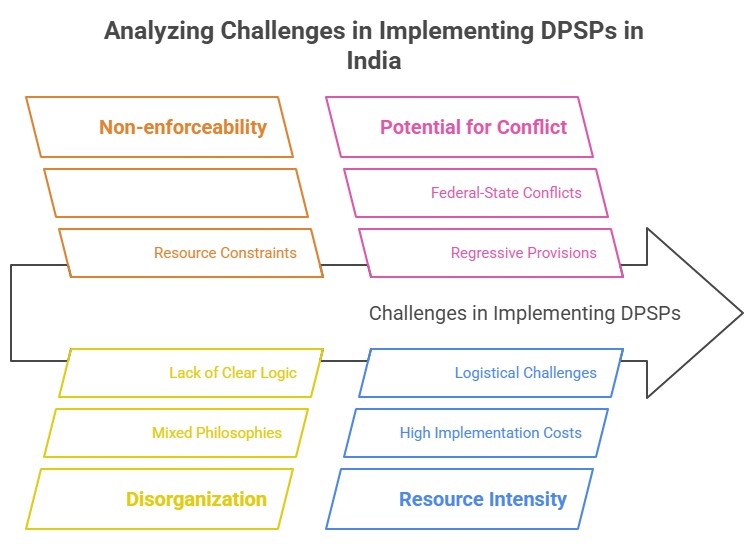
- Non-enforceable: Resource constraints and the potential for better laws make them non-enforceable.
- Disorganized: The arrangement mixes Gandhian, Socialist, and Liberal philosophies without clear logic.
- Potentially regressive: Some provisions can be reactionary or regressive, such as the Uniform Civil Code.
- Potential for conflict: They can cause constitutional conflicts between federal and state governments.
- Resource-intensive: Implementation of many DPSPs seem difficult due to very high cost associated
Schemes & Initiatives to Give Effect to DPSP in India
|
DPSP Article |
Program/Initiative |
|
Article 38 |
Mahatma Gandhi National Rural Employment Guarantee Act (MGNREGA), Pradhan Mantri Jan Dhan Yojana (PMJDY), MUDRA scheme |
|
Article 39A |
National Legal Services Authority (NALSA) to aid poor people |
|
Article 39 |
Pradhan Mantri Kaushal Vikas Yojana (PMKVY), Skill India, Deen Dayal Upadhyaya Grameen Kaushalya Yojana (DDU-GKY) |
|
Article 40 |
73rd and 74th Amendment, PM Adarsh Gram Yojna, Aspirational District Programs |
|
Article 41 |
Mid-Day Meal Scheme, National Rural Livelihood Mission (NRLM), Rights of Persons with Disabilities Act, 2016 |
|
Article 42 |
Maternity Benefit Act, Factories Act, Minimum Wages Act |
|
Article 43 |
Minimum Wages Act, Code on Wages, 2019 |
|
Article 44 |
Abolition of Triple Talaq, UCC in Goa |
|
Article 45 |
Sarva Shiksha Abhiyan |
|
Article 46 |
Reservation of SC, ST & OBCs, EWS |
|
Article 47 |
National Health Mission, Swachh Bharat Abhiyan, Poshan Abhiyaan, Prohibition on Alcohol in states like Bihar, Gujrat |
|
Article 48 |
Beef Ban across multiple states |
|
Article 49 |
Adopt a Heritage Scheme, National Museum, Indira Gandhi National Centre for the Arts |
|
Article 50 |
Striking down of NJAC by Supreme Court |
Recent Debates on DPSP in India – Uniform Civil Code
Uniform Civil Code: A Uniform Civil Code is one that would provide for one law for the entire country, applicable to all religious communities in their personal matters such as marriage, divorce, inheritance, adoption, etc.
Merits/Demerits and Challenges of Implementing UCC:
|
Merits |
Demerits |
Challenges |
|
Gender Equality |
Potential Erosion of Diversity |
Harmonizing Diverse Personal Laws |
|
National Integration |
Community Identity Concerns |
Addressing Cultural Sensitivities |
|
Simplification of Legal System |
Perceived Majoritarian Imposition |
Resistance from Religious Groups |
|
Reducing Gender-Based Discrimination |
Loss of Customary Laws |
Achieving Consensus among Stakeholders |
|
Streamlining Adoption and Marriage Laws |
Fear of Cultural Homogenization |
Balancing Gender Justice with Traditions |
|
Promoting Secularism |
May Create Initial Social Unrest |
Implementation and Enforcement |
|
Legal Clarity and Certainty |
Risk of Oversimplification |
Educating the Masses on New Laws |
|
Rationalization of Personal Laws and Protection of Individual Rights |
Possible Legal Loopholes |
Addressing Regional Differences and Consideration of Tribal Laws |
Key Recommendation of Law Commission (2018) on UCC

- Rejection of Uniform Civil Code (UCC): Law Commission deems UCC neither feasible nor desirable(By 21st Law commission).
- Recently, the 22nd Law Commission of India asked for ideas from public and religious bodies on Uniform Civil Code.
- Focus on Codification: Recommends codification of personal laws to expose prejudices and test them against constitutional fundamental rights. Equality Within Communities: Prioritizes achieving gender equality within religious communities before seeking equality across communities.
- Legal Status through Codification: Codifying customs and practices would classify them as ‘law’ under Article 13 of the Constitution.
- Alignment with Fundamental Rights: Laws under Article 13 must comply with fundamental rights, ensuring the protection of religious plurality.
Judicial Pronouncements Associated with UCC
|
Case Name |
Year |
Outcome and Remarks |
|
Shah Bano Case |
1985 |
|
|
Sarla Mudgal Case |
1995 |
|
|
Ahmedabad Women Action Group (AWAG) v. Union of India |
1997 |
|
|
Shabnam Hashmi v. Union of India |
2014 |
|
|
Shayara Bano v. Union of India (Triple Talaq Case) |
2017 |
|
Way Forward for UCC
- Inclusive Deliberative Process: Engage representatives from diverse backgrounds in a deliberative process to discuss UCC implementation, fostering dialogue and consensus.
- Consultation with Stakeholders: Seek inputs from religious leaders, women's rights activists, and marginalized communities to address concerns while formulating a UCC.
- Legislative Reforms: Initiate gradual legislative reforms to harmonize personal laws, respecting specific cultural and religious practices.
- Gender Equality and Women's Rights: Ensure a UCC promotes gender equality and safeguards women's rights, addressing discriminatory practices.
- Sensitivity and Flexibility: Develop a UCC framework sensitive to diverse practices, allowing for customary practices alongside provisions protecting individual rights and gender equality.
Other Key Issues with reference to DPSP in India
|
Topic |
Key Points |
|
Right To Health |
Recently, the Rajasthan Govt. announced a Right to Health bill, raising concerns about challenges of effective delivery of such right |
|
Affordable and Accessible Judicial System |
|
|
Free Legal Aid to People |
|
|
Environmental Protection (Article 48A) |
|
Way Forward for DPSP in India
- Legislative Reforms: Enact laws for effective implementation of Directive Principles.
- Policy Alignment: Align government policies with Directive Principles to address inequalities.
- Resource Allocation: Prioritize budgetary allocations for sectors related to Directive Principles.
- Inter-Departmental Coordination: Foster collaboration among government departments.
- Empower Marginalized Sections
- Establish mechanisms to monitor policy progress and outcomes.
- Judicial Interpretation: Encourage judiciary to interpret laws in line with Directive Principles.
- Political Will and Leadership: Demonstrate strong commitment to prioritize Directive Principles' implementation.
Balancing Fundamental Rights and Directive Principles for Social Order and Empowerment:
- Former Chief Justice of India P. Sathasivam said Fundamental Rights and the Directive Principles of State Policy needed to be balanced and harmonised if they were to reap social order and empower people.
Conclusion
- Effectively implementing the Directive Principles of State Policy (DPSP) in the Indian Constitution requires strong political will, streamlined governance, and active public participation. Engaging all stakeholders for transparency, promoting social justice, and ensuring sustainable development are key areas of focus to fulfil the vision of DPSPs.
5. Indian Citizenship: CAA 2019, NRC, NPR, OCI, and Constitutional Provisions
Citizenship encompasses the concept of being a full and equal member of a political community, with a shared political identity and entitlement to specific rights. It establishes an individual's affiliation with a particular country, like India, Japan, or Germany, representing the relationship between an individual and the state.
Important Points for Indian Citizenship
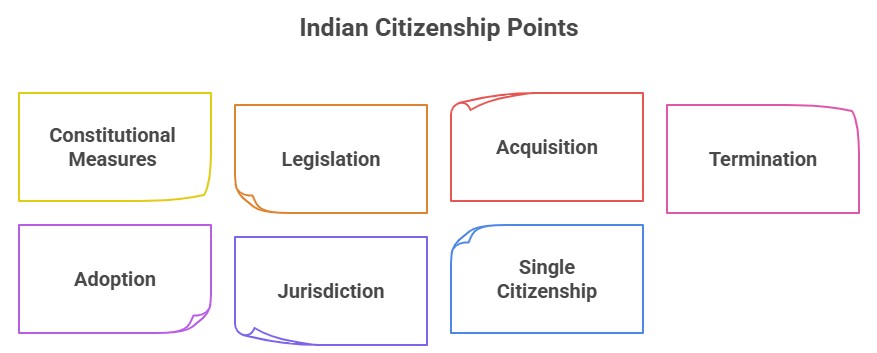
- Constitutional Measures: Articles 5-11 in Part II of Indian Constitution regulates the citizenship in India.
- Legislation: The Citizenship Act of 1955 is the legal framework governing the various aspects of citizenship.
- Acquisition of citizenship: Through various means such as birth, descent, registration, naturalization, and incorporation of territory.
- Termination and deprivation of citizenship: By renunciation, termination and deprivation.
- Adoption: It came into being on 26th November, 1949.
- Jurisdiction: Citizenship is a subject that falls under the exclusive jurisdiction of the Parliament.
- Single Citizenship for whole of India.
Citizenship Amendment Act 2019 (CAA 2019)
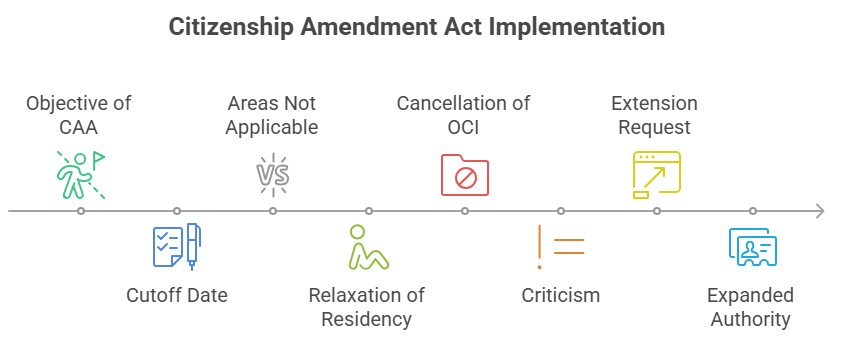
- Objective: To grant Indian citizenship to persecuted minorities of Hindus, Sikhs, Jains, Buddhists, Parsis and Christians from Pakistan, Bangladesh and Afghanistan.
- Cutoff date for citizenship: Who had come to India till December 31, 2014
- Not applicable: To areas under the Sixth Schedule and the Inner Line Permit.
- Relaxation of residency by naturalization: From 11 years to 5 years for applicants belonging to the specified religions and countries.
- The act also allows for the cancellation of registration of Overseas Citizens of India (OCIs) under certain grounds by the central government.
- Criticism: Critics argue that this act runs afoul of Article 14 of the Indian Constitution, a fundamental right that guarantees equal treatment for all individuals.
- In January 2023: Union Home Ministry seeks 6-month extension for framing CAA rules, marking the 7th extension requested. Implementation of CAA dependent on rule formulation.
- Expanded Authority under the Citizenship Act, 1955:
- District magistrates of 31 districts and home secretaries of nine states now have the power to grant Indian citizenship to Hindus, Sikhs, Buddhists, Jains, Parsis, and Christians from Afghanistan, Bangladesh, and Pakistan. It is not under the Citizenship (Amendment) Act, 2019 (CAA).
Trend of Indian Citizenship Renunciations
- Over 16 Lakh Indians renounced Indian citizenship since 2011.
- 2,25,620 individuals renounced their citizenship in 2022, the highest recorded in recent years.
- The largest numbers of Indians who relinquished Indian citizenship in 2021 went to the United States, followed by Australia, Canada, and the United Kingdom.
- Current context: Indian IT professionals on H1-B visas face deportation risk due to layoffs, prompting interest in EB-5 visa program for alternative pathway to US residency. Failure to find a new employer within 60 days can result in deportation as the employer sponsors the H1-B visa.
National Register of Citizens (NRC) in India
- The NRC is an official record of legal Indian citizens based on the Citizenship Act, 1955.
- It serves as a repository of demographic information for individuals who qualify as citizens of India.
- The NRC was first prepared after the 1951 Census of India and has remained unchanged until recently.
- NRC updation in Assam: On the SC order, Process started in 2015, with 1.9 million excluded from final NRC.
National Population Register (NPR)
Overview
- It is a register that contains details of individuals residing in villages, rural areas, towns, wards, and demarcated areas.
- It was first prepared in 2010 and updated in 2015 under the Citizenship Act, 1955 and related rules.
Objective
- To create a comprehensive database of usual residents in the country.
- Provides important demographic information and aids in government planning and policy formulation.
Overseas Citizenship of India (OCI)
Status and Benefits
- It grants immigration status to foreign citizens of Indian origin.
- It allows them to live and work in India indefinitely, providing various rights and privileges similar to Indian citizens.
Introduction of OCI Card
- It was launched in 2005 in response to the demand for dual citizenship by Indians residing overseas.
- It was introduced under The Citizenship (Amendment) Act of 2005 to address the needs of overseas Indians.
NRI vs OCI
- While NRIs are Indian citizens living abroad temporarily, OCI cardholders are foreign citizens with Indian origin granted special immigration status.
Conditions
- A foreign national, who was eligible to become citizen of India on 26.01. 1950 or was a citizen of India on or at any time after 26.01. 1950 or
- belonged to a territory that became part of India after 15.08. 1947 and his/her children and grandchildren, is eligible for registration as an Overseas Citizen of India (OCI).
- Recently, India extends OCI eligibility for Surinamese Indian immigrants to sixth generation, recognizing their significance in the bilateral relationship.
Constitution Bench to Assess Constitutional Validity of Section 6A of Citizenship Act
- Point of Question: To examine potential "constitutional infirmity" of Section 6A.
- Assam Accord and Section 6A:
- Section 6A was inserted into the Citizenship Act as part of the Assam Accord.
- Section 6A aims to address the issue of illegal immigrants, primarily from Bangladesh.
|
Myanmar Refugees case: In 2021, High Court of Manipur allows 7 Myanmar nationals to travel to Delhi for UNHCR protection. Court cites India's commitment to human rights and non-refoulement under Article 21. |
Conclusion
Citizenship in India is of great importance as it provides individuals with legal recognition, rights, and privileges, while also shaping their sense of identity and belonging to the nation.
6. Comparative Analysis of Indian Constitution with US, Russia, UK, and France
The Indian Constitution is a dynamic and comprehensive document that draws inspiration from various global democratic models. In crafting its legal and institutional framework, India borrowed significant features from nations like the United States, Russia, the United Kingdom, and France. Each of these countries contributed distinctive elements—such as federalism, parliamentary systems, separation of powers, and rights-based jurisprudence—which were adapted to suit India's unique socio-political context. This comparative analysis highlights the similarities and differences in structure, philosophy, and governance between the Indian Constitution and those of the US, Russia, UK, and France.
Comparative Analysis of Indian Constitution with US, Russia, UK, and France
India-USA
|
Similarities
Legislative framework:
Philosophical elements.
|
Differences Amenability of Constitution: India's constitution is both rigid and flexible, in contrast to the USA's rigid structure. Political framework: India has a parliamentary system of governance, whereas the USA has a presidential one. Setup for President:
Office of the Vice-president: USA: Because of a vacancy in the office of the President, a Vice President may become President.
Fundamental rights:
Checks and Balances:
Judicial structure:
Federalism:
|
India - Russia
|
Similarities Setup for executives: In both nations, the President appoints the prime minister. Legislative framework: Similar to India, the Lower House is more powerful. Both of them include a clause outlining essential rights. |
Differences
|
India – UK
|
Similarities
|
Differences Constitution: Written/Unwritten:
Political framework: India is a Republic, whereas the United Kingdom is a constitutional monarchy. In India, the Prime Minister may come from either House of Parliament, unlike the UK, where he must be chosen from the lower House. Legislative framework:
Executive: The executive has individual legal responsibility. In India there is no individual legal responsibility. Amendment to the constitution
|
India – France
|
Similarities
|
Differences
|
CONCLUSION
India's constitution was designed to make the government efficient, fair, and responsible. It ensures government lawfulness. It ensures the government follows the proper legislative process when passing or amending laws.
7. Federalism in India: Evolution, Features & Centre-State Relations
Federalism is a constitutional mechanism divides power between different levels of government, granting autonomy to federated units while sharing power according to agreed rules. It combines self-government and shared governance.
- Meaning: It is a system of government in which the same territory is controlled by two levels of government. Generally, an overarching national government is responsible for broader governance of larger territorial areas, while the smaller subdivisions, states, and cities govern the issues of local concern.
- Federalism of India: known as a quasi-federal system because it combines key characteristics of a federation and a union.
- No mention of the term 'federation' in the Constitution: Article 1 defines India as a 'Union of States'. Unlike the United States, the Indian federation is not the result of an agreement between the states.
- Federal features of Indian Federalism: Dual Polity, Division of Power, Written constitution, Supremacy of the Constitution, Constitutional Rigidity, Independent Judiciary, Bicameralism.
- Unitary Features of Indian Federalism: Emergency Powers, All-India Services, Parliament's Authority, Single Constitution, Demos-enabling federalism, Governors, Lack of comparable powers to states
- Federal principles and cooperation between central states serve to balance these unitary traits, which make Indian federalism asymmetric in nature and unique.
- The central and state governments cooperate with the state to achieve common goals while adhering to federal governance principles in Indian federalism. This led to rise of competitive and cooperative federalism in India.
Evolution of Federalism in India

Cooperative and Competitive Federalism in India
Cooperate Federalism
Cooperative federalism allows the central and state governments to collaborate on policies, programmes, and resources for national development.
- Cooperation, intergovernmental discourse, and harmonious governance are the priorities.
- Mechanism of Cooperative Federalism in India: Inter-State Council, NITI Aayog, 7Th schedule, GST Council
Competitive Federalism
- Meaning: Under competitive federalism, governments compete to attract investment by creating a business-friendly environment, implementing investor-friendly regulation.
- Significance: It encourages states to embrace innovative policies, reforms, and initiatives to strengthen governance and economic competitiveness.
- Apparatus of Competitive Federalism in India: Ease of Doing Business Rankings, Special Economic Zones (SEZs), Investment Promotion Initiatives.
Conclusion
- India has cooperative and competitive federalism. Competitive federalism encourages states to compete to improve economic growth and governance, while cooperative federalism emphasises teamwork and collaborative decision-making.

Centre-State Relations
The Indian Constitution divides powers, duties, and resources between the two tiers of government.
|
Domain |
Features |
|
Legislative Relations |
|
|
Financial relations |
|
|
Administrative relation |
|
Issues in Centre-State Relations
- Fiscal Imbalance: States often complain that they lack financial autonomy and rely largely on the federal government for funding.
- State fiscal autonomy has been sought due to concerns about financial resource allocation, revenue-sharing methods, and grant distribution.
- GST Implementation: The centre and states disagree on revenue-sharing, GST Council decision-making authority, and revenue loss compensation.
- Delayed GST compensation and shortfall in revenue had heightened the tension between centre and state.
- A council with 2/3 state voting authority oversees GST. However, many states have expressed concerns because any GST council decision requires 75% of the vote to pass, giving the Centre a veto power, that 19 states can override.
- Dispute Resolution: Constitutional interpretations, power distribution, and law enforcement have caused conflict.
- Role of Governors: Governors' discretionary powers and state politics are debated.
- Governors opposing elected state governments have raised issues about their impartiality and neutrality.
- State Autonomy and Central interference: Some states claim the central government's actions violate their powers and autonomy.
- Use of Article 356: President's Rule and political usage of central institutions have been contentious.
- Water sharing and river disputes: State-to-state river water disputes have led to judicial confrontations.
- Encroachment of the Centre on state-listed subjects: Many analysts view the Farmer's Produce Trade and Commerce Act of the Union government as an intrusion on state list subjects.
- Management of All India Services: Despite the fact that the officials work for the state, state administrations have no authority to punish them.
- Competitive and Cooperative federalism: Balancing them has proved difficult.
- Competitive federalism encourages state competitiveness, while cooperative federalism promotes collaboration and decision-making.
- Balancing these two approaches and ensuring a fair allocation of resources and opportunities among nations is a constant problem.
- Strong Centre: Indian variant of federalism upholds a strong centre in the Kuldip Nayar vs Union of India case (2006).
The deployment of central investigative agencies in the States much to the displeasure of the States
- Central Bureau of Investigation (CBI)’s attempted arrest of Kolkata Commissioner of Police Rajeev Kumar without a warrant in early 2019.
- The protracted investigations at the instance – in a gold-smuggling case in the Kerala saw a major State-Centre face-off, after the Customs, NIA and ED charge-sheeted the former Principal Secretary to the Chief Minister’s Office of Kerala.
- CBI, NIA, ED investigations, purportedly for political reasons, into the functioning of the State governments have caused considerable dent in the federal architecture of the country.
Combative federalism: where the States and the Centre are always at loggerheads.
- The proposed amendments to the Indian Administrative Service (IAS) (Cadre) Rules of 1954 will take away the liberty of the States to deny consent for handing over civil servants for Central deputation. Further, if there are differences between the Centre and the States, the Centre’s decision will have to be accepted by the States within a specified time period.

Asymmetrical federalism:
- Political asymmetry: Representation of States in the Rajya Sabha based on their population, it is a political asymmetry.
- Example: That is why States such as Uttar Pradesh have 31 seats in the Rajya Sabha, whereas Meghalaya and Mizoram have just one each.
Constitutional asymmetry: We find it in the special provisions and powers extended to Nagaland, Mizoram and others in the omnibus Article 371.
Fiscal asymmetry: When transferring funds from the Centre to States, statutory transfers are made based on the recommendations of the Finance Commission.
Way Forward for Federalism in India
- Strengthen inter-governmental relations through regular dialogue and conflict resolution mechanisms.
- Ensure fair and equitable distribution of financial resources between the center and states.
- Empower state governments by delegating more powers and encouraging policy leadership.
- Promote cooperative decision-making and shared responsibilities between the center and states.
- Protect state autonomy and prevent encroachment on their powers.
Conclusion
- The Interstate Council, Finance Commission, and constitutional modifications have helped the Indian government foster cooperative federalism and settle disagreements, but these problems still influence centre-state relations.
8. Devolution of Powers and Finances to Local Levels in India: Challenges and Solutions
Devolution of Powers in Local Self-Government: The idea of local self-government existed in India even in ancient times. Even if we accept it beginning as an organisational concept with Ripon's resolution, it is more than a century and two decades old.
- Present status: The 73rd and 74th Constitutional Amendments Acts of 1992 provided constitutional status to the Panchayati Raj institutions and urban local bodies, respectively.
- Scheduled and Tribal areas are officially exempt from Panchayati Raj.
- The Panchayat Extension to Scheduled Areas (PESA) Act, 1996 extends the 73rd Amendment (with some amendments and exceptions) to tribal areas in 10 Indian states.
Meaning of "devolution of power: In India, it refers to the transfer of political authority and decision-making powers from the central government to the state governments.
Evolution of Local Self Governments in India
Features of PRIs in India
- In India, the 73rd amendment act empowers a state to make provisions, by law, for the devolution of power and responsibilities upon Panchayat at appropriate level with respect to the preparation of plans for economic development and social justice and the implementation of schemes for such development and justice, including those related to matters in the Eleventh Schedule.
- Division of power: 11th Schedule contains 29 functional items of PRIs and the 12th Schedule to the Constitution contains 18 functional items of Municipalities.
- The regular conduct of local elections, provide for the reservation of seats for Scheduled Castes, Schedules Tribes and women in local councils, and institute participative forums like gram sabhas in panchayats and ward committees in municipal corporations.
Structure of PRIs in India

Importance of Local Self-Government
- It promotes grassroots empowerment, efficient governance, and democratic participation.
- Role in SDGs: Implementation of the SDGs requires local governments to have the best potential to act as intermediaries to facilitate partnerships.
- Ex: Ngopa village council in northeastern Mizoram has been adjudged the best panchayat in India on the basis of nine Localisation of SDGs themes at the National Panchayat Awards
- Localized Problem Solving: It enables local residents to identify and address their specific problems and needs, as they have first-hand knowledge of their own communities.
- Skill Development: Local self-government provides a platform for individuals to develop leadership, management, and administrative skills that can be useful at higher levels of government.
Challenges Faced by Local Government Bodies
- The decline in own-tax revenue: The introduction of GST has reduced the capacity of PRIs to generate its own funds by taking away revenue sources like entertainment tax.
- State governments are reluctant to implement the 74th amendment as Cities are economic powerhouses and state governments and political parties depend on urban land control.
- Panchayat pati: Interference of male family members in the leadership roles of women in panchayats.
- Policy Inconsistencies: The misalignment between higher-level government policies and local community needs can hinder effective implementation and impede local development efforts.
- Inadequate Devolution of Powers: limiting their ability to address local needs effectively.
- Financial Inadequate & Constraints: An RBI survey of 221 municipal corporations (2020-21) revealed that more than 70% saw a decline in revenues; in contrast, their expenditure rose by almost 71.2%.
- OECD data show that India has the lowest property tax collection rate in the world.
- Administrative Interference: Interference of central and state government in day to day activities. Ex. political interference brings interference over personnel management autonomy of local governments administrative.
- Infrastructure and Service Gaps: Local governments often face challenges in providing adequate infrastructure and services, such as clean water, sanitation, and healthcare.
- State Finance Commission: The timely appointment of the SFC, as mandated by Article 243 (I), has been neglected by numerous state governments.
- Ex: Before March 2024, the 15th FC has mandated that States establish State Finance Commissions in order to be eligible for grants for local bodies.
- Issues with State finance commission: SFC recommendations are not binding, and state governments often deviate from them.
- This has led to a lack of effective rule-based devolution of funds to local governments.
Role of State Finance Commission in Devolution of Powers (Article 243I)
- Resource Distribution: The commission ensures a fair distribution of financial resources between the state government and local bodies, such as panchayats and municipalities.
- Grants and Devolution: It recommends the devolution of funds from the state government to local bodies, enabling them to carry out their responsibilities effectively.
- Financial Autonomy: The commission works towards enhancing the financial autonomy of local bodies by recommending measures for revenue generation and fiscal management.
- It suggests the nature and extent of grants that should be provided to local bodies.
- Budgetary Planning: The commission assists local bodies in formulating their budgets by providing guidance and recommendations on revenue projections, expenditure priorities, and fiscal discipline.
- Review and Evaluation: It reviews the financial position, performance, and functioning of local bodies to identify areas for improvement and suggest corrective measures.
- Accountability and Transparency: promotes accountability and transparency in the financial dealings of local bodies by emphasizing the need for proper auditing, reporting, and disclosure practices.
- Reporting to the Governor: The commission submits its reports and recommendations to the Governor, who then presents them to the State Legislature for discussion and appropriate action.
|
Panchayat Devolution Index: Published by the Ministry of Panchayati Raj.
|
|
15th Finance Commission Recommendations
Rs. 70,051 crores allocated as Health Grants for local governments. |
Solutions for Strengthening Devolution of Powers to Local Bodies
- Providing financial assistance: The state government can provide financial assistance to local bodies to help them carry out their functions.
- Encourage Local Bodies: The 2nd ARC proposed that state governments should promote the delegation of certain tasks to external agencies, whether public or private.
- Increased financial autonomy: A committee reviewing the 74th constitutional amendment advocated giving cities 10% of income-tax received from them as a direct revenue handout from the federal government.
- Legislative support: The state government can pass laws that give local bodies more autonomy and power.
- Centre Government Involvement: The central government can increase its involvement at the local level by running schemes, and launching campaigns.
- City administrations need functional autonomy. City administrations should receive "functions, finances, and functionaries."
- Setting performance standards: The state finance commission can set performance standards for local bodies. This will help to ensure that local bodies are held accountable for their performance.
Panchayats (Extension to the Scheduled Areas) act, 1996
Context: Chhattisgarh implemented the PESA rules in November 2022. Also, Madhya Pradesh has notified its PESA Rules on the occasion of Janjatiya Gaurav Divas on 15th November, 2022.
- PESA Act: This provision extends Panchayats to Fifth Schedule Areas, benefiting the tribal population, and enabling self-governance through Gram Sabhas (village assemblies).
- Applicable: The Fifth Schedule (Article 244(1)), applicable in 10 states. These states are Jharkhand, Chhattisgarh, Odisha, Andhra Pradesh, Gujarat, Himachal Pradesh, Madhya Pradesh, Maharashtra, Rajasthan, and Telangana.
- In 2022, the governments of Chhattisgarh and Madhya Pradesh implemented the Panchayats Extension to Scheduled Areas (PESA) Act within their respective states.
- The objective of the PESA Act: To empower tribal communities by recognizing their rights over land, resources, and self-governance within the scheduled areas.
Significance of the PESA Act
- Involving Gram Sabha: By actively involving Gram Sabha, the Act protects the tribal population from exploitation.
- Ex: In 2013, the SC of India directed the Odisha government to seek gram sabha's permission for bauxite mining in Kalahandi and Rayagada district, referring to the PESA.
- Democratic Decentralisation: Gram Sabhas are given significant authority by PESA to oversee all social sectors and play a critical part in approving development plans.
- Empowerment of Tribal Communities:By granting them autonomy and self-governance over their resources, land, and local institutions.
- Recognition of Traditional Systems: It protects the traditional systems of governance, customs, and practices of tribal communities, preserving their cultural heritage.
- Strengthening Local Institutions:By providing them with powers to manage their own affairs and resources.
- Conflict Resolution: Gram Sabhas are made possible under the PESA Act as a safety net over rights and surroundings in the face of internal or external conflicts.
Challenges Faced by PESA Act

- Lack of Awareness: Many tribal communities are unaware of their rights and provisions under the PESA Act, which hinders its effective implementation.
- Delayed Elections: One of the challenges faced by the PESA Act is the delay in conducting elections, which hinders the timely implementation of the act's provisions.
- Ex: Panchayat for local governance has been delayed in the eastern Indian state of Jharkhand for more than a year because of the COVID-19 pandemic.
- Implementation of PESA: The lack of incorporation of PESA provisions into state laws is prevalent in several states like Jharkhand, Orissa.
- Weak Implementation Mechanisms: Inadequate infrastructure, resources, and capacity at the local level pose challenges to implementing the Act effectively.
- Conflicts with Central Laws: There are instances where provisions of the PESA Act conflict with central laws, leading to jurisdictional disputes and confusion.
- Limited Financial Resources: Insufficient financial resources allocated to tribal areas hinder the implementation of developmental projects and initiatives.
Way forward for PESA Act
- Awareness Campaigns: Conduct targeted awareness campaigns to educate tribal communities about their rights and provisions under the PESA Act.
- Capacity Building: Providing training and resources to local institutions and authorities to strengthen their capacity for effective implementation.
- Coordinated Efforts: Encouraging coordination between central and state governments to harmonize provisions of the PESA Act with other legislations to avoid conflicts.
- Enhanced Funding: Allocating adequate financial resources specifically for tribal areas to support developmental projects and initiatives.
- Monitoring and Evaluation: Expert committee from the civil society can be formed for monitoring and evaluation. Ex. Civil society for Social Audit
Conclusion
Indian governance relies on devolving authority and funds to local bodies. However, insufficient funding, capacity, and political meddling must be addressed. The central and state governments must address these issues and improve local administration in India.
9. Separation of Powers in India & MPLADS Scheme: Principles, Overlaps, Issues & Reforms
The doctrine of separation of powers ensures that the legislature, executive, and judiciary function independently while maintaining checks and balances. In India, this principle exists in a broad form, allowing functional overlaps to enable effective governance.
- Meaning: It implies that each pillar of democracy - the executive, legislature and judiciary – performs separate functions and acts as separate entities.
- There are no specific clauses addressing the doctrine of separation of powers in our Constitution. However, there are some guiding principles.

Models of Separation of Powers
- Separation of power: The US has strict separation of powers, but checks and balances help govern effectively.
- In the UK, separation of power is informal, unlike in the US.
- Separation of powers is not strictly observed in India. Function and personnel overlap.
- Functional overlap: SC can declare any law void passed by the legislature and executive actions if they violate the constitution or legislature-passed laws.
- Personal overlapping: However, the executive can influence the judiciary by appointing the Chief Justice and other judges.
- In Indira Nehru Gandhi vs Raj Narain (1975), it was found that the Indian constitution only has a broad separation of powers, unlike the American constitution.

Overlapping of Power between Various Organs in Indian Constitution
- Legislature
- Ministers are derived from the Legislature and Council is responsible/accountable to the Lok Sabha.
- The legislature exercises judicial powers in cases of breach of its privileges, impeachment of the President under Article-61 and removal of judges.
- According to Article 105(3), the legislative body has the ability to punish.
- Executive
- The President of India is the head of the Executive at the Union level, but he is also a part of Parliament (Article 53 and 74).
- He has the power to promulgate an ordinance under Article-123, also the Judicial powers under Article-103(1) and Article-217(3), he has the consulting power to the SC of India under Article-143 and also the pardoning power in Article-72 of the Constitution.
- The executive impacts the judiciary through appointing judges to the position of Chief Justice of India and other positions.
- Judiciary
- Under Article-142 and Article-145, the Supreme Court has the power to declare the laws passed by legislature and the actions taken by the executive unconstitutional and void in case they violate any provision of the constitution.
- Even the power to amend the constitution by Parliament is subject to the scrutiny of the Court.
Checks and Balances in Separation of Powers
- Judicial Review: Judiciary has the power to review executive and legislative action to determine if it violates the Constitution (Article 13).
- Executive control: The Executive (President) makes appointments to the office of Chief Justice and other judges.
- Legislative control: The legislative has the power to amend laws declared ultra vires by the Court and revalidating it.
- Through a no-confidence vote it can dissolve the Government. It also has the power to assess works of the executive through the question hour and zero hour.
Important Judgements with Regard to Separation of Powers
- Kesavananda Bharati Case, 1973: In this case, Sc held that amending power of the Parliament is subject to basic features of the Constitution.
- Indira Gandhi Vs Raj Narain Case, 1975: The Doctrine of Basic Structure was reaffirmed. SC held that to adjudicate any dispute among the parties are purely judicial function and parliament cannot do this function even by using amending power under the constitution.
- Swaran Singh Case, 1998: The SC held that the pardon act of the governor to the convicted is unconstitutional.
|
Rajya Sabha chairperson Jagdeep Dhankhar said any incursion by the three organs of the government into each other’s domains has the potential to upset the governance apple cart and asserted that all should respect the “laxmanrekha”. |
Way Forward
The Constitution of India is a living document and needs to be amended with the needs of the society. A Parliamentary structure with a rigid division of powers is unnecessary and unsustainable for a democratic politics and complex population such as India.
Members of Parliament Local Area Development Scheme (MPLADS)
What is MPLADS Scheme?
Under the scheme, each MP has the choice to suggest to the District Collector for public works to the tune of Rs.5 Crores per annum to be taken up in his/her constituency. The Rajya Sabha Members of Parliament can recommend works in one or more districts in the State from where he/she has been elected.
- The nominated members of Lok Sabha and Rajya Sabha can select any one or more sates for giving suggestion regarding work in that area.
How MPLADS Scheme Works

Recent Developments

- One MP – One Idea: With "One MP - One Idea," On the express request of an MP to promote such a scheme in his or her area, competition may be held annually in each Lok Sabha constituency to pick the top three ideas for cash awards.
- Convergence with other schemes: For the creation of durable assets, MPLADS funds could converge with MNREGS and Khelo India Schemes.
- Interest will go to the centre: The updated rules require MPs to return interest on their Rs 5 crore development fund to the Centre.
- Present status: The Ministry would release the MPLADS fund at Rs. 2 crore per MP in one payment for the remainder of FY 2021-22, and at Rs. 5.00 crore per MP each year from FY 2022-23 to FY 2025-26 in two instalments of Rs.2.5 crore each.
- The new MPLAD guidelines, effective from April 1, broaden fund utilization, simplify paperwork, and prioritize durable assets based on local needs.
- Funds can now be used for agriculture and natural calamities, easing previous restrictions.
- MP discretion in fund allocation is removed to prevent reckless use and ensure public purpose.
Significance of MPLADS
- Good number of projects completed: 19,86,206 projects and 54,171.09 crores have been completed since the scheme began.
- People-centric MPs: MPs were involved, local aspirations were met, and regional imbalances were addressed.
- Work for marginalised: The MPLADS fund allocates 20 lakh per year to disabled people.
- Antidote to favouritism: MPLADS gave opposition MPs a chance to develop their constituency, countering this favouritism.
Criticism of MPLADS Scheme
- The scheme violates the principal of Separation of powers: Legislators are effectively given executive powers under this scheme.
- Implementation issues: According to CAG’s report - Though the scheme envisages that works under the scheme should be limited to asset creation, 78% of the works recommended were for improvement of existing assets.
- Under-utilization of resources: A report published in IndiaSpend has highlightd that 93.55% of MPs did not, or could not, utilise the entire MPLADS amount between 2014 and 2018.
- Final decision rests on district authorities: As MPs only recommend the projects, but the final choice and implementation rests with the district authorities.
- Poor quality of work: CAG report of 2019-20 highlights the use of lesser quantities of material than specified by contractors resulting in excess payments and sub-standard works.
Conclusion
There is a notable gap between scheme formulation and implementation in India, along with breakdowns in record-keeping and internal control mechanisms. It is crucial to address these loopholes, ensure efficient fund utilization, and promote development in various areas within local societies.
10. Indian Parliament
Introduction:
- Parliamentary System of Government: Which combines the legislative and executive branches of the state. It is important to consider this aspect when discussing the functions of Parliament.
- Parliament provides the Council of Ministers to oversee the state's administration and holds them accountable (Article 75). The Council of Ministers is composed of members from both chambers of Parliament.
Powers/Functions of Parliament:
- Legislative Functions: The authority to create laws regarding subjects in the Union List lies solely with Parliament.
- Financial Functions: Parliament acts as the custodian of public funds. The government cannot levy taxes or spend money without Parliament's approval. The annual budget receives approval from Parliament.
- Electoral Functions: Parliament participates in the election of the President of India and elects the Vice-President. The Lok Sabha elects its Speaker and Deputy Speaker, while the Rajya Sabha elects its Deputy Chairman.
- Power of Removal: Parliament holds the authority to initiate the removal of certain high functionaries from office. The President, Judges of the Supreme Court, and High Courts can be removed through impeachment by Parliament for violating the Constitution.
- Amendment of the Constitution: The Parliament can amend most parts of the Constitution through a special majority. Certain provisions require the approval of States in addition to Parliament for amendment. The basic structure of the Constitution cannot be altered by Parliament.
- Power over Executive: Parliament exercises control over the Executive through various mechanisms such as question-hour, zero hour, calling attention notice, and adjournment motion. These motions are taken seriously by the government as they involve severe criticism of government policies and their potential impact on the electorate, whom the government ultimately faces.
Issues faced by Indian Legislature

- Trend of Shorter Parliamentary Sessions
- The 16th Lok Sabha functioned for a total number of 1,615 hours, 20% more than the 15th Lok Sabha. However, this is 40% less than the average of all full-term Lok Sabha (2,689 hours).
- Weakened Scrutiny by the Legislature
- The Government of NCT of Delhi (Amendment) Bill, 2021 was passed by both the Lok Sabha and Rajya Sabha within a 10-day process. Similarly, the Mines and Minerals (Development and Regulation) Amendment Bill, 2021 was passed by both Houses within a week.
- The National Bank for Financing Infrastructure and Development (NaBFID) Bill, 2021 was passed just three days after its introduction.
- This swift passage of bills suggests a lack of regard for parliamentary scrutiny rather than an emphasis on efficiency.
- Gradual Marginalization of Parliamentary Committees
- Data from PRS Legislative Research shows a decline in the percentage of billsreferred to Departmentally Related Standing Committees (DRSCs)
- Apart from DRSCs, there are minimal bills referred to Select Committees of the Houses or Joint Parliamentary Committees.
- Declining Quality of Parliamentary Debates
- Parliamentary discussions, which used to focus on national and important issues, are now centred around local issues and settling political scores.
- Recent examples include discussions about comedians and actors, as well as debates over tweets, rather than productive debates related to national interest.
- Low Representation of Women
- Although women's representation in the Lok Sabha has increased from 5%in the first-ever election to 14% in the 17th Lok Sabha, it still remains unequal compared to democracies like the U.S., which has 32% representation.
Implications of the Poor Functioning of the Legislature
- Declining trust in the democratic process: It leads to lower voters’ turnout.
- Impact on Opposition's Accountability: Opposition's capacity to hold the government accountable for its actions will be harmed.
- Role of Extensive Debates: Extensive debates avoid hasty legislation by assisting politicians in understanding the core issue underlying the proposals and assisting them in rectifying them in Parliament.
- Less productivity: Disruptions and a low number of sittings contribute to a decrease in productivity.
- Legislative Vacuum: Delay in policymaking creates a legislative gap, which is then filled by other bodies, directly challenging the doctrine of Separation of Powers.
- Increase in Burden of Judiciary: Poor functioning of the parliament leads to rushed legislation and unnecessary litigation, causing inconvenience to citizens, courts, and other stakeholders. The Chief Justice of India has expressed concerns about gaps in law-making that have resulted in increased litigation.
Suggested Parliamentary Reforms
- Enhancing Parliamentary Efficiency and Accountability: Fix a minimum number of settings, Strengthen Departmental Committees
- Promoting Transparency and Access to Information: Keep Members of Parliament up to date with the latest information on parliamentary matters to enable informed decision-making.
- Ensuring Professionalism and Training: Establish a strict code of conduct for Members serving on important parliamentary committees, ensuring professionalism and ethical behavior in their roles.
- Enhancing Legislative Assessment and Planning: Incorporate a comprehensive assessment of social, economic, environmental, and administrative impacts in every legislative proposal, raising awareness and facilitating informed decision-making.
- Strengthening Opposition and Alternative Leadership: Establish the institution of a Shadow Cabinet in India, similar to the British system, to enhance the role of the opposition.
Way Forward:
- Strengthen democratic processes: Enhance transparency, accountability, and ethical conduct????Implement code of conduct strictly.
- Improve legislative functioning: Streamline the legislative process????Empower parliamentary committees for scrutiny and policy input.
- Embrace technology: Digitize processes for efficiency and transparency????Implement e-Parliament and digital archives.
- Strengthen institutions: Empower Speaker's office and research services????Ensure independent functioning.
11. Indian Judiciary: Structure, Independence, Challenges & Recent Developments
Among the noble aims and objectives of the Constitution, the founding fathers accorded the highest place to Justice. Most significantly, Justice is placed higher than the other principles of Liberty, Equality and Fraternity.
- The Indian Supreme Court is the federal court. The Apex Court's powers and jurisdiction are covered in Part V of the Constitution, Articles 124–147.
Structure of Indian Judiciary
Here is the Structure of Indian Judiciary;
Integrated System
There is an integrated judiciary as established by the Indian Constitution with the Supreme Court at the top and High Courts below it.
- Below the High Courts, there is a hierarchy of subordinate courts.
Supreme Court
Article 124 to 147 - It deals with the organisation, independence, jurisdiction, powers, and procedures of the Supreme Court.
Independence of Indian Judiciary
- Security of Tenure (Articles 124 and 217) - The President can only remove judges for misbehavior and incapacity.
- Fixed salary and allowance - The legislature cannot vote on judges' salaries and allowances, making them independent.
- Separation of Judiciary from the Executive (Article 50).
- Powers and Jurisdiction of Supreme Court - Parliament cannot limit the Supreme Court's powers.
Major Issues with Indian Judiciary

- Justice delays: The backlog of cases is one of the biggest issues. Inadequate resources, procedural complexity, and a lack of judges might act as causes. As per the National Judicial Data Grid (NJDG), 93 crore cases are pending in the subordinate courts, 49 lakhs in High Courts, and 57,987 cases in Supreme Court.
- Alternative dispute resolutions and empowering Family courts and Gram Nyayalayas can mitigate these issues.
- Diversity and representation: Many judiciaries lack gender and ethnic diversity. As a result, fairness and equality before the law may be tarnished.
- According to data given in the Lok Sabha, there are no ST judges in district and subordinate courts in ten states/UTs, including Haryana, Odisha, Punjab, and West Bengal.
- Similarly, there are no Scheduled Caste (SC) judges in such courts in 12 states/UTs, including Goa and West Bengal.
- There are no OBC judges in any of the ten states or union territories, including Delhi, Assam, and West Bengal.
- Corruption and unethical behavior: Bribery, favoritism, and political interference can taint justice.
- Accessibility and affordability: It prevents marginalized and impoverished people from accessing justice.
- Judicial activism vs. judicial restraint: Balancing judicial activism, which involves judges impacting public policy, and judicial restraint, which limits the judiciary to interpreting and enforcing laws, can be problematic.
- The Supreme Court and all High Courts must use English.
- Use of other languages: Article 348 (2) of the Constitution states that the Governor of a State may, with the prior consent of the President, authorize the use of Hindi or any other language used for official purposes of the State in proceedings in the High Court having its principal seat in that State.
- Ex: The use of Hindi in the proceedings of the High Court of Rajasthan was authorized under clause (2) of Article 348 of the constitution in 1950.
- Technological issues: Rapid technological innovation presents opportunities and challenges for the court. Electronic filing and virtual hearings boost judicial efficiency.
- The courts use two tools: Supreme Court VidhikAnuvaad Software (SUVAS) and Supreme Court Portal for Assistance in Court Efficiency (SUPACE).
- SUVAS converts orders/judgments to vernacular languages using AI, while SUPACE is being developed as an AI Research Assistant tool.
Public trust depends on the judiciary's perceived independence, justice, and transparency. Lack of transparency in the selection, appointment, and disciplinary process for judicial misbehavior can cast doubt on the judiciary's credibility.
Friction between Indian Judiciary and Executive
Montesquieu introduced the "separation of powers" in the 18th century. He considered the Legislature, Executive, and Judiciary the three branches of government. This is a system adopted in India as well.
|
Recent Developments:
|
Sealed Cover Jurisprudence in Indian Judiciary
- Meaning: The Supreme Court and sometimes subordinate courts request or receive government agency material in sealed envelopes for judges only.
- Origin: Rule 7 of Order XIII of the Supreme Court Rules and Section 123 of the Indian Evidence Act of 1872 give the Supreme Court the right to employ the notion of sealed cover, even though no legislation defines it.
Issues
- Undermining basic human rights: The state's "routine" handing over of sealed covers in court to parties battling for life and liberty is undermining public confidence.
- Without understanding their opponent, the petitioners cannot defend themselves.
- Against the Natural Justice of Law: In circumstances where the government's narrative is challenged, giving the court sealed materials forces judges to accept it.
Recent observation of the Supreme Court
- The court advised the government to assert "specific privilege" in an affidavit and explain "extenuating circumstances" to keep documents secret during the Media One transmission ban hearing.
- The government must prove that even disclosing redacted copies of the information will harm national security and public order.
- Only a "small exception" of instances can use sealed coverings, according to the court.
- The principles of natural justice and the fundamental right to know cannot be taken away by the state.
Conclusion
Reducing friction between the judiciary and executive in India requires a balanced approach that upholds the independence of the judiciary while allowing for transparent and accountable judicial appointments. It's crucial to engage in open dialogue and reform, ensuring respect for constitutional principles and the separation of powers to maintain democratic integrity.
12. Pressure Groups in India: Types, Role, Benefits & Challenges
Influential organizations or associations that seek to promote specific interests and exert pressure on the government or other institutions to achieve their goals are called Pressure groups. Many organizations have vested interests in national governance, hence they could be called "Interest Groups."
The pressure group serves as a point of contact for the government's citizens.
Techniques used by Pressure Groups
- Lobbying
- Advocacy campaigns
- Public demonstrations
- Petitions and letter-writing campaigns
- Media campaigns
- Political donations
- Grassroots mobilization
- Direct action and civil disobedience
- Coalition building
- Litigation and legal challenges
- Research and policy analysis
- Public relations and communication strategies
- Expert testimony and lobbying decision-makers
- Corporate and consumer boycotts
- Online activism and social media campaigns
Types of Pressure Groups
|
Type of Pressure Group |
Example in India |
|
Institutional Interest Groups |
Federation of Indian Chambers of Commerce and Industry (FICCI) |
|
Associational Interest Groups |
All India Confederation of SC/ST Organisations (AICSO) |
|
Anomic Interest Groups |
Local communities protesting against industrial pollution |
|
Non-Associational Interest Groups |
Anonymous online activist groups advocating for social causes |
Pressure Groups and Political Parties
A political party is an organized group of people who share common principles and goals. Its objectives revolve around gaining political power through collective effort.
Differences
|
Pressure Group
|
Political Parties
|
Similarities
- Both works to sway public opinion on an issue of public importance.
- Serve as a conduit for information between the common people and the government.
- Both try to influence the government's public policies.
Benefits of Pressure Groups
- Advocate Democracy: They become the “voice” of the people, express their opinion, and bring forward their message.
- Ex. SEWA and NCW campaigned for the Protection of Women from Domestic Violence Act, 2005.
- Encourage Legislators: Interest groups use their size and motivation to push legislators to pass and implement laws that uphold the interest groups’ beliefs. Ex.FICCI advocated for removing obsolete laws.
- Check and balance for government: Interest groups are strongly driven by their belief and support in upholding human rights and public interest.
- Support Political Awareness: Help to disseminate valuable information to the common public. They spur political involvement among the people who are otherwise helpless, meek, or ignorant on their own.
- Better Representation: Interest groups advocate causes that are dear to their hearts, and those of the people (minorities) they represent.
- Link between government and public: Pressure groups keep the government in touch with public opinion in-between elections. Ex.IAC’s anti-corruption movement
- Widen political participation through grass roots activism and decentralised organisation.
- Ensure competition and debate by promoting democracy by widening the distribution of political power
- Promote Political education through debates, discussions, and argument
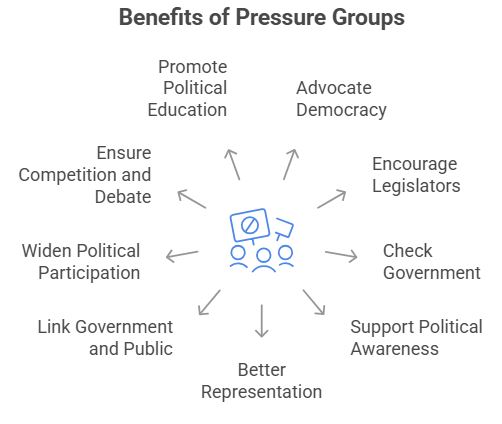
Issues and Challenges of Pressure Groups
- Pluralism and chaos: For Example-FICCI pushes for an easy hire and fire policy, whereas trade unions ask for the promotion of unionism.
- Increased socio-political crimes: Ex: use of unconstitutional means like corruption, horse trading, and violence.
- Poor organisational structure: Ex: Absence of internal democracy.
- Increased inequality: Ex: direct buying of products from the industry, excluding intermediaries
- Increased inequality: Ex: direct buying of products from the industry, excluding intermediaries
- Influence of Castes and Religions: Ex: functions in the interest of the group.
- Lack of Commitment: Ex: Shifting in loyalties in accordance with the political situation.
- Lack of accountability and transparency in the functioning of pressure groups.
Conclusion
Pressure groups play a vital role in shaping Indian democracy by advocating for diverse interests and holding institutions accountable. Moving forward, fostering transparency, promoting constructive dialogue, and ensuring inclusive representation can enhance the effectiveness and legitimacy of pressure group activities in India.
13. Constitutional Bodies
Finance Commission (Article 280):
Introduction
- Article 280 of the Constitution established the Finance Commission to manage the distribution of tax revenues between the union and states, as well as among states, in order to address vertical and horizontal imbalances.
Functions:
|
Role of Finance Commission |
Example |
|
|
|
|
|
|
|
|
|
|
|
|
|
|
|
|
Composition:
- Chairman: He oversees the Commission's operations as its chairperson. He should have prior public affairs experience.
- Members, there are four members total, excluding the chairman.
- Both the qualifications and the standards for the Commission members are mandated by statute and set by Parliament.
Membership qualifications as per the constitution:
- Judge of HC or qualified to be one.
- Special knowledge in finance and administration.
- Special knowledge and experience in government accounts and finance.
- Person with special knowledge of economics.
Significance
- The Finance Commission contributes to the upkeep of fiscal federalism in India by carrying out the following duties:
- the allocation of the Union's and the States' respective parts of the net profits of taxes that must be shared between them as well as the distribution of these proceeds among the States.
- determining the guidelines and number of grants-in-aid to be given to States who require such help.
- On the basis of the suggestions given by the state's finance commission, actions are required to increase a state's consolidated fund in order to complement the resources of its panchayats and municipalities.
Key Recommendation of the 14th Finance Commission:
- The commission recommended an increase in the states' share in the Union tax revenues from 32% to 42%, the largest ever increase.
- It removed the distinction between plan and non-plan expenditures for a holistic development process.
- Grants-in-aid for states were divided into two categories – revenue deficit grant and local bodies grant.
- For local bodies, the commission recommended a basic grant and a performance grant.
Key Recommendations of the 15th Finance Commission:
- Vertical Devolution: The 15th Finance Commission maintained vertical devolution at 41%, similar to the 14th Commission's 42%, adjusted due to the changed status of Jammu and Kashmir into Union Territories.
- Horizontal Devolution: Allocation between states considered factors like demographic performance, income, population, area, forest and ecology, and tax and fiscal efforts with different weights.
- Revenue Deficit Grants: Recommended grants amounting to about Rs. 3 trillion over five years, with the number of qualifying states decreasing from 17 in FY22 to 6 in FY26.
- Performance-Based Incentives and Grants: These revolve around four main themes - social sector (health, education), rural economy (agriculture, rural roads), governance/administrative reforms, and power sector, providing additional borrowing windows for states.
- Grants to Local Governments and Fiscal Space for Centre: Proposed both basic and performance-based grants for local bodies, with a special focus on urban services, incubation of new cities, and health grants. Ensured sufficient fiscal space for the Union to meet its obligations and national development priorities.
Criticism of the 15th Finance Commission:
- Performance-based incentives could potentially limit states' independent decision-making.
- Imposing conditions on states' borrowing capacity may negatively impact state expenditure, particularly in the realm of development.
- This approach could potentially challenge the principle of cooperative fiscal federalism.
- The system does not sufficiently require the Union government to exercise fiscal prudence.
- The mutual fiscal responsibility shared between the Union and the States might be diluted under such a system.
Comparative analysis of the 14th and 15th Finance Commission with reference to Municipal Governance:
|
Parameters |
14th Finance Commission |
15th Finance Commission |
|
Increment of funds to cities |
Local governments received 4.31 percent of the distributable pool from the 14th FC, of which 30% were given to municipalities. |
Local governments received 4.15 percent of the divisible pool from the 15th FC, of which 40% were given to municipalities. |
|
Metropolitan Governance |
About 20% of the 14th FC's allotments were designated as performance grants. These funds were contingent upon increased income, audited financial statements, and the publication of service-level standards. |
The 15th FC has rewarded the metropolitan government by tying 100% of financing to results. |
|
Transparency in Municipal finances |
It maintained much-needed policy consistency but did not always result in better data or more openness. The 14th FC had made the disclosure of service level benchmarks a requirement for performance grants. |
The 15th FC has also stressed the necessity of digitizing municipal accounting and of having a comprehensive understanding of the finances of the municipal sector at the state and union levels. |
Conclusion
The Finance Commission has performed a valuable purpose and met a big demand as an independent entity. It served as a specialist in cooperative energy for the efficient operation of a federal system in a difficult and complicated country like India.
14. Statutory Bodies in India 2025: Lokpal and Lokayukta: Powers, Issues, Reforms
Statutory Bodies are non-constitutional bodies that are established by an act passed by the Parliament or the state legislatures. Statutory bodies do not have any definition mentioned in the Constitution. It is a self-governing body.
Types of Statutory Bodies in India

Major Statutory Bodies in India in News
About Lokpal and Lokayuktas as Statutory Bodies in India
It is a known fact that corruption is a major problem, which endangers the stability and security of the nation; threatens socio-economic and political development; and undermines the values of democracy and morality.
AnnaHazare started a hunger strike on 5 April 2011 to exert pressure on the Indian government to enact a stringent anti-corruption law, The Lokpal Bill, 2011 as envisaged in the Jan Lokpal Bill, for the institution of an ombudsman with the power to deal with corruption in public places. The fast led to nationwide protests in support.
About Lokpal and Lokayuktas
- Lokayukta is an anti-corruption ombudsman organization in the state of India.
- In this context, the Lokpal and Lokayuktas Act, 2013 paved the way for the establishment of the institution of Lokpal at the center; and Lokayuktas at the state levels to inquire into allegations of corruption against public functionaries, and for related matters.
- The Lokpal is an investigative body headed by the incumbent Chief Justice of India or a retired judge. It has eight members, four of whom are judicial members.
- The Lokpal has jurisdiction to inquire into allegations of corruption against the Prime Minister, Ministers, Members of Parliament, Group A, B, C and D officers and officials of the central government.
- Section 14 of the Lokpal Act, which has now been amended, said that if the Lokayukta is satisfied on the complaint against the public servant being substantiated that he should not continue to hold the post held by him, he shall make a declaration to that effect in his report to the competent authority who shall accept it and act upon it.
- However, an investigative body does not have the legal authority to direct the public servant to resign his post on the basis of its findings. It can only submit its findings to the competent authority or, as is provided in the Lokpal Act, file a case in the special court.
Mandate of Lokpal and Lokayukta

Composition and Appointment in Lokpal and Lokayukta
- The Lokpal would be appointed by the president after consultation with the chief justice of India, the Speaker of Lok Sabha and the Chairman of the Rajya Sabha.
- The Lokpal will have a chairperson and up to eight members, half of whom will be judges. The Lokpal must have 50% members who are women, minorities, SC/ST/OBC, and/or SC/ST.
- Lokayuktas are appointed by the Governor of respected states through nomination by its Chief Minister.
Functions and Powers of Lokpal and Lokayukta
- Power of Search and seizure
- Power of civil court in certain cases
- Power to utilise services of officers of the State Government
- Power regarding confirmation of attachment of assets
- Power related to confiscation of assets, proceeds, receipts, and benefits arising or procured by means of corruption, in special circumstances
- Power to give directions to prevent the destruction of records during the preliminary inquiry
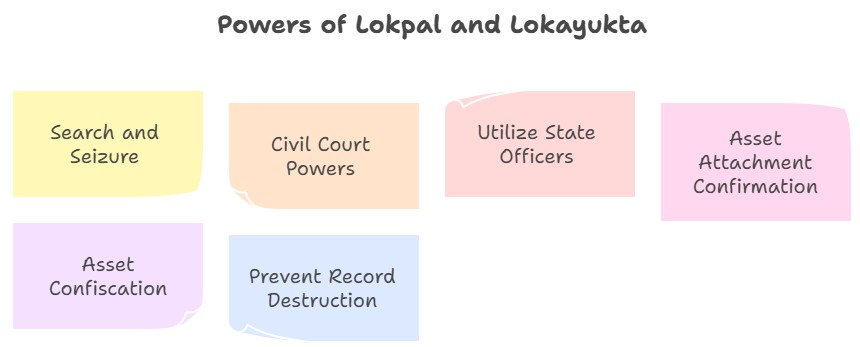
Critical Examination of Lokpal under Statutory Bodies in India
- Only three anti-corruption complaints were fully investigated, according to information provided by the Lokpal’s office to a parliamentary panel.
- Around 68% of corruption complaints against public functionaries that landed with the Lokpal of India were “disposed off” without any action in the past four years.
- Nearly 90% of complaints were not “in the prescribed format”.
- According to data provided by the Lokpal office to a parliamentary panel on the Department of Personnel and Training (DoPT), since 2019-20, the anti-corruption body received 8,703 complaints, out of which 5,981 complaints were disposed of.
- “The Committee recommends Lokpal not to reject genuine complaints merely on the technical ground that the complaint is not in the prescribed format.
Issues and Challenges in Statutory Bodies in India (Lokpal and Lokayukta)

- Delayed appointment: SC requested a search committee for suggesting names for first Lokpal.
- Currently, the Lokpal has a vacancy of two judicial members.
- Complicated investigation process: On a complaint filed against a Union Minister or a Member of Parliament, the rules state that it has to be decided, at the admission stage, by a bench consisting of not less than three members of the Lokpal.
- Lokpal cannot take Suo mot action.
- Whistle-blowers were not given any specific immunity: According to the complaint form, all complainants must submit an affidavit on non-judicial stamp paper that states, "making any false and frivolous or vexatious complaint is punishable with imprisonment for a term which may extend to one year and with fine which may extend to one lakh rupees".
- Lokpal fails to give prosecution sanction to anyone in nearly three years. The Lokpal has received 4,244 corruption complaints between April 2021 and January 31, 2022, a jump of over 80% from 2020-21.
- A complaint must be resolved by the Lokpal within 30 days.
- Most of the cases filed in the Lokpal were disposed of as they were not coming under its purview or the jurisdiction.
Way Forward
- Autonomy to Lokpal: Both Lokpal and Lokayukta must be legally, financially, and administratively independent.
- Appointments for Lokpal and Lokayukta must be made in a transparent manner to reduce the possibility of the wrong types of persons being selected.
- Timely appointment and keeping vacancy zero for effective functioning.
Conclusion
Lokayukta and Lokpal are becoming more popular. Due to massive government expansion and corruption. Corruption hurts economic growth and national security. Thus, more transparency and probity in public affairs were suggested. At this juncture when India is heading the G20 Anti-Corruption Working group, Lokpal should rise to the occasion and make every effort to strengthen the anti-corruption landscape in the country.
15. Regulatory Bodies
Introduction:
- A regulatory body is an entity of the government tasked with acting independently and in the capacity of a supervisor over a certain area of human activity. This process includes setting expectations for behaviour, imposing norms, conditions, and restrictions, as well as enforcing them or obtaining compliance. Ex. PFRDA, RBI, SEBI etc.
Quasi-judicial Bodies
Introduction:
- Quasi-judicial bodies in India are entities that have powers and procedures resembling those of a court of law or judge, and they are able to remedy a matter or impose legal penalties. They are non-judicial bodies that can interpret the law.
- These bodies have the authority to make judgments on certain types of matters. While they are not courts or part of the traditional judicial structure, their powers and decision-making processes are similar to those of a court. These bodies can make binding rulings and decisions, although they do not possess the full authority and jurisdiction of a court.
Quasi-Judicial bodies: Ex. NGT, CIC etc.
National Green Tribunal
Introduction:
The National Green Tribunal has been established in 2010 under the National Green Tribunal Act 2010 for the effective and expeditious disposal of cases relating to environmental protection and conservation of forests.
- The Supreme Court has declared the National Green Tribunal’s (NGT) position as a “unique” forumendowed with Suo motu powers to take up environmental issues across the country.
Appointment:
- The Central Government, in conjunction with the Chief Justice of India, shall appoint the Tribunal's Chairperson, Judicial Members, and Expert Members.
Composition: Refer diagram ????
Term: All of the members of the National Green Tribunal shall hold office for a term of five years from the date on which they enter their office.
Roles of NGT:
- Vital role: The Tribunal has to perform equally vital roles that were preventative, ameliorative or remedial in nature.
- Justice: The functional capacity of the NGT was intended to leverage wide powers to do full justice in its environmental mandate.
- The Supreme court described the NGT “as a complimentary, competent, specialised forum to deal with all environmental multidisciplinary issues both as original and also as an appellate authority.
- Not binding: The Code of Civil Procedure of 1908 does not bind the Tribunal; instead, it will be guided by the notions of "natural justice."
- Wider Reach: Because the tribunal, unlike the Supreme Court, might have benches in many States, expanding access for all residents, the quality of time spent discussing these matters could also be improved.
- The NGT deals with civil cases under the seven laws include:
Background:
- A.P. Pollution Control Board vs Prof.M.V. Nayudu: The Environmental Court appealed to the Supreme Court, and the Supreme Court stressed the necessity for a court that was "a combination of a Judge and Technical Experts" in the precedent-setting decision.
- Establishment of NGT: NGT established in 2010 under national green tribunal Act, for disposal of cases related to the environment.
Important judgments of NGT:
- The NGT stopped the approval awarded to POSCO, a South Korean steel manufacturer, to build a 12-million-ton steel facility in Odisha in 2012.
- The NGT invalidated an EIA 2006 notification amendment from December 2016 because it was seen to be a "ploy" (by the government) to get around the regulations.
- The amendments essentially intended to give local authorities the authority to award environmental clearance to builders.
- Numerous illegally granted projects, including the Aranmula Airport in Kerala, the Lower Demwe Hydro Power Project, Nyamnjangu in Arunachal Pradesh, mining projects in Goa, and coal mining projects in Chhattisgarh, were either revoked or given new assessments.
Issues or challenges:
- Wildlife (Protection) Act, 1972, and Scheduled Tribes and Other Traditional Forest Dwellers (Recognition of Forest Rights) Act, 2006 have been kept out of the jurisdiction of NGT.
- The decisions which are taken by NGT can be challenged in high courts meaning of giving the high court more power than NGT.
- Absence of formula-based mechanism
- One of the appeals challenged the forest clearance on the ground that the impact of the diversion of 130.75 square kilometers of pristine tropical rainforests on biodiversity and tribals has not been considered.
- The eastern bench of the National Green Tribunal (NGT) has ordered a stay on the ?72,000 crores Great Nicobar Island project and constituted a committee to revisit the environmental clearance.
Way Forward:
- By serving the orders and seeking responses by email only saves time and enables the Tribunal to take decisions in a time-bound manner.
- 'Factual and action were taken' reports are issued to identified statutory authorities
- Need for more autonomy and widen NGT’s scope. A formula-based mechanism should be adopted

2026-27 UPSC Mains English QEP Power Pages
View DetailsSubmit Your Details to Learn More



