The ‘Right to Repair’ Must Also Protect India’s ‘Right to Remember’ Repair Knowledge

India’s push for a Right to Repair law and repairability index must integrate its informal repair ecosystem, preserving tacit skills, reducing e-waste, and aligning grassroots knowledge with digital innovation and sustainability goals.

editorial-analysis
THEIASHUB
Get an Instant Call Back from Our Expert Mentors Now!
+91

Context

  • As India advances its digital public infrastructure and Al strategies, there is a growing need to integrate grassroots repair ecosystems into policy frameworks. This editorial advocates for recognising the tacit knowledge embedded in India's informal repair economy and aligning it with sustainability and digital innovation goals. 

Background

  • In May 2025, India accepted a report to develop a Repairability Index to rate mobile phones and appliances based on repair ease, spare parts access, and software support.
  • This move complements e-waste policy changes that include minimum incentives for formal recycling.
  • India's Digital Public Infrastructure (DPI) and Al strategy highlight innovation and efficiency but often exclude the informal repair economy that sustains everyday resilience. 

Government Initiatives

  • Right to Repair: Legislative initiative empowering consumers to repair and modify their electronic devices independently. 
  • Repairability index: A compulsory label that manufacturers must display on electrical and electronic devices, indicating how easily the product can be repaired. 
  • E-Waste (Management) 2022 Rules: Extended Producer Responsibility (EPR): Producers must meet annual recycling targets via registered recyclers. EPR certificates ensure recycling accountability. 
  • E-Waste (Management) 2023 Rules: Refrigerant Management: Clause added under Rule 5 to ensure safe and sustainable refrigerant handling in cooling appliance manufacturing. 
  • E-Waste (Management) 2024 Rules: EPR Certificate Trading: Government  may establish trading platforms as per CPCB guidelines. 
  • Mission LiFE (Lifestyle for Environment) -- Launched at: COP26, Glasgow (Nov 2021) by Indian PM. 
  • Objective: Promote individual and community-based sustainable lifestyles globally.
  • Core Principle: Pro-Planet People (P3 model).

Challenges Highlighted

  • Erosion of Repair Ecosystems: Informal repairers face marginalisation due to complex, non-repairable product designs and changing consumer habits. Their tacit, undocumented knowledge is being lost amidst Al-driven systems and disposable culture. 
  • Tacit Knowledge is undervalued: Skills are passed via observation and mentorship, not certification hard to formalise within current training models. Al and tech systems often benefit from this kind of labour but fail to recognise or reward it.
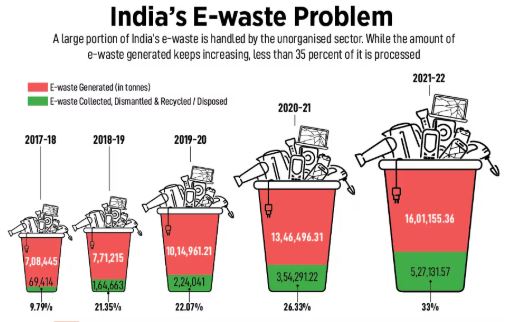
  • Blind Spots in Policy: India generated 1.6 million tonnes of e-waste in 2021–22, third-highest globally. - 
  • E-waste rules focus on recycling, barely mentioning repair.
  • Skill development schemes (e.g., PMKVY) and education reforms (NEP 2020) overlook informal, experiential learning in repair work. 
  • Existing sustainability campaigns like Mission LiFE need stronger links with grassroots repairers. 
  • Lack of Institutional Recognition: Informal repairers remain outside the formal workforce and social security nets. Digital products are not designed for easy disassembly, limiting reuse and learning.
Way Forward

  • Policy Alignment with Ground Realities: Embed repairability norms in procurement and product design policies. Encourage "designing for unmaking" and reuse from the outset.
  • Institutional Actions Suggested: MeitY: Integrate repairability in Al and hardware standards. 
  • - Department of Consumer Affairs: Expand the Right to Repair to include community involvement. 
  • - Ministry of Labour: Use e-Shram to register informal repairers and extend social benefits. 
  • - MSDE: Update skilling models to accommodate improvisational and diagnostic repair methods. 
  • Leveraging Al for Repair Equity: Use LLMs (Large Language Models) to codify and translate tacit repair knowledge into structured datasets for training without losing local context. Develop decision-free models to support real-time repair diagnostics.
  • Cultural and Educational Shifts: Recognise repair as knowledge work, not just manual labour. View breakdowns and repairs as design feedback loops, not product failures. 


UPSC QEP 2026 Batch 5 - English
Buy now View Details
Submit Your Details to Learn More
I agree to give my consent to receive updates through SMS/Email & WhatsApp*.

NEEV GS + CSAT Foundation 2026/27
Buy now View Details


Join theIAShub’s Mains Answer Writing Program

Refine your answer writing skills and elevate your UPSC preparation with personalized support and expert feedback.

Fill out the form to get started with the program or any other enquiries !

I agree to give my consent to receive updates through SMS/Email & WhatsApp*.

Best IAS Coaching In Delhi, UPSC Online & Offline Classes by IAShub

Are you dreaming of becoming an IAS officer? Then, IAShub can be your best guide. It is one of the Best IAS Coaching in Delhi. Many students who want to clear the UPSC exam join IAShub for learning. The institute gives both online and offline classes. Their teachers are experienced and helpful. They easily explain every topic. Students also get notes, tests, and tips to do well in the exam.

UPSC Online Classes by IAShub

IAShub is in Delhi and is trusted by many UPSC students. It offers coaching for every part of the UPSC exam – Prelims, Mains, and Interview. The classes are simple and easy to understand. The teachers are experts and guide students in the right way. IAShub is also known for its helpful notes, test series, and answer-writing practice. IAShub is the best coaching in Delhi and also gives UPSC Online Classes. This helps students from any place in India to learn. The online classes are live and also recorded. So, students can watch them anytime. These classes cover the full UPSC syllabus.

Key Offerings Provided by IAShub

Here are some important services provided by IAShub:

  • UPSC Prelims: IAShub teaches for Prelims with a focus on basics. It also gives daily current affairs and monthly magazines.
  • Classroom Courses: IAShub has classroom learning for students in Delhi. The environment is good and peaceful for study.
  • Live Classes: Students who live far can join live UPSC online classes. These classes are just like real classes.
  • QEP for Mains: The Quality Enrichment Program (QEP) is special for Mains preparation. It helps students write better and faster.
  • Answer Writing: Regular answer writing practice is given. Teachers also check answers and give tips to improve.
  • Free Resource: IAShub gives free notes by toppers and helpful Main Booster material.
  • Test Series: Test series are available for every subject. These help students know their weak points and improve.
  • Interview Guidance Session: IAShub also gives interview practice sessions with experts. These help students feel confident.

UPSC Exam Overview

The UPSC Civil Services Exam has three parts:

  • Prelims: It has two papers: General Studies and CSAT.
  • Mains: It has nine papers, including essays and optional subjects.
  • Interview: It tests the personality and confidence of the student.

This exam is tough, but with the right guidance, it becomes easy to manage. Students must study smart and stay regular.

How IAShub Helps in the UPSC Journey

IAShub supports students from the beginning to the end. It gives the right books, tests, and notes. The classes are easy to follow, and the teachers are always ready to help. Students get personal doubt sessions too. The test series and answer checking help students learn where they need to do better. Also, free study materials save time and money.
IAShub also guides students during the final stage – the interview. Experts take mock interviews and give useful tips. This full support makes IAShub one of the best IAS coaching in Delhi.

Best IAS Coaching In Delhi FAQs

Yes, IAShub offers live and recorded online classes. Students can attend from any part of India.

Classes are available in both English and Hindi, so students can choose the language they are comfortable with.

The classroom centre is located in Delhi. Students can visit and join offline batches there.

IAShub gives interview guidance sessions to help students prepare for the final round of UPSC.