


The State Funding of Elections provides financial support to political parties, ensuring fairer elections. Learn about its benefits, challenges, and the way forward.
 theIASHub | 12 May, 2025 | 3762

The State Funding of Elections is a concept that has gained traction as a potential solution to address issues like money power, corruption, and inequality in political funding. This approach aims to provide financial support to political parties and candidates directly from the government, ensuring a more level playing field for all participants in the electoral process.
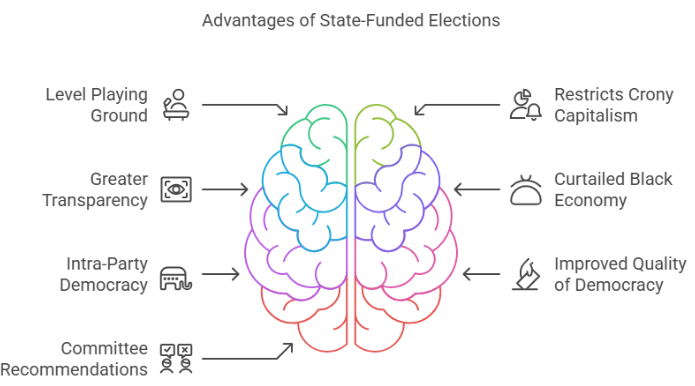
The State Funding of Elections ensures that candidates from all sections of society can start with equal financial resources. This allows individuals with a clean image and honest intent to join politics without being restricted by financial constraints. It encourages greater diversity and participation in the electoral process.
By reducing the dependence of political parties on private donations, the State Funding of Elections helps curb the influence of corporate money in politics. This ensures that political parties serve the public interest rather than the interests of private corporate entities, promoting more democratic governance.
When political parties receive a significant portion of their funding from the state, they are compelled to ensure transparency in disclosing their income and expenditures. This transparency helps reduce the scope for corruption and improves accountability, making the electoral process more transparent.
The State Funding of Elections can significantly reduce the use of black money in political campaigns. By providing legitimate and regulated funding sources, the scheme helps prevent the flow of illegal money into the electoral process, thus curbing money laundering and ensuring a cleaner election system.
State funding reduces the dominance of wealthy individuals within political parties. With financial resources provided by the state, positions within the party can be based on merit, rather than wealth. This fosters a more democratic internal structure within political organizations.
With the financial burden of raising election funds lifted, candidates can focus more on important public issues and governance. This leads to more citizen-centric governance, where the emphasis shifts from fundraising to addressing the real concerns of the public.
State funding has been advocated by several committees, including the Indrajit Gupta Committee, the 2nd Administrative Reforms Commission (ARC), and the Law Commission of India. These bodies have highlighted the need for such funding to ensure the fairness and transparency of the electoral process.
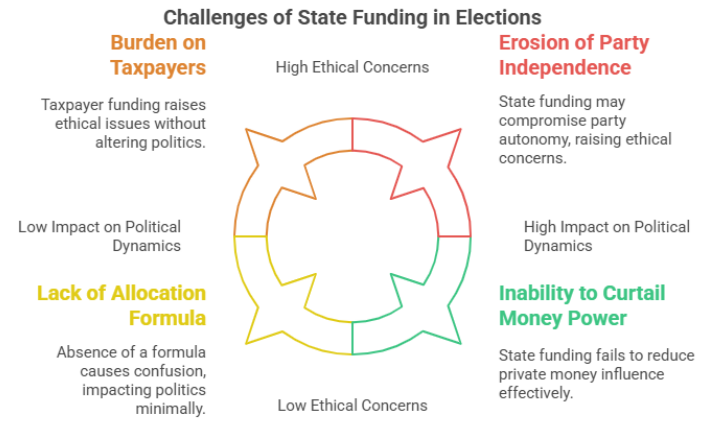
Despite the benefits, the State Funding of Elections might not be sufficient to entirely eliminate private contributions and misuse of money power. Without a robust mechanism to monitor party expenditure and restrict private donations, state funding alone cannot solve all the issues related to money in politics.
There is no universally accepted formula for allocating funds to new or independent parties. The absence of a clear mechanism could lead to confusion about who qualifies for funding and under what conditions, potentially resulting in inequities in the distribution of resources.
Political parties might become more answerable to the state for their financial management and internal workings. This could limit their autonomy and make them more susceptible to state influence, thereby compromising their independence.
While state funding may provide opportunities for new parties, it may inadvertently benefit established parties more, maintaining the political status quo. This could make it difficult for emerging parties to break into the political landscape.
Using taxpayers’ money for state funding could be seen as economically unsustainable, especially when the country faces resource constraints in areas like health, education, and poverty alleviation. It could also be unpopular among taxpayers who do not support certain political parties.
Taxpayers’ money might be used to support political parties or candidates whose views they do not agree with, leading to potential dissatisfaction among the public.
The State Funding of Elections can be a crucial step toward cleaner elections, but it cannot work in isolation. To be truly effective, state funding must be part of a broader set of electoral reforms, including:
Electoral reforms should focus on eliminating criminal elements from politics, ensuring that only honest candidates participate in elections.
A comprehensive regulatory framework is essential to ensure transparency and accountability in political funding, with stringent monitoring mechanisms.
Enforcing anti-corruption laws and ensuring strict compliance with election financing regulations will help mitigate the misuse of state funds and private donations.
Regular audits of political party funding and expenditures should be conducted to ensure transparency and proper use of state resources.
The State Funding of Elections holds the potential to reduce the influence of money in politics, promote transparency, and level the playing field for all candidates. However, to be successful, it must be accompanied by broader electoral reforms, including better monitoring, stricter regulations, and transparency measures. Only then can state funding truly enhance the quality of democracy in India.


Refine your answer writing skills and elevate your UPSC preparation with personalized support and expert feedback.
Fill out the form to get started with the program or any other enquiries !

Are you dreaming of becoming an IAS officer? Then, IAShub can be your best guide. It is one of the Best IAS Coaching in Delhi. Many students who want to clear the UPSC exam join IAShub for learning. The institute gives both online and offline classes. Their teachers are experienced and helpful. They easily explain every topic. Students also get notes, tests, and tips to do well in the exam.
IAShub is in Delhi and is trusted by many UPSC students. It offers coaching for every part of the UPSC exam – Prelims, Mains, and Interview. The classes are simple and easy to understand. The teachers are experts and guide students in the right way. IAShub is also known for its helpful notes, test series, and answer-writing practice. IAShub is the best coaching in Delhi and also gives UPSC Online Classes. This helps students from any place in India to learn. The online classes are live and also recorded. So, students can watch them anytime. These classes cover the full UPSC syllabus.
Here are some important services provided by IAShub:
The UPSC Civil Services Exam has three parts:
This exam is tough, but with the right guidance, it becomes easy to manage. Students must study smart and stay regular.
IAShub supports students from the beginning to the end. It gives the right books, tests, and notes. The classes are easy to follow, and the teachers are always ready to help. Students get personal doubt sessions too. The test series and answer checking help students learn where they need to do better. Also, free study materials save time and money.
IAShub also guides students during the final stage – the interview. Experts take mock interviews and give useful tips. This full support makes IAShub one of the best IAS coaching in Delhi.
Join 39,000+ UPSC Aspirants! 🚀
Get Free UPSC/State PSC Study Materials, Daily Current Affairs Question & Exam Updates.
Join Telegram Channel
