


Explore the concept of Socialism—its types, key features, advantages, and limitations. Learn how socialism shapes economies, societies, and political systems globally.
 theIASHub | 20 Jun, 2025 | 12115

Socialism is a political and economic ideology that promotes public ownership and democratic control of the means of production and distribution of goods and services. It aims to reduce inequalities, empower workers, and ensure that wealth and resources are distributed fairly across society.
Unlike capitalism, which emphasizes private ownership and profit motives, socialism focuses on collective welfare, equal opportunity, and economic planning. The core belief is that economic decisions should benefit the majority, not just a wealthy few.
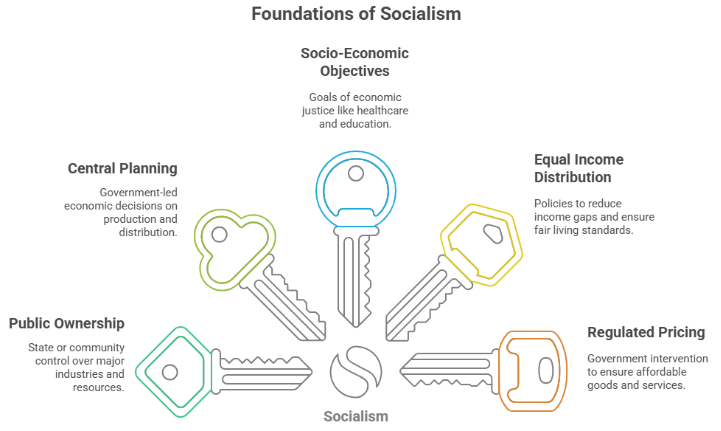
Understanding the defining traits of socialism helps explain how it differs from other economic models:
Under socialism, major industries, infrastructure, and resources are owned and managed by the state or the community. This eliminates monopolies and focuses on social welfare.
A key aspect of socialism is centralized economic planning. Government institutions or collective councils make decisions about what to produce, how to distribute resources, and where to invest.
Socialism operates with clear goals of economic justice, such as poverty eradication, universal healthcare, education access, and employment for all.
Socialism seeks to bridge income gaps by redistributing wealth. Tax policies, social programs, and minimum wage laws help ensure fair living standards for everyone.
Instead of leaving pricing to market forces, socialism involves price controls or subsidies to make goods and services affordable to the masses.
Over the years, socialism has evolved into several variants based on ideology, implementation, and goals. Here's a detailed look:
Democratic socialism blends democratic political systems with socialist economic principles. It advocates public ownership, universal social services, and workers’ participation in decision-making, all while respecting individual rights and democratic processes.
Derived from Karl Marx’s theories, Marxian socialism envisions a transitional phase between capitalism and communism. Production is centrally planned, and private ownership is replaced by common ownership to eliminate class distinctions.
Revolutionary socialism believes that radical social change—often through revolution—is essential to overthrow capitalist systems. It rejects gradual reform, aiming for a complete societal transformation.
This early form of socialism imagined ideal societies based on cooperation, shared resources, and harmony. However, it lacked practical strategies for achieving these goals and remained largely theoretical.
Libertarian socialism advocates for a decentralized, non-hierarchical society, free from both capitalism and authoritarian state control. It supports direct democracy, free access to information, and worker cooperatives.
Market socialism blends free-market mechanisms with socialist values. While goods and services are priced through supply and demand, enterprises are either publicly owned or run as cooperatives.
Eco-socialism merges environmental concerns with socialist principles. It criticizes capitalism for environmental degradation and promotes sustainable development, green technology, and climate justice.
Socialism has had significant influence in reducing inequality and promoting collective welfare. Its positive effects include:
Socialism works to ensure that income and wealth are evenly distributed, reducing the gap between rich and poor. Social safety nets like healthcare, education, and housing are accessible to all.
By prioritizing public welfare, socialism provides essential services—such as healthcare, education, transport, and utilities—at low or no cost to citizens.
Socialist economies typically guarantee employment and enforce labor protections. Workers enjoy stable incomes, job benefits, and legal safeguards against exploitation.
Socialism promotes equality regardless of race, gender, or economic background, fostering inclusive development and empowering marginalized communities.
Centralized planning in socialism allows governments to make long-term investments in infrastructure, renewable energy, and sustainable growth rather than short-term profits.
While socialism promotes equity and access, critics argue it has certain limitations:
Because profit motives are diminished, socialism may reduce entrepreneurial spirit and personal ambition, leading to slower innovation and lower efficiency.
Socialism often involves large bureaucracies to manage the economy. This can cause inefficiency, corruption, delays, and rigid systems that resist change.
Without market competition, state-owned enterprises may become complacent and unresponsive to consumer needs, which can hamper economic growth.
Socialism tends to restrict economic freedom, such as ownership of businesses or choice of employment, which can hinder personal autonomy.
With the government providing most services, people might become reliant on the state, losing self-initiative and independent economic action.
|
Aspect |
Socialism |
Capitalism |
|
Ownership of Production |
Public or State-owned |
Privately owned |
|
Economic Planning |
Central Planning |
Market-driven |
|
Wealth Distribution |
Equal or need-based |
Based on individual success |
|
Incentives |
Collective welfare |
Profit and competition |
|
Innovation |
Moderate due to limited incentives |
High due to competition |
|
Social Services |
Universal and publicly funded |
Market-based or private |
Absolutely. With growing concerns about climate change, income inequality, and corporate monopolies, socialism offers alternative models of governance and resource distribution. Countries like Norway, Sweden, and Finland have successfully integrated socialist principles into their capitalist frameworks, ensuring economic dynamism while maintaining social justice.
Emerging ideas like Green New Deals, universal basic income, and worker-owned cooperatives show that socialism continues to evolve with time.
Socialism remains a powerful ideology that envisions a world of equity, justice, and shared prosperity. While it comes with its own set of challenges, its core values—fairness, inclusion, and community welfare—make it an important part of the global discourse on economic systems.
Understanding socialism, its types, and its impact helps citizens and policymakers make informed decisions about the future of their societies.


Refine your answer writing skills and elevate your UPSC preparation with personalized support and expert feedback.
Fill out the form to get started with the program or any other enquiries !

Are you dreaming of becoming an IAS officer? Then, IAShub can be your best guide. It is one of the Best IAS Coaching in Delhi. Many students who want to clear the UPSC exam join IAShub for learning. The institute gives both online and offline classes. Their teachers are experienced and helpful. They easily explain every topic. Students also get notes, tests, and tips to do well in the exam.
IAShub is in Delhi and is trusted by many UPSC students. It offers coaching for every part of the UPSC exam – Prelims, Mains, and Interview. The classes are simple and easy to understand. The teachers are experts and guide students in the right way. IAShub is also known for its helpful notes, test series, and answer-writing practice. IAShub is the best coaching in Delhi and also gives UPSC Online Classes. This helps students from any place in India to learn. The online classes are live and also recorded. So, students can watch them anytime. These classes cover the full UPSC syllabus.
Here are some important services provided by IAShub:
The UPSC Civil Services Exam has three parts:
This exam is tough, but with the right guidance, it becomes easy to manage. Students must study smart and stay regular.
IAShub supports students from the beginning to the end. It gives the right books, tests, and notes. The classes are easy to follow, and the teachers are always ready to help. Students get personal doubt sessions too. The test series and answer checking help students learn where they need to do better. Also, free study materials save time and money.
IAShub also guides students during the final stage – the interview. Experts take mock interviews and give useful tips. This full support makes IAShub one of the best IAS coaching in Delhi.
Join 39,000+ UPSC Aspirants! 🚀
Get Free UPSC/State PSC Study Materials, Daily Current Affairs Question & Exam Updates.
Join Telegram Channel
