


Explore the historic role of Sardar Patel in Integration of Princely States, unifying over 560 territories into modern India through diplomacy, strategy, and vision.
 theIASHub | 28 Jun, 2025 | 9956

The unification of India post-1947 is one of the most significant political accomplishments in world history. A divided land with over 560 princely states—each enjoying autonomy—posed a serious challenge to India’s integrity. Sardar Patel in Integration of Princely States played the most pivotal role in turning that patchwork into one united nation. As the first Deputy Prime Minister and Home Minister of independent India, Sardar Vallabhbhai Patel used a mix of diplomacy, tact, firmness, and incentives to bring all princely states under the Indian Union.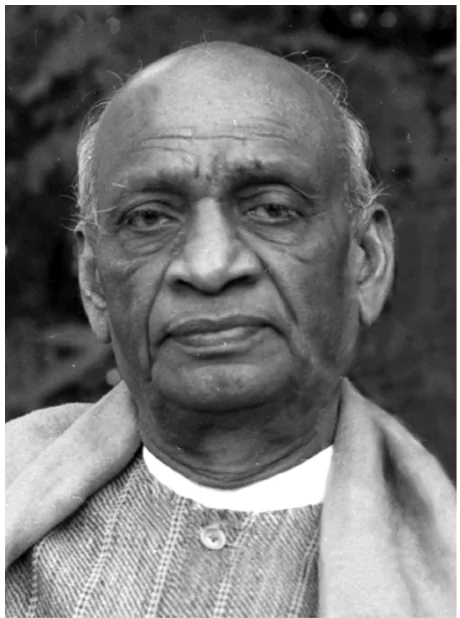
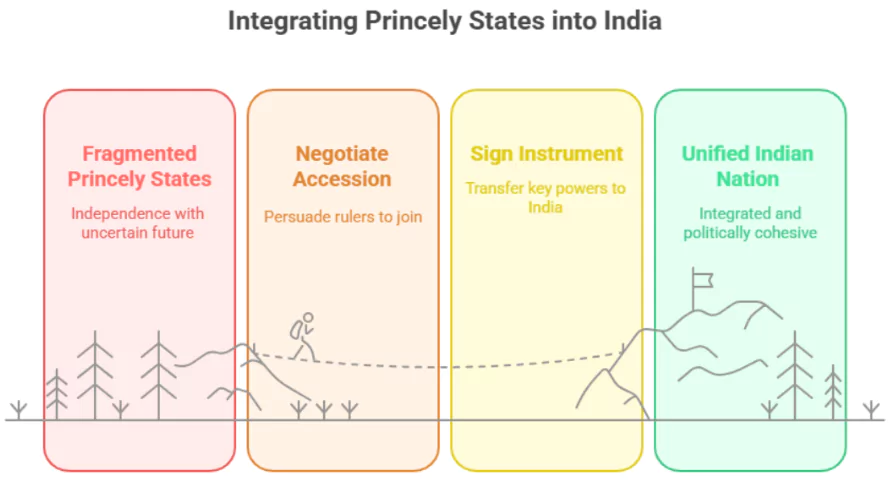
Upon independence in August 1947, India was divided not only into India and Pakistan but also between British India and princely states. These princely states were not legally bound to join either dominion. The British had announced that these states could choose to accede to India or Pakistan, or remain independent.
This situation created a potential for fragmentation, threatening India's political and geographical unity. The responsibility to avoid such disintegration fell upon Sardar Patel in Integration of Princely States, and he accepted it with unwavering commitment.
To execute this difficult task, Sardar Patel closely worked with V.P. Menon, the then Secretary of the Ministry of States. Together, they designed the plan of integration which included the signing of an Instrument of Accession, through which the rulers agreed to hand over defence, communication, and external affairs to the Government of India.
This collaboration proved essential in managing negotiations, administrative arrangements, and political persuasion required for success.
A unique strategy applied by Sardar Patel in Integration of Princely States was the introduction of Privy Purses. These were annual payments made to royal families who agreed to merge their states with India.
This tactic created a non-violent and mutually beneficial path for state integration, earning Patel both respect and success.
Under the leadership of Sardar Patel in Integration of Princely States, several smaller and medium-sized states like Bikaner and Baroda were among the first to accede willingly. These early mergers gave momentum to the larger integration movement and set an example for other states.
The Rajputana region (now Rajasthan) gradually saw the formation of a unified Rajasthan as Patel combined multiple small princely states into one administrative unit.
One of the most delicate cases handled by Sardar Patel in Integration of Princely States was Jodhpur. Despite being a Hindu-majority state with a Hindu ruler, Maharaja Hanvant Singh flirted with the idea of joining Pakistan due to certain economic temptations and promises made by Jinnah.
Patel, recognizing Jodhpur’s strategic location near Pakistan’s border, personally intervened in the talks, offered significant economic and political advantages, and even assured the continuation of royal privileges through the privy purse. This convinced Jodhpur’s ruler to finally accede to India.
Another sensitive case was Junagadh, a princely state with a Muslim Nawab ruling over a majority Hindu population. The Nawab decided to join Pakistan, but public unrest and geographical constraints made this unacceptable to India.
Patel swiftly handled the situation by supporting a popular revolt, followed by a plebiscite which clearly voted for union with India, making the accession both legal and democratic.
Hyderabad, India’s largest princely state, under Nizam Osman Ali, wanted to remain independent. The state became a center for feudal oppression and communal tension. Despite repeated negotiations, the Nizam remained firm.
Sardar Patel ordered ‘Operation Polo’, a brief five-day military operation in September 1948, which led to the liberation of Hyderabad and its merger with India. Patel emphasized the need for strong national integration over individual royal ambitions, firmly establishing the Indian Union.
The integration of princely states significantly boosted India’s economy by:
From a security standpoint, Sardar Patel in Integration of Princely States ensured that India’s borders became secure. The newly integrated territories helped build a coherent defense strategy, especially around the Pakistan and China frontiers.
The success of Sardar Patel in Integration of Princely States established him as the “Bismarck of India”. Without waging prolonged wars or creating permanent animosity, he managed to:
Patel’s vision, negotiation skills, and uncompromising nationalism made modern India possible.
The Sardar Patel in Integration of Princely States was more than a political act—it was an act of nation-building. Without his wisdom and firmness, India could have remained a fragmented subcontinent. His combination of diplomacy, administrative brilliance, and national vision helped preserve India’s unity when it was most vulnerable.
Even today, his contributions remind us that political integration, when guided by wisdom and courage, can shape the destiny of a nation.


Refine your answer writing skills and elevate your UPSC preparation with personalized support and expert feedback.
Fill out the form to get started with the program or any other enquiries !

Are you dreaming of becoming an IAS officer? Then, IAShub can be your best guide. It is one of the Best IAS Coaching in Delhi. Many students who want to clear the UPSC exam join IAShub for learning. The institute gives both online and offline classes. Their teachers are experienced and helpful. They easily explain every topic. Students also get notes, tests, and tips to do well in the exam.
IAShub is in Delhi and is trusted by many UPSC students. It offers coaching for every part of the UPSC exam – Prelims, Mains, and Interview. The classes are simple and easy to understand. The teachers are experts and guide students in the right way. IAShub is also known for its helpful notes, test series, and answer-writing practice. IAShub is the best coaching in Delhi and also gives UPSC Online Classes. This helps students from any place in India to learn. The online classes are live and also recorded. So, students can watch them anytime. These classes cover the full UPSC syllabus.
Here are some important services provided by IAShub:
The UPSC Civil Services Exam has three parts:
This exam is tough, but with the right guidance, it becomes easy to manage. Students must study smart and stay regular.
IAShub supports students from the beginning to the end. It gives the right books, tests, and notes. The classes are easy to follow, and the teachers are always ready to help. Students get personal doubt sessions too. The test series and answer checking help students learn where they need to do better. Also, free study materials save time and money.
IAShub also guides students during the final stage – the interview. Experts take mock interviews and give useful tips. This full support makes IAShub one of the best IAS coaching in Delhi.
Join 39,000+ UPSC Aspirants! 🚀
Get Free UPSC/State PSC Study Materials, Daily Current Affairs Question & Exam Updates.
Join Telegram Channel
