LPG Reforms in India: Transforming the Indian Economy Since 1991

Explore the impact of LPG reforms in India, initiated in 1991, that liberalized the economy, promoted privatization, and integrated India with global markets.

THEIASHUB
Get an Instant Call Back from Our Expert Mentors Now!
+91

The LPG reforms in India, introduced in 1991, marked a historic turning point in India’s economic policy. Standing for Liberalization, Privatization, and Globalization, these reforms transformed the Indian economy from a protectionist, socialist model into a more market-oriented, globally integrated system. These changes came in response to a balance of payments crisis, economic stagnation, and rising fiscal deficit that plagued the country in the late 1980s.

The LPG reforms in India not only rescued the economy from collapse but also laid the foundation for long-term growth, foreign investment, and modernization. Let’s explore each pillar of these reforms and their wide-ranging impact on the Indian economy.
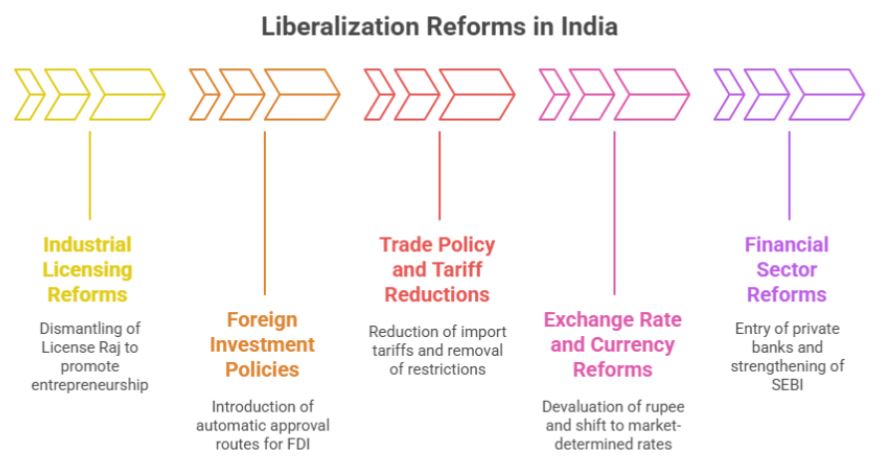
Liberalization: Opening the Economy

Industrial Licensing Reforms

One of the major steps in the LPG reforms in India was the relaxation of the Industrial Licensing Policy:

  • License Raj, which had stifled entrepreneurship and industrial growth, was dismantled.
  • Licensing was abolished for most industries except for a few related to security and environmental concerns.
  • Companies could now freely enter, expand, and compete in various sectors.

Foreign Investment Policies

The liberalization component of LPG reforms in India made foreign investment easier:

  • Introduction of automatic approval routes for Foreign Direct Investment (FDI).
  • Limits on foreign equity were relaxed across multiple sectors.
  • Sectors like telecom, power, and infrastructure saw a surge in foreign capital inflow.

Trade Policy and Tariff Reductions

Trade liberalization was a key agenda in the LPG reforms in India:

  • Import tariffs were reduced substantially.
  • Quantitative restrictions on imports were removed.
  • Export promotion replaced import substitution as the core trade philosophy.

Exchange Rate and Currency Reforms

  • The rupee was devalued and later shifted to a market-determined exchange rate system.
  • This boosted export competitiveness and helped stabilize foreign exchange reserves.
  • These changes were critical in re-establishing trust in India's macroeconomic fundamentals.

Financial Sector Reforms

Liberalization also touched the financial sector:

  • Private banks were allowed entry, improving efficiency and competition.
  • Capital markets were reformed, and regulatory institutions like SEBI were strengthened.
  • Technology and automation were introduced in banking and stock markets.

Privatization: Empowering the Private Sector

Disinvestment of Public Sector Enterprises

A core part of the LPG reforms in India was disinvestment in Public Sector Enterprises (PSEs):

  • Government reduced its stake in several PSEs to raise funds and reduce inefficiency.
  • Strategic disinvestment brought in private sector management and investment.
  • Sectors like steel, airlines, and telecommunications witnessed privatization.

Restructuring Public Sector

The reforms emphasized improving corporate governance and competitiveness in the public sector:

  • Modernization of PSEs and professional management practices were encouraged.
  • Many loss-making units were either shut down or merged.
  • The aim was to reduce fiscal burden and allow the government to focus on essential services.

Globalization: Integrating with the World

Increased Global Trade

The LPG reforms in India aimed to make the Indian economy part of the global trading system:

  • Exports and imports were liberalized.
  • India became a member of the World Trade Organization (WTO) in 1995.
  • Bilateral and multilateral trade agreements were signed to facilitate global commerce.

Technology and Capital Inflow

  • Globalization led to advanced technologies entering the Indian market.
  • Multinational companies started investing in India, boosting employment and innovation.
  • India began attracting portfolio investments, improving stock market performance.

Impact of LPG Reforms in India

Accelerated Economic Growth

Post reforms, GDP growth witnessed a dramatic shift:

  • Growth rates increased from an average of 5% in the 1980s to 7% or more in the 1990s and 2000s.
  • India emerged as one of the fastest-growing economies globally.

Rise in Foreign Investment

The LPG reforms in India led to a sharp rise in FDI inflows:

  • FDI rose from $98 million in 1990-91 to $36.5 billion in 2020-21.
  • Increased investor confidence made India a preferred destination for global capital.

Export and Industrial Growth

  • Exports jumped from $18.7 billion in 1990-91 to $291.8 billion in 2020-21.
  • New industries like Information Technology (IT), BPOs, and telecommunications flourished.
  • Existing industrial sectors were modernized and made competitive.

Job Creation and Poverty Reduction

  • Sectors like services, IT, and retail created millions of new jobs.
  • The percentage of people living below the poverty line dropped from 45% in 1993-94 to 22% in 2011-12.

Infrastructure Development

The LPG reforms in India also spurred large-scale infrastructure development:

  • Significant investments were made in roads, railways, ports, and power.
  • Telecom revolution improved connectivity across the country.

Challenges and Criticism of LPG Reforms in India

Rising Income Inequality

  • Though economic growth accelerated, income inequality widened.
  • The urban-rural divide became more prominent.

Job Displacement and Traditional Sector Neglect

  • Traditional sectors like handloom, agriculture, and small-scale industries suffered.
  • Job losses in unorganized sectors led to social unrest in some regions.

Environmental Concerns

  • Rapid industrialization and urbanization increased pollution and resource depletion.
  • India faced issues of unsustainable development and climate stress.

Financial Sector Risks

  • The expansion of the financial sector led to rising NPAs (Non-Performing Assets).
  • Cases of corporate frauds and poor governance raised concerns.

Global Economic Vulnerability

  • As India became part of the global economy, it became vulnerable to external shocks.
  • Events like the global financial crisis of 2008 and oil price fluctuations directly impacted the Indian economy.

Conclusion: Legacy of LPG Reforms in India

The LPG reforms in India were a watershed moment that transformed the country’s economic direction. They broke the shackles of a controlled economy and introduced a new era of competition, growth, and globalization. Despite certain criticisms and challenges, the reforms have had long-term positive impacts on India's economic landscape.

From increased foreign investments and exports to job creation and poverty reduction, the success of LPG reforms in India continues to shape India's global position as a rising economic power.



UPSC QEP 2026 Batch 5 - English
Buy now View Details
Submit Your Details to Learn More
I agree to give my consent to receive updates through SMS/Email & WhatsApp*.

NEEV GS + CSAT Foundation 2026/27
Buy now View Details


Join theIAShub’s Mains Answer Writing Program

Refine your answer writing skills and elevate your UPSC preparation with personalized support and expert feedback.

Fill out the form to get started with the program or any other enquiries !

I agree to give my consent to receive updates through SMS/Email & WhatsApp*.

Best IAS Coaching In Delhi, UPSC Online & Offline Classes by IAShub

Are you dreaming of becoming an IAS officer? Then, IAShub can be your best guide. It is one of the Best IAS Coaching in Delhi. Many students who want to clear the UPSC exam join IAShub for learning. The institute gives both online and offline classes. Their teachers are experienced and helpful. They easily explain every topic. Students also get notes, tests, and tips to do well in the exam.

UPSC Online Classes by IAShub

IAShub is in Delhi and is trusted by many UPSC students. It offers coaching for every part of the UPSC exam – Prelims, Mains, and Interview. The classes are simple and easy to understand. The teachers are experts and guide students in the right way. IAShub is also known for its helpful notes, test series, and answer-writing practice. IAShub is the best coaching in Delhi and also gives UPSC Online Classes. This helps students from any place in India to learn. The online classes are live and also recorded. So, students can watch them anytime. These classes cover the full UPSC syllabus.

Key Offerings Provided by IAShub

Here are some important services provided by IAShub:

  • UPSC Prelims: IAShub teaches for Prelims with a focus on basics. It also gives daily current affairs and monthly magazines.
  • Classroom Courses: IAShub has classroom learning for students in Delhi. The environment is good and peaceful for study.
  • Live Classes: Students who live far can join live UPSC online classes. These classes are just like real classes.
  • QEP for Mains: The Quality Enrichment Program (QEP) is special for Mains preparation. It helps students write better and faster.
  • Answer Writing: Regular answer writing practice is given. Teachers also check answers and give tips to improve.
  • Free Resource: IAShub gives free notes by toppers and helpful Main Booster material.
  • Test Series: Test series are available for every subject. These help students know their weak points and improve.
  • Interview Guidance Session: IAShub also gives interview practice sessions with experts. These help students feel confident.

UPSC Exam Overview

The UPSC Civil Services Exam has three parts:

  • Prelims: It has two papers: General Studies and CSAT.
  • Mains: It has nine papers, including essays and optional subjects.
  • Interview: It tests the personality and confidence of the student.

This exam is tough, but with the right guidance, it becomes easy to manage. Students must study smart and stay regular.

How IAShub Helps in the UPSC Journey

IAShub supports students from the beginning to the end. It gives the right books, tests, and notes. The classes are easy to follow, and the teachers are always ready to help. Students get personal doubt sessions too. The test series and answer checking help students learn where they need to do better. Also, free study materials save time and money.
IAShub also guides students during the final stage – the interview. Experts take mock interviews and give useful tips. This full support makes IAShub one of the best IAS coaching in Delhi.

Best IAS Coaching In Delhi FAQs

Yes, IAShub offers live and recorded online classes. Students can attend from any part of India.

Classes are available in both English and Hindi, so students can choose the language they are comfortable with.

The classroom centre is located in Delhi. Students can visit and join offline batches there.

IAShub gives interview guidance sessions to help students prepare for the final round of UPSC.
